

Lavender Needs at Least 6 Hours of Sun — What Happens When It Gets Less

Lavender’s 6-hour sun minimum is a hard biochemical floor. Below it: reduced oil quality, fungal pathogens, leggy structure. Here’s the science and the fix.
Wild lavender doesn’t grow in gardens. It grows on open limestone hillsides in Provence and Andalusia — baking in eight or more hours of Mediterranean sun, with nothing overhead but sky. That exposure shaped every aspect of the plant’s chemistry: the terpene pathways that produce its oils, the structural habit that keeps it compact and upright, and the natural disease resistance that lets it thrive on rocky, exposed ground with minimal care.
Most gardeners know lavender likes sun. Fewer understand that the requirement is a hard biochemical floor, not a preference — or that falling below it doesn’t just reduce flowers. It reduces oil quality, activates specific fungal pathogens, and causes structural decline that no amount of feeding or pruning reverses. This article covers the exact numbers, why the biology makes them non-negotiable, which cultivars offer any real flexibility, and how to fix a placement that isn’t working.
Lavender’s Sun Requirement: 6 Hours Minimum, 8 Hours Optimal
The rule across every university extension service is consistent: lavender requires a minimum of 6 hours of direct, unfiltered sunlight per day, with 8 hours the target for strong growth and flowering during the main growing season. Both Utah State University Extension and Colorado State University Extension list full sun as a non-negotiable baseline; Illinois Extension states flatly that ‘it is dampness more than cold that is responsible for killing lavender plants’ — and shade is the primary driver of dampness.
‘Direct’ matters here. Dappled light through a tree canopy, filtered light through a shade cloth, or light reflected off a wall doesn’t count toward those 6 hours. Lavender evolved on open terrain where nothing stands between plant and sun from mid-morning through late afternoon.

Three pre-planned garden beds, free
Stop staring at empty beds: printable plans with exact layouts, plant lists and planting calendars — yours free from the Garden Library.
In practice, sun availability shifts by zone:
- Zones 5–6: June and July deliver long days with 10+ usable hours. But the shorter days of April and September (8 hours or fewer) mean spring establishment can be slow for new plants.
- Zones 7–8: Adequate sun year-round during the growing season. The constraint shifts from light quantity to light intensity — peak July heat can stress English lavender.
- Zones 8–9 (hot summers): Full sun remains the baseline, but an afternoon exception applies in the hottest months. More on this below.
A seasonal nuance worth noting for northern gardens: a spot receiving full sun in July may drop below 6 hours by late September as the sun’s arc lowers. This doesn’t harm established plants heading into dormancy, but it matters for young plants trying to build root systems in autumn. Plant early in the season to capture the maximum light window.
Why Sunlight Builds Fragrance: The Oil-Production Mechanism
Lavender’s scent comes from a complex of aromatic compounds — primarily linalool and linalyl acetate — synthesized in microscopic secretory glands on the surface of leaves and stems. These glands run a terpene biosynthesis pathway that operates most efficiently under sustained heat and solar radiation. Cut sun hours, and you cut oil output — not proportionally, but dramatically.
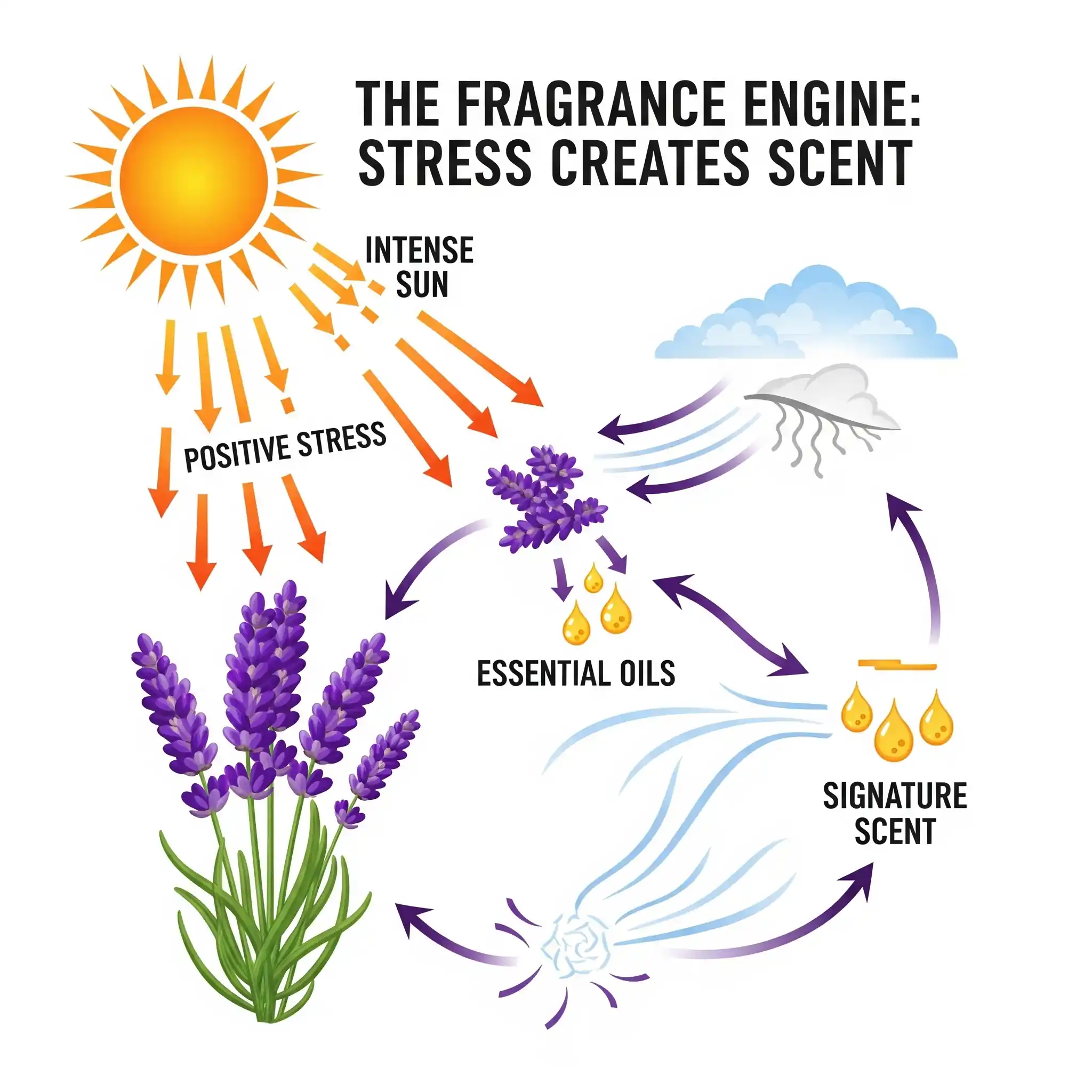
Peer-reviewed research on lavandin essential oil shows exactly how dramatic: summer harvests yield oil at 3.8% of flower dry weight, while winter harvests drop to 2.0% — a swing of nearly 90%. The correlation between temperature (a proxy for solar input in these studies) and oil yield is statistically strong (r = 0.899, p < 0.05). Linalool, the compound most responsible for lavender’s characteristic scent, peaks in summer at 12.5% of total oil composition and drops sharply in cooler, lower-light seasons.
Oil quality is just as affected as quantity. High-quality lavender oil is defined by ISO standard 3515:2002 as requiring linalool at 20–45% and linalyl acetate at 25–47%, with camphor below 1.2%. Camphor above that threshold measurably reduces aroma quality — and camphor tends to peak in cooler, lower-light conditions. A shaded lavender plant doesn’t just make less oil; it makes proportionally more of the compound you don’t want.
There’s a compounding factor: soil fertility. UF/IFAS Extension confirms that nutrient-lean soil encourages higher oil concentration by forcing the plant to synthesize secondary metabolites, including aromatic compounds, in response to mild nutrient stress. Full sun plus lean, well-drained soil is the combination that produces the most intensely fragrant lavender. Add shade and heavy fertilisation, and you get the most disappointing lavender on your street.
What Shade Actually Does to Lavender
The most visible symptom of insufficient sun is leggy, floppy growth: technically called etiolation. When lavender doesn’t receive adequate light, it redirects its photosynthate — the energy products of photosynthesis — toward upward shoot growth rather than lateral branching. The result is long, weak stems and an open, sparse habit.
From the outside this looks like poor health or wrong variety. The plant is actually doing exactly what its biology dictates: stretching toward available light. A lavender that looks disheveled and floppy is almost always telling you it needs more sun, not more fertiliser or different pruning. You can prune it into shape, but without fixing the light, it will revert to etiolation within a season.
Reduced photosynthesis also means fewer lateral shoots, which means fewer flower stems. Flowering directly tracks photosynthetic input: the more energy the plant makes from light, the more it invests in reproductive structures. You cannot compensate for sun deficiency with fertiliser — if the photosynthetic input is insufficient, there’s no raw material to build blooms with. This is why lavender that won’t flower is often a sun problem before it’s anything else.
The third consequence is less obvious but ultimately more damaging: moisture retention. Full sun rapidly dries the surface of lavender foliage and the immediate root zone after rain or watering — this is one of the key reasons lavender is naturally disease-resistant in its native habitat. Shade disrupts that drying cycle. The plant retains surface moisture longer; air circulation within the canopy decreases; the humidity pocket around the plant rises. That moisture accumulation is where the real long-term damage begins.
The Shade-Triggered Disease Cascade
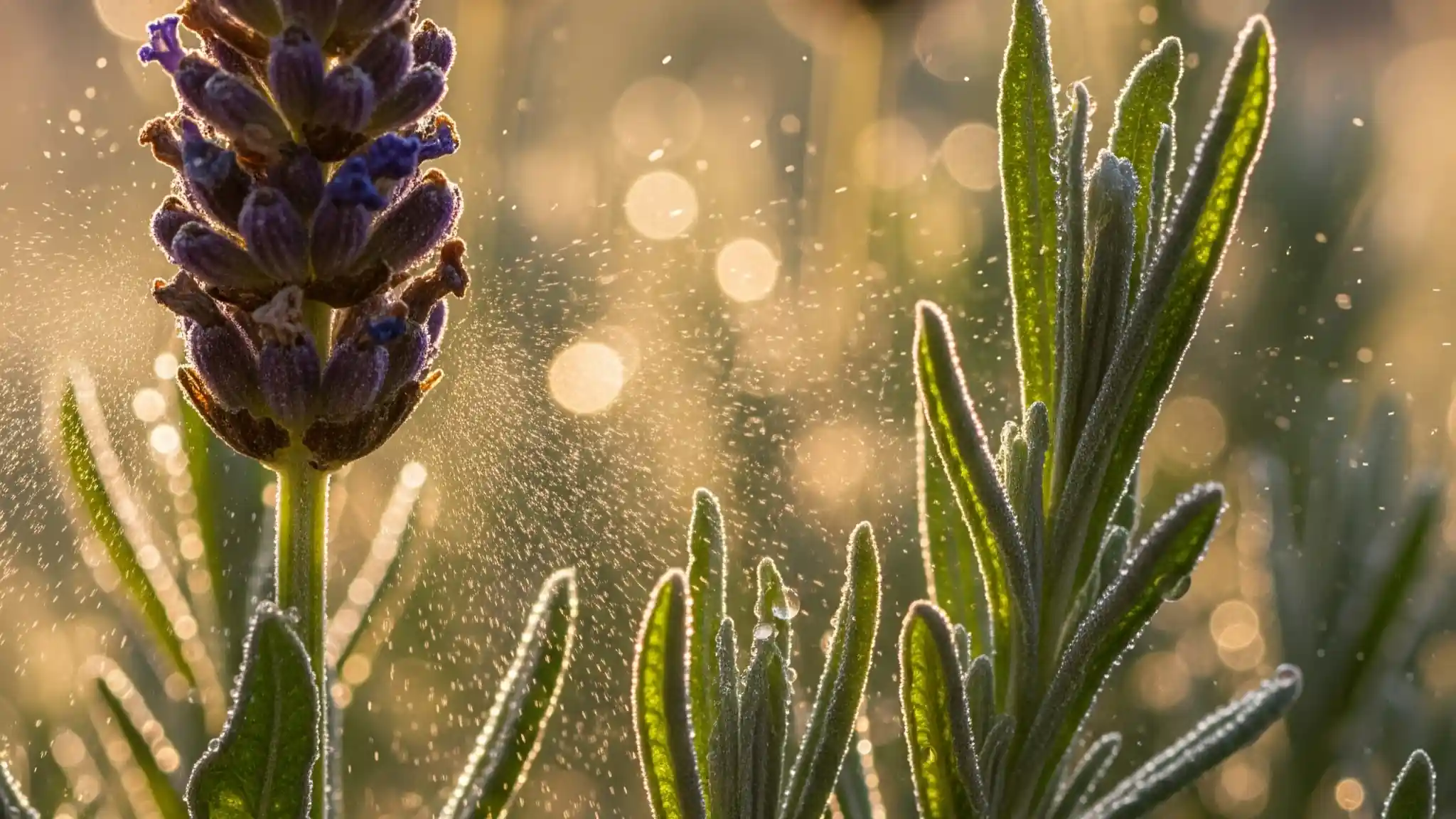
Shade creates the specific conditions that activate three fungal diseases that rarely trouble well-sited lavender.
Botrytis cinerea (grey mold): Thrives in cool, humid conditions with poor airflow — exactly what lavender experiences when shaded. The fungus colonises at the base of the plant, turning lower foliage grey and eventually causing yellowing, wilting, and collapse. Illinois Extension specifically identifies adequate spacing and air circulation as the primary prevention — both of which full sun promotes naturally by drying and opening the canopy.
Root rot: The OSU Plant Clinic has identified a specific consortium of pathogens on lavender roots: Fusarium avenaceum, multiple Phytophthora species (including P. megasperma, P. cinnamomi, and P. cryptogea), Pythium spp., and Rhizoctonia. These pathogens thrive in cold, wet soils — and shade contributes to persistently wet soils by reducing evaporation and slowing drainage. Roots develop a discoloured vascular system, turn black, and rot; the first aboveground sign is wilting that doesn’t respond to watering. See the guide to lavender root rot for full diagnosis and recovery steps.
Septoria leaf spot: Caused by a fungal pathogen that requires water on leaf surfaces to germinate. In a shaded spot where foliage stays wet for hours after rain, the conditions are ideal. Small grey-brown spots appear and spread, eventually killing foliage and stunting growth.
Stop missing your zone's planting windows.
Select your US zone and month — get a complete checklist of what to plant, prune, feed, and protect right now.
→ View My Garden CalendarThe common thread: all three are overwhelmingly preventable by siting lavender in full sun. The sun doesn’t just feed the plant — it dries the environment the plant lives in.
Shade stress symptom guide:
| Symptom | Most Likely Cause | Action |
|---|---|---|
| Leggy stems, floppy open habit | Etiolation from insufficient light | Relocate to full sun; prune or remove shading structures |
| Few or no flowers despite healthy foliage | Sun below 6-hour minimum | Move plant or clear light obstacles |
| Weak or undetectable fragrance | Reduced linalool/linalyl acetate synthesis from low light | Full sun relocation; switch to lean, well-drained soil |
| Grey powder or mold at plant base | Botrytis cinerea — thrives in humid, low-airflow conditions | Improve airflow, reduce watering, remove infected tissue, apply sulfur fungicide |
| Yellowing or wilting despite adequate watering | Root rot (Phytophthora, Fusarium, Pythium) from moisture trapped by shade | Improve drainage; transplant if severe; reduce watering frequency |
| Small grey-brown spots on leaves spreading outward | Septoria leaf spot — humid conditions with water on leaves | Remove infected leaves; improve sun exposure and air circulation |
The Exception: When a Little Afternoon Shade Actually Helps
The 6-hour-minimum rule holds across virtually all climates — with one specific exception for English lavender in zones 8 and 9 where summer temperatures regularly exceed 95°F.
Lavandula angustifolia evolved in the Mediterranean highlands, where even peak summer temperatures rarely push past the low 90s°F. In the heat of Texas, Georgia, or central Florida, July afternoon temperatures frequently exceed 100°F. At sustained heat that intense, English lavender shows heat stress: bleached foliage, premature dieback, and significantly reduced oil quality.
The recommended adjustment is full morning sun through midday — keeping the most productive light hours when photosynthesis and terpene synthesis are highest — plus dappled or light shade from approximately 2pm onwards. This provides afternoon relief without dropping below the 6-hour threshold. UF/IFAS Extension and UC ANR both make this recommendation for subtropical and hot interior climates.
This exception applies specifically to angustifolia cultivars in zones 8–9. Heat-adapted varieties handle uninterrupted full sun without modification:
- ‘Phenomenal’ (lavandin hybrid) — bred for heat and humidity; thrives in full sun in zones 5–8 and doesn’t need afternoon shade even in warm climates
- Spanish lavender (L. stoechas) — native to lower-elevation Mediterranean sites; better heat tolerance in zones 7–10
- ‘Provence’ (lavandin) — grown commercially under full sun in the south of France; handles zone 8–9 without shade
If you’re growing English lavender in zone 8 or 9, afternoon shade after 2pm is a genuine improvement. If you’re growing Spanish lavender or lavandin in the same zone, leave it in full sun.
Cultivar Shade Tolerance: What the Species Difference Really Means
‘Shade-tolerant lavender’ appears in a lot of gardening content online. The term is misleading. No lavender species performs well in shade — all produce fewer flowers, weaker fragrance, and poorer structure when deprived of adequate light. ‘Tolerance’ means only a higher survival threshold in suboptimal light, not meaningful productivity. Understanding the actual differences between lavender varieties helps set realistic expectations.
| Species | Common Name (Cultivars) | Workable Min. Sun | Hardy Zones | Shade Risk | Best For |
|---|---|---|---|---|---|
| L. angustifolia | English lavender (Hidcote, Munstead, Vera) | 6 hours — strict floor | 5–8 | Highest — declines noticeably below 6 hrs | Oil quality, culinary use, cut flowers |
| L. × intermedia | Lavandin (Grosso, Phenomenal, Provence) | 6 hours — strict floor | 5–8 | High — same as angustifolia | Large hedges, commercial oil, Midwest gardens |
| L. stoechas | Spanish lavender (Castilliano Violet, Madrid) | 5–6 hrs survivable | 7–11 | Moderate — survives but underperforms | Hot climates, zones 8–9, containers |
| L. dentata | French lavender (Goodwin Creek Grey) | 5–6 hrs survivable | 8–11 | Moderate — similar to stoechas | Long bloom season, warm-winter zones |
A few practical notes from this table:
- Hidcote and Munstead are often cited as ‘less fussy’ — they’re forgiving of suboptimal soil and temperature extremes, but their light requirement is identical to other angustifolia types. They decline below 6 hours.
- Lavandin hybrids (Phenomenal, Grosso, Provence) show better disease resistance than angustifolia in humid climates — but that resistance comes from vigour and specific disease tolerance, not from needing less sun. They require the same 6-hour floor.
- Spanish lavender’s slightly higher tolerance is real but modest. Anecdotal accounts from growers and the UC ANR Savvy Sage gardening blog suggest survival at 4–5 hours with noticeably reduced flowering. It isn’t a workaround for a genuinely shaded garden.
Also worth noting: the difference between English and French lavender affects more than just cold hardiness. French lavender’s longer bloom season makes it appealing for warm-winter zones, but its sun requirement is no lower than its cold-hardy cousins.
How to Map Sun in Your Garden Before Planting
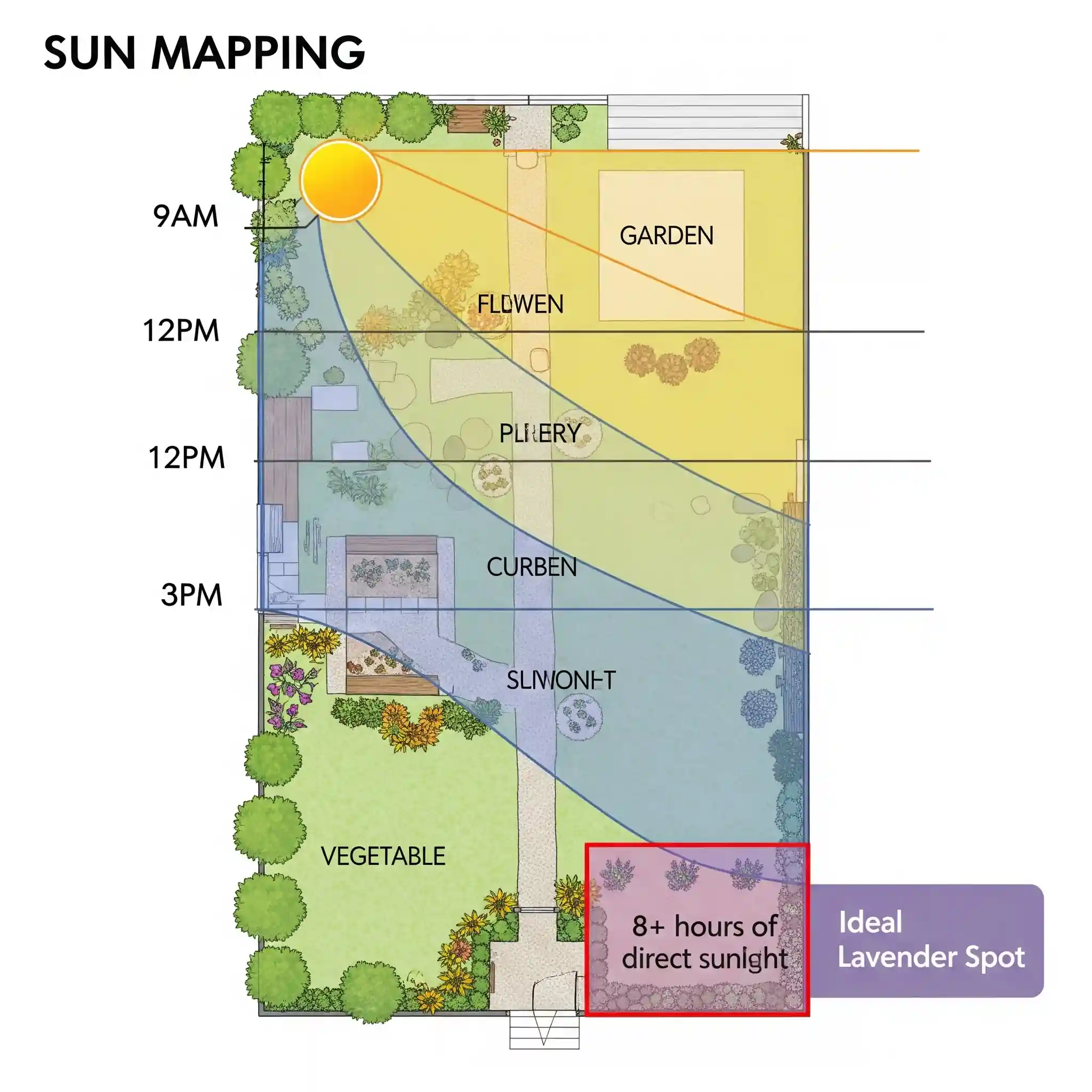
Most gardeners estimate sun hours rather than measure them — and most overestimate. A spot that looks bright and open often receives less direct sun than it appears, particularly when surrounded by fences, hedges, or buildings that block low-angle morning or late-afternoon light.
Three methods that work:
1. The three-observation method. Check your proposed planting spot at 8am, 12pm, and 4pm on a clear day in late spring or early summer. Each time the light is fully direct and unobstructed, count it as a confirmed block of sun. If all three check-ins are direct sun, you have 6+ hours. If shaded at 8am and 4pm but open at noon, you’re below the threshold.
2. Sun-tracking apps. Apps like SunCalc or Sun Surveyor let you model a specific location and date to see the sun’s exact path and when shadows from your fence, neighbour’s house, or tree canopy will fall across the planting area. These are particularly useful in zones 5–6 where the sun’s angle varies significantly across the season.
3. Soil drying rate. The fastest practical diagnostic. After rain, check how quickly the proposed area dries. Spots suitable for lavender should be visibly dry within 24 hours in summer. Areas that stay damp two days after rainfall are too shaded (and too moisture-retentive) for lavender, regardless of the hour count.
One nuance for zones 5–6: the sun’s arc drops significantly from July to September, and a full-sun spot in midsummer may slip below 6 hours by late August. New plants establishing in late summer or autumn won’t get the light budget that a midsummer planting would. Plant in spring if possible, and ensure the plant is well-rooted before the days shorten. If your lavender is potted and you’re uncertain about outdoor light, this guide to lavender indoor light needs covers the indoor equivalent.
What to Do When Your Lavender Isn’t Getting Enough Sun
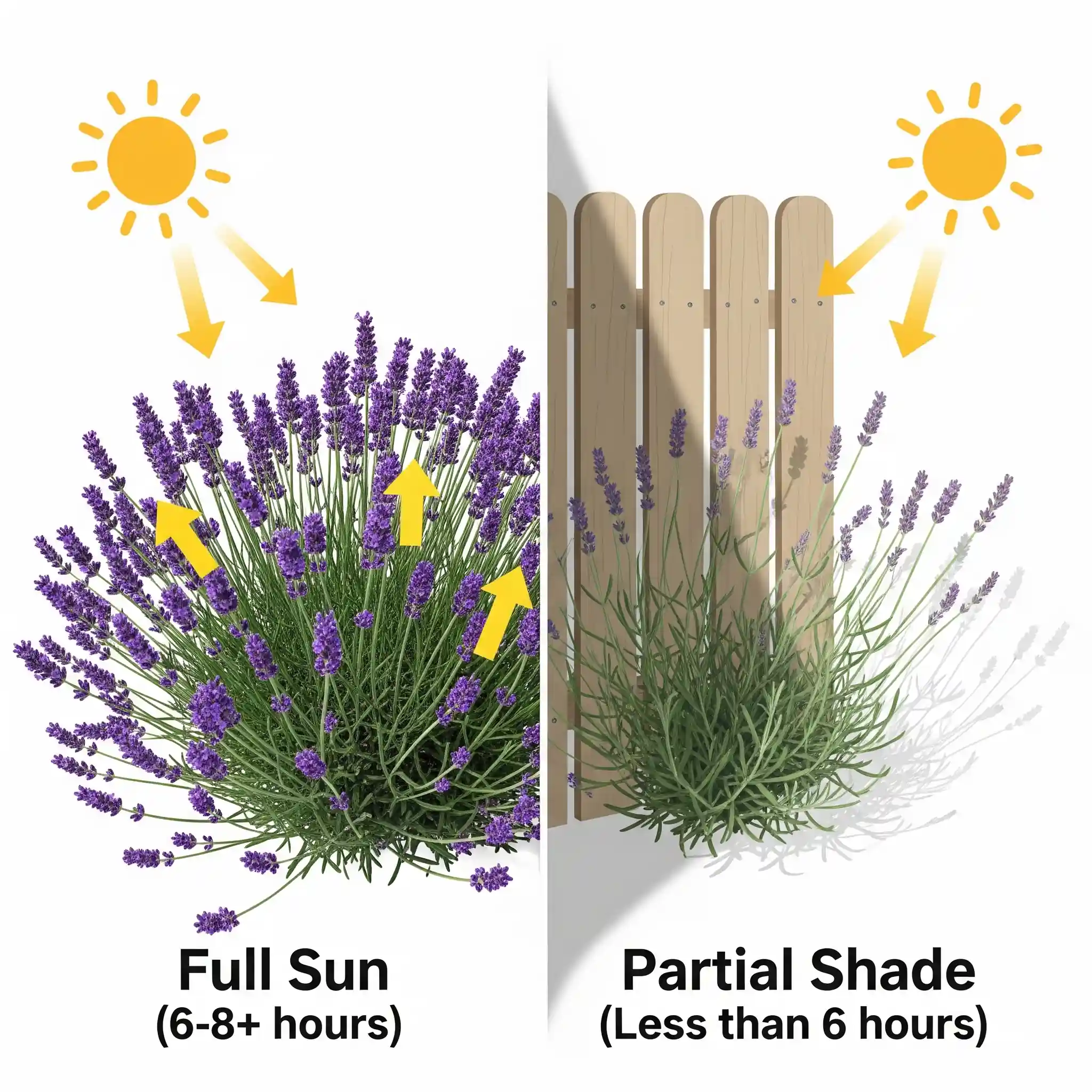
If your lavender is in the wrong spot, the options are limited but clear. Ranked by effectiveness:
1. Relocate the plant — the most effective fix. Lavender transplants reasonably well in early spring or autumn when temperatures are cool and the plant is not in active growth. Dig a generous root ball, replant at the same depth in a confirmed 6+ hour spot, and water in once. After that, leave it alone — resist the urge to compensate for transplant stress with extra water. Expect reduced flowering in the first season after moving. The plant will recover faster than you’d expect if it’s now getting adequate light.
2. Remove the obstruction. If a fence, overgrown shrub, or low-hanging tree branch is casting the offending shade, removing that obstruction may recover the hours you need without transplanting. Before digging up an established plant, spend a week measuring actual sun hours. If the obstruction is taking you from 4 hours to 7, pruning it back is far less disruptive than moving a mature lavender.
3. For container lavender: move the pot. The biggest practical advantage of container growing is relocatability. If potted lavender isn’t performing, moving it to a south- or west-facing position is low-effort. In apartments or constrained gardens, south-facing window ledges, rooftop spots, and balcony railings that receive unobstructed afternoon sun are all workable options.
What won’t work: adding fertiliser, installing supplemental grow lights outside, or adjusting watering to compensate for inadequate sun. Light is the input the plant requires for its core chemistry. Nutrients and water support that chemistry — they cannot substitute for it.
If your garden has no spot with 6 hours of unfiltered sun, lavender isn’t the right plant for it. A genuinely shaded space is better served by shade-tolerant herbs like mint or chervil than by a struggling lavender that produces minimal fragrance, sparse flowers, and chronic fungal problems year after year. Lavender in deep shade is a plant being kept alive, not grown — and there’s a difference.
Frequently Asked Questions
Can lavender survive on 4 hours of sun?
Some Spanish lavender cultivars (L. stoechas) can survive at 4–5 hours but will produce noticeably fewer flowers and significantly weaker fragrance. English lavender (L. angustifolia) typically shows clear decline below 6 hours — leggy growth, sparse flowering, and elevated disease susceptibility.
Does lavender prefer morning or afternoon sun?
Morning sun is preferable in most climates because it dries dew from the foliage early, reducing the window for fungal germination. In zones 8–9, full morning sun plus dappled afternoon shade (after 2pm) is the ideal configuration for English lavender, as it delivers peak photosynthetic hours while preventing heat stress.
My lavender gets 6 hours but is still leggy — what else could cause this?
Three other possibilities: insufficient annual pruning (lavender needs firm cutting back by one-third each year to maintain compact structure), soil too rich in nitrogen (promotes leafy vegetative growth over flowering), or cultivar habit — some lavandin hybrids are naturally taller and more open regardless of sun exposure. Check all three before moving the plant.
Does indoor lavender need the same light?
Yes, and indoor conditions almost never provide it naturally. A sunny south-facing window in the US provides approximately 3–4 hours of equivalent direct sun intensity — below the minimum for most lavender types. Grow lights set to 14–16 hours daily are the practical solution for indoor lavender. Full details on indoor lavender light requirements.
Sources
- Utah State University Extension — English Lavender in the Garden
- Colorado State University Extension — Growing Lavender in Colorado
- University of Maryland Extension — Lavender
- University of Illinois Extension — Lavender
- University of California ANR Savvy Sage — Growing Lavender
- UF/IFAS Extension Pasco County — A Beginner’s Guide to Growing Lavender
- PMC / MDPI Plants — Current Trends for Lavandula angustifolia Crops and Essential Oil Quality
- PMC — Seasonal Variation in Chemical Compositions of Essential Oils Extracted from Lavandin Flowers
- Hopes Grove Nurseries — Pests, Diseases and Common Problems with Lavender
- Oregon State University Pacific Northwest Pest Management Handbooks — Lavender Root Rot
