

Best Companion Plants for Turnips: 7 Picks That Reduce Pests and 3 to Avoid

Discover 7 research-backed companion plants that protect turnips from flea beetles, aphids, and nematodes — plus 3 plants that concentrate pests and why marigolds aren’t the flea beetle fix you’ve heard.
Why Turnip Companion Planting Is Half Folklore (And How to Use the Half That Works)
Turnips are one of the fastest-maturing vegetables in the cool-season garden — most reach harvest size in 40 to 60 days — but that short window also makes pest damage particularly costly. Lose the first two weeks of a seedling to flea beetles and you’ve lost most of the crop.
Here’s what most companion planting guides won’t tell you: a Washington State University field study tested spring onions, dill, and marigolds alongside broccoli (a close turnip relative in the same brassica family) and found that none of these companions reduced flea beetle densities on the crop. The same research, published through the SARE grant program, found that trap crops — plants placed to draw beetles away from your turnips — outperformed companion deterrents in every trial.
That doesn’t mean companion planting is useless for turnips. It means the goal shifts: choose companions that attract beneficial insects, fix nitrogen, improve space efficiency, or serve as true trap crops — not plants you’re hoping will magically repel pests they haven’t been shown to repel. The seven companions below do exactly that, and they’re chosen to give you honest expectations, not garden folklore. For full growing details on timing, varieties, and soil preparation, see our turnip growing guide.
The Flea Beetle Problem: Why Turnips Are So Vulnerable
Before choosing companions, it helps to understand why turnips attract flea beetles in the first place. Turnips belong to Brassicaceae, and like all brassicas, they contain glucosinolates — sulfur-based compounds that release allyl isothiocyanate (AITC) when leaf tissue is damaged. Field research published in the Journal of Chemical Ecology found that AITC attracted more flea beetles (Phyllotreta cruciferae and P. striolata) than any other compound tested, with 4 mg per day being the threshold for substantial attraction.

Skip the guesswork — get a pre-planned 4×8 kitchen garden bed
Free printable planting plan: what goes where, when to plant it, and how to keep it alive. Plus two bonus flower bed plans.
This is a critical detail: when a flea beetle chews a turnip seedling, it triggers AITC release that draws more beetles. The damage compounds quickly. It also explains why planting more brassicas nearby — broccoli, kale, cabbage — makes the problem worse, not better. You’re not diluting the signal; you’re amplifying it across a wider area.
University of Minnesota Extension recommends a four-year rotation: don’t grow turnips, or any brassica, in the same bed for at least four years after a planting. That’s your single most effective cultural control. Companion planting works within that rotation — it doesn’t replace it.
7 Best Companion Plants for Turnips
1. Peas — Nitrogen Without Root Competition (With One Important Caveat)
Peas are the most popular turnip companion for good reason: legumes fix atmospheric nitrogen through root nodules, and research from NMSU Extension shows legumes can transfer 30 to 50 pounds of nitrogen per acre to neighboring non-legume plants through nodule leakage. For turnips — which need adequate nitrogen for healthy leaf and root development — this is a genuine benefit.
The caveat is real, though. A pea-turnip intercropping study found that when peas were planted at 10 cm intervals among turnips, root yield dropped 29 percent compared to sole-cropped turnips (from 28.83 t/ha to 20.45 t/ha). The nitrogen savings were real — fertilizer costs fell by half — but the yield reduction matters if you’re growing turnips for root harvest rather than greens.
The practical solution: plant peas on the edges of your turnip bed rather than interplanting row-by-row. Peas on a north-facing edge won’t shade turnips, root competition is minimal, and the nitrogen benefit still reaches the turnip root zone. Illinois Extension notes that fall turnips are commonly broadcast after early peas have been harvested, which is another effective approach — the pea residue improves soil nitrogen before turnips occupy the space.
2. Nasturtiums — Trap Crop for Aphids and Cabbage Moths
Nasturtiums don’t repel pests from turnips — they attract them instead, which is exactly the point. Aphids and cabbage moth adults (Pieris rapae) are drawn to nasturtium foliage ahead of your turnip leaves, concentrating the damage where you can manage it. University of Minnesota Extension research confirmed that nasturtiums helped reduce cabbage looper and imported cabbageworm damage on brassicas when used alongside other companions.
For nasturtiums to function as a trap crop rather than an aphid nursery, two rules apply. First, plant them at least 18 to 24 inches from your turnip rows — close enough to draw pests away, far enough that aphid colonies can’t overflow onto the main crop when populations spike. Second, inspect them twice weekly. Yellow-flowering varieties attract the highest aphid pressure. When colonies build up, pinch off affected stems or knock aphids off with a strong water stream before the population gets ahead of natural predators.
Marigolds are often recommended in the same breath as nasturtiums, but the evidence diverges here. University of Minnesota Extension explicitly states there is little research to support marigolds repelling flea beetles from brassicas, and the SARE GW11-005 field trials confirmed this — marigolds provided no measurable flea beetle reduction. Marigolds are still worth growing near turnips for nematode suppression (see below), but if flea beetles are your primary concern, nasturtiums used as a trap crop are a better bet.
3. Sweet Alyssum — The Best Parasitoid Wasp Attractor
Sweet alyssum (Lobularia maritima) is small, low-growing, and easy to dismiss — until you look at the research. A study published in Scientific Reports (2020) found that alyssum volatiles specifically attracted Cotesia vestalis, a parasitoid wasp that targets the diamondback moth (Plutella xylostella), which is one of the most destructive brassica pests globally. Access to alyssum flowers increased adult wasp longevity and realized fecundity — meaning more wasps survived long enough to parasitize more pest caterpillars.
Observation studies at Purdue University reinforced this: sticky card trap counts showed significantly higher parasitoid wasp and syrphid fly abundance in beds where sweet alyssum was planted compared to controls. Strawberries grown alongside alyssum had almost no aphids; the same variety planted without alyssum had measurable aphid pressure.
For turnips, the benefit is especially valuable for caterpillar pests — imported cabbageworm, cabbage looper, and diamondback moth are all brassica feeders. Plant alyssum at the bed edges or in narrow strips between turnip rows. It blooms for roughly 90 days and reseeds readily, so a single spring planting often continues through fall — which aligns neatly with the fall turnip planting window. Space it every 12 to 18 inches for adequate density.
4. Spinach and Lettuce — Space Efficiency With No Nutrient Competition
Spinach and lettuce are cool-season crops that share turnips’ preferred temperature window: both germinate well between 45°F and 75°F and slow down once summer heat arrives. This overlap makes them natural space-efficiency companions rather than pest-management companions.
The root architecture works in your favor. Spinach is a shallow-rooted crop (roots to 6 inches), while lettuce is shallower still. Turnips develop a taproot that extends well below the 6-inch zone. There’s no meaningful root competition, and both crops are light enough feeders that they don’t deplete the nutrients turnips need for bulb development.
The practical approach: sow spinach or lettuce in the spaces between turnip rows immediately after planting. Spinach and lettuce will reach harvest size in 30 to 45 days — before turnips need full canopy space. You harvest the greens and the turnips fill the vacated space. One caveat: don’t allow lettuce to bolt and go to seed near turnips in hot weather. Lettuce bolts above 86°F, releasing a bitter latex, and the stressed plants become more attractive to aphids. Succession-sow instead.
Stop missing your zone's planting windows.
Select your US zone and month — get a complete checklist of what to plant, prune, feed, and protect right now.
→ View My Garden Calendar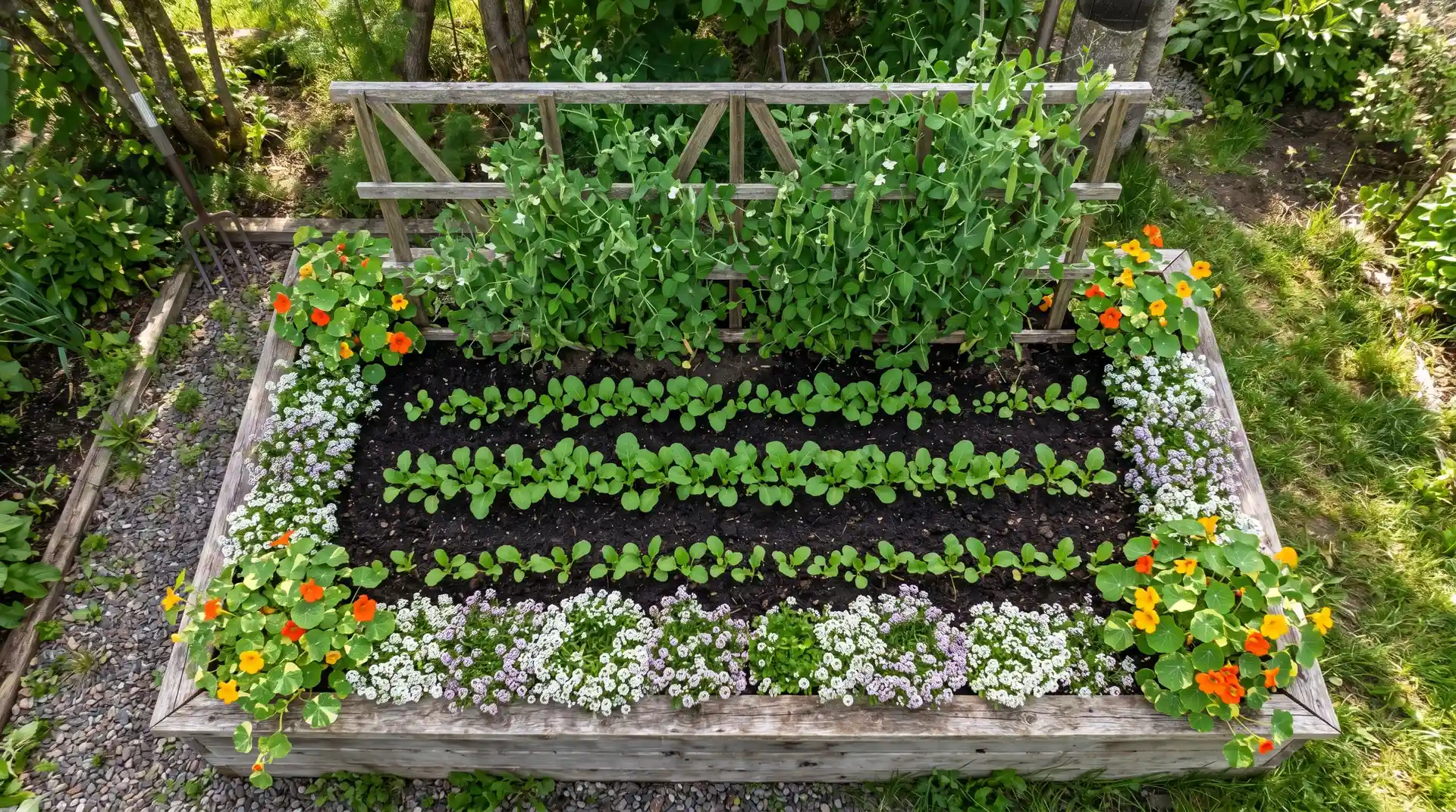
5. Marigolds — Effective for Nematodes Only (Plant 8 Weeks Early)
French marigolds (Tagetes patula) earn their place near turnips for one specific purpose: suppressing root-knot nematodes (Meloidogyne spp.) in the soil. The active compound is alpha-terthienyl, a thiophene produced in marigold roots that is toxic to nematode larvae. University of Florida IFAS research confirms this suppression only works when marigolds are planted densely for at least eight weeks before the susceptible crop occupies the soil.
That timing requirement changes how you use marigolds. If you’re planning a fall turnip planting (typically August 1 to September in most US zones), plant French marigolds in June as a precursor crop. Let them establish for eight weeks, then pull them and direct-sow your turnips in the same bed. The alpha-terthienyl remains in the soil for several weeks after removal.
What marigolds don’t do: repel flea beetles. University of Minnesota Extension is direct about this — there is little research to support the claim, and field trials have not confirmed it. If you plant marigolds in early spring hoping to protect spring turnip seedlings from flea beetles, you’re relying on folklore. The nematode benefit is real; the flea beetle claim is not.
6. Garlic — Aphid Deterrence, Not a Flea Beetle Solution
Garlic and other alliums emit sulfur-based VOCs (volatile organic compounds) from their foliage continuously during the growing season. Research on allium companions has shown these sulfur compounds — primarily dimethyl sulfide and diallyl disulfide — can physically adhere to nearby plant surfaces, masking the host-plant chemical cues that aphids use to locate feeding sites. For aphid management, this is a credible mechanism.
For flea beetles, it’s a different story. The SARE GW11-005 research tested spring onions alongside broccoli and found no significant reduction in flea beetle densities. If you’re growing garlic or onions in your garden anyway, planting a row adjacent to turnips costs nothing extra and may reduce aphid pressure. Just don’t rely on it as your primary pest strategy — it’s an aphid aid, not a flea beetle deterrent.
One consideration: garlic and leeks are alliums, and alliums release allicin from roots into surrounding soil. Allicin disrupts Rhizobium bacteria, which matters for legume nitrogen fixation. If you’re pairing peas with turnips for the nitrogen benefit, don’t interplant alliums in the same bed — keep them 18 to 24 inches from your pea rows to avoid interfering with nodule formation.
7. Dill and Chamomile — Caterpillar Control Through Beneficial Insect Habitat
Dill’s flat umbel flowers and chamomile’s daisy-like blooms both have wide, shallow flower structures that make nectar accessible to short-tongued parasitoid wasps — the same insects that target cabbage loopers and imported cabbageworms. University of Maryland Extension explicitly identifies this architectural feature as the key to why umbelliferous flowers are so effective at sustaining beneficial insect populations near brassica crops.
SARE GW11-005 greenhouse research found that sage and thyme reduced diamondback moth populations on Brussels sprouts. Dill and chamomile operate through the same mechanism — providing nectar that keeps parasitoid wasps active and reproducing near your turnips throughout the season.
Two practical rules for dill near turnips. First, use young dill (harvest stage) for aromatic VOC benefits and let a separate row go to flower for beneficial insect attraction — you can’t do both from the same plants simultaneously. Second, keep dill away from carrots and parsley: all three are Apiaceae and share the carrot rust fly (Psila rosae) as a common pest. Plant dill at bed edges, not in mixed Apiaceae clusters.
Good soil under all these companions starts with organic matter. Before planting any companion combination, incorporating aged compost builds the microbial diversity that supports both plant health and beneficial insect habitat at the soil level. Our compost guide walks through the full composting process.
3 Plants That Harm Turnips
1. Other Brassicas — The Worst Mistake in a Turnip Bed
Broccoli, cabbage, kale, and cauliflower are all in Brassicaceae, which makes them the most natural-seeming companions for turnips — and the most harmful. Every brassica in the bed is another source of AITC, drawing more flea beetles into the area. Every shared root zone is another potential reservoir for root maggots and clubroot spores, which can persist in soil for up to seven years. Dense brassica plantings also create ideal conditions for diamondback moth and imported cabbageworm, since there is no escape crop for caterpillars to switch to.
University of Minnesota Extension recommends that turnips not be grown where any member of the cabbage family has grown in the past four years. Planting broccoli next to your turnips resets that rotation clock — you’re effectively treating adjacent soil as the same plot. Keep brassica species separated by as much distance as your garden allows, and reserve companion planting slots for non-brassica partners instead.
2. Fennel — Allelopathic and Universally Poor Company
Fennel (Foeniculum vulgare) releases trans-anethole and fenchone from its roots as it grows. These compounds inhibit root elongation and germination in many neighboring plants, and turnips are sensitive to them. Fennel’s reputation as a poor garden companion is consistent across nearly all crop categories — it’s one of the few plants that horticultural literature almost universally recommends isolating from other vegetables.
Keep fennel at least five feet from any turnip planting, or better yet, grow it in a dedicated container where its root chemistry stays confined. If fennel has grown in a bed previously, allow its roots to fully decompose (several months) before planting turnips in the same soil zone.
WSU Extension lists potatoes as plants to avoid near turnips, and the reasoning is straightforward: both crops are root-zone feeders that compete for the same soil nutrients, and both attract similar pest pressure. Aphids that feed on potatoes include species that also vector diseases on brassicas. Root maggots that damage potato tubers will move to turnip roots in the same bed. The combination concentrates shared problems rather than dispersing them.
There’s also a rotation consideration: potatoes and turnips should not follow each other in the same bed. Illinois Extension notes that turnips can be broadcast after certain crops — but potato is not on that list.
The Trap Crop Strategy: What Actually Works for Flea Beetles
If flea beetles are your primary concern, no companion plant will reliably protect your turnips. What works, according to WSU and SARE research, is a trap crop planted seven to fourteen days before your turnips. Pacific Gold mustard (Brassica juncea) is the most effective species — it produces high concentrations of sinigrin (allyl glucosinolate), making it more attractive to flea beetles than turnips. When beetles emerge from overwintering in spring, they hit the mustard border first. You treat the trap crop with a targeted application (or simply sacrifice it), protecting the main planting.
For a full-season approach: plant mustard as a border crop 7 to 14 days before turnips, combine with sweet alyssum inside the bed for parasitoid wasp habitat, and use straw mulch between rows — SARE found moderate flea beetle improvement with barley straw mulch in small-scale trials. This three-layer system (trap crop + beneficial insect habitat + mulch) is more reliable than any single companion plant. Adding a layer of mulch also retains soil moisture critical for turnip bulb development.
Frequently Asked Questions
Do marigolds protect turnips from flea beetles?
No — despite being widely recommended, marigolds have not shown significant flea beetle reduction in field trials with brassicas. University of Minnesota Extension states there is little research to support this use. Marigolds are valuable near turnips for nematode suppression in the soil, but only when planted as a dense precursor crop at least eight weeks before turnips. For flea beetle management, use Pacific Gold mustard as a trap crop instead.
What is the single best companion plant for turnips?
Sweet alyssum, for overall pest pressure reduction. It attracts parasitoid wasps that target caterpillar pests (cabbage looper, imported cabbageworm, diamondback moth) and syrphid flies that prey on aphids. It’s inexpensive, blooms for up to 90 days, and fits neatly at bed edges without competing for root space. For nitrogen benefit, add peas on the north edge of the bed.
Can I grow turnips and radishes together?
It’s not recommended. Radishes and turnips are both brassicas and share the same pest suite — flea beetles, root maggots, and cabbage family diseases. WSU lists radishes among the plants to avoid near turnips. Growing them together concentrates pest pressure rather than reducing it. The exception: radishes planted 7 to 14 days earlier than turnips as a dedicated trap crop for flea beetles — the same principle as the mustard trap crop approach, using the radishes as a sacrifice border.
Do turnips grow well with garlic?
Yes, with one condition. Garlic’s sulfur VOCs may reduce aphid pressure on nearby turnips — the masking mechanism is documented for allium companions generally. The limitation: garlic provides no measurable flea beetle protection (per SARE research), so pair it with other strategies. Also, if you’re growing peas alongside turnips for nitrogen, keep garlic at least 18 to 24 inches from peas to avoid allicin disrupting the Rhizobium bacteria in pea root nodules.
Sources
- University of Minnesota Extension. Growing Turnips and Rutabagas in Home Gardens. extension.umn.edu
- Burgess, L., et al. (1992). Response of flea beetles, Phyllotreta spp., to mustard oils and nitriles in field trapping experiments. Journal of Chemical Ecology. PubMed 24254090.
- SARE Grant GW11-005. Combining Trap Cropping with Companion Planting to Control the Crucifer Flea Beetle. projects.sare.org
- University of Minnesota Extension. Companion planting in home gardens. extension.umn.edu
- eOrganic / WSU. Managing Cruciferous and Solanaceous Flea Beetles in Organic Farming Systems. eorganic.org
- Intercropping study. Effect of pea intercropping on biological efficiencies and economics of some non-legume winter vegetables. (Root yield: 28.83 t/ha sole crop vs 20.45 t/ha intercrop, 29% reduction; fertilizer costs cut 50%.)
- Ye, M., et al. (2020). Alyssum selectively attracts and enhances the performance of Cotesia vestalis. Scientific Reports, Nature.
- Purdue University / Vegcrops Hotline. Observations on the Companion Plant: Sweet Alyssum. vegcropshotline.org
- Illinois Extension. Turnip | Home Vegetable Gardening. extension.illinois.edu


