Garlic and Tulips Sprouting in October: Why a Warm Spell After the Freeze Pushes Shoots Up, and Why 2–3 Inches of Green Is Not a Problem

Garlic or tulips sprouting after the freeze? About 3 inches of fall green is normal. See what extension sources say is too much and when to mulch.
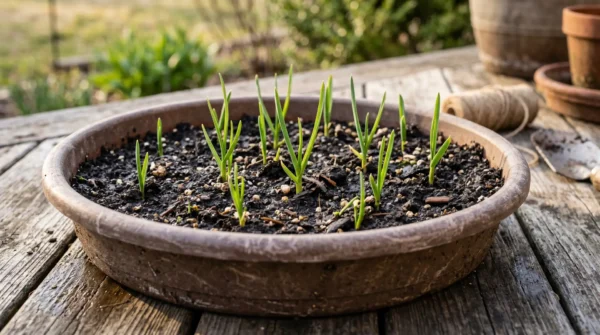
Up to about 3 inches of green on garlic you planted this month is ordinary, and the clove underneath is fine. The one number I found for “too much” comes from a seed company, not an extension service: Fruition Seeds says more than 3 inches of leaf growth in fall exposes the clove to drying winter wind, because the leaves keep drawing moisture out of it. For tulips and daffodils, the thing to watch is a hard freeze after the leaves are up. In both cases the move is mostly to leave the shoots alone and get mulch on before the next hard cold. None of the sources below suggests cutting shoots back or replanting.
Why a warm week after a freeze wakes up the cloves
A freeze warning covered eastern Nebraska and western Iowa on Friday night into Saturday, Oct. 17, and WOWT in Omaha said many places would see their first light freeze of the season. Then the warmth came back. Fox 32 Chicago forecast highs of 70 to 75°F from Wednesday, against a normal Thursday high of 60°F. The Weather Prediction Center’s extended discussion issued 2:20 PM EDT on Oct. 22 puts highs 5 to 15 degrees above normal from the southern Plains to the Upper Midwest and Great Lakes through Monday.
I found no source that ties this exact freeze-then-warmth pattern to sprouting, so treat the link as my inference. The general case is documented. UConn’s Dawn Pettinelli describes the trade-off: garlic planted too early “will start sending up green shoots instead of putting efforts into root growth,” which “may result in smaller bulbs.” Spring bulbs also respond to warmth: Colorado State says they “sometimes start to emerge early during periods of warm weather in late winter or early spring.”
What a fall shoot costs, and what it doesn’t
The cold is the smaller threat. Iowa State’s Aaron Steil writes that garlic foliage “can tolerate cold temperatures (down into the 20s °F)” and that below 20°F “the foliage will likely see some damage.” Even foliage killed to the ground will likely regrow, he says, but the crop will likely be smaller because energy went into leaves that were then destroyed. His answer is about a mid-winter warm-up; I am applying the same logic to a fall flush.

Skip the guesswork — get a pre-planned 4×8 kitchen garden bed
Free printable planting plan: what goes where, when to plant it, and how to keep it alive. Plus two bonus flower bed plans.
The second cost is water. Cornell’s Petra Page-Mann notes that the green shoot of garlic planted too early can rise several inches, “acting as a straw over the winter to draw water from the clove.” The Fruition course describes the same mechanism: the leaf draws moisture from the clove and winter wind carries it away. That is why the height of the shoot matters more than the fact that it appeared.
How much growth is too much
For garlic, the height of the shoot matters more than its existence. For tulips and daffodils, a hard freeze after the leaves are up is the scenario worth planning for. Here is how the sources sort the cases. The two bulb sources describe late-winter emergence, and I am applying them to an October flush:
| What you see | What the sources say | What to do |
|---|---|---|
| Garlic, up to about 3 inches of green | Iowa State calls early emergence “not unusual.” Fruition’s 3-inch figure is the only threshold I found. | Leave it. Mulch before hard cold. |
| Garlic, past 3 inches and still growing | Fruition: more than 3 inches exposes the clove to drying wind. Cornell: the shoot can draw water from the clove. | Mulch heavily now. Cornell’s rate is 6 inches or more. |
| Garlic leaf tips browned by a freeze | Iowa State: foliage tolerates the 20s; below 20°F some damage; killed foliage likely regrows, crop likely smaller. | Nothing to repair. Add mulch before nights forecast near the teens. |
| Tulip or daffodil leaf tips up | Colorado State (writing about late-winter and early-spring emergence): foliage is hardier than the flower buds but can be damaged. Buds are at greatest risk below 26°F. | Leave them. Watch for nights in the mid-20s. |
| Bulb leaves more than a few inches tall, mid-20s°F in the forecast | Iowa State (tulip page, written about February emergence): add organic mulch such as straw or pine needles around the base, and remove it once normal temperatures return. | Mulch before the cold night. |
| Bulbs against a south- or west-facing wall | Colorado State: most susceptible to early emergence and freeze injury. | Check these beds first. |
Iowa State’s tulip answer adds that the foliage of tulips, daffodils and other spring bulbs can tolerate cold temperatures, and that earliest growth shows on the south and west sides of buildings.
When to mulch: the sources disagree
Mulch timing is the one thing I can’t reduce to a single rule, because the extension sources split:
- Cornell: “Spread six inches of mulch or more as soon as you sow.”
- UConn: after planting but before the ground freezes, put down 4 to 6 inches of leaves or straw, so the soil takes longer to freeze and the roots get more time to grow.
- Iowa State (garlic page): once normal winter temperatures return, add mulch, especially if snow cover is thin.
- Colorado State, for spring bulbs on susceptible sites (near foundations, on south or west sides, on south-facing slopes): mulch in fall after the ground has frozen, with six inches of straw or shredded leaves.
My read, not a finding from those pages: for a garlic bed that is already up, get mulch down before the first night forecast to reach the teens, which is below the 20°F line Iowa State names. Don’t wait for the ground to freeze. For deeper detail on rates and frost heave, see our overwintering garlic guide.
What a see-saw fall does to the cold the bulb needs
UConn says garlic needs “at least 2 months of temperatures 40 F or below” for good bulb formation. UConn does not say how a warm spell counts toward that total; it only advises later planting in a warm fall. My reading is that days above 40°F do not count toward that total, so a warm week is a reason to want winter to arrive on schedule, not a reason to dig up and replant. Tulips have their own cold requirement; the 6 to 10 week, 45°F rule in our pre-chilling guide for zones 8 to 10 shows how much.
What to do this week
- Measure before you worry. Hold a ruler to the tallest garlic shoot. Up to about 3 inches, leave it and mulch before the hard cold. Past that, mulch heavily now; Cornell’s rate is 6 inches or more.
- Check the forecast for the cold nights that matter: the teens for garlic foliage, the mid-20s for emerged tulip and daffodil growth.
- Skip fertilizer. UConn’s nitrogen advice is for spring, when shoots reach about 6 inches, and I found nothing recommending it now.
- Plan next year’s date. Cornell says to plant between Halloween and Thanksgiving. UConn says about a month before a hard frost is expected. Our soil-temperature planting guide explains the timing, and the November zone 7 task list shows what else to do before the freeze. The full garlic growing guide covers the rest of the season.
Sources
- Fruition Seeds. The most common death of garlic and how to avoid it (Garlic & Shallot Academy course transcript; a seed company, not an extension service). Viewed Oct 22, 2026.
- Cornell Small Farms Program (Petra Page-Mann). Six Mistakes to Avoid When Planting Garlic & Shallots, Oct 7, 2019. Viewed Oct 22, 2026.
- UConn Home & Garden Education Center (Dawn Pettinelli). Plant Garlic Now for Summer Harvest. Viewed Oct 22, 2026.
- Iowa State University Extension and Outreach (Aaron Steil). It’s only February, but my garlic is coming up. What should I do? Updated Jul 24, 2024. Viewed Oct 22, 2026.
- Iowa State University Extension and Outreach. It’s only February, but my tulips are coming up. What should I do? Updated Dec 3, 2024. Viewed Oct 22, 2026.
- Colorado State University Extension. PlantTalk Colorado 1074: Early Emergence of Spring Bulbs. Viewed Oct 22, 2026.
- NOAA/NWS Weather Prediction Center. Extended Forecast Discussion, 220 PM EDT Thu Oct 22, 2026. Viewed Oct 22, 2026.
- Fox 32 Chicago. Chicago weather: Above-normal temps expected through October, Oct 19, 2026. Viewed Oct 22, 2026.
- WOWT Omaha (Matt Serwe). Matt’s First Alert 6 Forecast: Winds calm down tonight, widespread frost likely, Oct 16, 2026. Viewed Oct 22, 2026.
Stop missing your zone's planting windows.
Select your US zone and month — get a complete checklist of what to plant, prune, feed, and protect right now.
→ View My Garden Calendar