Plant Garlic 6 Weeks Before Ground Freeze — Here’s How to Find That Date for Your Zone

Plant garlic in the 4–6 week window before your ground freezes, not your first frost date. Zone-by-zone timing table, the biology behind bulb size, and the date-finding method most guides skip.
Every fall, gardeners pull up garlic in July and wonder why their bulbs are the size of golf balls when their neighbor’s look like a fist. The most common reason has nothing to do with variety choice or fertilizer. It comes down to a single decision made six months earlier: what date did you put the cloves in the ground?
Garlic is one of the few vegetables where the exact planting date is the primary yield lever. Plant too late and you’ll pull small, loosely formed bulbs. Plant too early and frost-damaged shoots invite disease before the bulb has a root system to defend itself. Get the window right — and garlic does most of the work for you through winter and spring.
This guide gives you the correct timing framework (most articles use the wrong benchmark), the biology behind why fall root development drives summer bulb size, and a zone-by-zone table so you can find your planting date in under two minutes. For the full picture of growing garlic from seed to harvest, see our garlic growing guide. And for everything else going into the ground this fall, the year-round planting guide coordinates all your cool-season crops in one calendar.
Why Garlic Grows Bigger When Planted at the Right Time
Garlic is unlike almost every other vegetable you plant in fall. You’re not racing to beat frost — you’re using winter as a biological tool.

Skip the guesswork — get a pre-planned 4×8 kitchen garden bed
Free printable planting plan: what goes where, when to plant it, and how to keep it alive. Plus two bonus flower bed plans.
When you plant a garlic clove in fall soil, it immediately begins growing roots. Those roots push downward and outward through October and November, building a dense network while air temperatures drop. The clove isn’t forming a bulb yet. It doesn’t try to divide into cloves yet. It’s storing capacity — like laying down a foundation before raising walls.
Come spring, when day length crosses roughly 10–12 hours, that root network becomes the delivery system for a rapid burst of leaf growth. Each leaf the plant produces in spring represents one potential layer of the final bulb. And those layers swell to their full size as days lengthen through May and June before the plant triggers harvest readiness by drying down its lower leaves.
Cornell Cooperative Extension frames the mechanism precisely: “Garlic roots develop in the fall and winter, and by early spring they can support the rapid leaf growth that is necessary to form large bulbs.” [5] Without that fall root infrastructure, the spring delivery system is undersized — and every leaf that would have become a bulb layer either doesn’t form or forms small.
The yield consequences of getting this wrong are sharp. Research published in the Bangladesh Journal of Botany compared yields across three planting dates in the same season. Compared to optimal October 23 planting, delaying to December 3 cut yield by roughly 33%. Delaying to January 1 cut yield by approximately 80% [7]. That’s not a minor inconvenience — an 80% yield reduction from a timing decision means four-fifths of your potential harvest stays in the ground.
Cold also does something more fundamental than just “chilling” the cloves. At sustained temperatures between 32°F and 50°F, garlic undergoes vernalization — a biological state transition in which the meristem (the clove’s growing tip) shifts from vegetative to reproductive mode. A peer-reviewed study in Frontiers in Plant Science found that this transition activates approximately 14,000 genes involved in clove differentiation, with the circadian clock integrating cold signals and coordinating the flowering pathway [6]. Without adequate cold exposure, the clove may fail to divide into distinct segments at all, producing a single undivided bulb that looks more like a marble than a multi-clove garlic head.
The upshot: fall planting isn’t a tradition or a convenience. It’s when garlic’s two essential biological processes — root establishment and vernalization — happen simultaneously, in the ground, for free.
The Benchmark Most Garlic Guides Get Wrong
Here’s the error that trips up most garlic timing advice, including many otherwise good extension publications: using first frost as the planting benchmark instead of ground freeze.
These are not the same event, and they can be weeks apart.
Your first fall frost is the night air temperature dips to 32°F or below. Leaves blacken. Tomatoes die. But the soil is still warm — often 40–55°F measured six inches down — because soil holds heat far longer than air. In zone 5, for example, first frost typically arrives in early October, but the ground doesn’t freeze solid until November or December.
Your ground freezes when the top several inches of soil become frozen solid — and that typically happens weeks to months after your first frost, depending on your zone:
- Zone 3: Ground freezes late October, roughly 6–8 weeks after first frost
- Zone 5: Ground freezes in late November to December, 6–10 weeks after first frost
- Zone 7: Ground rarely freezes solid; soil temperature is your practical guide
- Zone 8 and warmer: Ground doesn’t freeze; use soil thermometer only
Garlic roots grow through soil, not air. The biological trigger for root growth is soil temperature, not air temperature. Roots actively grow when soil stays above 32°F at the root zone. Once soil temperature drops below 32°F and stays there, root growth stops until spring — but the root system you built in fall determines everything about spring performance.
The correct benchmark: plant garlic 4–6 weeks before your ground freezes. In cold zones (3–6), this translates to roughly 6–8 weeks before your average first frost date, or whenever your soil temperature at 4 inches drops into the 50–60°F range and is trending down.
To find your local ground freeze date: search “[your city] average ground freeze date” on NOAA’s climate portal, or contact your county cooperative extension office — most publish climate normals that include soil freeze data by month. A soil thermometer ($12–20 at any garden center) removes all guesswork: plant when the reading at 4 inches drops to 55°F and is trending downward on consecutive readings.
When to Plant Garlic by Zone
Use the table below as your starting point. Adjust 1–2 weeks based on whether your local winters run early or late. The “Planting Window” represents the optimal 4–6 week lead time before typical ground freeze for each zone, based on USDA climate data and synthesis across multiple university extension sources [1][2][3][5].
Stop missing your zone's planting windows.
Select your US zone and month — get a complete checklist of what to plant, prune, feed, and protect right now.
→ View My Garden Calendar
| USDA Zone | Avg First Frost | Planting Window | Best Type |
|---|---|---|---|
| Zone 3 | Sep 1–15 | Sep 1–20 | Hardneck only |
| Zone 4 | Sep 15–Oct 1 | Sep 10–30 | Hardneck |
| Zone 5 | Oct 1–15 | Sep 20–Oct 15 | Hardneck; some softneck |
| Zone 6 | Oct 15–31 | Oct 1–25 | Both types |
| Zone 7 | Nov 1–15 | Oct 15–Nov 10 | Both types |
| Zone 8 | Nov 15–30 | Nov 1–Dec 1 | Softneck preferred |
| Zone 9 | Dec or rare | Nov 15–Dec 15 | Softneck; pre-chill hardneck |
| Zone 10+ | None typical | Dec–Jan | Pre-chill all cloves 6–8 wks |
Not sure which zone you’re in? The USDA Plant Hardiness Zone Map lets you look up your zone by ZIP code at the USDA Agricultural Research Service website.
Note for zone 9 and 10 growers: your soil never reaches the sustained cold temperature garlic needs for proper vernalization. Hardneck varieties especially will produce poorly or not at all without pre-chilling. See the refrigeration guidance in the FAQ section below.
Hardneck or Softneck: Match the Type to Your Zone
Planting at the right time is necessary but not sufficient. Planting the wrong type for your climate is the second most common mistake, and it often shows up as poor storage, underwhelming flavor, or cloves that barely divide rather than poor yield per se.
Hardneck varieties (Porcelain, Rocambole, Purple Stripe, Marbled Purple Stripe):
- Best in zones 3–7
- Need genuine winter cold — sustained temperatures below 28°F for at least 4–6 weeks
- Produce 4–8 large, easy-peel cloves per head
- Flavor is typically more complex — nutty, hot, earthy, or rich depending on sub-type
- Storage life: 3–6 months after curing
- Grow a flowering stalk (scape) in spring that should be removed to redirect energy to the bulb
- Example varieties: Music and Romanian Red (Porcelain), Spanish Roja (Rocambole), Chesnok Red (Purple Stripe)
Softneck varieties (Artichoke, Silverskin):
- Best in zones 6–10
- More heat-tolerant; don’t require deep or sustained cold to vernalize
- Produce 12–18 smaller, tightly layered cloves per head
- Milder, less complex flavor; the type sold in most grocery stores
- Storage life: 8–12 months after curing — ideal for large-batch growers
- Necks stay flexible when dry, making them braid-able
- Example varieties: California Early and Inchelium Red (Artichoke), Nootka Rose (Silverskin)
Zones 6 and 7 are the sweet spot where both types perform well. If you’re in that range, consider splitting your planting: hardneck for fresh use and culinary complexity, softneck for the heads you want to store through winter and into the following spring.
In warm climates (zones 8 and warmer), hardneck varieties planted at standard timing don’t receive enough cold exposure to vernalize properly. The workaround: refrigerate your seed garlic for 6–8 weeks at 40–45°F before planting, at high humidity to prevent desiccation. The fridge mimics winter. Plant as soon as tiny white rootlets appear at the base of the clove — don’t wait for shoots.
For a full breakdown of garlic types, flavor profiles, and which sub-varieties perform best in specific conditions, see our guide to garlic types: hardneck vs. softneck explained.
What Happens If You Plant Too Early or Too Late
Understanding the failure modes is as useful as knowing the optimal window — because both extremes happen in real gardens, and the recovery steps are different.
Planted too early (more than 8 weeks before ground freeze):
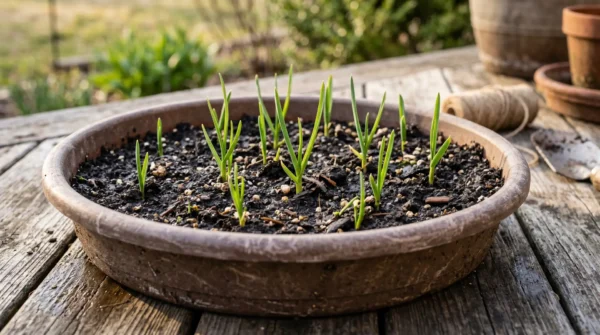
The clove germinates quickly in warm soil and sends up top growth. In zones 3–5, this means shoots can emerge in August or early September, well before sustained cold sets in. Shoots exposed above soil level before a hard freeze are frost-damaged tissue — and frost injury on tender green growth creates entry points for fungal rot (Botrytis, Penicillium) and bacterial soft rot that can travel down the shoot to infect the clove itself [4].
The cloves aren’t necessarily ruined. If you catch it early: mulch immediately with 4–6 inches of straw to slow further shoot elongation and insulate the soil. Garlic shoots can tolerate brief exposure down to 20°F before significant damage, per SDSU Extension [3]. It’s sustained exposure below 10°F on unprotected shoots that causes true dieback. If shoots are already 3–4 inches tall before your first hard freeze, there’s real disease risk but most established cloves will still produce — just at reduced vigor.
Planted too late (less than 2 weeks before ground freeze):
Roots don’t have time to establish before soil freezes. The clove survives winter in dormancy and emerges in spring — but it emerges with minimal root infrastructure. As Cornell’s guide explains, it’s precisely that fall root system that supports the rapid spring leaf growth necessary for bulb size [5]. You’ll likely harvest garlic, but expect significantly reduced bulb development.
Research quantified this: a shift from October planting to January planting cut yields by 80% in controlled conditions [7]. Even two or three weeks of late planting compounds — each week of missed root-building in fall is a week of spring delivery capacity that doesn’t exist.
If you’ve realized you’re planting late: go ahead and plant, then mulch more heavily than you otherwise would (6–8 inches). Heavy mulch slows soil freeze, sometimes by several weeks, giving whatever root growth is possible a longer window. Accept the harvest will be smaller and plan to use those bulbs first rather than saving them as seed stock for next year.
How to tell where you are in the window:
Push a finger 4 inches into the soil. If it feels like summer garden soil — warm, loose, crumbly — you’re probably too early (or in a warm zone where the soil thermometer is your guide). If the soil is stiff, cold, and requires effort to push through, you’re at the late edge. The ideal planting soil feels clearly cooler than late summer but still workable without a spade.
Depth, Spacing, and Mulching: Locking In the Timing Advantage
Once you’ve chosen the right date, three physical details determine whether your cloves perform at the level your timing deserves.
Planting depth: Set the base of each clove 2–3 inches below the soil surface, pointed end up. Shallow planting (less than 1.5 inches) leaves cloves vulnerable to winter heave — freeze-thaw cycles that physically push them upward and out of the ground. Too deep (4+ inches) in heavy or clay-heavy soil delays emergence in spring [2]. In loose, amended soil, err toward 3 inches. In heavy clay, stay at 2 inches to prevent waterlogging around the clove.
Clove selection: Only plant the largest cloves from each head. Discard or eat anything under about three-quarters of an inch in diameter. Bulb size next year correlates directly with the size of clove you plant this year — the clove is the initial energy reserve that powers root and shoot development through the entire overwinter period [1].
Spacing: 6 inches between cloves, 12 inches between rows. Garlic is a moderate competitor for water and nutrients. Crowding compresses root zones and reduces bulb size reliably — tighter spacing that seems efficient in October produces noticeably smaller heads in July.
Mulching immediately after planting: Apply 4–6 inches of clean straw or dry shredded leaves the same day you plant. This does two things that most planting guides mention but don’t explain:
- It extends your root-growing window. Mulch insulates the soil and keeps it above freezing several weeks longer than bare ground. In zones 4–6, a good mulch layer can add 2–3 extra weeks of root-growing time — time that translates directly into a larger root system and, ultimately, larger bulbs. This is the hidden compounding benefit of mulching at planting time rather than waiting.
- It prevents winter heave. Freeze-thaw cycles that happen in bare soil physically eject cloves. Mulch dampens the temperature swings that drive heave, keeping cloves in place through winter.
Apply mulch right up to the edge of your bed but not piled against any permanent structures. In spring, rake mulch off the emerging row as shoots push through — usually late March to April depending on your zone. Leave it between rows to suppress weeds through the bulbing period in May and June.
Watering: One thorough soak immediately after planting settles the soil and initiates root contact. After that, fall rains typically handle irrigation until dormancy unless you’re in a drought year. Waterlogged soil in fall is a rot risk — well-drained beds matter more for garlic than for most vegetables.
Frequently Asked Questions About Garlic Planting Time
Can I plant garlic in spring instead of fall?
Yes, but expect significantly smaller bulbs and lower yields. Spring-planted garlic misses the vernalization window and the extended root-building period in fall and winter. SDSU Extension notes spring planting must achieve approximately one month of cool temperatures (around 40°F) to get any clove differentiation at all [3]. The result is typically 30–50% smaller bulbs compared to fall planting in the same soil, and the cloves may not divide properly in warm springs. If you missed fall planting, plant in earliest spring as soon as soil is workable and mulch heavily. Don’t wait until the ground warms.
What if I miss the ideal window by one or two weeks?
Plant anyway. Two weeks late is far better than waiting until spring. Apply 6–8 inches of straw mulch to slow soil freeze and extend root-growing time. Even two weeks of root establishment before freeze is meaningfully better than none. Save the smallest bulbs you get from a late planting for eating, not as seed stock — use your best-formed bulbs as next season’s seed garlic.
Do I need to refrigerate my garlic before planting?
In zones 3–7: no. Your winter handles vernalization naturally, and refrigerating is unnecessary. In zones 8–9: refrigerate hardneck varieties for 6–8 weeks at 40–45°F in a paper bag at high humidity before planting. Softneck varieties in zone 9 may also benefit from 4–6 weeks of pre-chilling. In zone 10 and warmer: refrigerate all varieties, as your soil never reaches the cold threshold garlic needs for proper clove division [6].
How do I know when my ground will freeze?
Two methods. The accurate one: push a soil thermometer 4 inches into the ground every few days starting in October. When the reading holds below 35°F across two or three consecutive days, plant within the week. The reference method: search “[your city] average soil freeze date” and use NOAA climate normals for your county.
Does mulching change my planting timing?
Yes, positively. A 4–6 inch straw layer keeps soil above freeze threshold 2–3 weeks longer than bare ground in zones 4–6. That means if you’re at the edge of your timing window, planting and mulching on the same day effectively buys back 2–3 weeks of root-growing time you thought you’d lost. This is one reason experienced garlic growers plant when others think it’s “too late” — the mulch extends the effective window.
I planted garlic but the shoots are emerging before a hard freeze. What should I do?
Add mulch immediately — 4 to 6 inches if you haven’t already. Garlic shoots can handle light frost and brief exposure to 20°F without catastrophic damage [3]. The goal is to slow further elongation so the shoots stay short rather than getting tall and vulnerable before hard freeze arrives. Don’t cut or flatten the shoots — they’ll go dormant on their own once sustained cold arrives.
Once your garlic is established and growing, the next decision point is knowing when to pull it. The garlic leaf-count harvest test is the most reliable way to time your harvest — pulling too early is as costly as planting too late.
Sources
- Penn State Extension. “Growing Garlic Fall Planting.” extension.psu.edu/growing-garlic-fall-planting
- University of Minnesota Extension. “Growing Garlic in Home Gardens.” extension.umn.edu/vegetables/growing-garlic
- South Dakota State University Extension. “Garlic: How to Grow It.” extension.sdstate.edu/garlic-how-grow-it
- Ohio State University Extension (CFAES). “Growing Garlic in the Garden.” cfaes.osu.edu/fact-sheet/growing-garlic-garden
- Cornell Cooperative Extension. “Guide for Growing Garlic.” cceschoharie-otsego.org/gardening/food-gardening/guide-for-growing-garlic
- Jian et al. “Crosstalk in the Darkness: Bulb Vernalization Activates Meristem Transition via Circadian Rhythm and Photoperiodic Pathway.” Frontiers in Plant Science, 2020. pmc.ncbi.nlm.nih.gov/articles/PMC7027078/
- Siddique MA, Rabbani MG. “Growth and Bulbing of Garlic in Response to Low Temperature Treatment of Bulb and Planting Date.” Bangladesh Journal of Botany, 1985. Abstract indexed at agris.fao.org