

How to Support Any Houseplant: When to Use a Moss Pole, Stake, or Trellis (and How to Do It Right)

Stop guessing which support your houseplant needs — find out why aroids need moss poles, which need a stake, and how to attach without damaging stems.
Your Monstera is flopping over the side of the pot, its aerial roots reaching for a surface that isn’t there. Your fiddle-leaf fig is leaning at an angle that seems to defy physics. Your Hoya has grown three feet in one direction and you’re not sure what to do with it.
These are all solvable problems — but the solution depends entirely on what your plant actually is and what it needs, not just what looks right on a store shelf. Moss poles, stakes, and trellises each work by a different mechanism for a different growth habit. Use the wrong one and you’ll spend months wondering why your Monstera isn’t responding, why your stake is doing nothing for your Hoya, or why your plant seems worse off than before you added support.

This guide cuts through that confusion. By the time you finish reading, you’ll know exactly which support your plant needs and why, how to install it safely, and — just as importantly — how to recognize when support isn’t the right answer at all.
Does Your Houseplant Actually Need Support?
Three categories of houseplants need different answers to this question.
True climbers — Monsteras, climbing philodendrons, pothos, Rhaphidophora — evolved to scale tree trunks in tropical rainforests. In the wild, they attach themselves to bark with aerial roots and grow toward the upper canopy. Indoors without a support structure, they sprawl across the floor or hang limply from shelves. A vertical support changes their growth pattern entirely: they compact, produce larger leaves, and in Monsteras, develop the fenestrations (holes in the leaf) that are stunted without upward movement.
Trailing vines — Hoyas, Tradescantia, string of pearls, English ivy — don’t need moisture-retaining support the way aroids do. They look their best cascading, but a trellis can redirect them upward when you want height rather than spread.
Upright but top-heavy plants — fiddle-leaf figs, tall dracaenas, Amaryllis in bloom — have naturally thick single trunks that sometimes can’t hold themselves upright, especially in low-light conditions where stems grow taller and thinner in search of light.
Signs your plant needs support now: leaning more than 30 degrees from vertical; aerial roots actively reaching outward from the stem with no surface to grab; stems drooping after new leaf sets; a newly rooted cutting too young to hold its own weight.
When NOT to use a support: If a stem is weak because of poor light or overwatering, staking is a band-aid that masks the real problem. According to the University of Minnesota Extension, rigidly supporting any plant leads to taller but weaker stems because the plant no longer develops the strength response triggered by natural movement. Fix the root cause first — move the plant to better light, dial back watering — then reassess whether a support is still needed.
The Three Main Support Types — At a Glance
| Support Type | Best Plants | Moisture Retention | Cost | Avoid If |
|---|---|---|---|---|
| Sphagnum moss pole | Monstera, climbing philodendron, pothos | Very high | $15–30 (or $5–8 DIY) | Plant twines rather than aerial-roots |
| Coco coir pole | Hoya, Scindapsus, Jasmine, pilea | Low | $10–20 | Plant needs moisture from support surface |
| Bamboo stake | Fiddle-leaf fig, dracaena, Amaryllis, orchid spikes | None | $2–8 | Plant is a climber wanting to aerial-root |
| Trellis (fan/ladder) | Hoya, English ivy, Jasmine, Tradescantia | None | $8–25 | Plant needs textured, moisture-holding surface |
Moss Poles — The Aroid’s Best Friend
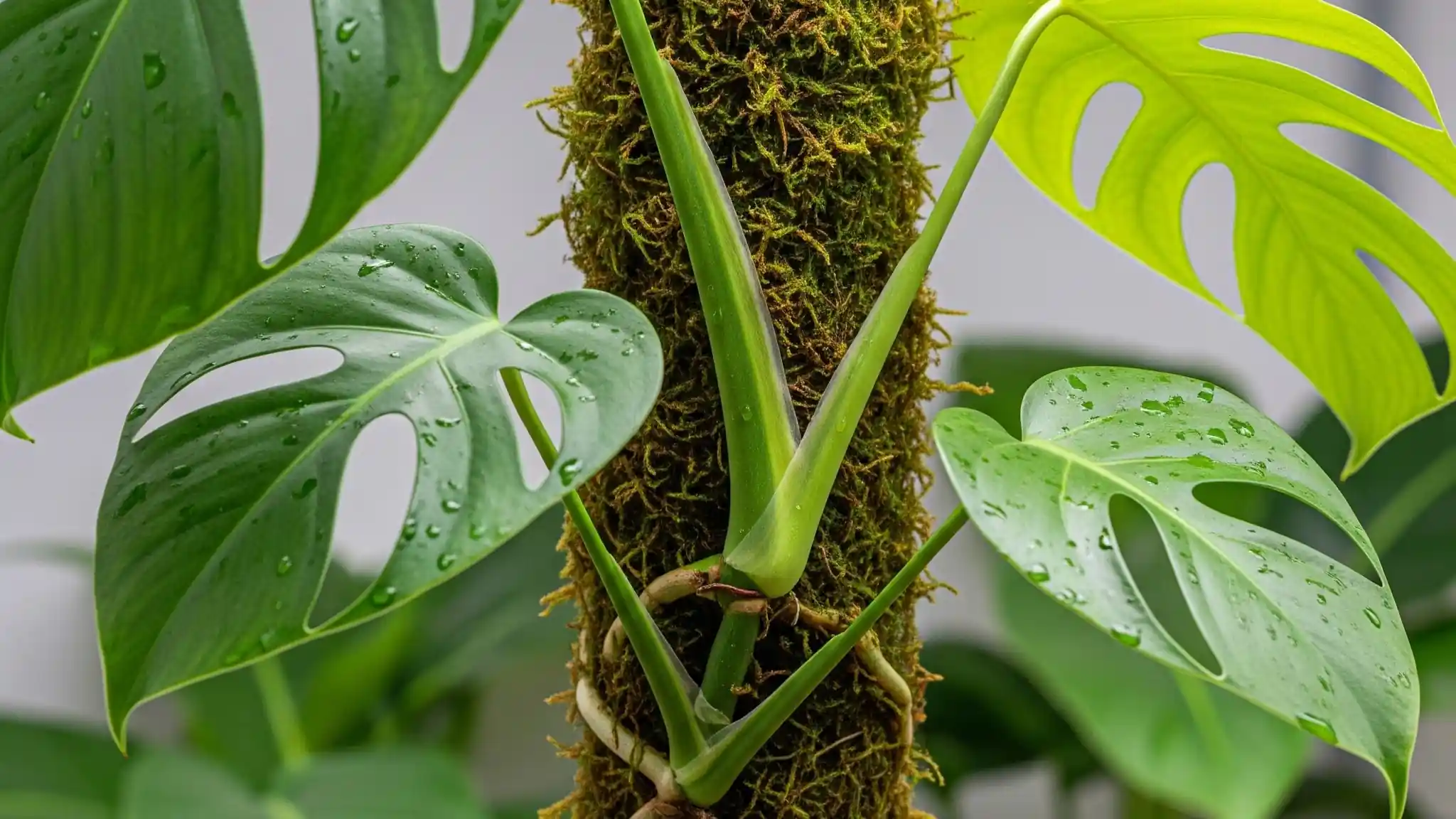
Aroids — the family that includes Monstera, Philodendron, and Pothos — evolved climbing mechanisms over millions of years. In their natural rainforest habitat, Monstera seedlings are actually negatively phototropic at first: rather than growing toward light, they grow toward shade, hunting for a tree trunk to climb. Once they make contact with bark, aerial roots extend and grip the surface, absorbing moisture and nutrients directly from the humid tree bark.
A sphagnum moss pole mimics that bark surface in two important ways. First, sphagnum moss holds up to 20 times its own weight in water — aerial roots making contact with damp moss can absorb moisture directly, bypassing the need to pull everything from the soil. Second, the textured surface triggers a biological response called thigmomorphogenesis: when stems and nodes sense contact with a solid surface, the plant redirects energy from root extension (searching for support) into leaf production. The result is visibly larger leaves and, in Monsteras, more pronounced fenestrations.
Which plants truly benefit from a sphagnum moss pole:
- Monstera deliciosa and M. adansonii — produce larger, more fenestrated leaves once climbing vertically
- Climbing philodendrons: especially P. melanochrysum, P. gloriosum, P. micans, and P. hastatum (‘Silver Sword’)
- Pothos (Epipremnum aureum) — leaf size can nearly double when climbing versus trailing
Sphagnum vs. coco coir — does it matter? Significantly. Coco coir poles are more durable and need less maintenance, but they cannot retain enough moisture for aerial roots to actually attach in typical indoor conditions. Research from plant growers comparing the two found zero aerial root attachment after months on coco coir, but visible root penetration into sphagnum moss within weeks after switching. For Hoyas and Scindapsus, which twine around support rather than root into it, coco coir is perfectly adequate and easier to manage.
Maintaining your moss pole: Mist the moss directly where aerial roots are growing — not the plant, the pole itself. Sphagnum becomes hydrophobic once completely dry, meaning it repels water rather than absorbing it. If your pole dries out fully, submerge the bottom 6 inches in water for 30 minutes to rehydrate. When your plant outgrows the pole, add a modular extension before the plant gets too tall — once aerial roots embed deeply, removing the pole causes root damage. See our guide to repotting a Monstera for the best time to install a new pole.


Stakes — When Your Plant Just Needs a Spine
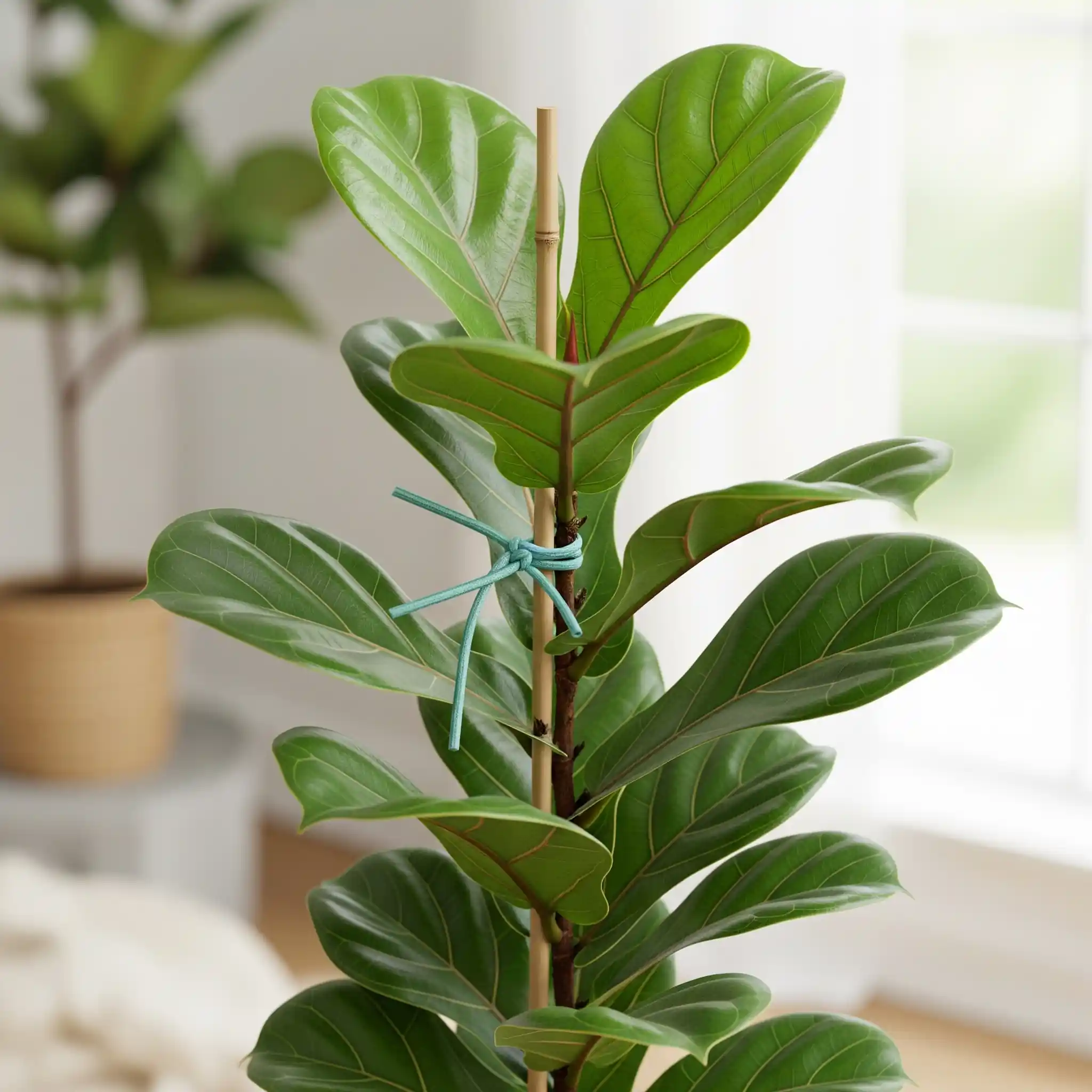
Not every houseplant that tips over wants to climb. A fiddle-leaf fig with a heavy canopy and a still-developing root system doesn’t need a moss pole — it needs a temporary spine while its roots catch up with its ambitions.
Bamboo stakes are the right tool here. Insert the stake into the soil on the side opposite the lean — not through the center of the pot, where it risks piercing the root ball. Push it down to the base of the pot, leaving the top about 12 inches above the plant’s current height to accommodate growth without needing constant replacement.
Plants that benefit from staking:
- Fiddle-leaf fig (Ficus lyrata): especially in the first year, before the trunk thickens
- Tall dracaenas (Dracaena marginata, D. fragrans): single-trunk plants prone to sideways lean
- Amaryllis in bloom: flower stalks can reach 24 inches and topple without support
- Orchid spikes: tie gently to a thin bamboo rod as the spike extends
- Newly rooted cuttings: until the root system is established enough to anchor the plant
Material matters: Avoid stained or treated wood stakes — the chemicals used to prevent rot can leach into the soil and affect plant health. Untreated bamboo or natural wood is safe. For a more discreet look, slender metal rods from a craft store blend into the foliage better than bright green bamboo.
The most important rule about staking: keep it loose and keep it temporary. Plants need slight stem movement to develop natural structural strength — a plant rigidly staked for years never builds the wood density it would have developed with some natural flexion. Attach the stem with a soft, stretchy material and check it every few weeks. Once the plant can hold itself upright without the stake, remove it. That’s the whole point.
Trellises — Structure for Trailing and Decorative Vines
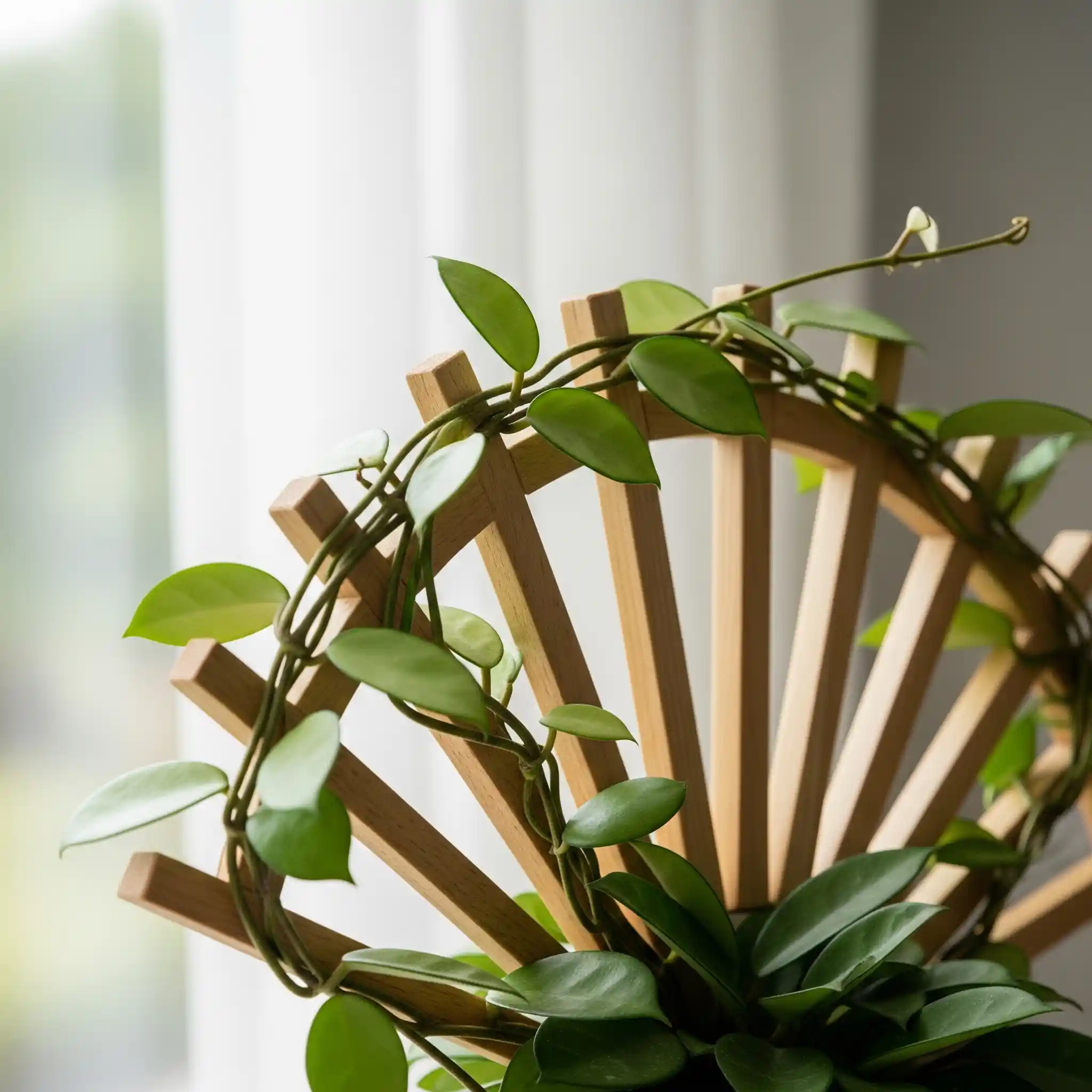
Trellises shine for plants that twine, clip, or scramble rather than aerial-root their way upward. Hoyas, English ivy, Jasmine, and Tradescantia don’t need a moisture-retaining surface — they need something to weave around, and a trellis gives them structure without the maintenance demands of a moss pole.
Trellis shapes and their uses:
- Fan trellis (triangle shape): compact, fits a single pot, perfect for a single Hoya vine working upward
- Grid/ladder trellis: supports multiple stems across a wider surface — good for vigorous climbers like pothos redirected upward rather than trailing down
- U-shaped bamboo hoop: inexpensive, nearly invisible, ideal for single-vine hoops on Scindapsus or small Philodendron Brasil
- Obelisk/tower: decorative statement piece for larger climbers like an established Jasmine or a climbing rose kept indoors
Training plants on a trellis: Don’t try to attach all stems at once. Start with the leading stems and loosely secure them with plant clips or soft ties. As the plant grows, guide new growth along the structure every few weeks. Forcing mature stems into sharp angles damages the vascular tissue — you want the plant to grow along the trellis, not be bent into it.
What trellises cannot do: They provide no moisture to aerial roots. A mature Monstera on a trellis won’t produce the same fenestrated leaves as one on a damp moss pole — aroids on trellises simply don’t experience the contact-triggered growth response the same way. If you have an aroid and want maximum leaf development, a moss pole is the better investment.
One creative alternative worth trying: larger houseplants as living support structures. Monsteras and dracaenas work well as hosts for smaller trailing philodendrons or pothos — the rougher stems give aerial roots something to grip, the arrangement looks natural, and both plants benefit from the shared microclimate.
Stop killing plants with wrong watering.
Select your plant, pot size, and climate zone — get a precise watering schedule with amounts and timing.
→ Build Watering ScheduleHow to Make a DIY Moss Pole (Under $10)
Commercial moss poles cost $15–30. A DIY version that performs just as well costs under $10 and takes about 20 minutes to make, using materials available at any hardware or garden store.
Materials:
- Bamboo stake, PVC pipe, or wooden dowel (height = plant’s target height + 12 inches)
- Sphagnum moss (one bag covers most poles)
- Jute twine or fishing line (3–4 feet)
- Scissors
Steps:
- Soak sphagnum moss in water for 15 minutes, then squeeze until damp but not dripping.
- Tie jute tightly around the top of the stake with a double knot.
- Place handfuls of damp moss against the stake and wrap the string downward in a diagonal spiral, holding the moss in place as you go. Aim for ½–1 inch of moss around the full circumference.
- Leave the bottom third of the stake bare — this section goes into the soil.
- Insert the bare section into the pot as deep as possible for stability. The pole should not wobble.
Self-watering upgrade: If you use a hollow PVC pipe with small holes drilled every 2–3 inches along its length, you can pour water directly into the top of the pipe. Water distributes through the holes into the surrounding moss, keeping it evenly moist without daily misting. This works especially well for Monstera owners in dry climates or low-humidity apartments. For more on keeping your plant happy year-round, see our guide to increasing humidity for houseplants.
Best time to install: At repotting time, when you can position the pole before the plant is back in soil. This ensures the bottom is anchored at the base of the pot rather than resting on surface soil. A pole installed at repotting is significantly more stable than one pushed in afterward.
How to Attach Plants Safely — Avoiding Girdling
The most common mistake in plant support isn’t choosing the wrong structure — it’s attaching the plant too tightly. Girdling happens when a tie material compresses the stem, and it’s more damaging than most growers realize.
A constricted stem can’t move water upward from the roots or sugar downward from the leaves. The section of plant above the constriction gets progressively starved, causing wilting and yellowing that looks identical to root rot — making it easy to misdiagnose. One Monstera arrived at a shop with rubber bands embedded so deeply into its base that the stem had visible ridged indentations. The plant recovered only because the damage hadn’t penetrated the inner vascular tissue. Rubber bands, wire, and coarse string are the most common culprits.
Safe tie materials:
- Green garden tape (self-adhesive, stretches as the plant grows)
- Strips cut from an old cotton T-shirt (soft, won’t cut into tender stems)
- Nylon stocking loops (stretch reliably over time)
- Plastic plant clips (best for moss poles — no wrapping, no constriction risk)
The figure-8 technique: Loop the tie around the stem, cross it, then loop around the support. The cross sits between stem and support, creating a cushion that prevents the stem from rubbing directly against the bamboo or wire. You should be able to slide one finger between the tie and the stem after attaching.
Inspection schedule: Check all ties every 3–4 weeks, especially on fast-growing plants. Remove any tie that shows signs of embedding — visible as a subtle ridge or color change in the bark. Reattach with fresh tape or a new loop, positioned slightly above or below the old spot.
6 Mistakes That Damage Plants — and How to Fix Them
| Mistake | What Happens | Fix |
|---|---|---|
| Tying too tightly | Girdling cuts off water and sugar transport | Cut tie immediately; switch to green garden tape or plant clips |
| Staking a weak-stemmed plant without diagnosing why | Stem stays weak; root cause goes untreated | Check for low light, overwatering, or root rot first — a stake can’t fix these |
| Using stained or treated wood stakes | Chemicals leach into soil, affecting roots | Switch to untreated bamboo or natural hardwood |
| Using a coco coir pole for Monstera | Aerial roots don’t attach; no moisture-triggered growth benefit | Replace with sphagnum moss pole; aerial roots typically attach within weeks |
| Letting moss pole dry completely | Sphagnum becomes hydrophobic, repels further watering | Submerge pole base in water for 30 minutes to rehydrate, then resume misting |
| Inserting stake in pot center | Root ball punctured; nutrient and water uptake compromised | Position stake at pot edge, on the side opposite the lean |

FAQ
Do I need to mist my moss pole every day?
Not necessarily. The goal is to keep the moss damp, not dripping. In a humid room above 50% relative humidity, every 2–3 days is usually sufficient. In a dry apartment in winter, daily misting may be needed. The easiest test: press your finger into the moss. It should feel like a wrung-out sponge — moist but not saturated.
Can I use a trellis for my Monstera?
Technically yes, but you’ll sacrifice leaf size and fenestration development. Monsteras respond to the textured, moisture-retaining surface of a sphagnum moss pole in a way they simply can’t on a flat trellis. If aesthetics are the priority and leaf size doesn’t matter to you, a trellis will keep it upright. If you want the plant to express its full potential, a moss pole is the right tool.
When should I remove a stake from my plant?
Once the plant can hold itself upright without it — typically after one full growing season for most houseplants. Test by gently loosening the tie and watching for a week: if the plant holds its position, remove the stake. If it immediately leans, leave the stake for another month and retest.
Will supporting my plant make it grow faster?
For aroids like Monstera and Philodendron, yes — adding a moss pole can visibly accelerate leaf production and increase leaf size, because the plant is now growing with its evolved growth program rather than against it. For stakes and trellises, the support itself doesn’t speed growth; it simply directs it more usefully.
How long does it take for aerial roots to attach to a moss pole?
In good conditions — moss kept consistently moist, aerial roots gently pressed against the surface — you can see the first attachment within 2–4 weeks. Full integration, where the plant actively draws moisture from the pole, typically takes 1–3 months. Keep the moss moist throughout this establishment phase; roots won’t attach to dry sphagnum.
Sources
- Iowa State University Extension — What Do I Do with the Aerial Roots of a Philodendron?
- University of Minnesota Extension — Staking and Guying Trees
- Healthy Houseplants — Girdling: What It Is and Why It’s Bad for Houseplants
- OurHouseplants.com — Moss Poles and Climbing Supports
- Epic Gardening — 9 Ways to Stake and Support Vining Houseplants
- The Tye-Dyed Iguana — 6 Common Plant Support Mistakes
- Earthscape — Coir vs Moss Pole: Which is Best for Plants?
- Swansons Nursery — DIY Moss Pole for Indoor Plants in 4 Easy Steps


