

Jade Plant Varieties: Gollum, Hobbit, Tricolour and 8 More Cultivars With Their Care Differences

Discover 15 jade plant varieties from classic Crassula ovata to Gollum, Hobbit, Hummel’s Sunset and related Crassula species — with care differences, a comparison table and bonsai tips.
Walk into any garden center and you will find Crassula ovata — the classic jade plant — sitting on a shelf, solid green, glossy, reliable. What the label rarely tells you is that “jade plant” actually describes a sprawling family of varieties and related species with leaves that range from blue-grey coins to tubular trumpets to vivid sunset orange. The genus Crassula alone contains over 1,400 species, and the cultivars of C. ovata span an equally surprising range of forms.
This guide covers 15 jade plant varieties and related species in detail — from the classic standard jade to the bizarre and beautiful ‘Gollum’ — with practical information on identifying them, choosing the right one for your space, and adjusting care to match each variety’s specific needs. Whether you are a collector hunting for the most unusual form or a first-time buyer choosing a beginner-friendly succulent, our complete jade plant care guide covers the fundamentals that apply across every variety.


The Classic: Standard Crassula ovata and Compact Forms
These three varieties share the same basic oval-leaf form as the species. If you want a low-risk, long-lived jade that will grow into an impressive specimen over decades, start here.
1. Crassula ovata — Standard Jade Plant
Leaf: Flat, oval, 1–2 inches long | Colour: Deep glossy green, red-edged in direct sun | Max size: 4–6 ft indoors, up to 8 ft in ground in Zone 10–11 | Growth rate: Moderate | Difficulty: ★★☆☆☆
The species plant is the gold standard for a reason: it tolerates neglect that would kill most houseplants, develops an impressive woody trunk over time, and can live for 50 years or more with minimal care. The leaves are thick, rubbery, and store water efficiently — a drought of several weeks causes little damage beyond mild leaf wrinkling. In bright direct sun, the leaf edges develop a characteristic red blush from stress anthocyanins, which is aesthetically attractive and completely harmless. This is the jade to choose if you are a beginner or want a long-term specimen plant. It is also the best choice for bonsai training because its vigorous growth responds well to heavy pruning.
2. ‘Harbour Lights’
Leaf: Flat, oval, slightly smaller than standard | Colour: Deep green with intense red edges that deepen in winter | Max size: 2–3 ft | Growth rate: Moderate | Difficulty: ★★☆☆☆
‘Harbour Lights’ was selected specifically for the intensity of its red leaf edging, which becomes most pronounced in cool temperatures and bright light during autumn and winter. If you position it near a south-facing window and allow the temperatures to drop naturally to 50–55°F at night in winter, the entire margin of each leaf turns a vivid scarlet. It is more compact than the species, making it a good choice for windowsills where a full-sized jade would eventually outgrow the space.
3. ‘Crosby’s Compact’
Leaf: Small, rounded, noticeably smaller than species | Colour: Green with strong red margins | Max size: 12–18 inches | Growth rate: Slow | Difficulty: ★★☆☆☆
A genuinely dwarf jade that stays small without pruning. ‘Crosby’s Compact’ has proportionally smaller leaves than the species and a naturally bushy, dense habit. It is the best variety for growing in small pots on a desk or shelf, and it makes an excellent bonsai subject because the smaller leaves are naturally in better proportion to a miniaturised trunk. Care is identical to the species, but because the pot and root mass are smaller, it dries out slightly faster — check soil moisture a day or two earlier than you would for a standard jade.
Coloured Foliage Varieties
These three varieties are grown specifically for their unusual leaf colouring. All require more light than the standard jade to express their full colour, and all are more striking when allowed to experience mild stress conditions — bright light and slightly cooler temperatures — that intensify their pigments.
4. ‘Hummel’s Sunset’
Leaf: Flat, oval, standard size | Colour: Green centre, golden-yellow edges fading to orange-red tips in full sun | Max size: 3–4 ft | Growth rate: Moderate | Difficulty: ★★★☆☆
‘Hummel’s Sunset’ is arguably the most visually impressive jade plant cultivar. In sufficient light, the leaves develop a tricolour gradient: green at the centre, transitioning through golden-yellow at the margins, with orange-red tips at the extremities. The colour is produced by a combination of chlorophyll (green), carotenoids (yellow-orange), and anthocyanins (red) — the same pigment system that produces autumn leaf colour in deciduous trees. Full sun for at least four to six hours per day is essential; without it, the plant reverts to a dull greenish-yellow with no orange. An east or south-facing window with direct morning or afternoon sun is ideal indoors. The RHS Award of Garden Merit confirms its exceptional garden value in frost-free climates.
5. ‘Tricolor’ (Variegated Jade)
Leaf: Flat, oval | Colour: Green base with cream stripes and pink edges that intensify in bright light | Max size: 2–3 ft | Growth rate: Slow | Difficulty: ★★★☆☆
‘Tricolor’ carries a variegation mutation that removes chlorophyll from portions of each leaf, producing irregular cream and pink markings against the green base. The pink tones intensify in cooler temperatures and brighter light, reaching their peak in autumn and winter near a sunny window. Because the non-green portions cannot photosynthesize, ‘Tricolor’ grows more slowly than standard jade and is slightly more sensitive to overwatering — reduced photosynthetic capacity means it cannot tolerate as much water stress or recover as quickly from root damage. It also requires more light than a plain-leaved jade to maintain strong variegation, but less direct harsh afternoon sun than ‘Hummel’s Sunset’ — bright indirect to filtered direct light is ideal. Any all-green shoots that appear should be removed promptly, as they are more vigorous and will eventually dominate the plant.


6. ‘Campfire’ (Crassula capitella)
Leaf: Propeller-shaped, stacked in rosettes | Colour: Vivid red-orange in full sun, lime green in low light | Max size: 12–24 inches | Growth rate: Moderate | Difficulty: ★★☆☆☆
Technically a different species (Crassula capitella) rather than a C. ovata cultivar, ‘Campfire’ is commonly sold alongside jade plants in the succulent section and is grown as a companion or alternative. Its propeller-like stacked leaves turn a spectacular flame-red in full sun — one of the most vivid colour displays available in a small succulent. In low light, it goes entirely green and loses most of its appeal. Care is similar to jade: well-draining soil, infrequent watering, and maximum sun for colour. It is less cold-hardy than C. ovata (protect below 25°F) and shorter-lived as a specimen plant, typically growing as a spreading groundcover rather than a tree form.
Unusual Leaf Shape Varieties
The tubular-leaf variants are mutations of standard Crassula ovata that produce dramatically different leaf shapes. ‘Gollum’ and ‘Hobbit’ are the most popular and widely available; both have developed cult followings among succulent collectors.
7. ‘Gollum’
Leaf: Long, tubular with flared, suction-cup tips | Colour: Green with red tips in sun | Max size: 2–3 ft | Growth rate: Moderate | Difficulty: ★★☆☆☆
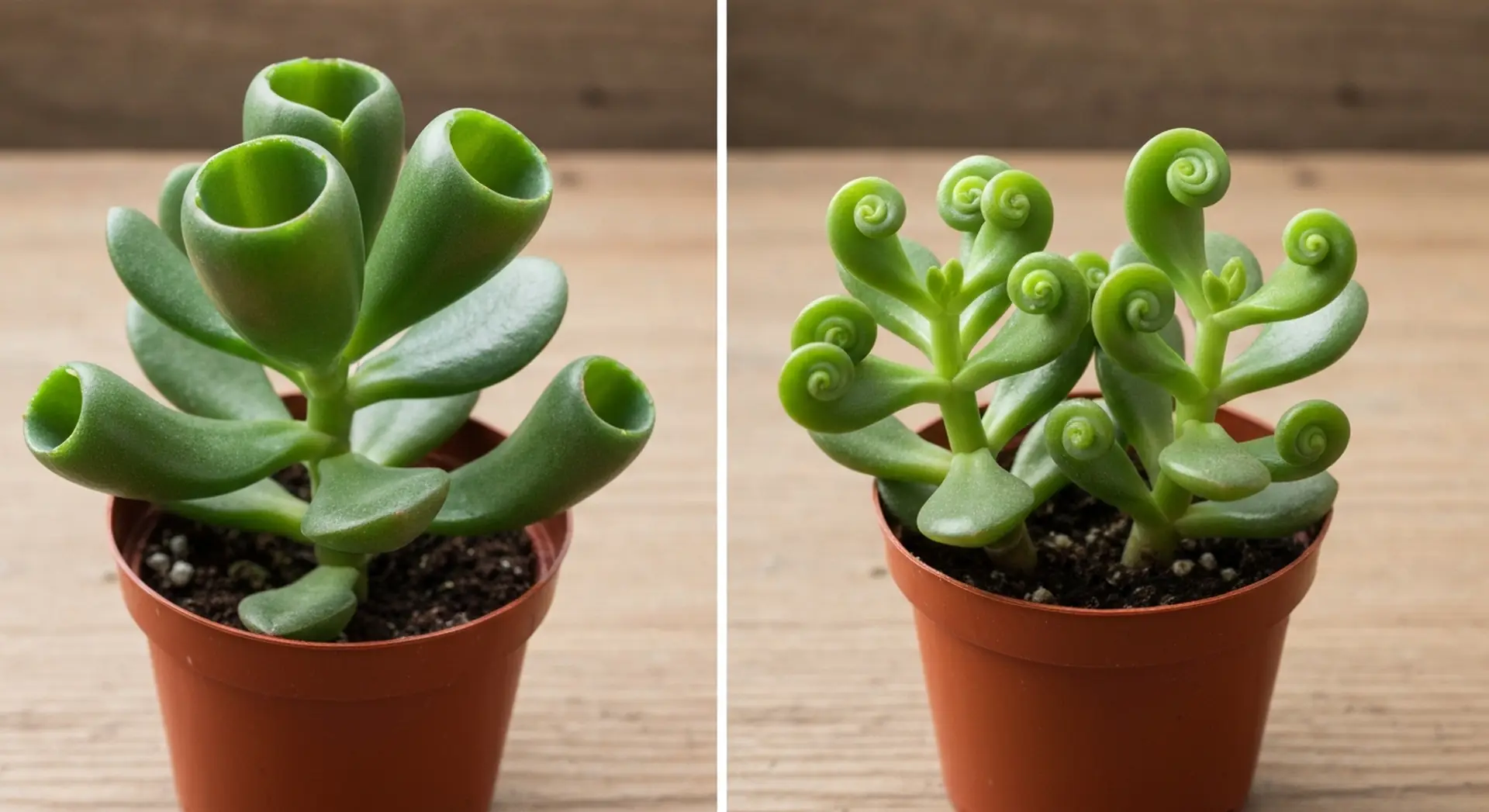
‘Gollum’ produces cylindrical, tubular leaves that flare open at the tip like a trumpet, creating a distinctive suction-cup effect. Named after the Lord of the Rings character — or possibly in reference to the “Star Trek” alien resemblance, depending on which origin story you prefer — it has become one of the best-selling jade cultivars. The tubular leaves are an actual mutation affecting how the leaf blade rolls and fuses during development, not a different species. ‘Gollum’ grows more upright and open than ‘Hobbit’, with longer tubes, and makes a spectacular bonsai subject because the alien leaf shape contrasts dramatically with the thick, gnarled trunk that develops over time. Care is identical to standard jade; the tubular leaves are not more susceptible to rot or sunburn than flat-leaved varieties.
8. ‘Hobbit’
Leaf: Curled inward to form a cup, shorter and rounder than ‘Gollum’ | Colour: Green with reddish tips in sun | Max size: 12–24 inches | Growth rate: Slow to moderate | Difficulty: ★★☆☆☆
Where ‘Gollum’ has open trumpet tips, ‘Hobbit’ curls its leaves inward to create a cupped, spoon-like shape. The two are often confused and sometimes mislabelled at garden centers; the easiest distinction is the tip — ‘Gollum’ tips flare outward, ‘Hobbit’ tips curl inward. ‘Hobbit’ is also slightly more compact and slower-growing than ‘Gollum’. Both were apparently discovered as chance mutations of standard jade in the 1970s and have been in cultivation since. Both root easily from stem cuttings, making propagation straightforward — see our jade plant propagation guide for step-by-step instructions that apply to all varieties.
9. ‘Skinny Fingers’
Leaf: Very thin, finger-like tubes, narrower than ‘Gollum’ | Colour: Green | Max size: 12–18 inches | Growth rate: Slow | Difficulty: ★★☆☆☆
A less common cultivar with thinner, more finger-like tubes than ‘Gollum’. ‘Skinny Fingers’ is rarer in cultivation and often requires specialist nurseries or succulent collectors to source. Its narrower leaves make it slightly more sensitive to overwatering than the broader-leaved variants, as less tissue volume means faster response to water changes. Primarily a collector’s plant rather than a mainstream variety.
10. ‘Baby Jade’ / Crassula ovata ‘Minima’
Leaf: Tiny, rounded, proportionally scaled down | Colour: Green with red edges | Max size: 12–18 inches | Growth rate: Very slow | Difficulty: ★★☆☆☆
Stop killing plants with wrong watering.
Select your plant, pot size, and climate zone — get a precise watering schedule with amounts and timing.
→ Build Watering Schedule‘Minima’ or ‘Baby Jade’ is a genuinely miniature form with proportionally small leaves and a naturally compact habit. It is the top choice for dish gardens, terrariums, and small bonsai displays where space is at a premium. Because the pot and root mass are inherently smaller, ‘Minima’ dries out faster than standard jade — check soil moisture every three to five days rather than weekly during the growing season.
Related Crassula Species Sold as “Jade”
Several other Crassula species are commonly grouped with jade plants in garden centers because they share similar care requirements and the succulent aesthetic. These are distinct species, not cultivars of C. ovata, but they are excellent companion plants and equally easy to grow.
11. Crassula arborescens — Silver Dollar Jade
Leaf: Large, rounded, flat — blue-grey with red margin | Max size: 4–6 ft | Difficulty: ★★☆☆☆
The silver dollar jade produces noticeably larger, more rounded leaves than C. ovata, with a distinctive blue-grey bloom (glaucous coating) on the leaf surface. It grows into a similar tree form over time but is slightly more tolerant of cool, damp conditions. It is sometimes confused with C. ovata but distinguishable by the leaf colour and the more pronounced coin shape. According to Missouri Botanical Garden, Crassula arborescens is native to the Western Cape of South Africa and hardy outdoors in USDA Zones 9–11.
12. Crassula perforata — String of Buttons
Leaf: Stacked triangular pairs, perforated by the stem | Max size: 18–24 inches | Difficulty: ★★☆☆☆
One of the most geometrically distinctive succulents available, string of buttons produces pairs of triangular leaves stacked along the stem, with each pair rotated 90 degrees from the one below — creating a four-sided spiral column effect. The leaves appear to be threaded on the stem (the stem literally passes through the leaf base). It works well in mixed succulent arrangements and trailing over the edge of a pot. Outdoors in Zones 9–11; elsewhere, grows as a houseplant with the same bright-light requirements as jade.
13. Crassula muscosa — Watch Chain Plant
Leaf: Tiny, scale-like, densely packed along the stem | Max size: 6–12 inches | Difficulty: ★★☆☆☆
The watch chain plant produces a completely different aesthetic from any other Crassula — tiny, scale-like leaves packed so densely along the stem that individual leaves are nearly indistinguishable. The overall effect resembles a green chain or braided rope. It is a low-growing, spreading plant rather than a tree form, and it works well as a groundcover in frost-free zones or as a trailing element in a mixed succulent pot. NC State Extension notes it produces inconspicuous yellow-green flowers in spring.
14. Crassula rupestris — Baby’s Necklace
Leaf: Stacked, rounded, red-edged | Max size: 12–18 inches | Difficulty: ★★☆☆☆
Baby’s necklace produces stacked rounded leaves threaded along the stem, similar to C. perforata but rounder and with more pronounced red edging. The stacked arrangement creates a beaded appearance that explains the common name. It produces attractive pink-white flowers in spring and summer, making it one of the more ornamentally versatile smaller Crassulas. Like most in the genus, it requires the same bright light and infrequent watering as jade.
15. Crassula ovata ‘Undulata’ — Ripple Jade
Leaf: Oval with distinctly wavy, undulating edges | Max size: 2–3 ft | Difficulty: ★★☆☆☆
‘Undulata’ retains the basic oval form of the species but with pronounced wavy edges on each leaf, giving the plant a ruffled, textured appearance. It is slower-growing than the species and less commonly available than ‘Gollum’ or ‘Hobbit’, but makes an interesting alternative for collectors who prefer a more subtle variation. Care is identical to standard jade.
Master Comparison Table
| Variety | Leaf Shape | Leaf Colour | Max Height | Growth Speed | Light Needed | Difficulty |
|---|---|---|---|---|---|---|
| C. ovata (standard) | Flat, oval | Green, red-edged in sun | 4–6 ft | Moderate | Bright indirect to full sun | ★★☆☆☆ |
| ‘Harbour Lights’ | Flat, oval (smaller) | Green, intense red edges in winter | 2–3 ft | Moderate | Bright indirect to full sun | ★★☆☆☆ |
| ‘Crosby’s Compact’ | Small, rounded | Green, red-edged | 12–18 in | Slow | Bright indirect to full sun | ★★☆☆☆ |
| ‘Hummel’s Sunset’ | Flat, oval | Green/yellow/orange-red gradient | 3–4 ft | Moderate | Full sun (4–6 hrs minimum) | ★★★☆☆ |
| ‘Tricolor’ | Flat, oval | Green, cream, pink edges | 2–3 ft | Slow | Bright indirect (not harsh direct sun) | ★★★☆☆ |
| ‘Campfire’ (C. capitella) | Propeller-shaped, stacked | Red-orange in sun, green in shade | 12–24 in | Moderate | Full sun for colour | ★★☆☆☆ |
| ‘Gollum’ | Tubular, trumpet tips | Green, red tips in sun | 2–3 ft | Moderate | Bright indirect to full sun | ★★☆☆☆ |
| ‘Hobbit’ | Tubular, curled inward | Green, red tips in sun | 12–24 in | Slow–moderate | Bright indirect to full sun | ★★☆☆☆ |
| ‘Skinny Fingers’ | Narrow tubes | Green | 12–18 in | Slow | Bright indirect to full sun | ★★☆☆☆ |
| ‘Baby Jade’ / ‘Minima’ | Tiny, rounded | Green, red edges | 12–18 in | Very slow | Bright indirect to full sun | ★★☆☆☆ |
| C. arborescens | Large, round, coin-like | Blue-grey with red margin | 4–6 ft | Moderate | Bright indirect to full sun | ★★☆☆☆ |
| C. perforata | Stacked triangles | Grey-green, pink-edged in sun | 18–24 in | Moderate | Bright indirect to full sun | ★★☆☆☆ |
| C. muscosa | Tiny scales, chain-like | Green | 6–12 in | Moderate | Bright indirect to full sun | ★★☆☆☆ |
| C. rupestris | Stacked, rounded | Green, red-edged | 12–18 in | Moderate | Bright indirect to full sun | ★★☆☆☆ |
| ‘Undulata’ | Oval, wavy edges | Green, red-edged in sun | 2–3 ft | Slow | Bright indirect to full sun | ★★☆☆☆ |
How Care Differs Between Varieties
All jade varieties share the same fundamental care requirements — well-draining soil, infrequent deep watering, bright light, and temperatures above 50°F. But there are meaningful differences between the groups that affect day-to-day management.
Coloured and variegated varieties
‘Hummel’s Sunset’: Requires at least four to six hours of direct sun daily to develop and maintain its orange-red colouring. Without sufficient light, the leaves revert to plain green with a slight yellow tinge. A south-facing window is the minimum indoors; an unobstructed outdoor position is ideal in frost-free zones. Do not be alarmed if new growth emerges green — colour develops as leaves mature and experience light stress.
‘Tricolor’: Needs more light than standard jade to maintain variegation, but is damaged by the harsh afternoon sun that ‘Hummel’s Sunset’ thrives in. Bright indirect light — or filtered direct light through a sheer curtain — is ideal. Avoid placing it in deep shade: the cream and pink portions already photosynthesise less efficiently, and low light compounds this. Remove any all-green shoots as soon as they appear.
‘Campfire’ (C. capitella): Needs maximum sun for colour. In anything less than four hours of direct sun, the spectacular orange-red fades to lime green. Water slightly less frequently than C. ovata, as it grows lower and has a shallower root system that can hold moisture longer in a given pot size.
Miniature and slow-growing varieties
‘Crosby’s Compact’, ‘Baby Jade’, and ‘Hobbit’ all have smaller root masses than the species when grown in appropriately sized pots. This means the soil dries out faster, so check moisture more frequently — every three to five days in the growing season rather than weekly. The risk of overwatering is also higher, since a small pot in low light can remain damp for a dangerously long time. Always err on the side of underwatering with compact varieties. If you notice any drooping, shrivelling, or discolouration, see our jade plant problems guide for a full diagnostic.
Tubular-leaf varieties
‘Gollum’, ‘Hobbit’, and ‘Skinny Fingers’ are not more fragile than the species — the tubular leaves are simply a different shape. They are equally drought-tolerant and equally susceptible to overwatering. The tubular shape does mean water can collect inside the leaf cavity in humid conditions; this is rarely a problem indoors but can lead to rot at the leaf base in outdoor growing in very wet climates. Standard succulent care applies.
Jade Plants as Bonsai: A Beginner’s Primer
Jade plant is widely regarded as the best introductory bonsai subject for beginners. The reasons are practical: jade tolerates heavy pruning without dying, produces a naturally thickening woody trunk, develops well-proportioned branching without wiring (which can cut into the soft stems), and recovers quickly from mistakes. The only bonsai technique that requires real patience is trunk thickening, which is accelerated by growing the plant in a larger pot for two to three years before moving it to a bonsai tray.
The best varieties for bonsai are:
- Standard C. ovata — fastest trunk development, most robust response to pruning
- ‘Gollum’ — the alien leaf shape contrasts dramatically with a thick, gnarled trunk
- ‘Crosby’s Compact’ — naturally proportioned small leaves suit a miniaturised form
- ‘Hobbit’ — compact growth, attractive cupped leaves, responds well to pruning
Avoid wiring jade — the stems snap under wire pressure. Instead, prune directionally: cut back to a branch growing in the direction you want, and pinch growing tips regularly once the basic shape is established. Repot in spring every two to three years, removing up to one-third of the root mass and refreshing the soil. For the full care framework that applies to all these varieties, our jade plant care guide covers watering schedules, soil mixes, and light requirements in detail.
If you are new to succulents and considering jade as a starting point, it remains one of the most forgiving plants available — see our guide to the best houseplants for beginners for how it compares to other low-maintenance options.

Frequently Asked Questions
What is the difference between Gollum and Hobbit jade plants?
Both are mutations of standard Crassula ovata with tubular leaves, but the tips differ: ‘Gollum’ leaves flare open at the tip like a trumpet, while ‘Hobbit’ leaves curl inward to form a cup. ‘Gollum’ also grows slightly taller and more upright. Both are equally easy to grow and care for in the same way as standard jade.
Which jade plant variety has the best colour?
‘Hummel’s Sunset’ produces the most dramatic colour display — a gradient from green through yellow-gold to orange-red that develops in bright sun. ‘Tricolor’ offers the most unusual multi-tone effect with pink, cream, and green on each leaf. ‘Campfire’ (C. capitella) produces the most intense all-over red-orange, but it is technically a different species.
Is there a rare jade plant?
‘Skinny Fingers’ is genuinely rare and hard to source outside specialist nurseries and succulent collectors. ‘Undulata’ (ripple jade) is also less common than the major cultivars. For most rare or specialist varieties, look at succulent-focused online nurseries and the Cactus & Succulent Society plant sales.
Can all jade plant varieties be grown outdoors in the US?
All Crassula ovata varieties are hardy outdoors year-round in USDA Zones 10–11 and can be grown outdoors in summer in Zones 4–9, brought inside before the first frost. C. capitella ‘Campfire’ is slightly less cold-tolerant — protect it below 25°F. Most related Crassula species share the same Zone 10–11 outdoor hardiness.
Why does my jade plant variety look different from pictures?
Light levels and temperature are the primary variables. Coloured varieties (‘Hummel’s Sunset’, ‘Campfire’, ‘Harbour Lights’) only develop their distinctive pigmentation under bright light and mild temperature stress. In low light or consistently warm conditions, they revert toward green. If your plant lacks colour, move it to a sunnier window and allow cooler night temperatures of 50–55°F in autumn and winter.
Sources
- Missouri Botanical Garden. Crassula arborescens. Missouri Botanical Garden Plant Finder.
- NC State Extension. Crassula ovata. NC State Extension Gardener Plant Toolbox.
- NC State Extension. Crassula muscosa. NC State Extension Gardener Plant Toolbox.
- Royal Horticultural Society. Crassula ovata cultivars. RHS Plant Selector.


