

15 Pothos Varieties Ranked by Variegation, Light Tolerance and Growth Speed

Epipremnum aureum is by some measures the most widely sold houseplant on earth. It turns up in offices, mall food courts, and dorm rooms with no care instructions and somehow thrives anyway. Most people know one variety — the one with the yellow-splashed green leaves — and assume that is the whole story. It is not.
There are at least 15 distinct pothos cultivars available to US gardeners, ranging from the nearly indestructible Jade to the deeply weird Shangri La, from the collector’s darling Cebu Blue to the velvety Scindapsus relatives that have been sold as “satin pothos” for years despite belonging to a completely different genus. Each variety has a distinct light requirement, growth rate, and visual character. Choosing the right one for your space is not difficult — but it does require knowing what the options actually are.
One important distinction before we begin: pothos (Epipremnum aureum) and philodendron are frequently confused at garden centres and even on care tags, but they are separate genera. Both belong to the Araceae family and both produce heart-shaped leaves on trailing vines, but pothos leaves are thicker, waxy, and slightly asymmetrical at the base, while philodendron leaves tend to be thinner and more uniform. If you are building a collection, our guide to philodendron types covers the other side of that comparison. For full growing details on any of the varieties below, see the complete pothos care guide.

Classic Pothos Varieties: Easy to Find, Hard to Kill
These four cultivars are available at virtually every plant nursery and big-box garden centre in the US. They are the entry points to the genus — forgiving, fast-growing, and effective in almost any indoor setting.

Three pre-planned garden beds, free
Stop staring at empty beds: printable plans with exact layouts, plant lists and planting calendars — yours free from the Garden Library.
1. Golden Pothos
The original. Golden Pothos produces medium-to-large heart-shaped leaves in mid-green with irregular yellow or gold splashes that vary considerably from leaf to leaf — some plants are nearly solid green, others are heavily marked with gold. It is the fastest-growing of all common pothos varieties and the most tolerant of low light, making it the default choice for dim corners, windowless offices, and north-facing rooms where most plants struggle. Growth rate is vigorous; a single vine can add 12 to 18 inches per month in a bright spot during the growing season.
- Light: Low to bright indirect. Accepts fluorescent-only light better than any other variety.
- Growth rate: Fast — the fastest of all pothos cultivars.
- Availability: Universal — every nursery, Home Depot, and Walmart garden section.
- Price: $5–$15 for a 4″ or 6″ pot. Cuttings are freely traded among houseplant owners.
2. Marble Queen
Where Golden Pothos is casual and exuberant, Marble Queen is architectural. Its leaves are streaked and swirled with cream-white against dark green — the proportion of white to green varies by plant, but most specimens are roughly 50–60% white. That high white content comes with a trade-off: white leaf tissue contains no chlorophyll and cannot photosynthesise. Marble Queen grows noticeably slower than Golden, and it needs significantly more light to maintain its variegation. In a dim corner, the new leaves will revert toward solid green within a few months. In bright indirect light, it is one of the most visually striking vines you can grow indoors.
- Light: Bright indirect — at least 4–6 hours. Avoid direct sun, which scorches the white sections.
- Growth rate: Moderate — roughly half the speed of Golden.
- Availability: Very common at nurseries and garden centres nationwide.
- Price: $8–$20 for a standard pot.
3. Jade Pothos
Jade is the un-fancy pothos, and that is its strength. Solid dark green leaves with no variegation whatsoever mean it contains more chlorophyll per square inch than any other variety — which translates directly into greater tolerance for low light. If Golden Pothos handles a dim room, Jade handles a dark one. It is also the most vigorous variety for pure biomass: vines grow thick, leaves reach their maximum size faster, and the plant recovers from neglect more quickly than any variegated cultivar. Gardeners who want fast coverage for a trellis, room divider, or high shelf should start here.
- Light: Low to moderate indirect. Among the best houseplants for north-facing rooms with minimal natural light.
- Growth rate: Very fast — matches or exceeds Golden Pothos under equivalent conditions.
- Availability: Common at most nurseries, though sometimes labelled simply “pothos” with no cultivar name.
- Price: $5–$12.
4. Neon Pothos
Nothing in the pothos family prepares you for Neon. The leaves are a vivid, solid chartreuse — not yellow-green, not lime, but something that reads almost fluorescent in bright light. There is no variegation at all; the entire leaf surface is this saturated colour, including the stem. Neon pothos tends to be the statement piece in a collection: one plant in a hanging basket near a well-lit window draws the eye across the room. It is as easy to care for as Golden Pothos and grows at a comparable rate, but its uniformly bright colour means it works best as a focal point rather than a backdrop.
- Light: Moderate to bright indirect. The colour intensifies with more light; in low light, it softens toward yellow-green.
- Growth rate: Fast.
- Availability: Very common — widely available at most plant retailers.
- Price: $8–$18.
Moderately Available Pothos Varieties
These cultivars are found at specialty plant shops, online retailers, and occasionally larger nurseries. They require a bit more searching than the classics but are not rare or expensive.
5. N’Joy
N’Joy is what happens when you want the white-and-green look of Marble Queen but in a more compact, architectural package. The leaves are smaller and the variegation is different in character: instead of Marble Queen’s flowing swirls, N’Joy shows distinct, crisp-edged patches of white against dark green with a clean boundary between the two colours and no speckling or gradation. It stays compact naturally — vines are shorter and leaves smaller than most other varieties — making it well suited to small shelves, desks, and terrariums. It does need reasonable indirect light to prevent the white sections reverting to green.
- Light: Moderate to bright indirect.
- Growth rate: Slow to moderate — the compact habit means it does not need frequent trimming.
- Availability: Specialty plant shops and online retailers.
- Price: $10–$25.
6. Pearls and Jade
Pearls and Jade was developed by the University of Florida IFAS Extension — one of the few pothos cultivars with a named institutional origin. It originated as a mutation of N’Joy and shares its compact growth habit and small leaf size, but adds a distinctive feature: the transition zones between the white and green sections are speckled and stippled with grey-green, creating a more nuanced, textured effect than the clean edges of N’Joy. The result is bushy, unusual, and slower-growing than the classic varieties. It tolerates lower light than other heavily variegated cultivars, a trait that may reflect its UF research origins.
- Light: Low to bright indirect — more light-tolerant than its variegation level would suggest.
- Growth rate: Slow — a deliberate grower suited to small spaces.
- Availability: Specialty plant shops and online.
- Price: $12–$30.
7. Manjula
Manjula was developed in India and is a patented cultivar, which explains why it is less widely reproduced than other varieties. Its leaves are broader and more rounded than most pothos, with distinctly wavy, undulating edges that give the plant a ruffly, textured appearance even at rest. The variegation pattern combines white, cream, silver, and green in soft swirls — richer and more complex than Marble Queen but without the stark contrast of Snow Queen. No two leaves look identical, which makes Manjula one of the most visually interesting varieties in a collection. It is moderately slow-growing and needs good indirect light to maintain colour.
New to this plant? pothos types varieties covers all the basics.
- Light: Bright indirect.
- Growth rate: Slow to moderate.
- Availability: Online retailers and specialty shops. Less common than N’Joy.
- Price: $15–$35.
8. Snow Queen
Snow Queen is the maximalist version of Marble Queen: where Marble Queen is roughly 50–60% white, Snow Queen is 70–90% white, with green reduced to thin veins and small patches. The effect is striking — almost ghostly in bright conditions. The practical consequence of this extreme variegation is that Snow Queen is the slowest-growing of all common pothos and the most demanding in terms of light. Without consistent bright indirect light (4–6 hours minimum), the limited green tissue cannot support the plant adequately and growth slows to a near halt. It is a beautiful cultivar, but not a beginner variety.
- Light: Bright indirect — more demanding than any other pothos variety.
- Growth rate: Very slow.
- Availability: Specialty plant shops and online.
- Price: $15–$40.
Rare and Collector Pothos Varieties
These cultivars require either hunting through specialty retailers or joining online plant-swap communities. Prices are higher and availability inconsistent, but none of these are genuinely difficult to care for once obtained.
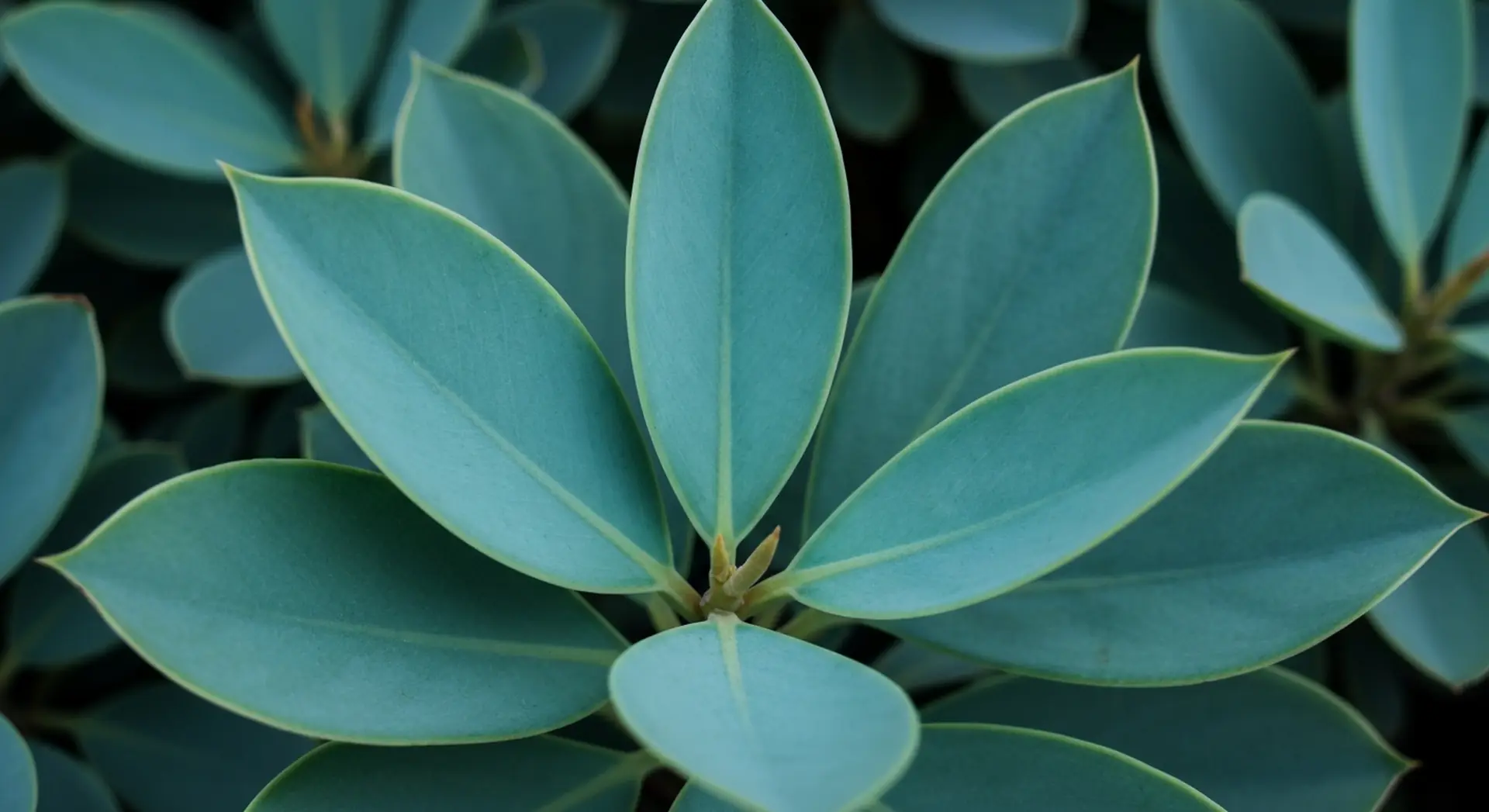
9. Cebu Blue (Epipremnum pinnatum)
Cebu Blue is the most important variety to understand correctly: it is not technically Epipremnum aureum at all. It belongs to Epipremnum pinnatum, a related but distinct species native to the Philippines. In juvenile form — the form almost always sold in the US — it produces elongated, narrow, arrow-shaped leaves in a distinctive silvery blue-green with a metallic sheen. This alone makes it unlike any other plant in the pothos section of a garden centre. When given a moss pole or other vertical support to climb, it transforms further: the leaves grow substantially larger and develop natural splits (fenestrations) similar to a Monstera, a trait called “ontogenetic leaf change.” Most people never see this because they keep it as a trailing plant, which locks it in its juvenile form indefinitely. Give it a pole and a bright spot, and you have a genuinely unusual specimen plant.
- Light: Moderate to bright indirect — brighter light encourages the metallic sheen.
- Growth rate: Moderate to fast when climbing.
- Availability: Specialty retailers and online. Increasingly common as demand has grown.
- Price: $15–$45.
10. Global Green
Global Green was introduced from Japan within the last decade and remains less well-known than its quality deserves. Unlike every other common pothos variety, its variegation is purely green-on-green: dark forest green at the margins and lighter lime-green at the centre of each leaf. There is no white or cream at all. The result is subtle and sophisticated — more interesting than Jade but not demanding the bright light of white-variegated types. It grows at a moderate pace and is more tolerant of lower light than its two-tone green patterning might suggest. A good choice for collectors who want something unusual without sacrificing adaptability.
- Light: Low to bright indirect — more versatile than white-variegated varieties.
- Growth rate: Moderate.
- Availability: Online retailers and specialty shops; increasingly available.
- Price: $15–$35.
11. Shangri La
Shangri La produces leaves that are different in texture rather than colour: they are curled and ruffled, creating a dense, compact growth habit unlike any other pothos. The leaves unfurl slightly as they mature but never fully flatten. Colouring is similar to Jade — solid mid-green — but the rolled, layered appearance gives the plant a structural quality that works well as a tabletop specimen. It stays compact naturally and rarely produces the long trailing vines associated with other varieties, making it useful in situations where a bushy, low plant is wanted rather than a trailing one.
Stop buying the wrong pot size.
Enter plant type and growth goal — get exact pot diameter, depth, and volume before you spend a cent.
→ Find the Right Pot- Light: Low to moderate indirect.
- Growth rate: Slow to moderate.
- Availability: Online retailers; not widely found in physical stores.
- Price: $15–$40.
12. Glacier
Glacier is a compact variety with smaller-than-average leaves in silver-grey and muted green — not the bright contrast of N’Joy or the heavy coverage of Snow Queen, but a cooler, more restrained palette. It stays compact naturally and works well in hanging baskets where its slightly cascading habit can be appreciated without the need for regular trimming. Its variegation is subtle enough to pair easily with bolder plants in a collection without competing visually. Less commonly available than N’Joy but worth seeking out for its distinctly cool-toned character.
- Light: Moderate to bright indirect.
- Growth rate: Slow to moderate.
- Availability: Online retailers and specialty shops.
- Price: $15–$35.
Related But Different: The Scindapsus “Pothos”
The three plants below are frequently sold as pothos, often in the same section of garden centres and online shops. They are not pothos. They belong to the genus Scindapsus, a close Araceae relative with similar care requirements but a fundamentally different leaf texture and appearance. All three feature a distinctly matte, velvety leaf surface — unlike the glossy, waxy surface of all true Epipremnum pothos — with silver markings that appear almost iridescent in the right light. Care is essentially identical to standard pothos, so the mislabelling causes few practical problems, but it is worth knowing what you actually own.
13. Satin Pothos (Scindapsus pictus ‘Argyraeus’)
The most widely available Scindapsus in the US. Dark green heart-shaped leaves covered in small, scattered silver spots — the spots are iridescent and shift slightly in different light conditions, giving the leaf a subtle shimmer. The texture is distinctly matte and soft, quite unlike the waxy feel of a Golden Pothos leaf. It tolerates similar conditions to most pothos but prefers slightly higher humidity. Grown in a hanging basket, it trails attractively. It does not tolerate overwatering as well as true pothos, so allow the soil to dry slightly more between waterings.
- Light: Low to bright indirect.
- Growth rate: Moderate.
- Availability: Common at most plant retailers, often sold simply as “satin pothos.”
- Price: $8–$20.
14. Exotica / Silver Splash (Scindapsus pictus ‘Exotica’)
The large-leaf version of the Scindapsus family. Where Argyraeus has scattered spots, Exotica has bold, large silver patches covering 40–60% of the leaf surface. The contrast between the dark green and the large silver sections is striking and immediately recognisable. Leaves are also larger than Argyraeus, making each individual leaf more impressive as a display element. It needs slightly more light to maintain the silver coverage, though it is not as demanding as Snow Queen or Manjula.
- Light: Moderate to bright indirect.
- Growth rate: Moderate.
- Availability: Specialty shops and online retailers.
- Price: $12–$30.
15. Trebi (Scindapsus pictus ‘Trebi’)
Trebi is the Scindapsus with the heaviest silver coverage of the three. Where Exotica has 40–60% silver, Trebi pushes toward 70–80%, with silver dominating the leaf surface and green reduced to dark margins and veining. The overall effect is closer to silver than green. It is the most visually dramatic Scindapsus and the slowest-growing, as the limited green tissue restricts photosynthetic capacity. It needs consistent bright indirect light and careful watering — never letting the soil stay soggy, as the high silver coverage makes it more susceptible to root stress than standard pothos.
- Light: Bright indirect.
- Growth rate: Slow.
- Availability: Online retailers and specialty shops.
- Price: $20–$50.
Pothos Varieties Comparison Table
Use this table to match variety to growing conditions at a glance.
| Variety | Genus/Species | Min. Light | Growth Rate | White/Pale Content | Difficulty | Approx. Price |
|---|---|---|---|---|---|---|
| Golden Pothos | E. aureum | Low | Fast | Yellow-gold 30–50% | Beginner | $5–$15 |
| Marble Queen | E. aureum | Bright indirect | Moderate | White/cream 50–60% | Easy | $8–$20 |
| Jade Pothos | E. aureum | Low | Very fast | None — solid green | Beginner | $5–$12 |
| Neon Pothos | E. aureum | Moderate | Fast | None — solid chartreuse | Beginner | $8–$18 |
| N’Joy | E. aureum | Moderate | Slow–moderate | White 40–60% | Easy | $10–$25 |
| Pearls and Jade | E. aureum | Low | Slow | White/grey speckled 30–50% | Easy | $12–$30 |
| Manjula | E. aureum | Bright indirect | Slow–moderate | White/cream/silver 40–70% | Intermediate | $15–$35 |
| Snow Queen | E. aureum | Bright indirect | Very slow | White 70–90% | Intermediate | $15–$40 |
| Cebu Blue | E. pinnatum | Moderate | Moderate–fast | None — blue-silver | Easy | $15–$45 |
| Global Green | E. aureum | Low | Moderate | None — green-on-green | Beginner | $15–$35 |
| Shangri La | E. aureum | Low | Slow–moderate | None — solid green | Easy | $15–$40 |
| Glacier | E. aureum | Moderate | Slow–moderate | Silver-grey 30–50% | Easy | $15–$35 |
| Satin Pothos (Argyraeus) | Scindapsus pictus | Low | Moderate | Silver spots 20–30% | Easy | $8–$20 |
| Exotica / Silver Splash | Scindapsus pictus | Moderate | Moderate | Silver patches 40–60% | Easy | $12–$30 |
| Trebi | Scindapsus pictus | Bright indirect | Slow | Silver 70–80% | Intermediate | $20–$50 |

The Core Rule: More White Means More Light
Across all 15 varieties, one principle predicts care requirements better than any other: the proportion of white, silver, or pale tissue in the leaves determines the minimum light the plant needs to thrive. White and silver sections contain no chlorophyll. The plant must generate enough energy from its green sections alone to fuel growth for the entire leaf. The higher the pale-to-green ratio, the more light is needed to compensate.
This creates a practical ranking: Jade and Golden Pothos at one end (mostly green, handles low light), Snow Queen and Trebi at the other (mostly white or silver, needs consistent bright indirect). Any variety you can’t find in the classic section should be researched individually before placing it in a dim spot. For a full breakdown of pothos problems including reversion, yellowing, and brown tips, see our dedicated troubleshooting guide. For a broader comparison of best houseplants for beginners, pothos (particularly Jade and Golden) appear consistently near the top of any ranked list.
Variegation Stability: Will Your Plant Revert?
Not all variegation is equally stable. Marble Queen, N’Joy, and Snow Queen can revert — producing new leaves with more green and less white than the parent plant. This happens most commonly in low light (the plant effectively downregulates chlorophyll-free tissue to survive) but can also occur at random due to chimeric instability in the leaf cells. If you notice a run of unusually green leaves on a variegated plant:
- Move the plant closer to a bright window.
- Cut the reverted stem back to the last well-variegated node.
- The new growth should resume normal variegation in better light.
Cebu Blue and Global Green do not revert in the same way because their character is not chimeric variegation but rather a fixed leaf pigment or texture trait. Neon Pothos, Jade, and Shangri La also do not revert — they have no white tissue to lose.
Trailing vs Climbing: How You Grow Them Changes the Leaves
All pothos and Scindapsus varieties exist in two states: juvenile and mature. In hanging baskets or trailing from a shelf, they stay indefinitely in juvenile form — smaller leaves, standard shape. Given a moss pole, wooden plank, or rough bark slab to climb, many varieties shift toward mature growth: larger leaves, more complex shapes, and in the case of Cebu Blue, actual fenestrations. Marble Queen, Golden Pothos, and Jade all produce noticeably larger leaves when climbing — sometimes twice the size of their trailing counterparts. If leaf size matters to you, give the plant something to climb.
Frequently Asked Questions
What is the rarest pothos variety?
Thai Constellation — a tissue-cultured Epipremnum aureum with stable cream-and-green variegation similar to Marble Queen — commands the highest prices ($50–$200+) and is the most sought-after cultivar. It is not covered in detail above because it remains expensive and inconsistently available in the US, but its variegation is considered more stable than Marble Queen and its growth rate moderate.
Is Satin Pothos actually a pothos?
No. Satin Pothos (Scindapsus pictus ‘Argyraeus’ and related cultivars) belongs to the genus Scindapsus, not Epipremnum. Care requirements are similar, but the matte, velvety leaf texture immediately distinguishes it from true pothos.
Which pothos variety is best for low light?
Jade Pothos, followed by Golden Pothos and Global Green. All three have high proportions of green (chlorophyll-bearing) tissue that allows them to photosynthesise efficiently in dim conditions. Avoid placing heavily variegated varieties like Snow Queen or Trebi in low light.
Can you mix pothos varieties in the same pot?
Yes, with one caveat: varieties with significantly different light requirements will eventually show stress in the weaker-light spot. Combining Golden Pothos and Jade works well since both tolerate low light. Mixing Golden with Snow Queen is trickier — Snow Queen will suffer if you position the pot for the Golden’s needs.
Why is my Marble Queen losing its white variegation?
Almost always a light issue. Marble Queen in insufficient light will produce progressively greener new leaves as the plant reduces chlorophyll-free tissue to conserve energy. Move it to a brighter spot and trim back the solid-green stems to a well-variegated node. New growth should re-establish normal variegation within 4–6 weeks.
Is pothos toxic to pets?
Yes. All Epipremnum pothos varieties contain insoluble calcium oxalate crystals, which cause oral irritation, drooling, and gastrointestinal distress in cats and dogs. Keep all varieties out of reach of pets. Scindapsus species are similarly toxic. See the ASPCA Toxic Plant List for full details.
Sources
- Broschat, T.K. “Golden Pothos Production Guide (FPS-194).” University of Florida IFAS Extension.
- Missouri Botanical Garden. “Epipremnum aureum (Pothos).” Plant Finder.
- NC State Extension. “Epipremnum aureum (Golden Pothos).” NC State Extension Plant Toolbox.
- Royal Horticultural Society. “Epipremnum aureum.” RHS Plant Finder.


