

Zone 3 Azaleas: 5 Cold-Hardy Varieties That Survive -40°F (And How to Plant Them)

Zone 3 azaleas exist—if you pick the right varieties. Discover 5 cold-hardy cultivars, exact planting dates, and the pre-winter protocol that keeps flower buds alive at -40°F.
Most azalea guides end at zone 4. For gardeners in Minnesota, North Dakota, northern Wisconsin, or anywhere else that dips below -30°F, the advice stops before it starts. But the premise is wrong: azaleas absolutely grow in zone 3—you just need to understand why they fail before you choose a variety.
The short answer is that flower buds die at temperatures the plant itself can survive. Once you know that, the whole strategy changes: you stop looking for “cold-hardy azaleas” and start looking for cold-hardy buds. The University of Minnesota spent decades solving exactly this problem, and their results are what zone 3 gardeners have been waiting for.
Why Zone 3 Kills Azalea Buds Before It Kills the Plant
Standard azaleas fail in zone 3 not because the shrub itself can’t handle cold—it usually can—but because the flower buds freeze before the branches do. A plant can survive -20°F intact and still produce zero blooms the following spring if the buds were killed in January.
The mechanism is cellular. Azalea flower buds avoid freezing injury through a process called deep supercooling: water inside the immature florets cools far below 32°F without crystallizing. When temperatures fall past the cultivar’s supercooling limit, that water migrates out of the florets into the bud’s scales and axis—ice forms there instead of inside the developing flowers. Varieties differ widely in how far down this mechanism can hold. Most standard azaleas lose their buds somewhere between -5°F and -15°F. The Northern Lights series, developed by the University of Minnesota specifically for northern climates, pushes that limit to -35°F—and one cultivar reaches -45°F.

Three pre-planned garden beds, free
Stop staring at empty beds: printable plans with exact layouts, plant lists and planting calendars — yours free from the Garden Library.
The practical implication: in zone 3, you don’t protect the plant from winter. You protect the buds. That means choosing cultivars with documented bud hardiness ratings, not just general “cold hardy” labels, and following a late-season care routine that lets the plant fully harden before temperatures drop.
5 Cold-Hardy Varieties for Zone 3
All five varieties below are deciduous, which matters: deciduous azaleas drop their leaves before hard frost and stop carrying transpiration stress through winter. That trait alone makes them dramatically hardier than evergreen types, which can desiccate in zone 3 even when the roots survive.
| Variety | Bud Hardiness | Zones | Color | Mature Size |
|---|---|---|---|---|
| Rosy Lights | -45°F | 3–7 | Deep rosy pink | Up to 8 ft tall and wide |
| Northern Hi-Lights | -35°F | 3–7 | Creamy white with yellow blush | 4–5 ft tall and wide |
| Golden Lights | -35°F | 3–7 | Golden yellow | 4–5 ft tall and wide |
| Orchid Lights | -35°F | 3–7 | Orchid purple | 3–4 ft tall and wide |
| White Lights | -35°F | 3–7 | White, fragrant | 4–5 ft tall and wide |
Start with Rosy Lights if you’re uncertain about your microclimate. Its -45°F bud hardiness rating gives you the widest margin for late cold snaps, and its large shrub form makes it a landscape anchor. The University of Minnesota documents this bud hardiness specifically—it’s not marketing language.
Golden Lights and Northern Hi-Lights bloom in mid-May in zone 3, one of the earliest spring color events in a zone 3 garden. If you want fragrance, White Lights is the pick. Orchid Lights stays the most compact, which makes it easier to wrap for winter protection during the first two years while the root system establishes.
One native option worth considering: Roseshell Azalea (Rhododendron prinophyllum) is native to northeastern North America and rated hardy to zone 4a by NC State Extension. In zone 3 protected sites with reliable snow cover, some growers report success—but it doesn’t carry the documented bud hardiness guarantees of the Lights series. Use it as a secondary plant after the Lights series is established.
Site Selection and Soil Preparation
The east side of a building or a north-facing slope behind a windbreak is the ideal zone 3 azalea site. Morning sun is welcome; afternoon sun in late winter is the problem—it warms buds during the day and then the temperature crashes overnight, stressing the cellular hardening process. Wind is the other enemy: desiccation from dry winter winds can kill even hardy plants. Avoid exposed corners and south-facing walls.
All azaleas need acidic, well-drained, organic soil with a pH of 5.0–5.5. In zone 3, most native soils are either too alkaline (glacial till areas of the Dakotas) or too heavy with clay to drain well. Test your soil before planting—don’t assume. Extension offices in Minnesota and North Dakota offer low-cost pH tests, and the results will tell you exactly what to add.
To prepare the bed, work in generous amounts of sphagnum peat moss, shredded pine bark, or composted pine needles until the top 12 inches are roughly one-third organic matter. To lower pH, use elemental sulfur at the rate your soil test recommends—typically 1–2 lbs per 100 sq ft to drop one pH unit. Do not use aluminum sulfate: Missouri Extension warns it is toxic to azalea roots, even though it’s widely sold for this purpose.
Plant the root ball slightly high—the top of the root ball should sit 1–2 inches above grade. Azaleas have shallow, fibrous roots that suffocate when buried too deep. Backfill with your amended soil, water in thoroughly, then apply a 3–4 inch layer of pine bark or shredded oak leaves over the root zone. Keep mulch 2–3 inches away from the main stem.
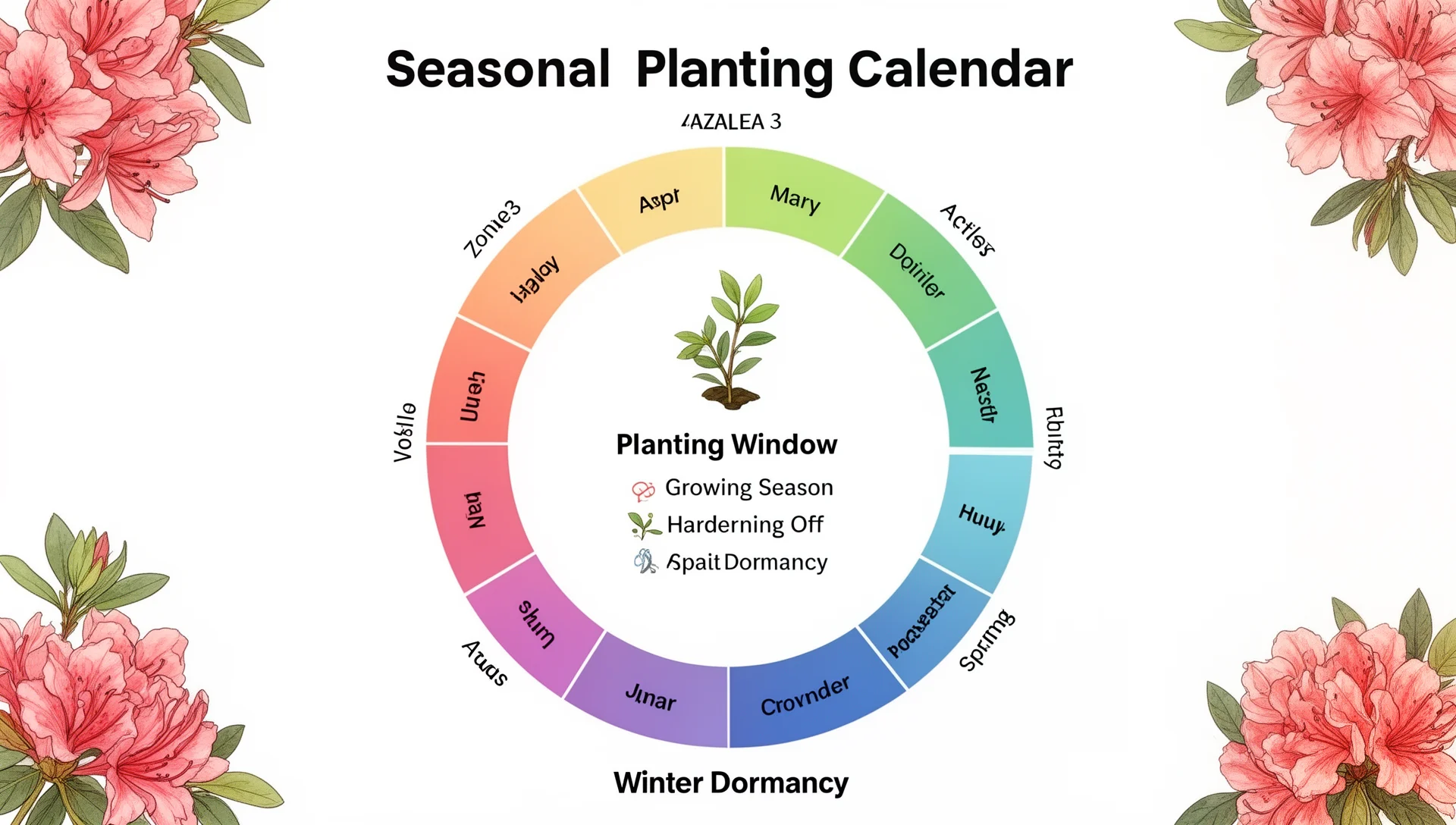
Zone 3 Planting Calendar
Zone 3 gives you a narrow window. The last spring frost in most of zone 3 falls between May 20 and June 10—check your specific ZIP code at the Old Farmer’s Almanac, since zone 3 spans from northern Minnesota to interior Alaska and dates vary considerably. The first fall frost arrives between September 1 and September 20 in most zone 3 locations.
| Season | Window | What Happens | Zone 3 Notes |
|---|---|---|---|
| Spring planting | Early to mid-June | Roots establish before summer heat | Preferred for new plants; 2–3 weeks after last frost |
| Fall planting | Late August only | Cooler temps reduce transplant stress | Must be 6+ weeks before first frost; risky in zone 3 |
| Avoid | July, September+ | Heat stress or insufficient root time | July = heat stress; September = too close to frost |
In zone 3, spring planting is strongly preferred. A plant placed in early June has three full months to establish roots before the first fall frost. Fall planting is only viable in late August and only if the plant is already a good size (2-gallon container minimum). A small transplant put in the ground in early September in northern Minnesota will not survive its first winter.
Watering and Fertilizing
Azalea roots are shallow—they stay in the top 12 inches of soil—which means they dry out faster than deeper-rooted shrubs. Aim for about 1 inch of water per week through the growing season, either from rain or irrigation. The mulch layer you applied at planting does most of the work here by retaining moisture and keeping soil cool.
Fertilizing has one firm rule in zone 3: do not feed after July 1. Missouri Extension is direct about this: late-season fertilization pushes out tender new growth that won’t have time to harden before frost, and that growth will be killed. The damage goes beyond cosmetics—repeated late-season frost kill weakens the plant over several years. Apply an acid-formulated fertilizer (look for “for azaleas and rhododendrons” on the label) once in May, after blooming, when the plant is actively growing. That’s it for the year. A 3–4 inch layer of organic mulch decomposing over the root zone provides additional low-level nutrition without any risk.
For detailed fertilizer product recommendations, we have a full comparison of acid-formula options tested for azaleas.
Stop missing your zone's planting windows.
Select your US zone and month — get a complete checklist of what to plant, prune, feed, and protect right now.
→ View My Garden CalendarPruning in Zone 3
Azaleas set their flower buds for next year during summer—specifically July and August—so pruning timing is the difference between a plant full of blooms and one that produces nothing. The rule is simple: prune only in May and June, immediately after flowering ends. That gives the plant the rest of summer to produce new growth and set buds.
For zone 3 plants, light pruning is better than hard cuts. Pinch out the soft growing tips by hand to encourage bushier branching. Hard pruning stimulates heavy regrowth that may not ripen completely before fall in a short zone 3 season, leaving you with soft stems vulnerable to bark split. If a plant has dead wood from winter damage, remove it as soon as new growth confirms which branches are alive—usually by mid-May.
Pairing azaleas with plants that improve their growing environment is a worthwhile strategy. Our guide to companion plants for azaleas covers acid-soil companions that benefit from similar conditions.
Zone 3 Winter Protocol
In my experience, zone 3 azalea losses come overwhelmingly from skipping the hardening-off steps—not from planting the wrong variety. I’ve seen healthy Rosy Lights with documented -45°F ratings fail when their owners kept watering through September. The plant’s biology needs that late-season dry-down to trigger dormancy. Follow this sequence each year:
This is where most zone 3 azalea failures happen—not from planting the wrong variety, but from skipping the hardening-off steps that prepare the plant for extreme cold. Follow this sequence each year:
August: Reduce watering gradually through August. The Azalea Society of America recommends cutting back irrigation about a month before your expected first frost to trigger natural hardening. A plant that’s slightly dry going into fall hardens its cell walls more effectively than a plant that’s been kept moist all season.
September (before first frost): Apply an anti-desiccant spray such as Wilt-Pruf when temperatures are near 40°F. The American Rhododendron Society recommends this step for cold-climate growing: it creates a waxy film on stems that reduces moisture loss during frozen-soil periods when roots can’t replace what’s lost to wind.
After first 2–3 hard frosts: Water the root zone deeply—one thorough soaking—before the ground freezes solid. Then apply 4 inches of mulch over the root zone. The Azalea Society specifically advises waiting until after hard frosts to mulch heavily, because mulch insulates the ground and can actually keep temperatures slightly warmer just above it, which delays the plant’s full dormancy entry.
For young plants (first two winters): Build a windbreak. Drive three or four stakes around the plant and wrap burlap around them, leaving the top open for air circulation. Do not let the burlap contact the branches. The goal is to block desiccating wind, not to create a greenhouse. The American Rhododendron Society also suggests using discarded Christmas trees laid against the plant as a low-effort windbreak—something Missouri Extension seconds as well.
Spring: Remove protection gradually—don’t pull everything off on the first warm day. The American Rhododendron Society recommends waiting until all frost has left the ground before removing winter protection. Remove the windbreak first, then let the plant acclimate for a week before removing any remaining mulch from around the crown.
If you see bark split: Bark separating from stems at the base is a common zone 3 damage symptom. Treat promptly by brushing melted paraffin or grafting wax into the split to seal it against drying and disease. Plants can recover from minor splits if treated early.
For general azalea identification when buying plants, the comparison between azaleas vs. rhododendrons is worth reading before you shop—nurseries sometimes mix them up, and a rhododendron sold as cold-hardy may not have the bud hardiness you need.
Frequently Asked Questions
Can azaleas actually survive zone 3 winters?
Yes, but only deciduous varieties from the Northern Lights series developed by the University of Minnesota. These are bred specifically for bud hardiness to -35°F, with Rosy Lights rated to -45°F. Standard nursery azaleas will not survive.
When do azaleas bloom in zone 3?
Expect blooms in mid to late May in most zone 3 locations—approximately 2–3 weeks after the last frost date, once soil temperatures have warmed. Golden Lights and Northern Hi-Lights tend to be among the earliest. The display lasts 2–3 weeks.
Do zone 3 azaleas need winter protection every year?
For the first two winters, yes—a burlap windbreak while the root system establishes. After that, established Northern Lights plants generally don’t need wrapping, though the August dry-down, anti-desiccant spray, and post-frost mulching steps should remain part of your annual routine.
Why are my zone 3 azalea buds brown but the branches are alive?
Bud kill from a cold snap during late winter or early spring. This is the most common zone 3 failure mode. The plant survives but produces no blooms that year. Switch to a higher-rated cultivar (Rosy Lights) and apply anti-desiccant the following fall.
Are azaleas toxic to pets?
Yes. All azaleas contain grayanotoxins and are toxic to cats, dogs, horses, and humans if ingested. NC State Extension notes that ingestion of moderate amounts poses little severe toxic hazard in most cases, but plant them away from areas where pets graze.
For a complete guide to azalea soil preparation, sun requirements, pruning timing, and variety selection across all zones, see the Azalea Growing Guide.
Sources
- University of Minnesota — Minnesota Hardy Azaleas: Lights Series Cultivars
- The Morton Arboretum — Azalea Northern Lights Series
- University of Missouri Extension — Growing Azaleas and Rhododendrons
- Azalea Society of America — Environmental Concerns
- American Rhododendron Society — Rhododendron and Azalea Weather Protection
- NC State Extension — Rhododendron prinophyllum


