

Why Is My Pothos Dropping Leaves? 7 Causes, Diagnosed and Fixed

Your pothos is dropping leaves for one of 7 reasons. Use this symptom table to find yours — and the fix — in under 5 minutes.
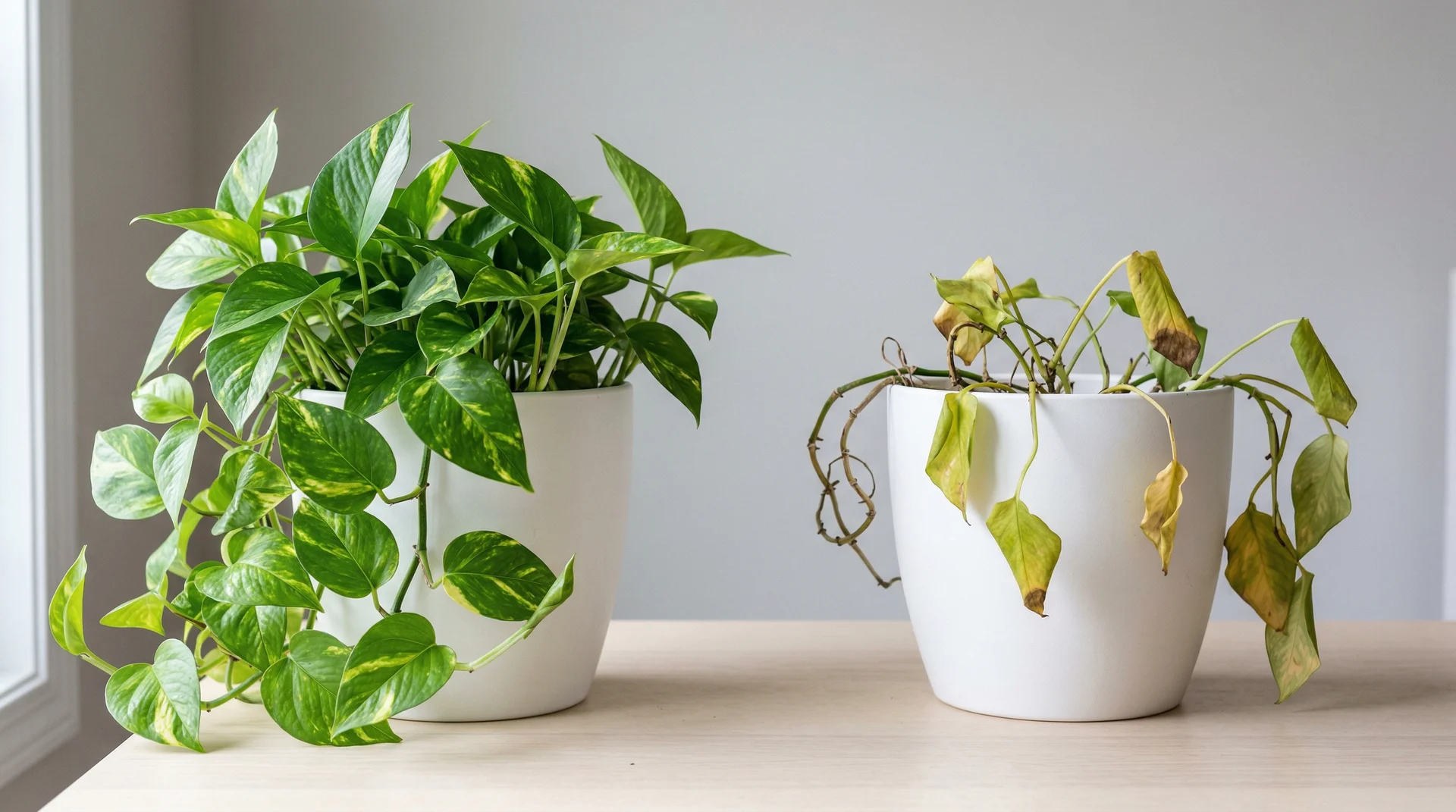
When your pothos starts shedding leaves, it’s easy to assume the worst. These plants have a reputation for toughness, so losing multiple leaves feels alarming. But leaf drop almost always points to one fixable problem — overwatering, too little light, temperature stress, pests, or a handful of others — and most pothos bounce back within two to four weeks once the cause is corrected.
The tricky part is diagnosing accurately. Misread the symptoms and the wrong fix makes things worse. This guide walks through all seven causes with a symptom-based diagnostic table, the biology behind why leaves fall, and specific corrections for each scenario.
If your pothos looks beyond leaf drop — vines collapsing, widespread blackening, no green growth at all — pair this guide with our plant-dying diagnostic for a full triage. For everything else about keeping pothos healthy long-term, the complete pothos care guide covers watering, light, fertilizing, and more.
Is the Leaf Drop Actually a Problem?
Not every fallen pothos leaf signals a care failure. As pothos vines lengthen, older leaves at the base naturally yellow and drop — the plant redirects energy toward actively growing tips rather than maintaining leaves that receive little light. The University of Wisconsin Extension describes this plainly: older leaves ‘will turn yellow and drop off naturally, eventually ending up with most of the leaves at the end of the vine.’

Three pre-planned garden beds, free
Stop staring at empty beds: printable plans with exact layouts, plant lists and planting calendars — yours free from the Garden Library.
This is normal senescence. If one or two leaves near the base of a long vine are yellowing while the rest of the plant looks full and healthy, the fix is usually just trimming vines back to encourage bushy growth — not a care overhaul.
The red flags that point to a real problem:
- Multiple leaves dropping at once across different positions on the vine
- Young leaves near the growing tips falling off
- Green leaves dropping suddenly without yellowing first
- Leaves that look spotted, mushy, or webbed before falling
Diagnose Your Pothos: Symptoms at a Glance
Check soil moisture, leaf location, and leaf appearance before reaching for any treatment. This table maps the most common symptom combinations to their causes.
| Symptom | Likely Cause | First Action |
|---|---|---|
| Wet soil, yellowing leaves, roots brown and mushy | Overwatering / root rot | Stop watering; repot if roots smell sour |
| Bone-dry soil, wilted or crispy leaves | Underwatering | Bottom-water for 30–45 minutes |
| Leaf drop on oldest, lowest leaves only | Insufficient light | Move to bright indirect light |
| Sudden drop after a move or season change | Temperature shock | Relocate away from vents and cold windows |
| Brown leaf tips before drop, dry indoor air | Low humidity | Add pebble tray or humidifier |
| Sticky residue, webbing, or white fluff on leaves | Pest infestation | Isolate plant; treat with insecticidal soap |
| Leaf drop 1–2 weeks after repotting | Repotting stress | Hold fertilizer; water lightly; wait |
Why Pothos Drop Leaves: The Biology
Every cause in this list triggers the same underlying process: leaf abscission driven by ethylene hormone. When a leaf becomes stressed — whether from too much water, too little water, cold temperatures, or darkness — auxin production in that leaf drops. The abscission zone (AZ) at the leaf’s base, normally suppressed by auxin, becomes sensitive to ethylene. The plant then produces enzymes that dissolve the cell wall bonds holding the leaf to the stem, and the leaf detaches. Research published in Frontiers in Plant Science describes ethylene generating ‘a clear decreasing gradient of ethylene biosynthesis activation’ from the leaf tissue through the abscission zone — the leaf effectively signals its own removal.
This mechanism matters practically: all seven causes produce leaf drop through the same pathway, but each requires a completely different correction. Treating overwatering the same way as underwatering — both cause leaf drop — would accelerate the plant’s decline. A symptom match comes first.
Cause 1: Overwatering and Root Rot
Overwatering is the most common cause of pothos leaf drop, and it works against intuition. Waterlogged soil doesn’t just make roots wet — it drives out the oxygen roots need to function. Oxygen-deprived roots can no longer absorb water or nutrients, so the plant enters a drought-like stress state even with saturated soil. Penn State Extension confirms that excess moisture causes root rot and that pothos ‘tolerates underwatering better than overwatering.’
Diagnosis: Lift the pot — it should feel heavy days after watering. Unpot the plant and check the roots. Healthy roots are white to cream-colored and firm. Rotting roots are brown or black, mushy to the touch, and smell sour or foul.
Fix: Stop watering immediately. If roots show rot, cut away all black or mushy tissue with clean scissors and repot in fresh, fast-draining mix — standard potting soil with 20–30% added perlite drains well. Let the top two inches of soil dry completely before the next watering, then resume the same finger-test routine going forward.
Cause 2: Underwatering
When soil dries out completely, leaf cells lose turgor pressure — the internal water pressure that keeps them rigid and metabolically active. The plant’s stress hormone abscisic acid (ABA) rises, signaling water scarcity. Non-essential leaves are shed to reduce the plant’s overall water demand. Leaves curl inward and droop before falling — the plant’s last attempt to reduce water loss through transpiration before it drops the leaf entirely.
Diagnosis: Soil is bone dry, pulling away from the pot edges. Leaves feel thin or papery, and tips may be brown and crispy.
Fix: For severely dried-out plants, bottom watering works better than top watering because dry soil repels water rather than absorbing it evenly. Set the pot in four inches of room-temperature water for 30–45 minutes to let the soil rehydrate from below through the drainage holes, then drain fully. Going forward, water whenever the top one to two inches of soil feel dry — pothos handles occasional drought, but repeated cycles of severe drying cause cumulative leaf loss that doesn’t reverse easily.
Cause 3: Insufficient Light
Pothos tolerates low light but quietly optimizes when light drops below the minimum threshold for efficient photosynthesis. The plant evaluates which leaves contribute net energy and which cost more to maintain than they produce. Older leaves deep on the vine — furthest from the light source and contributing the least — fail that calculation first and are shed to reduce metabolic load.
Diagnosis: Dropped leaves are concentrated on the oldest, lowest parts of the vine. Variegated varieties — golden pothos, marble queen — may revert to solid green before leaf drop begins, which is a reliable early indicator of insufficient light.
Fix: Move the plant to bright, indirect light — four to six feet from an east- or west-facing window is a reliable starting point. Avoid direct afternoon sun, which scorches leaves. If window light isn’t sufficient, a full-spectrum grow light running 12 to 14 hours daily provides an effective substitute. Expect two to four weeks before new growth confirms the plant has stabilized.
Stop killing plants with wrong watering.
Select your plant, pot size, and climate zone — get a precise watering schedule with amounts and timing.
→ Build Watering ScheduleCause 4: Temperature Shock and Cold Drafts
Pothos originate in tropical Southeast Asia and react sharply to cold. Clemson Extension specifies optimal conditions as 60–70°F nights and 70–85°F days. Below 60°F, metabolic processes slow and hormone signaling becomes erratic — leaf drop often follows within days. Cold air from a drafty window or AC vent can trigger this response even when the room’s general temperature seems comfortable. A plant positioned in the direct path of an AC vent may experience repeated cold shocks that owners never connect to the leaf drop appearing weeks later.
Diagnosis: Leaf drop began after a seasonal shift, a house move, or rearranging furniture near windows or vents. Brown patches or blackened areas may appear on leaves before they fall.
Fix: Move the plant at least three feet from exterior windows in winter and away from AC vents year-round. If the room regularly drops below 60°F at night, relocate to a warmer interior spot. The plant typically stops dropping leaves within one to two weeks once temperature stabilizes.
Cause 5: Low Humidity
Indoor humidity in heated or air-conditioned homes often falls to 20–30% — well below the 50–70% that Clemson Extension identifies as optimal for pothos. At low humidity, leaves lose water through transpiration faster than roots can replace it, even with appropriately moist soil. Leaf tips brown first; if the deficit continues, entire leaves drop to reduce the plant’s total water-loss surface area.
Diagnosis: Brown, crispy leaf tips that spread gradually before the leaf falls. A hygrometer confirms if indoor humidity is below 40% — they’re available at most hardware stores for under $15 and worth keeping near your tropical houseplants year-round.
Fix: A pebble tray is effective and low-maintenance: fill a shallow dish with pebbles, add water just below the pebble surface, and set the pot on top so roots stay above the waterline. Evaporation raises local humidity without overwatering. Grouping several houseplants together creates a shared humid microclimate with no extra effort. A small humidifier placed nearby is the most reliable method for consistently dry rooms. Misting helps briefly but evaporates too quickly to address ongoing deficits.
Cause 6: Pest Infestation
Spider mites, mealybugs, and scale insects all target pothos. These pests extract sap from leaves and stems, depleting the nutrients and water pressure needed to keep leaves attached. The feeding wounds also trigger the plant’s ethylene-driven abscission pathway, accelerating leaf drop well beyond what sap removal alone would cause. Infestations often go unnoticed until populations are large enough to cause rapid defoliation.
Diagnosis: Check leaf undersides carefully — spider mites leave fine webbing and a stippled pale appearance on upper leaf surfaces; mealybugs form white cottony clusters in leaf axils and stem joints; scale insects appear as small brown or tan bumps along stems. Sticky honeydew residue on the leaves or surfaces below the pot is often the first sign of mealybug or scale activity.
Fix: Isolate the plant immediately to prevent spread to other houseplants. Spray all surfaces — especially leaf undersides and stem joints — with insecticidal soap or diluted neem oil. Repeat every three to four days for at least two to three weeks. One treatment is never sufficient; eggs survive the initial application and hatch within days.
Cause 7: Repotting Stress
Fine root hairs — responsible for most water and nutrient absorption — are easily damaged during repotting. When disrupted, the plant temporarily can’t take up what it needs, triggering the same abscission response as drought. A pothos dropping a few leaves one to two weeks after a repot is responding normally to a temporary deficit, not failing irreversibly.
Diagnosis: Leaf drop begins within two weeks of a repot. The dropped leaves may look relatively normal — no dramatic yellowing, spotting, or wilting. Soil and remaining plant look healthy.
Fix: Resist the urge to water heavily or add fertilizer — both increase stress on already-damaged roots. Water lightly and consistently; hold off fertilizing for four to six weeks because fresh potting mix provides sufficient nutrition without the addition. Most plants complete recovery within two to four weeks as new root hairs develop. In future, repot only when clearly root-bound (roots circling drainage holes or pushing up through the soil), using a pot one inch larger than the previous one.
How to Prevent Pothos Leaf Drop
Four habits prevent the majority of leaf-drop incidents before they start:
- Water by soil feel, not by schedule. Check the top one to two inches of soil before every watering. Pothos give you a small early warning — slight leaf droop before actual drought stress sets in — if you’re watching for it. Fixed-schedule watering regardless of soil condition is the fastest route to root rot.
- Use pots with drainage holes. Stagnant water at the base of a pot without drainage is the primary cause of root rot. This is non-negotiable regardless of how attractive the decorative cachepot looks.
- Keep the plant away from drafts and vents. A plant in the direct path of an AC vent or near a drafty winter window experiences repeated temperature stress that accumulates quietly over weeks before leaf drop becomes visible.
- Inspect leaf undersides monthly. A 60-second monthly check catches pest infestations at the manageable stage — when a cotton swab with rubbing alcohol resolves the problem — before population explosion triggers rapid defoliation.
Sources
- Pothos as a Houseplant — Penn State Extension
- Pothos (Epipremnum aureum) — University of Wisconsin Horticulture Extension
- How to Grow Pothos Indoors — Clemson Home & Garden Information Center
- Epipremnum aureum — NC State Extension Plants Database
- Ethylene and Leaf Abscission — Frontiers in Plant Science (PMC)


