

The Soil Mix That Saves Alocasia From Root Rot: DIY Chunky Aroid Recipe + 3 Pre-Made Picks

Stop losing alocasia to root rot — here’s our exact 4-ingredient chunky aroid mix recipe, 3 store-bought picks, and the amendment ratios for each.
Alocasia is not a difficult plant — if the soil is right. Most of the problems people run into with alocasia, including the yellowing, wilting, and mysterious non-return from winter dormancy, trace back to a single issue: roots spending too long in waterlogged, oxygen-depleted media.
The fix isn’t complex. It’s a mix that drains fast enough to prevent anaerobic conditions, retains just enough moisture to keep the corm alive between waterings, and has enough air gaps for oxygen to reach feeder roots. This article walks you through building that mix from scratch, how to amend three widely-available store-bought potting soils, and how to diagnose soil-related problems before they cost you a plant. If you want a broader look at potting soil properties across plant types, our Potting Soil Growing Guide covers the fundamentals.
One thing I’ve noticed from repotting alocasia over the years: the difference between a thriving specimen and a struggling one often isn’t light, watering frequency, or fertilizer. It’s what’s happening three inches underground — in soil that looked fine from the surface.
Why Regular Potting Mix Suffocates Alocasia Roots
Standard potting mix — the kind formulated for the average tropical houseplant — is the leading cause of alocasia failure in home collections. Here’s the mechanism: most commercial potting soils use fine-textured peat moss or coco coir as their primary ingredient. These particles pack tightly together after a few waterings, reducing the air space between them. For most houseplants, this is manageable. For alocasia, it creates a slow suffocation problem.

Free printable garden plans for when you’re ready to grow outside too
Three pre-planned beds — pollinator, kitchen and cut-flower — from the free Blooming Expert Garden Library.

Alocasia roots are thick and fleshy, growing from a central corm — a bulb-like storage organ at the base of the plant. Those feeder roots need oxygen exchange between waterings almost as much as they need water itself. When potting media compacts, water sits in the root zone without draining, creating anaerobic (oxygen-depleted) conditions [7]. In those conditions, Pythium and Phytophthora — the water mold pathogens responsible for root rot — thrive and spread rapidly from feeder roots to main roots, and eventually to the corm.
The visual signs appear late. By the time you see yellowing leaves or soft tissue at the stem base, the rot has typically been progressing for weeks in substrate you can’t see. NC State Extension confirms that overwatering leads to both root rot and bacterial stem rot in Alocasia [2], two failure modes that compound each other in compacted soil.
A well-built chunky aroid mix should dry significantly within 7–10 days in typical indoor conditions [7]. Standard tropical houseplant mix retains moisture for two to three weeks in a container — doubling the anaerobic window with every watering cycle.
The difference between “moist” and “wet” is everything for alocasia. Moist means water is present at the micro level but air pockets remain throughout the substrate. Wet means those pockets have filled with water and oxygen has been displaced. Your soil recipe determines which side of that line your alocasia’s roots live on. For more on the signs that soil conditions have gone wrong, see our guide to alocasia problems and fixes.
What Alocasia Actually Needs From Its Soil
Four properties matter, and understanding what each does prevents the common mistake of over-optimizing for one at the expense of another:
Drainage. Excess water must escape the root zone within minutes of watering. The RHS recommends adding horticultural grit to any compost used for alocasia for exactly this reason [1]. A drainage layer at the base of the pot is optional — the mix itself should handle this.
Aeration. Air pockets between larger particles allow oxygen to diffuse to root surfaces between waterings. Orchid bark, perlite, and pumice all create these gaps. Coco coir alone, without chunky additions, collapses into a dense cake within weeks.
Moisture retention. Despite the drainage emphasis, alocasia roots cannot tolerate complete drying. The corm desiccates and dormancy becomes damage. A proportion of fine organic matter — coco coir or worm castings — maintains micro-level moisture without saturating the substrate.
pH. Alocasia performs best in slightly acidic to neutral soil: pH 5.5–7.0. NC State Extension accepts both acid (<6.0) and neutral (6.0–8.0) pH ranges for Alocasia [2], which means most quality potting mixes — naturally acidic from peat or coir — fall within range without adjustment. Extreme alkalinity above pH 8.0 locks up iron and manganese, causing pale new leaves.
In its natural habitat — the humid forest floors of tropical Southeast Asia — alocasia grows in loose, well-aerated soil rich in decomposed organic matter. That forest floor is never compact or waterlogged; leaf litter and root activity keep the structure open. Replicating that structure in a container is the entire goal of a chunky aroid mix [3].
The 4-Ingredient Chunky Aroid Mix Recipe
This recipe balances drainage with enough organic matter to support alocasia through its active summer growing season. Each ingredient earns its place:

| Ingredient | Ratio | Why It’s Here |
|---|---|---|
| Coco coir or peat moss | 2 parts | Moisture retention between waterings; maintains slightly acidic pH |
| Perlite or horticultural pumice | 2 parts | Drainage and aeration; keeps air pockets open as mix settles |
| Orchid bark (medium grade) | 2 parts | Chunky structure; creates long-lasting air gaps that perlite alone can’t maintain |
| Worm castings | 1 part | Slow-release organic nutrition; improves beneficial microbial activity |
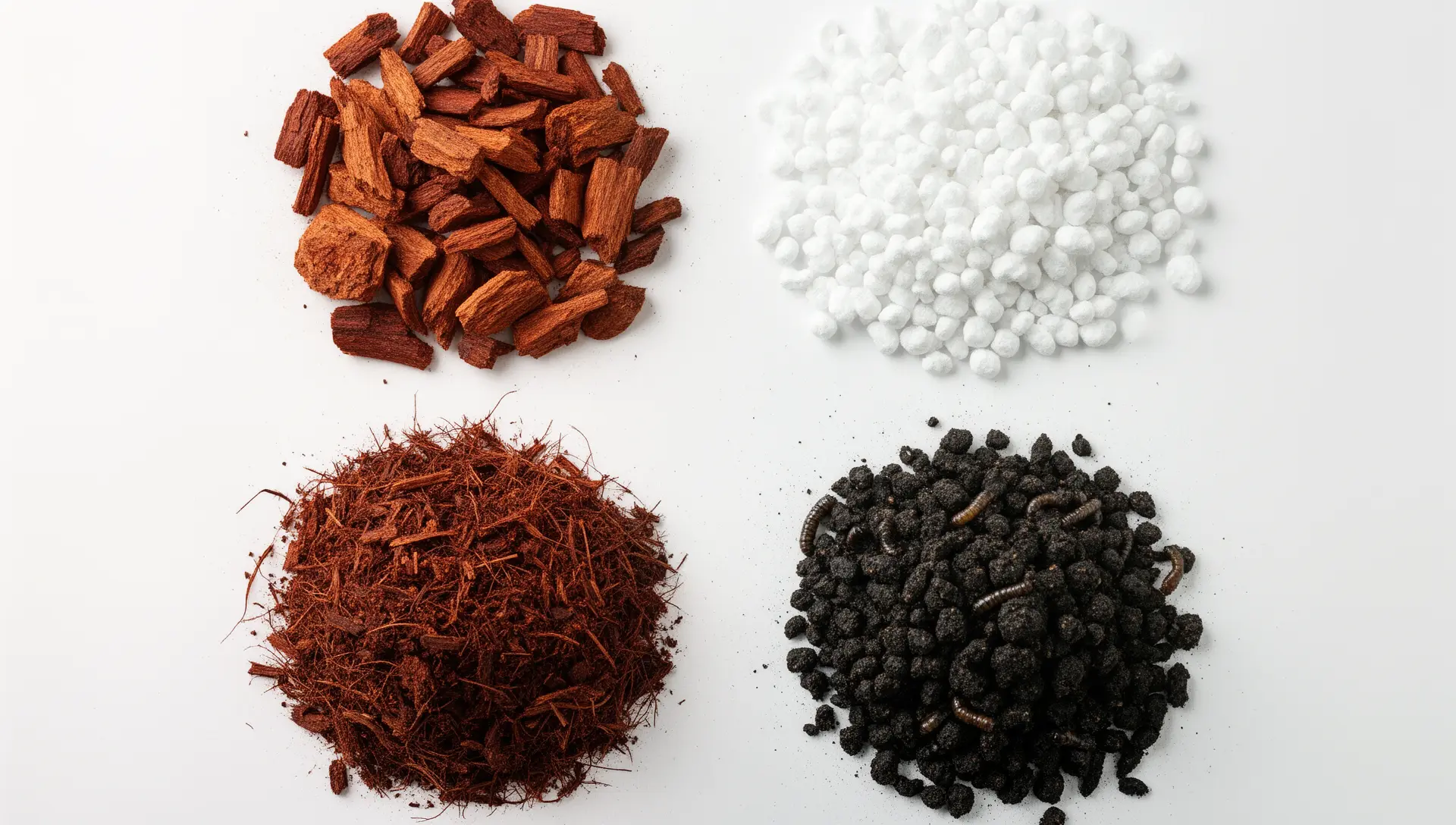
Mixing method: Combine dry ingredients in a large bucket. Pre-moisten the coco coir first — it resists absorbing water when bone dry. Work a small amount of water through the combined mix until it clumps loosely when compressed in your hand, then breaks apart with minimal pressure. If it forms a dense, slow-releasing ball, add another part of perlite and mix again.
Quick dry-down test: After potting, water thoroughly and note the date. In warm indoor conditions (65–75°F), the top inch of the mix should feel dry within 2–3 days. The full mix should dry significantly within 7–10 days [7]. If it’s still wet at day 5, the orchid bark ratio is likely too low — add more and repot.
Climate adjustments: In humid climates (Pacific Northwest, Florida interiors), increase orchid bark and perlite by one part each and reduce coco coir. High ambient humidity slows evaporation and extends the wet window. In dry environments or centrally-heated homes in winter, keep the base recipe or add a small amount of sphagnum moss to reduce watering frequency.
Stop guessing your soil pH.
Enter your soil type and test reading — get exact lime or sulfur rates for your plants in seconds.
→ Calculate Soil Needs3 Pre-Made Picks — and Exactly How to Amend Each
No standard potting mix works for alocasia straight from the bag, but the right bases need minimal work to get there. These three are widely available across the US and respond predictably to amendment.

1. FoxFarm Ocean Forest — Best Nutrient-Rich Base
FoxFarm Ocean Forest is probably the most recommended potting mix in the US houseplant community, and for good reason. Its pH sits at 6.3–6.8 [8] — right in the ideal range for alocasia without adjustment. The formula combines aged forest products, sphagnum peat moss, earthworm castings, bat guano, fish emulsion, and crab meal: a nutrient profile that feeds plants for at least 30 days without supplemental fertilizer [8].
Straight from the bag, Ocean Forest is too moisture-retentive for alocasia. The peat component compacts within a few weeks, reducing aeration below what the roots need.
How to amend: Mix 2 parts Ocean Forest + 1 part medium orchid bark + 1 part perlite. This improves drainage and aeration without sacrificing the nutrient advantages. A small handful of horticultural charcoal is optional but extends the usable life of the substrate by filtering mineral buildup.
Best for: growers who want nutritional depth and are comfortable doing light mixing. The nutrient density lets you delay fertilizing until mid-spring, simplifying early-season care.
2. Espoma Organic Potting Soil Mix — Best for Long-Term Root Health
Espoma’s Organic formula stands out in its category because of Myco-tone — a proprietary mycorrhizal fungi blend built into the mix [5]. Mycorrhizal fungi colonize plant roots and extend their effective absorption surface dramatically, improving both water and nutrient uptake. For alocasia, which needs to extract moisture efficiently from a well-drained substrate, this is a genuine advantage that most potting mixes don’t offer.
The ingredient list includes processed forest products (60–70%), sphagnum peat moss, perlite, humus, limestone (to stabilize pH), earthworm castings, and several organic meal amendments [5]. The limestone addition means pH stays stable over time — better than peat-only formulas that acidify with repeated watering.
How to amend: Mix 2 parts Espoma Organic + 1 part orchid bark + ½ part perlite. The formula already contains some perlite, so less amendment is needed than with Ocean Forest. Espoma itself recommends amending their mix with orchid bark for alocasia, noting the combination creates an “airy potting soil” suited to the plant’s needs [4].
Best for: growers who prioritize organic inputs and long-term soil biology. The mycorrhizae make a meaningful difference for large, established alocasia that will stay in the same pot for 12+ months. See our guide to potting compost for houseplants for a broader comparison of organic versus synthetic mixes.
3. Sun Gro Black Gold All Purpose — Best Budget Pick
Black Gold All Purpose contains Canadian sphagnum peat moss, compost, processed bark, earthworm castings, and horticultural-grade perlite or pumice [6]. The bark and inorganic drainage agents already present in the formula mean the amendment burden is lighter than with the other two picks.
How to amend: Mix 3 parts Black Gold + 1 part orchid bark. The existing perlite/pumice handles aeration; the additional bark provides the chunky structure alocasia roots need.
Best for: budget-conscious growers or those who prefer minimal mixing. Widely available at Home Depot and Lowe’s — often more accessible regionally than the other options. The controlled-release fertilizer in the formula feeds for up to 6 months [6], reducing early supplemental feeding needs.
| Brand | Straight from bag | Amendment per 2 parts soil | Result |
|---|---|---|---|
| FoxFarm Ocean Forest | Not suitable | + 1 part orchid bark + 1 part perlite | Excellent |
| Espoma Organic | Not suitable | + 1 part orchid bark + ½ part perlite | Excellent |
| Sun Gro Black Gold | Borderline | + 1 part orchid bark (per 3 parts soil) | Good |
Seasonal Soil Management: What Changes in Winter
This is the gap most soil guides leave open — and it’s where alocasia losses tend to happen.
During the active growing season (spring through early fall), alocasia is drinking actively, pushing new leaves, and giving you clear signals through leaf droop and soil dry-down. Your chunky mix works as designed. Watering when the top inch is dry keeps the balance right.
In late fall and winter, most alocasia slow significantly or drop all their leaves and enter dormancy. The rhizome is alive but metabolically quiet. This changes the soil equation in a critical way.
A fine, moisture-retentive mix becomes more dangerous in winter than in summer. When you water every two to three weeks instead of every week, the same soil volume sits wet for far longer. The RHS specifically cautions that overwatering during dormancy is a primary cause of root rot [1]. But the opposite mistake — letting the soil dry completely — desiccates the corm and causes damage that presents as non-sprouting in spring.
The practical rule for dormant alocasia: water only when the top half of the soil is dry. With a chunky aroid mix, this self-corrects — the fast drainage prevents saturation even when watering intervals extend. With a denser mix (or a plastic pot that doesn’t breathe), you need to be far more disciplined. For a full look at dormancy care decisions, see our guide to alocasia winter dormancy.
If your alocasia went dormant last winter and failed to re-sprout, soil type and watering behavior during dormancy are the first two variables to audit before assuming rhizome death.
Diagnosing Soil-Related Problems
Most alocasia problems have a soil fingerprint. This table maps the visible symptoms to their likely causes:

| Symptom | Most Likely Cause | Fix |
|---|---|---|
| Yellowing lower leaves + mushy stem base | Root rot from waterlogged soil | Unpot, trim black roots, repot into fresh chunky mix; let roots air-dry 20 mins before repotting |
| Yellowing leaves, no mushy tissue, firm roots | Overwatering pattern without active rot yet | Let soil dry deeper between waterings; check drainage holes are unblocked |
| Wilting despite moist soil | Root damage or compacted soil blocking water uptake | Unpot and inspect; repot with fresh mix if roots are brown, circling, or mushy |
| Brown crispy leaf tips | Soil too dry, salt buildup from fertilizer, or low humidity | Check moisture at 2-inch depth; flush soil with plain water; reduce fertilizer concentration |
| Stunted growth and pale leaves in summer | Compacted soil limiting oxygen and nutrient uptake | Repot with fresh chunky mix; add slow-release fertilizer at repot |
| White crusty deposit on soil surface | Mineral buildup from hard water or fertilizer excess | Flush thoroughly; top-dress with fresh bark; reduce fertilizer concentration |
| Fungus gnats | Too-fine potting mix retaining moisture at surface | Top-dress with perlite or orchid bark; let surface dry between waterings |
Repotting: Timing, Pot Choice, and Soil Interaction
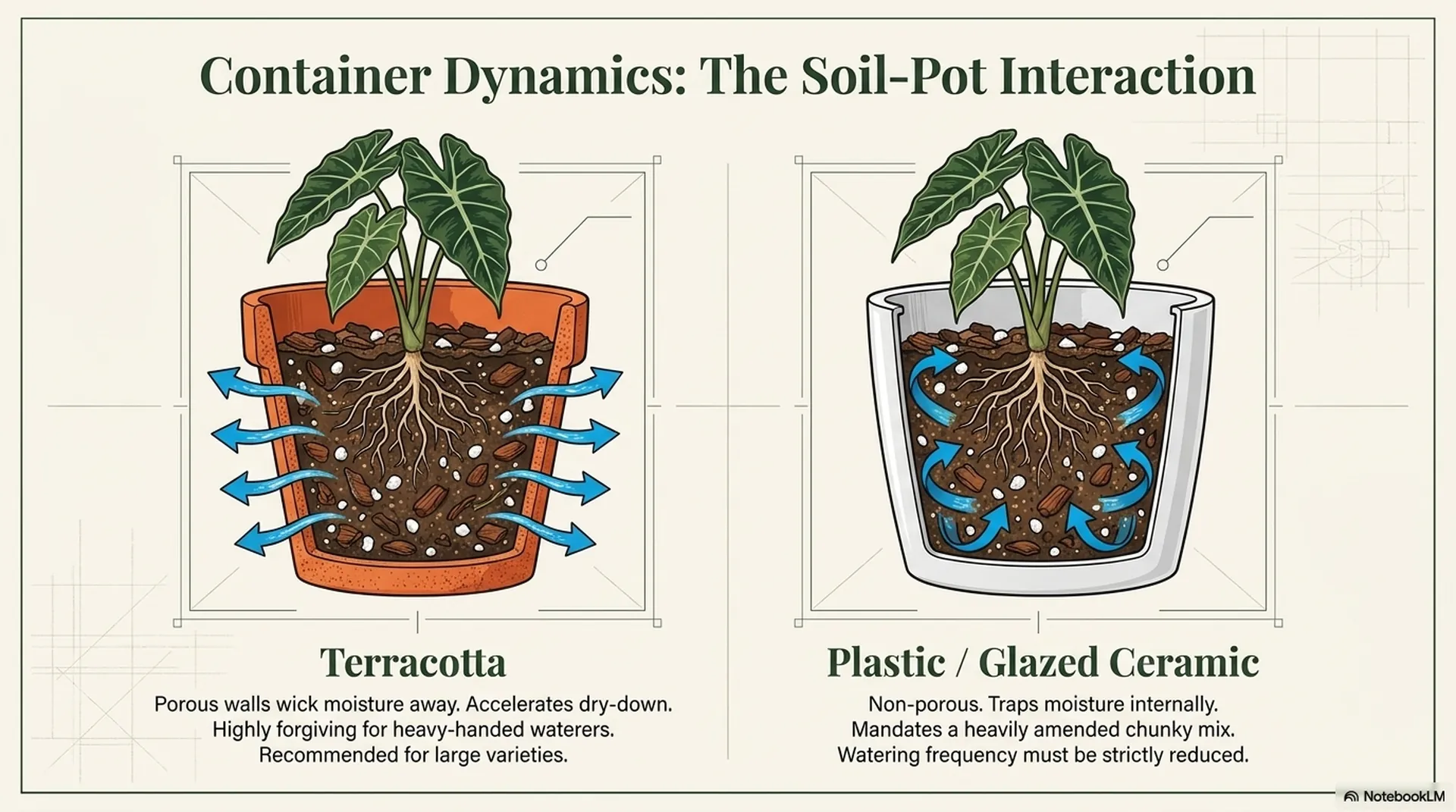
Soil choice and container type interact directly — the same mix performs differently in terracotta versus plastic.
When to repot: Spring is the best window — after dormancy, when new growth has started, before the summer growing sprint. Alocasia typically needs fresh soil every 1–2 years regardless of whether it’s root-bound. Organic components in potting mix break down over time, reducing air pockets and increasing moisture retention. Old, compacted soil is one of the most overlooked causes of gradual decline. For timing cues and step-by-step repotting technique, our full alocasia growing guide walks through the process in detail.
Pot sizing: Choose a pot only 5 cm (2 inches) larger in diameter than the current root ball [1]. Oversizing is a common mistake — excess soil volume holds more total moisture, increasing rot risk even with a chunky mix. When in doubt, size down rather than up.
Terracotta vs. plastic: Terracotta wicks moisture from the soil through the pot walls, accelerating dry-down. This makes terracotta more forgiving with a denser mix and is the better choice for growers who tend to overwater. The RHS specifically recommends heavy terracotta for large varieties [1]. Plastic or glazed ceramic retains moisture longer — with plastic, a chunky aroid mix is not optional, it’s mandatory. Adjust watering frequency to match your pot material.
Preserve some old soil: When repotting, leave approximately 20–30% of the old root ball’s soil attached to the roots. Beneficial microbial life — the organisms that help roots absorb nutrients — lives in that media. Stripping roots completely removes the soil biology you spent months building. Mix that retained old soil into the fresh batch.
Frequently Asked Questions
Can I use regular potting soil for alocasia?
Not as-is. Standard tropical houseplant potting mix compacts over time and retains more moisture than alocasia roots tolerate. It can work if amended heavily — at minimum 30% perlite and 20% orchid bark — but a purpose-built chunky mix from the start is lower maintenance and more consistent. The root rot risk from unamended mix is real, and by the time symptoms show, the damage is advanced.
Does alocasia need fertilizer in its soil?
Nutrient-rich mixes like Ocean Forest or Espoma reduce the need for supplemental feeding for the first 4–8 weeks after repotting. After that, a balanced liquid fertilizer at half-strength every two to four weeks through spring and summer handles nutritional needs. Stop all feeding in fall when growth slows. See the alocasia watering and feeding guide for the full schedule.
What about LECA or semi-hydro growing?
LECA (lightweight expanded clay aggregate) and semi-hydroponics eliminate root rot risk almost entirely by removing soil. The tradeoffs: you’ll need liquid fertilizer with every watering since LECA has no nutrients, the learning curve for water level management is real, and dormant alocasia in semi-hydro requires careful monitoring to prevent corm desiccation. It’s a legitimate option for experienced growers, not a first-repot solution.
How often should I change alocasia soil?
Refresh with new soil every 1–2 years at repotting. Even without root-bound conditions, the organic components of potting mix break down over time, reducing the air pockets that make the chunky formula work. Old, compacted media is one of the most overlooked causes of gradual alocasia decline — the plant keeps growing, just less vigorously, and the cause stays invisible until you unpot.
Sources
- “How to grow alocasias” — RHS Growing Guide
- “Alocasia x mortfontanensis” — NC State Extension Gardener Plant Toolbox
- “Alocasia spp.: Elephant’s Ear” — UF/IFAS EDIS
- “Alocasia Care 101” — Espoma Organic
- “Espoma Organic Potting Soil Mix” — Espoma
- “Black Gold All Purpose Potting Mix” — Sun Gro Horticulture
- “The Ultimate Guide to the Best Aroid Soil Mix” — Soltech
- “Ocean Forest Potting Soil” — FoxFarm


