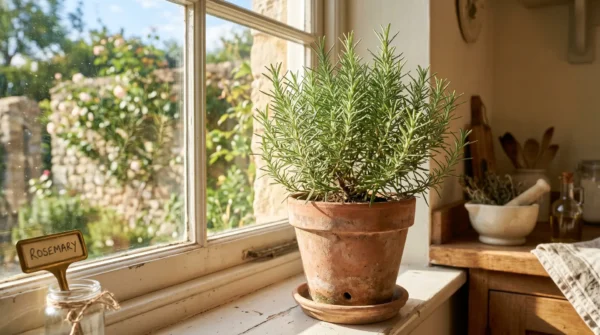
The 1/3 Rule for Harvesting Rosemary — And Why Most Gardeners Cut Too Much

Learn the 1/3 rule for harvesting rosemary correctly, the biology behind why cutting into old wood kills regrowth, and a zone-by-zone seasonal calendar.
Most gardeners cut rosemary one of two ways: tiny timid pinches that barely keep up with dinner, or one enthusiastic trim that leaves the plant looking ragged and slow to bounce back. The 1/3 rule sits in the middle — and understanding why it works changes how you look at every cut you make.
Rosemary is not basil. It doesn’t spring back from anywhere you cut it. It has a green zone and a woody zone, and the line between them is permanent. Once you cut past it, that branch is done producing new growth — not for the season, but forever. This guide explains where that line is, how to find it on any plant, and how to work with it across every month of the year.
How Rosemary Actually Grows
Rosemary is a woody subshrub, not an annual or even a soft-stemmed perennial. Every season, it adds a layer of secondary growth — bark — to its lower stems. That woody base gives it drought tolerance and longevity, but it also means the plant organizes itself into two distinct zones you can see and feel.
The green zone is the current and recent season’s growth: flexible, bright green, covered in leaves, actively photosynthesizing. This is where all future shoots come from. The woody zone is older growth: rigid, grey-brown, leafless or nearly so. It provides structure and conducts water, but it doesn’t generate new shoots.

Skip the guesswork — get a pre-planned 4×8 kitchen garden bed
Free printable planting plan: what goes where, when to plant it, and how to keep it alive. Plus two bonus flower bed plans.
That last point is worth pausing on. Most gardeners assume that if they cut back hard enough, rosemary will push new growth from old wood the way many shrubs do. It won’t. Rosemary is classified as a non-resprouter — it carries no epicormic buds or lignotubers capable of regenerating from old woody tissue. Research into bud dormancy confirms why: axillary buds in old woody stems enter endodormancy, an internally locked physiological state driven by elevated abscisic acid, reduced cytokinin signaling, and depleted carbohydrate reserves. Once established, that state is irreversible — even removing the tip of the branch won’t wake them up [PMC5440562]. Cut into bare brown wood and you’ll get a dead stub, not new shoots.
This is the biological foundation for every harvesting rule that follows.
The 1/3 Rule — What It Means and Why It Works
The 1/3 rule has two parts, and most guides only mention one of them.
Part one is about quantity: remove no more than one-third of the plant’s current-season green growth in a single harvest session. Iowa State University Extension recommends removing approximately one-third of the current year’s growth at a time [Iowa State Extension]. The University of Wisconsin Extension puts it more conservatively — no more than 20% in any single session [Wisconsin Extension]. Both guidelines exist for the same reason: rosemary uses its leaf surface area to manufacture the sugars that power regrowth. Strip too much foliage and the plant shifts from growing mode into survival mode. New shoots slow. Branches become prone to dieback.
Part two is about location: every cut you make must stay within the green zone. The UC Davis IPM Program recommends trimming up to 4-inch sprigs from the longest growing branch tips [UC Davis IPM]. That 4-inch figure isn’t arbitrary — it puts the cut point solidly in the zone where new buds are waiting. Go beyond it and you risk hitting wood that won’t recover.
Together, these two limits mean you’re harvesting from the top third of the plant’s canopy, never stripping any branch entirely, and always leaving enough green leaf mass to keep the plant producing. Applied consistently, regular harvesting actually improves rosemary’s shape — it stays compact and bushy rather than leggy and sparse.

Where to Make the Cut
Finding the right cut point takes less than ten seconds once you know what you’re looking for.
Hold a branch and run your fingers from the tip toward the base. You’ll feel the transition: the stem goes from flexible and green to stiff and grey-brown. That colour change — bright green giving way to dull grey or brown — marks the boundary of the woody zone. Your cut should always sit several inches above that boundary, in the green section.
Within the green zone, position your cut just above a leaf pair or leaf node. You’ll see two small leaves emerging from opposite sides of the stem — that’s your node. Make your cut about a quarter-inch above it, at a slight angle. Two new shoots will emerge from that node within a few weeks, and each will eventually become a harvestable branch. Every correct cut doubles the harvest points on that branch over time.
Use sharp, clean scissors or pruning snips. A clean cut heals faster and leaves less tissue exposed to fungal infection. Torn or crushed stems — from blunt scissors or pulling — can introduce disease and slow regrowth. Wisconsin Extension also notes that cutting into woody parts hinders the plant’s development [Wisconsin Extension], not just the cut branch’s regrowth, because a plant diverting resources to heal unnecessary wounds grows more slowly overall.
For beginners: when in doubt, cut shorter. A 3-inch tip cut is always safe. You can always come back for more next week.
When to Harvest for Maximum Flavor
The honest answer is: any time during the growing season works fine for the kitchen [UC Davis IPM]. If you’re cutting a sprig to throw in tonight’s roast chicken, go ahead.
But if you’re harvesting a significant amount for drying, timing does matter. Iowa State Extension recommends harvesting herbs like rosemary when flower buds are just beginning to open — that’s the moment when essential oil concentration is at its peak [Iowa State Extension]. Peer-reviewed research confirms the relationship between flowering stage and secondary metabolite accumulation in rosemary: peak essential oil yield reaches 1.73–2.75% during flowering, with dominant compounds including 1,8-cineole (27–36%), α-pinene (15–29%), and camphor (7–15%) [PMC12783073].
For daily kitchen harvesting, time of day makes a noticeable difference. Harvest in the morning after the dew has evaporated but before the midday heat — the essential oils are most concentrated before sun exposure drives off the volatile compounds [Iowa State Extension]. This is practical advice for anyone who grows rosemary in containers — bring those scissors out before 10 a.m.
Stop missing your zone's planting windows.
Select your US zone and month — get a complete checklist of what to plant, prune, feed, and protect right now.
→ View My Garden CalendarIllinois Extension notes that fresh rosemary can be harvested as needed throughout the growing season [Illinois Extension], and Penn State Extension adds that leaves harvested prior to blossoming have the best quality for drying [Penn State Extension]. The two recommendations align: everyday use doesn’t require precision timing, but bulk drying harvest is worth scheduling around the buds.
Zone-by-Zone Harvest Calendar
Rosemary’s growing season varies dramatically depending on your climate. In zone 6, a hard frost can end the outdoor harvest season by mid-October. In zone 10, rosemary may bloom and be harvestable every single month. The table below gives a practical framework by USDA hardiness zone.
One rule applies to every cold-climate zone: stop heavy harvesting by early September. NC State Extension warns against significant pruning in August, as it stimulates new growth that won’t harden before the first frost [NC State Extension]. Light snipping is fine into autumn, but don’t cut more than a few inches after September 1st in zones 6–7.
| Zone | Active Harvest Window | Light Harvest | Stop Heavy Cuts | Notes |
|---|---|---|---|---|
| 6–7 (New England, Midwest, Mid-Atlantic) | April – August | September | Early September | Mulch after first hard freeze; bring containers indoors 2–3 weeks before frost |
| 8–9 (Pacific NW, Upper South, Coastal) | March – November | December – February (mild years) | Mid-October | Rosemary is reliably perennial; light harvest possible in mild winters |
| 10+ (Gulf Coast, Southern CA, Hawaii) | Year-round | July – August (heat stress) | N/A | Reduce heavy harvesting during peak summer heat to avoid drought stress |
| Indoor / Container | Year-round | Year-round | N/A | Production slows in low winter light; supplement with a grow light to maintain harvest rate |
If you’re growing rosemary indoors, see our guide to growing rosemary indoors for light and humidity tips that directly affect how much you can harvest without stressing the plant.
How Often Can You Harvest?
Light tip harvesting — snipping 2–3 inch tips for kitchen use — can happen as frequently as every week during the active growing season without stressing a healthy established plant. Wisconsin Extension describes rosemary as something you can pick small amounts from at any time [Wisconsin Extension]. Weekly pinching also encourages branching, which means more harvest points over time.
Heavier harvests — removing 15–20% of the plant at once — need a recovery window. Allow 4–6 weeks before another heavy session. You’ll see the signal when it’s ready: the cut ends will have pushed out 1–2 inches of new growth, and the plant will look full again rather than sparse at the tips.
Watch these stress signals after any harvest:
- New growth is thin and spindly rather than robust — the plant needed more time
- Tips are yellowing or browning at harvest points — likely cut too close to woody wood, or the plant is water-stressed
- Regrowth is slower than usual — common in late summer or post-frost, not a problem if you’ve respected the zone calendar
For culinary planning: one mature rosemary plant (3+ years old, at least 18 inches tall) can comfortably supply a household of two with fresh rosemary year-round in zones 8+. In zones 6–7, plan for two plants — one outdoor, one in a container you bring inside — to avoid a winter gap.
How to Harvest for Different Uses
Fresh culinary use: Snip 3–6 inch tips as needed. UC Davis recommends taking from the longest growing branches [UC Davis IPM]. Fresh sprigs keep in the refrigerator for 1–2 weeks wrapped in a slightly damp paper towel inside a plastic bag. Alternatively, stand them upright in a glass with an inch of water — like cut flowers — and they’ll last equally long.
Drying: Harvest just before the flower buds open for peak oil content. Cut longer stems — 6–8 inches — so you have enough length to bundle. Tie 5–8 stems together at the base and hang upside down in a dry, well-ventilated spot away from direct sun [Penn State Extension][Wisconsin Extension]. Air-drying takes 1–2 weeks.
For faster results with better oil retention, use a food dehydrator set to 95–105°F. Research on Mediterranean herbs confirms this range preserves essential oil yield significantly better than oven drying at higher temperatures — above 140°F, EO yield and antioxidant capacity both drop [PMC8124978]. Dehydrator drying takes 2–5 hours.
Freezing: Strip the leaves from the stem and freeze them flat on a parchment-lined tray for 30 minutes, then transfer to a freezer bag. Penn State Extension also suggests packing them into ice cube trays with water for ready-to-use cooking portions [Penn State Extension]. Frozen rosemary works well in cooked dishes; the texture changes, so use it for soups, stews, and braises rather than fresh garnishes.
Stem skewers: Thick lower branches — the ones that have become semi-woody but still have a little green at the tip — make excellent grilling skewers for lamb, chicken, or vegetables. Strip the leaves from the lower 4–5 inches and thread your protein onto the bare wood. The woody stem is sturdy enough to hold without soaking (unlike bamboo), and it flavours the food as it cooks [Penn State Extension].
Three Mistakes That Damage Rosemary
1. Cutting into the woody zone. Now that you understand the endodormancy mechanism, this one should feel obvious. Brown, leafless wood won’t push new shoots. Every time a gardener does this accidentally — usually by harvesting on autopilot, cutting where the scissors land rather than where they should — they lose that branch permanently. The fix: slow down, find the green-to-grey boundary on each branch before you cut.
2. Stripping one branch completely while leaving others untouched. This happens when gardeners reach for the most accessible branch and take everything from it. The result is a lopsided plant and an overstressed branch trying to recover with no leaf mass. Spread your harvest across the whole plant, taking a little from multiple branches rather than a lot from one.
3. Not harvesting at all. I’ve watched healthy rosemary go untouched for a full season and come back to find stems 18 inches long with bare woody middles and sparse foliage only at the tips — completely avoidable. Rosemary that’s never cut grows long, floppy stems that arch toward the light and lose density at the base. Regular harvesting — even light weekly pinching — keeps the plant compact, encourages branching, and makes the next harvest easier. If your plant has gone unchecked for a full season and is starting to look straggly, see our guide to common rosemary problems for a recovery approach.
A word on diseased or pest-affected plants: if you see any signs of powdery mildew, scale, or dieback on a branch, don’t harvest from that branch. Disinfect your scissors with rubbing alcohol between plants. Harvesting from stressed tissue introduces wounds at exactly the moment the plant’s immune response is already occupied elsewhere.
Frequently Asked Questions
Can I cut rosemary all the way back?
No — not if you want regrowth. You can cut back to the lowest point where green leaves are still present, but cutting into bare brown wood means that branch won’t recover. A heavy renovation prune (removing one-third of the plant in spring) is fine; going all the way to the base is not, unless you’re happy to start over from a new plant.
How do I harvest rosemary without killing it?
Stay in the green zone, never exceed one-third of the current season’s green growth in a single session, and make cuts above a leaf node. That combination makes it essentially impossible to harm a healthy plant through normal harvesting.
When should I stop harvesting in fall?
In zones 6–7, stop heavy harvesting by early September. NC State Extension notes that pruning in late summer stimulates soft new growth that won’t harden before winter frosts arrive [NC State Extension]. Light tip harvesting (an inch or two) is fine through October in mild autumns.
Can I harvest from a young plant?
Wait until the plant is at least 6–8 inches tall and has been in the ground or container for at least one full growing season. Young plants need their leaf mass to establish roots. Light tip pinching to encourage branching is fine from the start, but don’t take significant amounts until the plant is settled in.
Does the 1/3 rule apply to container rosemary too?
Yes, and it’s even more important in containers. Pot-grown rosemary has a smaller total leaf area than a garden-grown plant the same height, so it has less buffer. Stick to the 20% end of the range (rather than the 1/3 end) for containerised plants, especially in winter when growth is slow.
Key Takeaways
- Rosemary is a non-resprouter — cutting into old wood creates permanent dead stubs, not new shoots
- The 1/3 rule means cutting no more than one-third of current-season green growth per session, always staying above the green-to-grey boundary
- Make cuts just above a leaf node, at a slight angle, with clean sharp scissors
- For best flavor/oil, harvest at bud-open stage; for daily kitchen use, any time is fine
- In zones 6–7, stop heavy harvesting by early September
- Light weekly pinching is fine year-round and improves plant shape
- Dehydrator drying at 95–105°F preserves far more essential oil than oven drying
For the full picture on growing rosemary successfully, see our complete rosemary growing guide.
Sources
- Illinois Extension — Rosemary. extension.illinois.edu/herbs/rosemary
- Penn State Extension — Herb Garden Plants: Rosemary. extension.psu.edu/herb-garden-plants-rosemary
- University of Wisconsin Extension — Rosemary. hort.extension.wisc.edu/articles/rosemary-rosemarinus-officinalis/
- Iowa State University Extension — How Do I Harvest Herbs? yardandgarden.extension.iastate.edu/faq/how-do-i-harvest-herbs
- UC Davis/UC ANR IPM — Cultural Tips for Growing Rosemary. ipm.ucanr.edu/home-and-landscape/cultural-tips-for-growing-rosemary/
- NC State Extension — Winterizing the Herb Garden. content.ces.ncsu.edu/winterizing-the-herb-garden
- PMC12783073 — Phytochemical Composition of Rosmarinus officinalis Essential Oils During Flowering. pmc.ncbi.nlm.nih.gov/articles/PMC12783073/
- PMC5440562 — Bud Dormancy and Carbon Starvation in Woody Species. pmc.ncbi.nlm.nih.gov/articles/PMC5440562/
- PMC8124978 — Temperature Effects on Essential Oil in Mediterranean Herbs. pmc.ncbi.nlm.nih.gov/articles/PMC8124978/