10 Trough Planter Ideas for Every US Garden Style — Vintage Farmhouse to Sleek Modern

10 trough planter ideas matched to your US garden style — from DIY hypertufa to antique stone sinks, with specific plants and a drainage myth debunked.
Trough planters date back to stone livestock feeding troughs repurposed by English cottage gardeners in the early twentieth century. Today they’re one of the most versatile container options in US gardens — long enough to anchor a porch entry, deep enough for perennials, and available in materials ranging from $20 DIY hypertufa to antique Belfast sinks that last 50 years.
The design challenge is matching the trough style to the garden around it. A galvanized stock tank that looks at home on a Montana ranch patio can feel out of place in a formal brick-edged entry garden. This guide covers 10 distinct trough planter ideas matched to specific US garden style archetypes, each with plant picks and setup notes. Three things cut across all 10: drainage holes are non-negotiable, the right soil mix prevents most root failures, and material choice determines how well the trough weathers in your USDA zone.
What Makes a Trough Planter Actually Work
A trough planter is a long, rectangular or oval container that mimics the shape of a traditional stone feeding trough. That shape matters: the 8–14-inch depth suits a wide range of plants, from alpine cushions to culinary herbs to trailing succulents, while the length creates a horizontal design line that ties garden zones together.
Three things determine whether a trough planting thrives or fails. First, drainage holes in the bottom — multiple, not one. Second, the right soil mix; standard garden soil compacts and suffocates roots in a closed container. Third, material match to your climate; a metal trough in zone 9 heats up rapidly, while a stone trough can crack in zone 3 freeze cycles. Get these right and the design ideas below are yours to run with.

Three pre-planned garden beds, free
Stop staring at empty beds: printable plans with exact layouts, plant lists and planting calendars — yours free from the Garden Library.
For a full overview of container options across all materials and sizes, the planter ideas growing guide covers 40-plus styles in one place.

The 10 Trough Planter Ideas
1. Galvanized Stock Tank Trough — Farmhouse and Ranch Style
The galvanized steel stock tank is the most distinctly American trough planter on this list. Originally designed as livestock water troughs, these heavy-duty containers read as rural and honest in farmhouse settings and look surprisingly sharp when planted with ornamental grasses or bold perennials against a barn board fence.
Best for: USDA zones 5–8, full sun. Plants: ‘Lemon Gem’ marigolds, Salvia nemorosa ‘Caradonna’, and cherry tomato ‘Sungold’ in the same trough give height, color, and something to eat.
Drill at least four ¼-inch holes in the base before planting. Galvanized steel absorbs and holds heat — in zones 7 and above, line the interior with coconut coir or plastic sheeting to buffer root temperatures during July and August. According to the American Galvanizers Association, zinc-coated steel lasts 10–20 years depending on soil acidity and local rainfall, so this is a long-term investment at $50–$200 for a classic oval ranch size [5].
See our comparison of galvanized vs. cedar raised beds if you’re deciding between metal and wood for the same farmhouse setting.
2. Hypertufa DIY Trough — Cottage and Traditional Garden
Hypertufa is Portland cement blended with peat moss and perlite to create a material that looks and weathers like tufa limestone, at a fraction of the weight and cost. The texture genuinely improves with age, developing lichen and moss that no bought planter can replicate. The RHS recommends stone-effect containers like hypertufa specifically for alpine and rock plant displays, where the porous walls assist drainage and keep roots cool [1].
Best for: Zones 4–8, partial to full sun. Plants: Saxifraga ‘Silver Cushion’, Dianthus deltoides, and Sempervivum tectorum fill a hypertufa trough with year-round structure. Add dwarf conifer Juniperus procumbens ‘Nana’ AGM for vertical contrast [2].
A standard mix uses 3 parts Portland cement to 4 parts peat moss to 4 parts perlite [4]. Cure for 24 hours, then wrap in plastic for four weeks of slow hardening. Brush the surface with a wire brush before the final cure for a more weathered finish. Total material cost runs around $20–$30 for a medium trough — significantly less than buying reconstituted stone.
3. Reclaimed Wood Trough — Rustic and Country Farmhouse
Cedar and teak planking cut into trough form delivers the warmth of natural wood without the visual weight of stone. This style anchors kitchen garden settings and pairs naturally with adjacent raised beds. Cedar is the right choice for an edible planting — it’s naturally rot-resistant and needs no preservative treatment that could leach into herbs or salad crops.
Best for: Any zone; adaptable to shade or sun. Plants: Basil, flat-leaf parsley, and chives beside a back door is both useful and good-looking. For ornamental use, Heuchera ‘Palace Purple’ with creeping jenny (Lysimachia nummularia ‘Aurea’) trailing over the front edge creates a low-maintenance display from May to November.
Line with landscape fabric, not plastic — fabric retains soil while allowing drainage, while plastic traps moisture against the wood. Elevate the trough on small feet or bricks; direct soil contact on the base board shortens service life from a decade to three years.
4. Belfast Sink or Cast Stone Trough — English Cottage Style
An original Belfast sink or genuine stone trough carries a weight of history that no other material can match. Even quality reconstituted stone replicas develop weathering quickly and add immediate character to a garden corner. This is the right choice for a shaded nook where galvanized metal would look out of place.
Best for: Zones 5–7, shade to partial sun. Plants: The RHS highlights Polygala chamaebuxus AGM — evergreen, honey-scented, and reliably perennial — alongside Androsace sempervivoides AGM for pink spring flowers [2]. Combine with miniature narcissus ‘Tête-à-Tête’ for late-winter color before the rock plants take over.
Stone is naturally porous, which is exactly why it suits alpines that demand sharp drainage. Position the trough with a slight forward tilt (about 5 degrees) so water runs toward the drainage hole rather than pooling at the back.
Stop missing your zone's planting windows.
Select your US zone and month — get a complete checklist of what to plant, prune, feed, and protect right now.
→ View My Garden Calendar5. Concrete Modern Trough — Contemporary and Minimalist
Cast concrete delivers the visual weight and permanence of stone at lower cost, and it accepts a range of finishes: raw gray, polished, or pigmented to match a specific palette. Sleek rectangular profiles suit modern outdoor rooms and urban rooftop gardens where clean geometry matters. UF/IFAS Extension notes that hypertufa — cement’s close relative — is among the most porous and well-draining container materials available [3], and pre-cast concrete performs similarly when drainage holes are present.
Best for: Zones 4–9, any sun exposure. Plants: Festuca glauca ‘Elijah Blue’ against black mondo grass (Ophiopogon planiscapus ‘Nigrescens’) creates a high-contrast graphic planting that looks sophisticated in gray or charcoal concrete. For warmer zones, dwarf agapanthus fills the same structural role.
Pre-cast concrete troughs often arrive without drainage holes. Check before buying, or drill with a masonry bit. A 36-inch concrete trough can weigh 60–80 lb empty — if you’re placing it on a deck or balcony, verify load ratings first.
6. Self-Watering Window Trough — Urban Patio and Balcony
Self-watering troughs use a reservoir beneath the soil and draw water upward through wicking action, keeping the root zone consistently moist without waterlogging. They’re the most practical choice for balcony setups where floor drainage is limited, or for gardeners who travel regularly.
Best for: Any zone; ideal for balconies, patios, and window sills. Plants: Petunias, calibrachoa, and bacopa in combination fill a self-watering trough with non-stop color from May to frost. The consistent moisture suits these high-demand annuals far better than irregular hand-watering.
The reservoir works best when you fill it from below rather than watering from the top, which saturates the soil rather than using the wick system. Refill every 5–7 days during peak summer heat. The overflow drainage hole — positioned above the reservoir — prevents true waterlogging if you overfill.
7. Culinary Herb Trough — Kitchen Garden and Everyday Practical
A dedicated herb trough outside the kitchen door is one of the most efficient small-garden investments possible. A 24-inch trough holds four to five herbs in a planting that stays tidy with minimal attention and delivers fresh flavor for most of the growing season.
Best for: Zones 5–10, full sun. Plants: Keep Mediterranean herbs together — rosemary, thyme, oregano, and sage share the same drainage requirement and sun preference, which simplifies care. Mint is the exception: it spreads aggressively and does better isolated in its own container or confined within the trough inside a buried pot.
The RHS recommends a 2cm grit surface layer for trough plantings [1]. For herbs, this conserves moisture at root level while preventing stem rot where plants contact wet soil — the failure point for rosemary in wet winters. Soil options by plant type are covered in our container potting mixes guide.
8. Succulent and Desert Trough — Southwest and Xeriscape Style
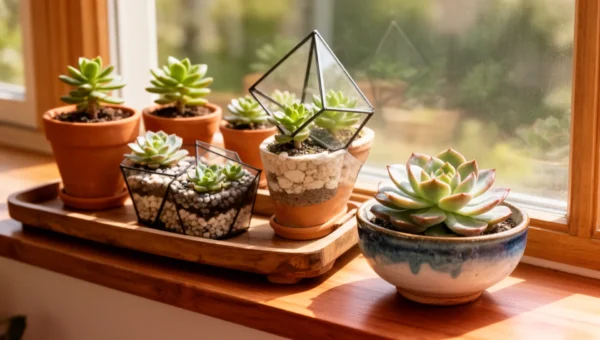
Succulents’ shallow root systems match trough depth precisely, and their drought tolerance suits anyone who doesn’t want to water daily. A well-designed succulent trough peaks in summer and holds textural interest well into fall. This style suits any zone in summer — just bring tender species indoors before first frost in zones below 7.
Best for: Zones 7–11 year-round; zones 4–6 as a seasonal display. Plants: Combine textural contrasts — the rosette form of Echeveria ‘Perle von Nürnberg’ against the upright Sedum ‘Autumn Joy’ and trailing Sedum rupestre ‘Angelina’. Add a single agave or aloe for a vertical anchor if the trough is large enough.
Use a 1:1 mix of cactus potting mix and coarse perlite, and increase perlite to 60% in wetter climates. Our succulent planter ideas guide covers plant combinations for different container sizes and exposures.
9. Trellis-Backed Climbing Trough — Small-Space and Vertical Garden
A trough paired with an attached or freestanding trellis solves two problems at once: it adds substantial planting in a small footprint while creating vertical structure that screens views or divides outdoor spaces. This is the most architectural option on the list and works equally well on a narrow side yard, a deck edge, or a fence line.
Best for: Any zone; versatile for sun or shade depending on plant choice. Plants: Clematis ‘Nelly Moser’ is well-suited to container growing and flowers prolifically without aggressive spreading. Annual sweet peas (Lathyrus odoratus) are lighter and easier for short-season zones. For edible use, pole beans or cucumbers trained up a bamboo trellis are both productive and attractive through summer.
Keep the trough at least 16 inches deep for perennial climbers — shallower containers can’t support the root mass a second-year clematis needs to perform reliably.
10. Mixed Bulb Seasonal Trough — Classic American Porch and Entry
A trough planted in layers — tulips deepest, daffodils in the middle, grape hyacinth shallowest — delivers a rolling procession of spring color from late February through May without replanting. This bulb lasagna method is one of the best ways to maximize a trough’s visual impact over a full season for relatively little cost.
Best for: Zones 4–8. Plants: Layer Darwin Hybrid tulip ‘Apeldoorn’ at the base (6 inches deep), narcissus ‘Jetfire’ in the middle (4 inches), and Muscari armeniacum at the top (2 inches). In zones 5 and below, elevate the trough on blocks — bulbs in containers face harder freeze cycles than bulbs in the ground.
Plant in October, mulch the surface with bark or coarse gravel, and keep barely moist through winter. After the final flush fades in May, replant the top two inches with summer annuals while the bulbs die back naturally below.
Trough Material Comparison
| Material | Best Style Match | Durability | Weight | Approx. Cost |
|---|---|---|---|---|
| Galvanized steel | Farmhouse, industrial | 10–20 years | Medium | $50–$200 |
| Hypertufa (DIY) | Cottage, traditional | 15–25 years | Light–medium | $20–$30 materials |
| Reclaimed wood | Rustic, country | 5–10 years | Medium | $20–$80 |
| Cast stone / Belfast sink | English cottage | 30–50 years | Heavy | $80–$300+ |
| Concrete | Modern, minimalist | 20–30 years | Heavy | $60–$250 |
| Self-watering plastic | Urban, balcony | 5–15 years | Light | $25–$80 |
Cost ranges are approximate and vary by size and supplier. Durability figures assume proper drainage and seasonal care.
Drainage: The One Detail That Determines Everything
The most common trough planting failure comes from a widely repeated misconception about drainage. Many gardeners layer gravel or stones at the bottom of a container “to help water drain.” It does the opposite.
Here’s the mechanism: water moves through soil by gravity, but when it reaches the boundary between fine soil and coarser gravel below, it stops moving and pools. This is the perched water table effect — the soil above the gravel saturates before water crosses the texture boundary into the gravel layer. You’ve created a wet layer at root level, not a drain. The RHS explicitly warns against gravel layers in trough planters for exactly this reason [1].
The correct approach: drainage holes in the bottom, covered with a piece of window screen or shade netting to stop soil washing out without blocking water flow. Fill the trough with a fast-draining mix. For alpines, the RHS recommends equal parts compost and coarse grit [1]; for most other plants, standard potting mix cut 50–50 with perlite performs well. The container gardening guide covers soil selection for different plant types in more detail.
Frequently Asked Questions
How deep should a trough planter be? For herbs, alpines, and succulents, 8–10 inches is enough. For annual flowers and most vegetables, 10–12 inches. For perennials and climbers, aim for 14–18 inches — shallower troughs can’t support the root mass these plants develop after a full season.
Can trough planters stay outside in winter? Stone, concrete, and hypertufa troughs designed for frost survive outdoors in zones 4–6 without protection. Galvanized metal handles temperature swings well. Ceramic and standard terracotta crack when water in the material expands during freeze cycles — empty or store them before the first hard frost. In zones 3–4, even frost-rated materials do better stored in an unheated garage through the coldest months.
What’s the best soil for a trough planter? Avoid straight garden soil in troughs — it compacts, drains poorly, and may carry soil pests into a closed container. For most planters, a 50–50 mix of quality potting mix and perlite works well. For alpines and succulents, increase perlite to 60% and top-dress with coarse grit. For vegetables in self-watering troughs, use premium potting mix alone — the reservoir manages moisture, so additional drainage amendment isn’t needed.
Sources
- Sink and Trough Gardening — Royal Horticultural Society
- Plants for Sink and Trough Gardening — Royal Horticultural Society
- Choosing a Container for Your Plant — UF/IFAS Extension, University of Florida
- How to Make a Hypertufa Garden Trough — This Old House
- Galvanized Water Trough Planters — Insteading