

Ocotillo Isn’t a Cactus: It Leafs Out in as Little as 48 Hours After Rain, and Too Much Water Can Kill a New Transplant

Ocotillo can grow leaves in 48 hours, yet too much water after planting can kill it. Zones, Arizona law and a bare-root planting routine from Arizona sources.
In short
- Ocotillo is a woody shrub, not a cactus. Leaves can appear within 48 hours of rain and drop within weeks.
- It tolerates about 10°F in fast-draining soil, and too much water after planting can kill it.
- Wild ocotillo is protected in Arizona, so buy plants that come with a tag.
- Checked against: University of Arizona Extension, Arizona-Sonora Desert Museum, Desert Botanical Garden, USDA NRCS.
To most buyers a bare ocotillo looks dead. In a dry spell it carries no leaves at all, and within days of a soaking rain the same canes can be green, then bare again a few weeks later. That cycle drives every care decision: how to tell a dormant plant from a dead one, how much water a transplant gets, and why University of Arizona Extension warns that too much irrigation after planting can kill it.
I read the University of Arizona Extension, Desert Botanical Garden and USDA NRCS planting guidance side by side, and they disagree on several steps, including whether a new plant is watered in and, between UA Extension and the NRCS interviewees, whether compass orientation matters. This guide shows where they differ and which version I would follow.
Is Ocotillo a Cactus? No, and the Difference Changes How You Plant It
Ocotillo (Fouquieria splendens) is a woody desert shrub in its own family, Fouquieriaceae, not a cactus. The Arizona-Sonora Desert Museum says ocotillos are “not even closely related to cacti,” and the Desert Botanical Garden says it is not a succulent and should not be treated as one. Texas Parks and Wildlife describes the ocotillo of the US Southwest as the northernmost member of a Mexican plant family of eleven species.

Three pre-planned garden beds, free
Stop staring at empty beds: printable plans with exact layouts, plant lists and planting calendars — yours free from the Garden Library.
The difference matters because cactus rules and ocotillo rules diverge. University of Arizona Extension’s guide to cactus, agave, yucca and ocotillo tells growers to replant cacti in dry soil and withhold water until new growth appears at the tip. Its separate ocotillo sheet and the Desert Botanical Garden both call for regular watering of a new ocotillo.
Plan for size and longevity: the Desert Museum says the canes grow up to 20 feet tall, though usually less, and the plant can be 6 feet wide or more, and Texas Parks and Wildlife says undisturbed plants typically live 60 to 100 years.
How Ocotillo Grows a Full Set of Leaves in Days
A leafless ocotillo can show new leaves within 24 to 48 hours of a soaking rain. Friends of Madera Canyon and a 2009 USDA NRCS technical note (citing Kearney and Peebles, 1969) give the timings in the table.
| Stage | Reported timing | Source |
|---|---|---|
| First leaves after a soaking rain | Within 24 hours in warmer months; 24 to 48 hours | Friends of Madera Canyon; Texas Parks and Wildlife |
| Leaves fully developed | 5 days; or as little as 48 hours | Friends of Madera Canyon; USDA NRCS |
| Leaves stay on | Usually 3 to 4 weeks, until the soil dries | Friends of Madera Canyon; USDA Forest Service |
| Leafy periods per year | 2 or 3 usual, up to 5 or 6; or 4 or 5 depending on rainfall | Friends of Madera Canyon; USDA Forest Service |
| Coldest part of winter | Dormant and leafless | Friends of Madera Canyon |
The sources agree on the pattern and differ on the count: the USDA Forest Service says a plant can grow and lose leaves four or five times in a year depending on rainfall, while Friends of Madera Canyon say up to five or six leafy periods can occur but two or three are more usual.
The leaves are a rain-triggered, short-lived tool. University of Arizona Extension says ocotillos shed their leaves quickly when the soil dries, to reduce evaporative loss and conserve moisture. Texas Parks and Wildlife, citing Matt Turner, adds that the leaves sprouted during the summer monsoon harden into the plant’s spines, while leaves produced after rain outside the monsoon last only a few weeks.
Does a Leafless Ocotillo Photosynthesize Through Its Canes?
Only a little, and not during drought. The Forest Service says leafless ocotillos rely on chlorophyll in their stems for photosynthesis. The 1964 gas-exchange study by Mooney and Strain in Madroño is less generous. They measured stem sections of three plants (two in Deep Canyon near Palm Desert, California, and one potted). On hydrated stems with the leaves removed, bark photosynthesis came to 0.25 to 0.45 mg of CO₂ per square decimeter of stem surface per hour, “a small fraction of the photosynthetic contribution of the leaves.” In no case did it reach the compensation point, meaning a lit leafless stem still released CO₂, only less than a dark one did.
For plants that were leafless from drought, Mooney and Strain measured no bark photosynthesis at all. They concluded it “probably contributes little to the overall seasonal photosynthetic economy of the plant.” A drought-bare cane is therefore waiting, not working, so judge it by its color and flex rather than by whether it has leaves.
Where Ocotillo Grows: Zones, Cold Limit and Drainage
Plan on a cold limit of about 10°F. University of Arizona Extension says ocotillos tolerate temperatures down to 10°F, and the Forest Service says they are cold tolerant to about 10°F, which prevents their use in areas with severe winters. The Desert Museum and the Southern Nevada Water Authority list 0°F instead, and the Authority puts the plant in USDA zones 8a to 10b. Use 10°F for planning, since two government sources give it and 0°F is a best case.
Its native range runs through the Sonoran and Chihuahuan deserts, from Baja California east to the Trans-Pecos in Texas and south to Zacatecas, Mexico, according to the Extension sheet. The Forest Service says ocotillos grow from sea level to 6,700 feet, and Texas Parks and Wildlife calls it an indicator plant of the Chihuahuan Desert, found on low-elevation slopes. In the Verde Valley it grows on south-facing gentle to moderate slopes, which the Extension sheet attributes to its need for well-drained soils, heat, and relative intolerance of prolonged low temperatures, so a warm site matters at the cold edge.
Drainage decides the rest. The Extension sheet says well-drained sandy or gravelly loam favors root development and gives a test: dig the hole, fill it with water, and plant only if it drains within an hour. The Desert Museum is more relaxed, saying most soils will do, even caliche. Our guide to soil for Arizona desert gardens explains the gritty mineral mixes that desert natives prefer.
None of the extension, museum or botanical-garden pages cited in this guide describes ocotillo grown in a humid climate, so there is no sourced humidity limit to give you. They do give the two conditions that matter: winters that stay above roughly 10°F, and soil that drains. A humid-climate or heavy-clay yard would have to pass the same hole-filling test as a desert one.
Buying Ocotillo: Container-Grown, Bare-Root or Wild-Collected
Most large ocotillos on sale are bare-root plants dug from the desert, not nursery-grown ones. The Desert Botanical Garden says most mature ocotillos found in nurseries were salvaged directly from the desert and that their root systems may be damaged or barely existing. University of Arizona Extension says many are salvaged from construction areas in Arizona or collected in other states, many of them from Texas.
| Option | Roots and establishment | What the sources say |
|---|---|---|
| Container-grown | No root pruning needed before planting; should establish at a much faster rate than bare-root | University of Arizona Extension |
| Bare-root (salvaged) | Roots may be damaged or barely existing; any transplanted ocotillo may take 6 to 24 months to leaf routinely and flower | Desert Botanical Garden; University of Arizona Extension |
| Wild-collected by you | Not permitted without a permit | Arizona Administrative Code R3-3-1104 |
If you must buy bare-root, the Desert Botanical Garden gives three checks. Inspect the roots, because a larger root system means better odds, and reject plants whose roots are extensively damaged or broken. Ask when the plants arrived, and avoid one that has sat for more than 1 to 2 weeks. Lift the candidates, because the heavier plant holds more moisture and has a better chance of surviving.
Arizona lists Fouquieria splendens as a salvage restricted native plant in Appendix A of its protected-plant rules (effective February 2, 2025). Rule R3-3-1104 says nobody may collect, transport, possess, sell, offer for sale, dispose of or salvage protected native plants without an appropriate permit, and the permits and plant tags it describes are valid only for the calendar year in which they are issued. University of Arizona Extension’s native plant law publication adds that protected plants may not be removed from any land, public or private, without the landowner’s permission and a permit from the Arizona Department of Agriculture.
Stop missing your zone's planting windows.
Select your US zone and month — get a complete checklist of what to plant, prune, feed, and protect right now.
→ View My Garden CalendarIn practice, ask the seller for the plant’s tag or receipt before you pay, and call the Arizona Department of Agriculture if the seller cannot show one. This guide checked only Arizona’s rule; if you live elsewhere, look up your own state’s.
The NRCS note records survival figures from 1995 interviews. A Desert Museum botanist put success at 90 percent for saguaro, barrel cactus and ocotillo planted at any time of year (the note’s own summary excludes the winter rainy season), with large old plants lower, and a contractor said all can reach 90 percent if they are in good vigor when transplanted. The note’s discussion section, citing a 1995 personal note by Wheat-Gallaher, says ocotillo do not transplant as well as cacti and that a minimum of 75 percent success can be expected. These are recollections, not trials, and none of the figures is below 75 percent.
Planting a Bare-Root Ocotillo: Where the Guides Disagree
The three planting authorities agree on the goal, a plant that sits in fast-draining soil with intact roots, and differ on the steps. The table sets out each one’s position on the questions that matter.
| Question | UA Extension sheet | Desert Botanical Garden guide | USDA NRCS note (1995 interviews) |
|---|---|---|---|
| Planting window | Year round, but best March through May | Not stated | Any time except the winter rainy season, when cool, moist conditions promote decay; spring is optimum |
| Hole size | Wide enough for the roots, no deeper than the root system | At least 1 foot wider and deeper than the root system | Not stated for ocotillo |
| Backfill | No organic amendments; notes the Garden’s 30% coarse sand | 30% coarse sand | The plant’s native soil if available (Boyce Thompson Arboretum); a contractor said a 50% river sand mix |
| Damaged roots | Prune cleanly, dry a week before planting | Prune, then soak roots in rooting-hormone solution | Two-week dry healing period before supplemental water; one interviewee kept roots dry two weeks before and after replanting |
| First water | Weekly in summer, twice a month in winter | Water in immediately, then weekly deep watering | After the healing period: irrigate through the first summer (Desert Museum botanist), or only if the soil holds little water (Boyce Thompson) |
| Orientation | Original orientation; south side faces south | Not mentioned | All four interviewees: critical for saguaro and barrel cactus, not necessary for ocotillo |
| Support | No stakes; large stones about 6 inches from the trunk if wind is a risk | Stand it upright, adjust any tilt, re-tamp | Not stated for ocotillo |
The disagreement is smaller than it looks: none of the three recommends compost in the backfill, and all treat drainage as the thing to get right. The two real splits are watering in versus a dry wait, and orientation. This is the version I would follow, and it is my reading of the three rather than any one source’s recipe.
- Pick the date. March through May is the Extension’s best window, and the NRCS note says to avoid the winter rainy season because cool, moist conditions promote decay in fresh transplants.
- Pick the site and test the drainage. The Extension guide says sunny, open locations where surface water does not collect are best. Fill the hole with water and plant only if it drains within an hour.
- Dry the roots. Cut broken roots back cleanly and let them dry. The Extension says a week, and one NRCS interviewee says about two weeks before and after replanting. The NRCS note also says to hold supplemental water for a two-week healing period after the move.
- Mark the south side. Tape or chalk the plant’s original south side before it is moved, and face it south. The NRCS interviewees say orientation is not essential for ocotillo, but marking costs nothing, and one interviewee in the same note warns that plants salvaged from the shade of other vegetation will sunburn in direct sun.
- Set it at its original depth and backfill with native soil plus coarse sand, working dry soil in among the roots so air pockets are minimized (Extension).
- Anchor with stones, not stakes. The Extension says no stakes or guys are needed and suggests large stones about 6 inches from the trunk; its cactus and ocotillo guide says 2 to 4 inches.
- Leave the tops alone. Both Extension publications say pruning the canes at transplant is neither necessary nor recommended.
- Wait out the healing period, then start the schedule. I would skip the Garden’s water-in and hold supplemental water for the NRCS two-week healing period, then begin the deep watering described below. The Extension sheet does not mention a wait, so this step is my judgment between the guides.

Watering the First Year: Roots Weekly, Canes Lightly, Then Taper Off
University of Arizona Extension says that in most cases a new ocotillo should be irrigated weekly at a minimum in summer and twice a month in winter until it is established, and the Desert Botanical Garden and an NRCS interviewee call for deep watering; a light spray over the canes is an extra, not a replacement. The Extension gives that schedule as a minimum and also warns that too much irrigation following transplanting can kill ocotillos, without giving a maximum, which is why the tapering matters.
The Desert Museum says to spray the canes daily and water thoroughly once a week for the first few weeks. The Desert Botanical Garden says to mist the canes as water is added, noting it is believed the canes absorb moisture. An NRCS interviewee said occasional stem spraying seems to initiate leaf growth. None of the three sources says misting can stand in for watering the roots, so “mist the canes, not the soil” is incomplete advice.
| Season | New transplant | Established plant |
|---|---|---|
| Spring (March to May) | Best planting window | Flowers open: April to May per the Desert Museum, March to June depending on latitude per the Forest Service |
| Summer | Water at least weekly | No more often than every second to fourth week, even in the hottest summers |
| Winter | Water twice a month; do not plant in the winter rainy season | Most need no supplemental water in the cooler months |
The schedule comes from the Extension’s ocotillo sheet, written by a Yavapai County agent, so adjust it to local rainfall. Watering tapers as the plant establishes, and the signal is the plant itself: the Extension says an ocotillo is established when it leafs out routinely and starts to flower, which may take 6 to 24 months. The NRCS note gives a Desert Museum botanist’s view that it takes a maximum of one year to determine whether an ocotillo transplant has succeeded, while a Boyce Thompson Arboretum horticulturist said an ocotillo may not leaf out in its first growing season and two seasons may be needed to judge success.
The quick check for a live plant is the Extension’s: the canes should still be pliable and have a greenish color. Containerized plants should become established at a much faster rate than bare-root plants.
Is My New Ocotillo Alive? A Symptom Table
A bare cane that is still pliable and greenish passes the Extension’s live-plant check, and being leafless is normal for an ocotillo. The table covers the common cases.
| Symptom | Likely meaning | What to do |
|---|---|---|
| Bare canes weeks after planting, still pliable and greenish | Alive and establishing; routine leafing can take 6 to 24 months | Keep the watering schedule (UA Extension) |
| Canes stiff and no longer green | Fails the Extension’s live-plant check; the cane has probably died back | Do not raise watering to compensate, since excess irrigation is the documented risk; cut a dead cane at its base to tidy up (my practice, not a cited rule) |
| An established plant stays bare after a good rain | Possible ocotillo borer or agave snout weevil | Inspect the base and ask your county extension office (Lady Bird Johnson Wildflower Center data) |
| Plant leans or falls over in wind | Roots not yet anchored | Stones about 6 inches from the trunk (UA Extension) |
| Scorched patch on one side of the canes | Possible sun injury; one NRCS interviewee says plants salvaged from the shade of other vegetation will sunburn in direct sun | Prevention only: UA Extension advises matching orientation, the NRCS interviewees say it is unnecessary for ocotillo, and the sources describe no rescue |
| Decline after cool, wet weather following planting | Decay in a fresh transplant | Cut back irrigation to the twice-a-month winter schedule and recheck drainage (USDA NRCS, UA Extension) |
Flowers, Hummingbirds and Who Else Visits
Ocotillo blooms mainly once in spring, with clusters of bright red tubular flowers at the stem tips. The Forest Service puts the bloom from March through June depending on latitude, then sporadically after summer rain; the Desert Museum gives April and May for its 1-inch flowers, and the Lady Bird Johnson Wildflower Center data, reproduced on a Sunnylands fact sheet, says March through July.
Hummingbirds pollinate the flowers. The Forest Service notes that in southern Arizona the bloom coincides with the northward migration of hummingbirds and provides a dependable food source even when other spring plants fail to bloom. Friends of Madera Canyon name hummingbirds and carpenter bees as the main pollinators and say research suggests flowering time evolved in response to hummingbirds. For bee-focused companions, see our guide to desert keystone plants for the Southwest.
Living Fences, Cuttings and Pruning
Cut stems are sometimes planted close together as living fences, according to the Forest Service, and Texas Parks and Wildlife notes the old tradition of ocotillo-wood fences. The sources are cautious about cuttings. The Desert Museum says individual cut stems, if planted, may eventually grow into new plants, and the Lady Bird Johnson Wildflower Center data says ocotillo can reproduce from cuttings taken at any time. Neither page gives a success rate. Seed is a long shot: Friends of Madera Canyon report that only about one seedling in a thousand survives to the following summer. The Desert Museum says pruning is not necessary or recommended and advises choosing a site with the plant’s ultimate width in mind.
Ocotillo vs Saguaro vs Cholla vs Desert Willow
The desert plants sold next to ocotillo are not interchangeable: ocotillo, saguaro and most cholla species fall in Arizona’s salvage restricted category (the crested form of saguaro and two cholla taxa are highly safeguarded), while desert willow, a tree in the catalpa family, sits in the less strict salvage assessed category. The table compares the four on the points that decide a planting.
| Plant | Family | Cold tolerance | Bloom | Water once established | Arizona protection |
|---|---|---|---|---|---|
| Ocotillo | Fouquieriaceae | About 10°F | April to May (Desert Museum) | Little or none (Desert Museum); no more often than every second to fourth week in summer (UA Extension) | Salvage restricted |
| Saguaro | Cactaceae | Larger plants endure short freezes of 20°F or less | Peak toward the end of May (National Park Service) | Rainfall plus occasional deep waterings | Salvage restricted; crested form highly safeguarded |
| Teddy bear cholla | Cactaceae | USDA zones 9 to 11 | Spring and summer | Very low | Salvage restricted, as for cholla species not named as highly safeguarded |
| Desert willow | Bignoniaceae | Hardy to at least 15°F | Flowers follow leaf-out in late March or April; some varieties bloom to early fall | Low to moderate when young; weekly deep irrigation in leaf gives best growth | Salvage assessed |
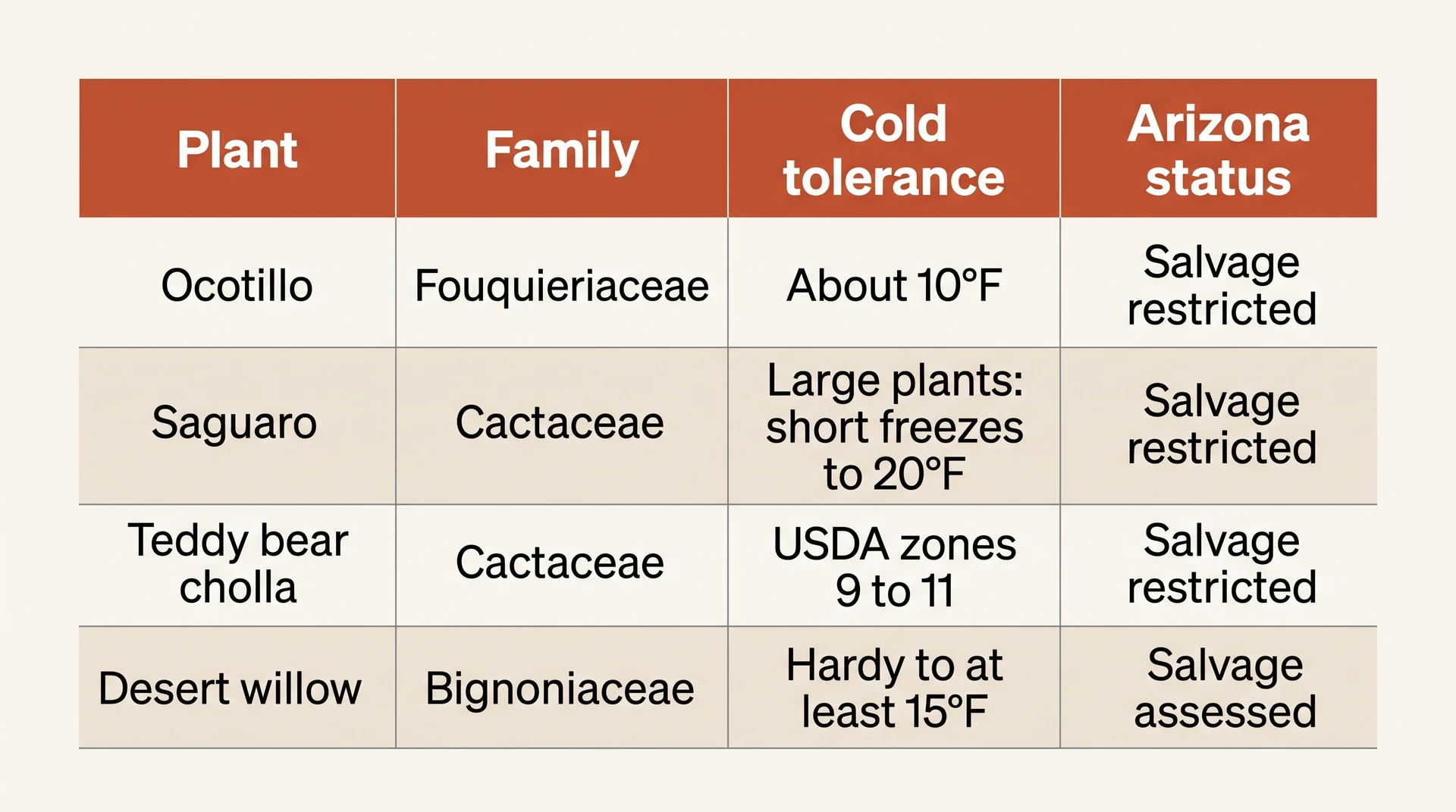
The figures come from the Desert Museum saguaro sheet, its desert willow sheet, the Saguaro National Park flower page, The Living Desert’s teddy bear cholla sheet and Arizona State University’s plant profile, with legal categories from Appendix A. Cholla species differ; the teddy bear cholla stands in for the group. The cold figures are not like for like, since they are temperatures for ocotillo, saguaro and desert willow and a zone range for cholla, so read them as rough guides. The takeaway is that the legal status differs more than the care does: only desert willow sits in the lighter category.
For a bed built around an ocotillo, the Desert Museum says saguaro is native to the Sonoran Desert and does well in most soils as long as they drain; our saguaro care guide, palo verde care guide (Appendix A lists blue and foothill palo verde as salvage assessed) and agave growing guide cover the usual neighbors.
Ocotillo FAQ
Is ocotillo a cactus?
No. Ocotillo is a woody shrub in the family Fouquieriaceae, and the Arizona-Sonora Desert Museum says it is not even closely related to cacti.
How fast does an ocotillo grow leaves after rain?
Friends of Madera Canyon report leaves within 24 hours in warmer months, and the NRCS note says it may leaf out completely in as little as 48 hours.
How often should I water a new ocotillo?
University of Arizona Extension says at least weekly in summer and twice a month in winter, tapering as the plant establishes, after the NRCS two-week dry healing period if you follow it. The Extension also warns that too much irrigation after transplanting can kill ocotillos.
How long until a transplanted ocotillo leafs out and flowers?
The Extension says 6 to 24 months before it leafs out routinely and starts to flower. In the NRCS note a Desert Museum botanist says up to one year to judge success, and a Boyce Thompson Arboretum horticulturist says two growing seasons may be needed.
Can I dig up a wild ocotillo in Arizona?
Not without a permit. Arizona lists ocotillo as a salvage restricted native plant, and rule R3-3-1104 bars collecting, transporting, possessing or selling protected native plants without an appropriate permit.
How cold can ocotillo get?
University of Arizona Extension and the Forest Service give about 10°F; the Desert Museum and the Southern Nevada Water Authority list 0°F. Use 10°F for planning.
Sources
- University of Arizona Cooperative Extension. Ocotillo, Backyard Gardener #80. Adapted from Schalau J, Yavapai County (linked in text)
- Arizona-Sonora Desert Museum. Ocotillo or Coachwhip (Fouquieria splendens), Plant Care Information (linked in text)
- Desert Botanical Garden. Planting a Bare Root Ocotillo, Desert Gardening Guides, 03/04 (linked in text)
- USDA Natural Resources Conservation Service, Tucson Plant Materials Center. Salvage Techniques for Saguaro Cacti, Barrel Cacti and Ocotillo, Technical Note Plant Materials 9-1, Arizona, September 2009 (linked in text)
- Mooney HA, Strain BR. Bark photosynthesis in ocotillo. Madroño 1964;17:230-233 (linked in text)
- McDonald C. Ocotillo (Fouquieria splendens), Plant of the Week. USDA Forest Service (linked in text)
- Friends of Madera Canyon. Ocotillo fact sheet (linked in text)
- Sunnylands. Fact sheet: Fouquieria splendens, with Lady Bird Johnson Wildflower Center data (linked in text)
- Texas Parks and Wildlife. Florafact: Ocotillo. Texas Parks and Wildlife magazine, December 2014 (linked in text)
- Southern Nevada Water Authority. Plant profile: Ocotillo (linked in text)
- Arizona Administrative Code, Title 3, Chapter 3, Article 11, Appendix A: Protected Native Plants by Category, effective February 2, 2025 (linked in text)
- Arizona Administrative Code R3-3-1104. Protected Native Plant Permits (linked in text)
- McReynolds K. Arizona Native Plant Law: What You Need to Know, AZ1506. University of Arizona Cooperative Extension, 2010 (linked in text)
- Kelly J, Grumbles R. Cactus, Agave, Yucca and Ocotillo, AZ1225. University of Arizona Cooperative Extension, 2009 (linked in text)
- Arizona-Sonora Desert Museum. Saguaro (Carnegiea gigantea), Plant Care Information (linked in text)
- Arizona-Sonora Desert Museum. Desert Willow or Mimbre (Chilopsis linearis), Plant Care Information (linked in text)
- National Park Service. Flowers, Saguaro National Park (linked in text)
- The Living Desert Zoo and Gardens. Teddy-bear cholla (Cylindropuntia bigelovii) (linked in text)
- Arizona State University Library. Cylindropuntia bigelovii, plant profile, Martin plant collection (linked in text)


