

Baobab Fruit: The Pulp Is Already Dry on the Tree, the Oldest Dated African Baobab Was About 2,450 Years Old, and You Can Grow One From Seed in the US

Baobab fruit pulp is dry inside the pod and only 20% of the fruit. See the vitamin C numbers, why radiocarbon dates the trunk, and how to grow one from seed.
In short
- Baobab tree fruit is a woody pod of dry, powdery pulp; the pulp is only about 20% of the fruit by weight.
- You can grow the tree from seed after scarifying the coat, but SANBI says baobabs cannot tolerate even mild frost.
- Oregon State lists zone 11 (with a question mark on zone 10); elsewhere it is a pot plant, and no source we read reports fruit from a potted tree.
- Checked against: Nature Plants, Nature, SANBI, Oregon State University, USDA.
Crack open a ripe baobab pod and the pulp inside is already dry: a pale, chalky mass packed around dark, kidney-shaped seeds, with no drying step needed. South Africa’s National Biodiversity Institute (SANBI) describes a shell that never splits open on its own. The pod hangs on the tree until wind knocks it off or monkeys, baboons or people collect it.
That one fact explains the fruit’s reputation as a superfood powder, and it hides three bigger stories. Very little of the pod is pulp, the famous vitamin C claim depends on what you compare it with, and the oldest trees in Africa were dying fast between 2005 and 2017. It is also a tree a US gardener can grow, on the tree’s terms. This guide covers the fruit first, then the trunk, then the seed-to-pot steps.
What Is Inside a Baobab Fruit?
A baobab fruit is a hard, woody, egg-shaped capsule covered in yellowish-brown hairs, with a dry, powdery pulp over the seeds. SANBI gives the capsule as often longer than 120 mm; Oregon State University gives a range of 12 to 40 cm long and 7 to 17 cm across, forming up to six months after flowering in the late dry season or early wet season.

Three pre-planned garden beds, free
Stop staring at empty beds: printable plans with exact layouts, plant lists and planting calendars — yours free from the Garden Library.
Most of that bulk is not food. A 2022 Molecules paper puts the pulp at 20% of the whole fruit, with the other 80% split between the hard shell, reddish fibers around the seeds, and the seeds themselves. Fruit size varies widely by tree. In a study of 64 Kenyan trees, the big-fruited coastal cluster averaged 515 g per fruit and 103 g of pulp, while the small-fruited cluster averaged 106 g per fruit.
The pulp stays dry because the pod stays shut. None of the sources we read measured how the drying happens, so the following is our reading and not a tested result. The capsule is indehiscent (it never opens on the tree), the fruit forms late in the dry season or early in the wet season, and the Oregon State entry says the ripe fruit contains powdery pulp. A sealed woody shell that loses water slowly fits those facts. An Associated Press report says the fruit remains fresh for long periods because of its thick shell. A 2017 study across Africa measured pulp moisture of 8.81 to 9.93 g per 100 g, about a tenth of the weight.
The taste explains the nicknames. SANBI says the powder soaked in water makes a drink reminiscent of lemonade, and one of the tree’s English names is “cream of tartar tree.” The flowers behind the fruit last about a day. They open in the late afternoon, bats pollinate them after dark, and they fall within 24 hours.

Does Baobab Have 10 Times the Vitamin C of an Orange?
Not on a like-for-like basis. Published vitamin C values for baobab pulp run from 45 to 466 mg per 100 g depending on the study and the weight basis, and a raw orange has 53.2 mg per 100 g according to the USDA FoodData Central entry. None of the baobab figures we read reaches ten times that.
The trap is water. An orange is 86.8% water and baobab pulp is about 9% water, so a gram of pulp holds far more solids than a gram of orange. The table compares the foods two ways: as eaten, and per 100 g of dry matter (our calculation from the sources shown).
| Food | Vitamin C, mg per 100 g as eaten | Water, g per 100 g | Vitamin C, mg per 100 g dry matter (our calculation) |
|---|---|---|---|
| Raw orange (USDA) | 53.2 | 86.8 | 403 |
| Raw apple with skin (USDA) | 4.6 | 85.56 | 32 |
| Baobab pulp, Kenya mean (59 samples from 64 trees) | 175 ± 62 | about 9 to 10 (from a separate study) | about 190 |
| Baobab pulp, 64 Kenyan accessions | 45 to 155 | not reported | not calculated |
As eaten, the Kenyan mean of 175 mg per 100 g (Stadlmayr and colleagues, 2020) is 3.3 times an orange and 38 times an apple. Per gram of dry matter, our calculation puts the same pulp at roughly half of an orange. On these numbers the pulp wins on the plate mainly because it is nearly dry, not because baobab concentrates more vitamin C than citrus does.
Where could “ten times” come from? A 2023 review in Nutrients tabulates 466 mg per 100 g on a dry-weight basis from one cited study. Set against a fresh orange that is 8.8 times, and against an orange’s dry matter it is 1.2 times. It is a mixed-basis comparison, and it still falls short of ten.
One more caution applies. The 2023 review notes that composition can differ significantly between locales, and Stadlmayr’s team found high tree-to-tree differences. Two papers from overlapping author teams on 64 Kenyan trees report a 45 to 155 range (2014) and a 175 mean from 59 pulp samples (2020). We cannot tell from the abstracts why they differ, so we quote both and do not average them.
Who Harvests Baobab Fruit, and Who Gets Paid?
The fruit is mostly wild-harvested, and the people who pick it earn little of the retail price. The Associated Press report quotes a Zimbabwean harvester paid 17 cents per kilogram of fruit, walking up to eight hours a day, while a kilogram of powder sells for about 27 euros (about $30) in Germany. The report names the US, Europe and China as the biggest powder markets.
In 2009 the FDA said it had no questions about a notice that dried baobab pulp is generally recognized as safe. The FDA’s GRAS inventory entry for baobab dried fruit pulp shows a notice from PhytoTrade Africa, filed December 19, 2008, and closed July 25, 2009 with “FDA has no questions.” The intended uses were blended fruit drinks up to 10%, fruit cereal bars up to 15%, and other foods at 0.5 to 3.8%.
Some projects share the income. Baobab Products Mozambique buys from women harvesters, has trained more than 200 of them, and sets aside 20% of its shares for their co-operative.
Supply is also uneven, which matters if demand grows. In a southern African production study, adult trees produced eight times more fruit than sub-adults, and 41% of adult trees consistently produced fewer than five fruit a year. Baboons destroyed up to 85% of immature fruit in nature reserves and on rocky outcrops.
Why the Trunk Is Not Wood, and Why Rings Can’t Date It
The swollen trunk is mostly soft, water-filled tissue. In the six Madagascar species measured by Chapotin and colleagues in the American Journal of Botany, the wood held up to 79% water, had a density of 0.09 to 0.17 g per cubic centimeter, and was 69 to 88% parenchyma, a soft tissue of living cells. The African baobab, Adansonia digitata, was not one of those six, so treat this as the genus’s pattern and not a measurement of the fruit-powder tree.
“Water tank” is only half the story. The same paper notes that recent studies indicate limited use of stored water. A second paper in Plant, Cell & Environment found, in two Madagascar species, that stem anatomy restricts water movement between storage and the conducting pathway, so reserves suit longer deficits and not a daily buffer. We found no measurement of how much water a full-grown African baobab trunk holds. The only volume in the sources we read is SANBI’s record of a tree hollowed out on purpose that held 4,546 liters, about 1,200 gallons.
Stop missing your zone's planting windows.
Select your US zone and month — get a complete checklist of what to plant, prune, feed, and protect right now.
→ View My Garden CalendarBecause the trunk is soft tissue and not annual wood, ring counting fails. Patrut and colleagues state that neither a baobab’s architecture nor its age can be determined accurately by tree-ring methods. They used accelerator mass spectrometry radiocarbon dating on small wood samples taken from inner cavities and the outer trunk instead. Big baobabs turned out to be multi-stemmed, with stems that fuse into a ring around an empty space the team calls a false cavity. The oldest wood sits between the cavity wall and the outer trunk, within reach of a long increment borer.
The oldest dated tree was Panke in Zimbabwe, with a calibrated age of about 2,450 years for its oldest sample. The paper’s introduction says the biggest and oldest specimens may reach ages close to 2,000 years, and its own table puts Panke higher. Panke is dated from remains, because all its stems toppled in 2010 and 2011.
The die-off of the oldest trees
Patrut’s team reports that 9 of the 13 oldest and 5 of the 6 largest African baobabs died, or lost their oldest stems, over the 12 years before the paper. The two lists overlap, giving 15 trees in all, and all 15 stood in southern Africa. The Chapman baobab in Botswana lost all six stems on January 7, 2016. The Platland (Sunland) baobab, at 501 cubic meters the biggest known, had its largest unit split and topple in 2016 and 2017.
The cause is not known. The authors say it was not an epidemic and suspect climate change is involved “at least in part,” while stressing that more research is needed. That is a hypothesis, and nothing in the paper tests it.
The Eight Baobab Species
There are eight living species: six endemic to Madagascar, one in northwestern Australia (A. gregorii), and one on mainland Africa, A. digitata, which is the source of the powder. A 2024 genome study in Nature sequenced all eight and argued that Madagascar is the centre of origin. A Queen Mary University of London release, with comments from Andrew Leitch and Kew’s Ilia Leitch, adds that two species later travelled to Africa and to Australia, and that the flowers evolved for hawkmoths, lemurs and bats.
For a home grower, the practical point comes from the Baobab Foundation: most baobabs look very similar for their first 100 years. If you buy seed, record which species it is, because you will not tell them apart for a long time.
Can a US Gardener Grow a Baobab Tree?
Yes, from seed, but only outdoors in a frost-free climate or in a pot. SANBI says the tree cannot tolerate even mild frost, and it records that baobabs apparently grown in England reached 5 to 6 meters before the frosts of 1740 destroyed them.
Hardiness ratings are thin. Oregon State lists “Hardy to USDA Zone (10?) 11” and says the tree is sometimes grown in Hawaii, southern California and southern Florida. The Fairchild Tropical Botanic Garden says that in South Florida baobabs grow very well and make excellent landscape trees. The USDA hardiness zone map is built on the average annual extreme minimum winter temperature, so a zone 10 garden that still gets a rare frost is a gamble for this species.
Everywhere else, the tree lives in a container. SANBI says saplings can be grown in containers or tubs for many years before they outgrow them, and can be moved indoors behind a sunny window to avoid frost. If a potted trunk reminds you of bonsai, our bonsai tree care guide covers soil, watering, pruning and wiring, and our guide to fruit trees for bonsai covers three species and how to get them to produce. For other tropical fruit trees with their own zone limits, see our guides to the soursop tree and the acai palm.
How to Grow a Baobab From Seed
Step 1: Buy seed, not powder
Pulp powder will not sprout, because it is made after the seeds are taken out. The Molecules paper lists seeds among the side streams discarded in pulp production. Use seed from a whole pod or a seed seller. The Baobab Foundation says to wash the white powder off seed that comes straight from the fruit, and to sow three to six seeds because not all germinate in the first year.
Step 2: Scarify the seed coat
The coat is the barrier, and untreated seed barely germinates. In a greenhouse trial with Kenyan seed, the control germinated 0.2%, sandpaper 55%, boiling for 5 seconds 32%, and soaking in 96% sulfuric acid 80%. The authors recommend sandpaper as the alternative because the acid is not always accessible. We would use sandpaper at home: 96% sulfuric acid is a hazard and sandpaper reached 55%. SANBI’s method is to soak the seeds in hot water, let it cool, and sow after 24 hours of soaking.
Step 3: Sow, then wait two to six weeks
SANBI says germination takes two to six weeks. The two sources give different sowing depths: SANBI covers seed with 4 to 6 mm of sand, and the Baobab Foundation pushes seeds 2 to 3 cm into the mix. Both want a well-drained medium with sand (one-third sand in SANBI’s mix, 25 to 50% in the Foundation’s) and a warm spot. The Foundation says to sow in midsummer and to water daily until the seeds sprout.
Use a deep pot. The Foundation says a seedling grows a tuber in its first and second years, so bags should be at least 20 cm deep, and warns that damaging or bending the main root or tuber affects the tree’s future growth.
| What to decide | What the sources say | Who says it |
|---|---|---|
| Seed treatment | Sandpaper 55% germination; 24-hour hot-water soak as an alternative | Tropentag trial; SANBI |
| Soil mix | Well-drained; 25 to 50% sand (SANBI one-third, Baobab Foundation 25 to 50%) | SANBI; Baobab Foundation |
| Pot depth | At least 20 cm (8 in) for the first-year tuber | Baobab Foundation |
| Germination time | 2 to 6 weeks | SANBI |
| Winter | Leaves drop and the plant goes dormant; water only when in leaf | Baobab Foundation |
| Hardiness | No frost; Oregon State lists zone 11, with a question mark on zone 10 | SANBI; Oregon State |
| Size at 1, 5 and 10 years in a container | Not documented in any source we read | None |
The table’s biggest takeaway: the sources document the steps from seed to dormancy, but not the one gardeners ask about most, how big the potted tree will be.
Winter Dormancy: Leaf Drop Is Normal, Overwatering Is Not
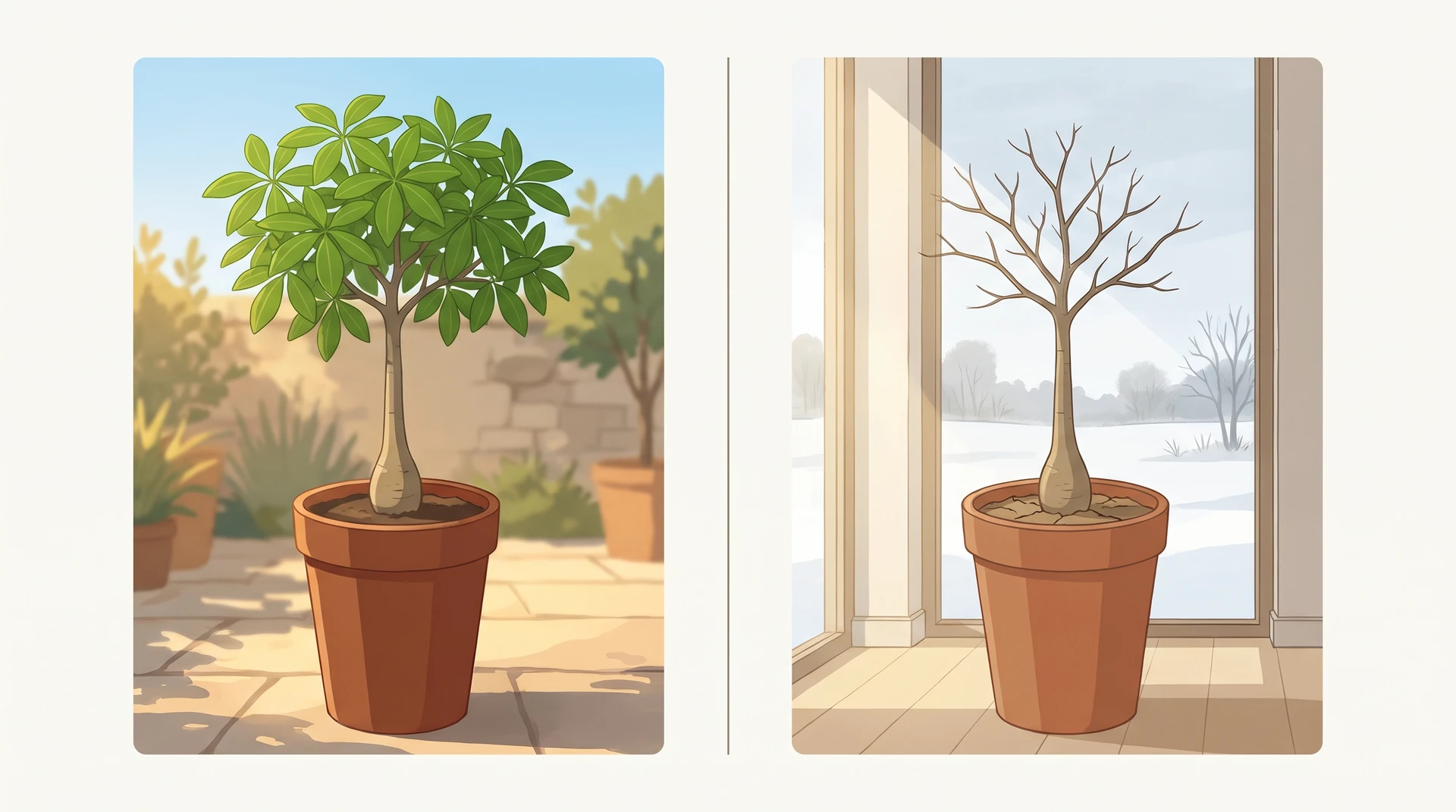
A baobab that drops its leaves in winter is healthy. SANBI calls the species deciduous, losing its leaves in the winter months and regrowing them in late spring or early summer. In the wild, a two-year southern African study recorded trees in leaf from about October or November until March or April.
The Baobab Foundation’s rule is to water only while the plant has leaves. When it goes bare in winter, stop. Restart in early spring at once a week, and water more often only as the leaves fill in. Overwatering a leafless seedling, or one with small new leaves, can cause root rot and kill it, according to the Foundation. Our reading of that rule is that a leafless plant is not drawing much water, so a wet pot stays wet.
Young plants do not look like adults. SANBI notes seedlings have thin stems and simple leaves, not the divided hand shape of mature trees. The Foundation says fertilizer is not normally needed, though young trees respond to most off-the-shelf nitrogen fertilizers. Move the pot outside only when nights are reliably frost-free, and bring it in before the first cold one.
Will a Potted Baobab Ever Fruit?
No source we read reports fruit from a container tree, and wild trees are slow and erratic about it. In the same phenology study, mean fruit set was 20%, and it varied enormously between trees: 33.5% on producer trees against 0.2% on poor producers, even though both flowered about equally. The authors suggest baobabs may be functionally dioecious, and a complete picture of their reproduction is still lacking.
Flower number tended to rise with stem diameter in the same study, a modest relationship, so a small trunk is unlikely to be a heavy flowerer. The pollinators add a second hurdle: SANBI says bats pollinate the flowers at night. A houseplant has neither the size nor the bats. We found no source describing hand pollination of this species, so the safe expectation is a handsome swollen-trunked tree, not a harvest.
Baobab Tree Fruit: Quick Answers
Can you grow a baobab tree from baobab powder?
No. Powder is made from pulp after the seeds and shell are discarded, so it contains no seed. Buy seed, or use seed from a whole pod.
How long do baobab seeds take to sprout?
SANBI says two to six weeks after sowing. Untreated seed germinated 0.2% in the Kenyan trial, so scarify the coat first.
Is it normal for a baobab to lose its leaves in winter?
Yes. The species is deciduous. The Baobab Foundation says to stop watering once the plant is leafless and restart in early spring.
Can I plant a baobab in Florida?
South Florida is the best US case. The Fairchild Tropical Botanic Garden says baobabs grow very well there, and Oregon State lists the tree as hardy to zone 11, with a question mark on zone 10.
How old can a baobab get?
Patrut and colleagues say the biggest and oldest African baobabs may reach ages close to 2,000 years, and the oldest dated tree, Panke, was about 2,450 years old for its oldest sample. Ring counts are not a reliable guide, so ages come from radiocarbon dating.
Sources
- Patrut A, Woodborne S, Patrut RT, Rakosy L, Lowy DA, Hall G, von Reden KF. The demise of the largest and oldest African baobabs. Nature Plants 2018;4:423-426. Author postprint, University of Pretoria repository (linked in text)
- Hankey A. Adansonia digitata. PlantZAfrica, South African National Biodiversity Institute, Walter Sisulu National Botanical Garden, 2004, updated 2017 (linked in text)
- Oregon State University, Department of Horticulture. Adansonia digitata. Landscape Plants (linked in text)
- Chapotin SM, Razanameharizaka JH, Holbrook NM. A biomechanical perspective on the role of large stem volume and high water content in baobab trees (Adansonia spp.; Bombacaceae). American Journal of Botany 2006;93(9):1251-1264 (linked in text)
- Chapotin SM, Razanameharizaka JH, Holbrook NM. Water relations of baobab trees (Adansonia spp. L.) during the rainy season: does stem water buffer daily water deficits? Plant, Cell & Environment 2006;29:1021-1032 (linked in text)
- Wan JN, Wang SW, Leitch AR, Leitch IJ, et al. The rise of baobab trees in Madagascar. Nature 2024;629 (linked in text)
- Queen Mary University of London. The origin and long-distance travels of upside down trees. News release, 15 May 2024 (linked in text)
- Baobab Foundation. Grow your own baobab (linked in text)
- Cermak T, Lojka B. The influence of pre-treatment methods for baobab (Adansonia digitata) seed germination. Tropentag 2018, Ghent, abstract (linked in text)
- Stadlmayr B, Wanangwe J, Waruhiu CG, Jamnadass R, Kehlenbeck K. Nutritional composition of baobab (Adansonia digitata L.) fruit pulp sampled at different geographical locations in Kenya. Journal of Food Composition and Analysis 2020;94:103617 (linked in text)
- Murage M, Kehlenbeck K, Wanangwe J, Njogu K, Waruhiu C, Kasili R, Stadlmayr B. Morphological, genetic and chemical fruit characterisation of baobab (Adansonia digitata L.) accessions from Kenya. Tropentag 2014, Prague, abstract (linked in text)
- Kinuthia MU, Karori SM, Muchugi A, Indieka AS, Dembele C, Mng’omba S, Jamnadass R. Nutritional variation in baobab (Adansonia digitata L.) fruit pulp and seeds based on Africa geographical regions. Food Science & Nutrition 2017;5(6):1116-1129 (linked in text)
- US Department of Agriculture. FoodData Central, SR Legacy: oranges, raw, all commercial varieties (169097); apples, raw, with skin (171688) (linked in text)
- Silva ML, Rita K, Bernardo MA, de Mesquita MF, Pintão AM, Moncada M. Adansonia digitata L. (baobab) bioactive compounds, biological activities, and the potential effect on glycemia: a narrative review. Nutrients 2023;15(9):2170 (linked in text)
- Baobab-fruit shell and fibrous filaments are sources of antioxidant dietary fibers. Molecules 2022;27(17):5563 (linked in text)
- US Food and Drug Administration. GRAS Notice Inventory, GRN No. 273: baobab (Adansonia digitata) dried fruit pulp (linked in text)
- Mutsaka F. Ancient baobab trees in Africa once supplemented local’s income, now climate change and demand have them barely surviving. Associated Press, via PBS NewsHour, 18 September 2024 (linked in text)
- SEED. Baobab Products Mozambique, 2014 SEED Africa Award profile (linked in text)
- Venter SM, Witkowski ETF. Baobab (Adansonia digitata L.) fruit production in communal and conservation land-use types in Southern Africa. Forest Ecology and Management, doi 10.1016/j.foreco.2010.11.017 (linked in text)
- Venter SM, Witkowski ETF. Phenology, flowering and fruit-set patterns of baobabs, Adansonia digitata, in southern Africa, 2019 (linked in text)
- Fairchild Tropical Botanic Garden. Baobab, Adansonia digitata (linked in text)
- USDA Agricultural Research Service. 2023 USDA Plant Hardiness Zone Map, planthardiness.ars.usda.gov


