

Catmint vs Catnip: The Nepetalactone Level That Makes Your Cat Lose It

Catmint feeds bees all summer. Catnip sends cats into a euphoric roll. Here’s the chemistry — and a diagnostic table — that tells them apart.
Plant Nepeta racemosa ‘Walker’s Low’ along a sunny border and bumblebees will work it from June frost to fall frost, while your cat walks past it without a second glance. Plant Nepeta cataria — true catnip — in the same spot, and your cat will find it before you’ve finished tamping down the soil, then flatten it within a week. Same genus, same family, wildly different result, and the reason comes down to one molecule that one plant makes in bulk and the other barely bothers with.
Most “catmint vs catnip” articles stop at “they’re related but different.” This one goes further: the exact compound responsible, how much of it each plant actually contains, why roughly a third of cats don’t react to either one, and which plant earns a spot in your garden depending on whether you’re gardening for pollinators, for your cat, or for both without one wrecking the other.
Same Genus, One Wildly Different Molecule
“Catmint” and “catnip” aren’t interchangeable names for the same plant — they’re common names that get used loosely, but botanically they land on different species inside the genus Nepeta. Catnip is specifically Nepeta cataria, an erect, spreading herb with white, pale-purple-spotted flowers that blooms May through September and tops out around knee to waist height [1]. “Catmint” usually refers to the ornamental hybrids and species sold at garden centers — Nepeta x faassenii and Nepeta racemosa, including the ubiquitous ‘Walker’s Low’ — which form tidy, silvery-leaved mounds with lavender-blue flower spikes instead of catnip’s white ones [2].
Every Nepeta species produces some amount of nepetalactone, the iridoid compound behind the cat response. The difference between catmint and catnip isn’t that one has it and the other doesn’t — it’s concentration. Nepeta cataria was bred and selected (accidentally, over centuries of cultivation as a medicinal and culinary herb) toward high nepetalactone output. The ornamental catmint hybrids were selected for flower color, bloom length, and compact habit — traits that had nothing to do with nepetalactone and, as an incidental side effect, mostly didn’t select for it either. NC State Extension notes that cats do find Nepeta x faassenii’s scent attractive, “despite the name” suggesting otherwise, but the response is a fraction of what true catnip triggers [2].

Three pre-planned garden beds, free
Stop staring at empty beds: printable plans with exact layouts, plant lists and planting calendars — yours free from the Garden Library.
Nursery tags add to the confusion. Plants sold as “Nepeta mussinii” are usually Nepeta racemosa under an older, still-common synonym, and “Persian catmint” and “dwarf catmint” both get used for the same low, spreading species — none of which is catnip, whatever the tag implies with the word “cat” in it. If a label says Nepeta cataria anywhere in the fine print, that’s the one your cat will find.
The Diagnostic Table: Tell Them Apart in 10 Seconds
If you’re standing in a nursery aisle looking at two silvery-leaved, purple-flowered pots with no tags, here’s what actually separates them — not just “one’s for cats,” but the specific traits you can check with your eyes and your fingers.

| Trait | Catmint (N. racemosa / N. x faassenii) | Catnip (N. cataria) |
|---|---|---|
| Flower color | Lavender-blue to deep blue-mauve | White, with pale purple spotting |
| Height & habit | Tidy mound, 0.6–0.9m (2–3ft); shears back cleanly | Loose, straggly, up to 1m; leans and sprawls |
| Leaf shape | Small, narrow, silvery-gray, finely toothed | Larger, heart-shaped, coarsely serrated, felted gray-green |
| Nepetalactone level | Present, but a fraction of catnip’s output | Up to roughly 0.8% of dry leaf weight at full bloom [3] |
| Bee & pollinator value | RHS “Plants for Pollinators” listing; AGM cultivars available [4] | Also visited by bees, but rarely grown for it |
| Cat response | Mild to none in most cats | Strong euphoric response in roughly two-thirds of cats [5] |
| Garden use | Border edging, xeriscaping, cut flowers | Culinary/medicinal herb, companion planting, cat enrichment |
The single fastest field test if the tag is missing: crush a leaf. Catmint smells like a clean, minty-lavender blend. Catnip smells sharper and more medicinal — closer to what’s in a bag of dried catnip toy filling, because that’s exactly what it is [6].
Why Nepetalactone Turns One Into a Cat Magnet (and Barely Registers in the Other)
The mechanism isn’t just “cats like the smell.” Nepetalactone binds to receptors in a cat’s nasal tissue, which signal sensory neurons that route through the olfactory bulb to the amygdala and hypothalamus — the brain regions handling emotion and instinctive behavior [7]. In a 2021 Science Advances study, researchers went further and found that exposure to the related iridoid compound in silver vine (a chemical cousin of catnip’s nepetalactone) triggers a measurable spike in beta-endorphin and activates mu-opioid receptors; block those receptors pharmacologically, and the signature rubbing-and-rolling response disappears entirely [8]. The same study found cats that rubbed the compound onto their fur got landed on by significantly fewer mosquitoes afterward — the rolling isn’t just pleasure-seeking, it’s functional self-anointing with a compound that happens to repel insects. Catnip’s nepetalactone triggers the same rubbing behavior through the same pathway; it just wasn’t the specific compound tested most rigorously in that particular study, so treat the mosquito-repellent detail as “the same mechanism, closely related molecule” rather than a catnip-specific finding.
None of this happened by accident, and it’s not really about cats at all. The prevailing explanation among researchers who’ve traced nepetalactone’s evolutionary history is that the compound didn’t evolve to please felines — it evolved as a chemical defense against insects. A peer-reviewed study on nepetalactone’s origins concludes that its adaptive function is “to protect against herbivorous insects, not to stimulate cats,” with repellency efficiency against pest insects comparable to synthetic DEET [9]. Cats hijacking an insect repellent for recreational rolling is an evolutionary coincidence — their opioid receptors happen to respond to a molecule the plant makes for an entirely different reason.
Here’s the part that trips people up: not every cat reacts, to either plant. Sensitivity to nepetalactone is an inherited, autosomal-dominant trait, so a non-response is genuine biology, not a picky cat ignoring a weak plant [7]. Kittens don’t respond at all until they hit sexual maturity around six to eight months, regardless of genotype. A peer-reviewed study that tested cats directly against several plants found 68% responded to catnip specifically, versus around 79% for silver vine [5] — so roughly one cat in three simply isn’t wired to notice either plant, the same way some people can’t taste cilantro’s soapiness. The genetics hold up oddly well across the wider cat family, too: that same study found lions, jaguars, leopards, and snow leopards typically respond to catnip the way house cats do, while most tigers tested showed no reaction at all [5].
Quantity matters too, and this is where the two plants really diverge. Essential oil analysis of Nepeta cataria found nepetalactone content climbing through the growing season — the lowest yield at the vegetative stage, roughly tripling by full flower [3]. Practically: a catnip plant just coming into bud is a weaker draw than the same plant three weeks later, fully in bloom. Ornamental catmint never reaches that concentration regardless of growth stage, which is the real, chemical reason your cat treats Walker’s Low as scenery.
Catmint: Built for Bees, Borders, and Drought

Plant catmint for the garden it builds, not for what it does to your cat, because mostly it does nothing. Nepeta racemosa ‘Walker’s Low’ carries the RHS Award of Garden Merit and an official “Plants for Pollinators” designation, and it earns both — the whorled flower spikes bloom from spring into fall if you shear them back after the first flush, which is longer than almost any other drought-tolerant perennial in a similar color range [4] [10]. In my own zone 6 border, Walker’s Low is still putting out flower spikes in October while the true catnip two beds over finished blooming and dropped seed back in July.
That October detail matters for a reason most catmint write-ups skip: not every catmint cultivar behaves the same way once it sets seed. Nepeta racemosa ‘Walker’s Low’ can self-seed fairly readily in ideal conditions, according to Missouri Botanical Garden’s cultivation notes [10] — it’s a straight species selection, not a sterile hybrid. If you want zero volunteer seedlings, look instead for a true Nepeta x faassenii cultivar (‘Six Hills Giant’, ‘Cat’s Meow’); NC State Extension notes these are sterile hybrids that won’t reseed at all [2]. That’s a real distinction inside “catmint” as a category, and it’s worth checking the tag before you plant a hundred-foot border expecting one behavior and getting the other.
For side-by-side comparisons with the other purple-flowering, drought-tolerant perennial gardeners reach for in the same bed, see our full breakdown of catmint vs lavender and which needs less water. If you’re starting a bed from scratch, our step-by-step guide to growing catmint covers site prep, spacing, and the pruning schedule that keeps it blooming past the first flush.
Catnip: Useful, But Plant It Like You Mean It
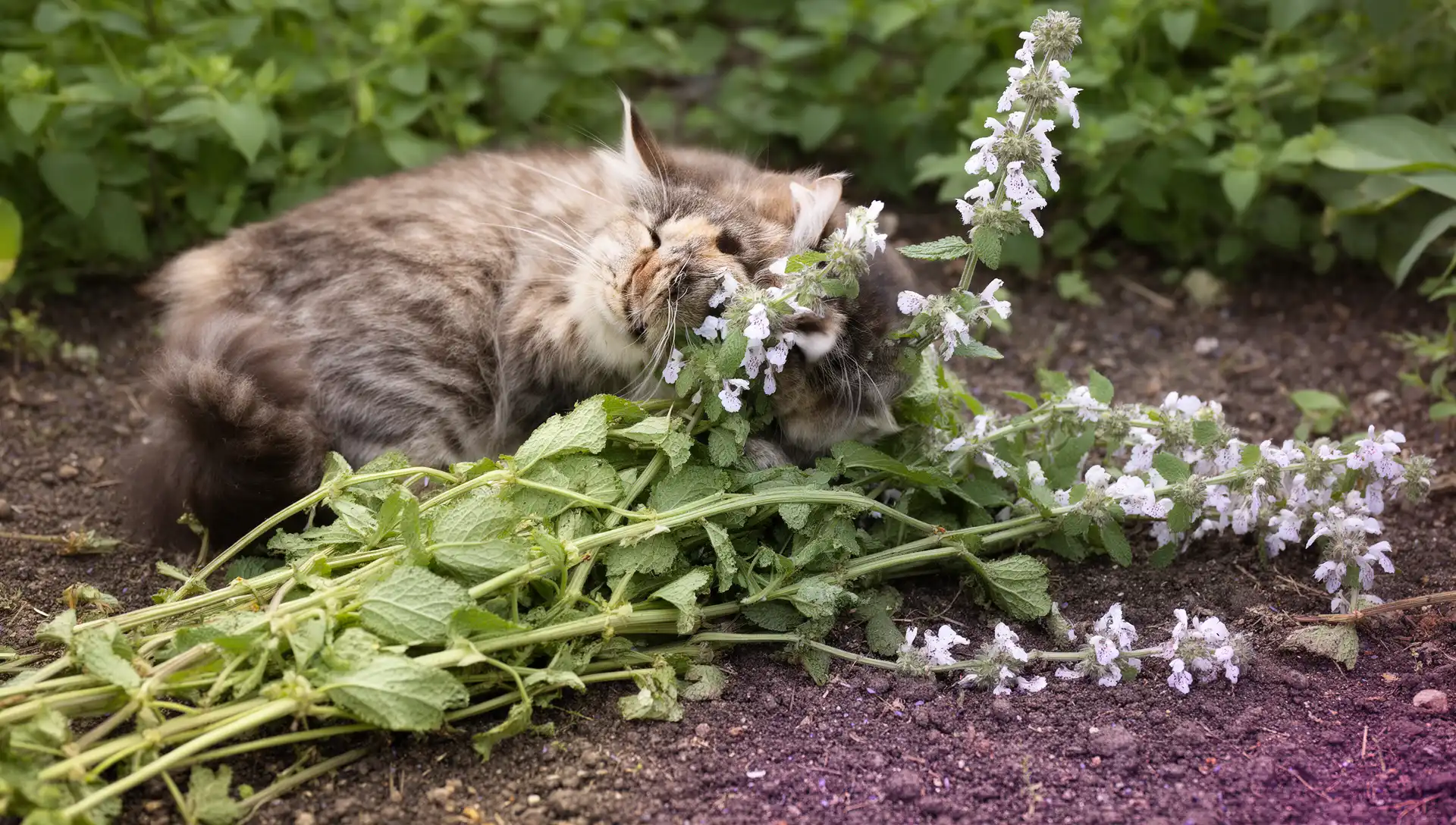
Grow true catnip and you’re growing a working herb, not a border plant — and it needs to be treated like one. Nepeta cataria has genuine culinary and historical medicinal use as a mild tea herb, doubles as a companion plant that keeps aphids and squash bugs off nearby vegetables through scent-masking, and gives outdoor and indoor cats an enrichment source that doesn’t involve a $12 pouch from the pet aisle [1]. It also self-seeds far more readily than most catmint cultivars and has a loose, sprawling habit that reads as weedy by midsummer if it isn’t contained. The one time I let a catnip patch go to seed near a vegetable bed, I spent the next two growing seasons pulling volunteers out of the carrot row.
Worth knowing before you plant it near a household cat: the ASPCA lists catnip in its toxic-plant database, with nepetalactone as the toxic principle, and its own description is a good calibration for how seriously to take that — it can cause vomiting and diarrhea, and it sedates some cats while over-stimulating others [11]. That’s not the same as “dangerous.” Cats self-regulate their catnip intake almost universally — the euphoric window runs about ten minutes before a roughly hour-long refractory period sets in where the same cat won’t react again even if you dangle fresh leaves in front of it [7]. Problems show up almost exclusively when a cat gorges on a large quantity of fresh foliage in one sitting, which a living garden plant makes easy to do if it’s planted where your cat has unsupervised access around the clock. Container-grown, in a spot you can monitor, is the practical fix — not avoiding the plant.
If you’re building a working herb bed rather than a purely ornamental one, our guide to herb companion planting covers exactly where catnip earns its place alongside lemon balm, borage, and yarrow for pest deterrence.
For indoor cats, skip the garden bed entirely and grow catnip in a pot on a windowsill out of jumping range, then snip and offer fresh leaves rather than letting the cat access the whole plant unsupervised — that’s the difference between a controlled ten-minute play session and a shredded pot of soil on the floor. Outdoors, a large container sunk at the edge of a patio does the same containment job while still letting the roots stay cool, which catnip needs in hot summer climates far more than the ornamental catmints do.
Stop missing your zone's planting windows.
Select your US zone and month — get a complete checklist of what to plant, prune, feed, and protect right now.
→ View My Garden CalendarWhich One Should You Actually Plant?
If you’re gardening primarily for pollinators and don’t have a cat in the mix, catmint wins without much debate — longer bloom window, tidier habit, official pollinator credentials, and no risk of a resident cat treating your border like a wrestling mat. If you have an indoor cat that needs enrichment, or you want a genuine culinary/medicinal herb, catnip is the only one of the two that actually delivers either — just grow it in a container or a bed your cat can’t reach unsupervised, and deadhead before it sets seed if you don’t want volunteers.
The middle ground that most guides miss: you can grow both in the same yard without conflict, as long as they’re not in the same bed. Put catmint in the front border where it needs to look intentional and bloom for months. Put catnip in a back corner or a large container near a cat door, where a flattened, chewed-on plant is the point rather than a problem. Given how differently the two plants behave once a cat actually finds them, that separation does more for both plants’ survival than any amount of pest spray or netting would.
Frequently Asked Questions
Is catmint the same as catnip?
No. Both are Nepeta species, but catnip specifically refers to Nepeta cataria, while catmint usually refers to ornamental hybrids like Nepeta x faassenii and Nepeta racemosa. All catnip is technically a catmint, but most catmints aren’t catnip [1] [2].
Will cats destroy ornamental catmint the way they destroy catnip?
Rarely to the same degree. Catmint contains far less nepetalactone, so most cats show mild interest at most, not the rolling, flattening response catnip triggers [2] [3].
Is catnip actually toxic to cats?
The ASPCA lists it in its toxic-plant database because overconsumption can cause vomiting, diarrhea, and over- or under-stimulation, but cats almost universally self-limit their intake and the reaction passes within about an hour. It’s a mild irritant risk from overeating fresh foliage, not a poisoning hazard in normal garden quantities [11] [7].
Why doesn’t my cat react to catnip at all?
Sensitivity is an inherited, autosomal-dominant trait that only about two-thirds of cats carry, and kittens don’t respond until sexual maturity regardless of genotype. A non-reacting cat isn’t a sign of a weak plant — it’s genetics [5] [7].
Do lions and tigers respond to catnip too?
Lions, jaguars, leopards, and snow leopards generally do, rolling and rubbing much like house cats. Tigers are the outlier — in controlled testing, nearly all of them ignored catnip completely [5].
Which one is better for pollinators?
Catmint, specifically Nepeta racemosa ‘Walker’s Low’ and similar cultivars, which carry the RHS Award of Garden Merit and an official Plants for Pollinators designation for their long, reliable bloom window [4] [10].
Sources
- NC State Extension Gardener Plant Toolbox — Catnip (Nepeta cataria)
- NC State Extension Gardener Plant Toolbox — Nepeta x faassenii (Blue Catmint)
- PMC — Chemical Composition and Antimicrobial Activities of Essential Oil of Nepeta cataria L.
- RHS — Nepeta racemosa ‘Walker’s Low’ plant profile
- Bol et al., BMC Veterinary Research — Responsiveness of Cats (Felidae) to Silver Vine, Tatarian Honeysuckle, Valerian and Catnip
- Douglas County (WSU Extension) Master Gardener Program — Ask a Master Gardener: Catnip vs Catmint
- Compound Interest — The Chemical Behind Catnip’s Effect on Cats
- Sci.News — Bioactive Compounds Found in Catnip and Silver Vine Protect Cats Against Mosquito Bites (Uenoyama et al., Science Advances, 2021)
- PMC — The Evolutionary Origins of the Cat Attractant Nepetalactone in Catnip
- Missouri Botanical Garden Plant Finder — Nepeta racemosa ‘Walker’s Low’
- ASPCA — Toxic and Non-Toxic Plants: Catnip


