

Peace Lily Meaning: The One Common Houseplant That Means Purity and Peace in Every Culture

Discover peace lily meaning, symbolism across cultures, spiritual significance, and what it means as a gift — including a prominent toxicity warning for pet owners.
Most flowers mean something. The peace lily means exactly what it looks like. That alignment between name, form, and cultural weight is rarer than it sounds, and it’s the reason Spathiphyllum wallisii has become the default condolence plant, a consistent Feng Shui recommendation, and a quiet fixture in Buddhist and Christian symbolism alike.
This guide unpacks what the peace lily actually represents across cultures and traditions, why it became the world’s most popular sympathy flower, and what you need to know before giving one as a gift. Including the one point most guides bury at the end: it’s toxic to cats and dogs, and that matters before you choose it. For the wider context of floral symbolism, see our flower symbolism guide.
What Does a Peace Lily Symbolise?
The peace lily carries four core meanings — peace, purity, healing, and hope — and earns all four. What makes it unusual among houseplants is that its name, its appearance, and its cultural associations all point in exactly the same direction. That kind of symbolic coherence is genuinely rare.
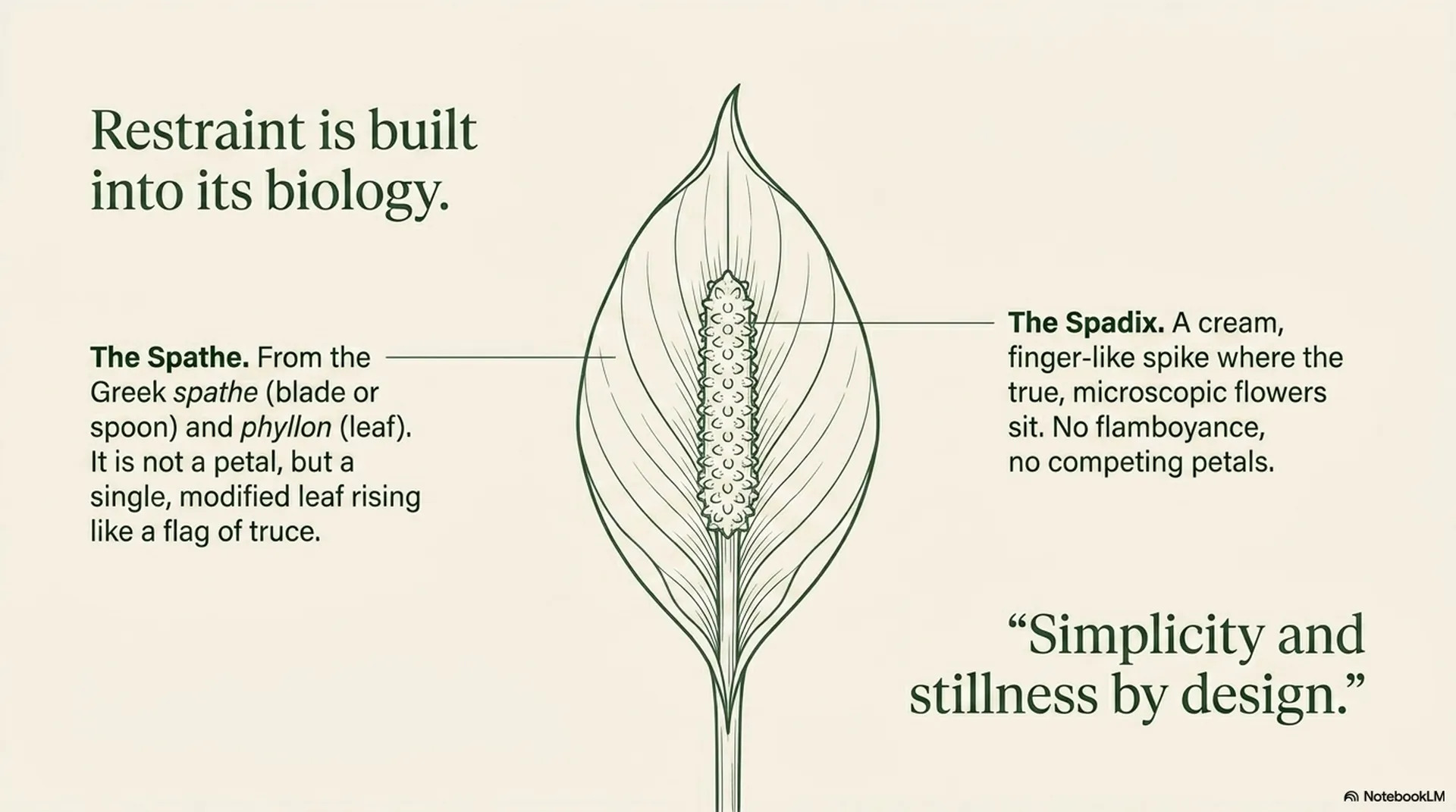
The white spathe rises above dark green foliage like a flag of truce. The plant blooms even in dim corners where little else flowers. Its botanical name, Spathiphyllum, comes from the Greek spathe (blade or spoon) and phyllon (leaf) — and that’s precisely what the “flower” actually is: a single white modified leaf (the spathe) cradling a cream finger-like spike called the spadix, where the true tiny flowers sit [2]. There’s no flamboyance, no competing petals. Just a still, upright, white form. Restraint is built into its biology.

Get a free pre-planned flower bed (vase-worthy from June to frost)
Printable planting plans for a cut-flower bed and a cottage pollinator bed — plant list, spacing, and calendar included.
One clarification worth making upfront: despite the name, peace lily is not a true lily. It belongs to the Araceae family — the same family as monsteras and anthuriums — not the Lilium genus. This matters practically, particularly for pet owners. True Lilium species can cause fatal kidney failure in cats from even minimal exposure; the peace lily’s toxicity operates through a different and generally less severe mechanism. More on that below. For the full picture of lily symbolism, see our article on white lily meaning and funeral flower symbolism.
Why the Peace Lily Is the Most Common Sympathy Flower
Walk into a florist and ask for the most popular condolence plant. In most cases, the answer is the peace lily — ahead of cut white roses, ahead of potted orchids, ahead of everything else. This dominance isn’t convention for its own sake. Several symbolic and practical qualities converge in a single plant in a way that nothing else quite matches.

The white spathes carry an immediate association with the peace of the soul. That quiet, luminous white — without the showy intensity of roses or the complexity of true lilies — reads as gentle and appropriate in grief rather than intrusive. But what truly cements the peace lily as a bereavement gift is something less often remarked upon: it blooms in low light.
Most flowering houseplants need bright, indirect light to perform reliably. The peace lily doesn’t. It produces its white spathes even in shaded rooms, north-facing living rooms, and hospital wards — the exact places where grieving families often spend the most time [2]. That biological fact carries a metaphor no florist needs to explain. Hope and life persisting in the darkest times isn’t a slogan printed on a card; it’s the literal growing condition of the plant you’re giving. I’ve thought about this every time I’ve recommended a peace lily over cut flowers for a bereavement gift. The metaphor is structural, not decorative.
The longevity argument completes the picture. A well-cared-for peace lily lives for years indoors [2]. Cut flowers last days — typically five to ten before they’re cleared away. The peace lily persists through the period of acute grief, through the months of adjustment, and into the years that follow. It becomes a living presence in the household rather than a temporary gesture. For bereaved recipients, a plant that continues to grow and bloom is a different kind of comfort from one that dies within the week.
Peace Lily Symbolism Across Cultures
Christian tradition
In Christian liturgical symbolism, white is the colour of holiness, spiritual purity, and divine grace. White vestments appear at baptisms and at Easter — the rites of new life and resurrection. The dove, symbol of the Holy Spirit, is white: Matthew 3:16 describes the Spirit descending “like a dove” at Christ’s baptism, and from that image the white dove became the universal Christian emblem of divine peace [5].

The peace lily ties these threads together precisely. A white spathe shaped like a raised wing, standing upright as a flag of truce, it carries centuries of accumulated Christian association between whiteness and divine grace. For Christian mourners, a peace lily at a funeral or memorial service holds this entire weight without requiring it to be stated — the peace of Christ, the presence of the Holy Spirit, the flag of truce with death. For related floral symbolism in this tradition, see our article on iris meaning — faith and peace.
Spanish-speaking cultures
In Spanish, the peace lily is “Lirio de la Paz” — Lily of Peace. The word paz carries strong Marian resonance in the Spanish-speaking Catholic world. Bolivia’s administrative capital, founded in 1548, was named Nuestra Señora de La Paz — Our Lady of Peace — placing peace specifically within the domain of the Virgin Mary’s intercession. In Catholic Latin American communities, the peace lily’s very name invokes this: paz is not simply the absence of conflict, but the grace that flows through Marian devotion. Giving a Lirio de la Paz at a time of bereavement or illness carries this theological undertone for those who recognise it.
Feng Shui
In Feng Shui practice, the peace lily is one of the most widely recommended plants for improving the energy flow within a home. It’s associated with the absorption of Sha Chi — stagnant or negative energy — and its conversion into Sheng Chi, positive and life-giving energy [6]. Traditional placement recommendations include the north sector of a room (associated with the Water element, which the white bloom reinforces), near doorways to welcome positive chi, or in workspaces where mental clarity and calm are needed. The plant’s Feng Shui reputation for purification connects naturally to its cultural association with the NASA clean air research discussed below.
You might also find spider lily meaning: symbolism, colours helpful here.
The NASA Clean Air Study — and its real limits
The 1989 NASA Clean Air Study, led by researcher B.C. Wolverton in association with the Associated Landscape Contractors of America, tested houseplants in sealed chambers for their ability to filter volatile organic compounds (VOCs) — including benzene, formaldehyde, and trichloroethylene [3]. The peace lily was among the best performers. This study embedded the plant in popular culture as an “air-purifying” houseplant, reinforcing its cultural association with cleansing and domestic purification.
The caveats matter, and most plant articles quietly omit them. A 2019 review by Bryan Cummings and Michael Waring at Drexel University, published in the Journal of Exposure Science & Environmental Epidemiology, analysed 196 experiments from 12 previously published studies [4]. Their conclusion: to match the natural air-exchange rate of a typical ventilated building, you would need between 10 and 1,000 plants per square metre of floor space. One peace lily — or a dozen — does not measurably change indoor air quality in a real home environment.
The symbolic association with purification has its own cultural life regardless of the chemistry. But the scientific claim, as it circulates in lifestyle content, is significantly overstated. A peace lily is still a beautiful and meaningful plant — just not an air filter in any practically meaningful sense.
The Spiritual Meaning of the Peace Lily
The peace lily’s spiritual significance runs deeper than condolence convention. The still white spathe — upright, quiet, perfectly formed — has become a visual shorthand for inner silence and equanimity: the quality of remaining calm not because nothing is happening, but because the interior life is settled.
Stop building garden beds by guesswork.
Drag and drop plants into your raised bed grid — see companion pairs, spacing, and full layout before you dig.
→ Plan My Garden Layout
In Buddhist thought, upekkha (Pali) or upeksha (Sanskrit) is one of the four Brahmaviharas — the “immeasurable qualities” of a developed mind, sometimes called the four divine abodes. Equanimity here means the capacity to be fully present without being pulled into craving or aversion: a peace that emerges from non-attachment rather than from external stillness. The peace lily embodies this precisely. It doesn’t riot with colour or crowd the room. It simply persists, quietly, in whatever light it’s given.
What adds particular depth is where the spathe originates. The white bloom doesn’t arrive from outside — it rises from within the plant, unfolding from among the deep green leaves. As a metaphor, this is precise: true peace doesn’t depend on circumstances resolving or on the right external conditions being met. It grows from the interior life outward. That’s a more demanding message than most condolence flowers carry, which tend to offer peace as a wish or consolation. The peace lily’s own growth pattern enacts it.
What Does a Peace Lily Mean as a Gift?
The peace lily is the right choice for three distinct gifting contexts:

- Condolences and bereavement — the primary and most established use, for all the reasons described above: the white spathes, the low-light bloom, the longevity. It says: I am with you, and this presence will outlast the immediate grief.
- Healing and recovery — for someone unwell, navigating illness, or in a difficult period. The spiritual dimension — equanimity, the peace that rises from within — is appropriate in a way that a festive flower isn’t. It doesn’t demand cheerfulness; it simply offers steadiness.
- Housewarming — the Feng Shui associations make a peace lily a natural housewarming gift, wishing positive energy flow and calm in the new home.
For growing and care advice once you have one, see our peace lily care guide.
⚠️ Toxicity warning — check before giving
Peace lily (Spathiphyllum) is toxic to cats and dogs, according to the ASPCA Animal Poison Control database [1]. The toxic principle is insoluble calcium oxalates — microscopic needle-like crystals present in all parts of the plant. Clinical signs after ingestion include intense burning and irritation of the mouth, tongue, and lips; excessive drooling; vomiting; and difficulty swallowing [1].
Peace lily is not in the same danger category as true Lilium species, which can cause fatal kidney failure in cats from minimal exposure. Peace lily toxicity is typically acute and localised rather than systemic. However, any suspected ingestion still warrants immediate veterinary contact. The RHS also lists Spathiphyllum as toxic to children and advises wearing gloves when handling the plant [2].
Do not give a peace lily to a household with cats, dogs, or young children who put things in their mouths.
Frequently Asked Questions
Is a peace lily appropriate for a funeral?
Yes — the peace lily is the most widely used sympathy plant in the UK and US. The white spathes represent the peace of the soul; the plant blooms even in low light (hope persisting in darkness); and it endures for years rather than dying within days like cut flowers. It’s appropriate at the home of the bereaved, at a memorial service, or as a lasting condolence gift. Check first whether the recipient has cats or dogs — if so, substitute with an orchid, which carries similar elegance without the toxicity risk.
What does a peace lily mean spiritually?
Spiritually, the peace lily represents inner silence, equanimity, and the peace that rises from the interior life rather than from external circumstances resolving. It connects to the Christian peace of Christ (white = Holy Spirit dove), the Feng Shui transformation of negative energy into positive chi, and the Buddhist concept of upekkha — the cultivated quality of non-reactive stillness. The spathe’s emergence from within the plant itself enacts the core idea: peace grows from the inside out.
Is a peace lily toxic to pets?
Yes. Peace lily is toxic to both cats and dogs due to insoluble calcium oxalates [1]. Symptoms include intense oral burning, excessive drooling, vomiting, and difficulty swallowing. Unlike true Lilium lilies, it’s rarely life-threatening — but it is painful and any suspected ingestion warrants prompt veterinary attention. If you suspect your pet has eaten any part of a peace lily, call the ASPCA Animal Poison Control at (888) 426-4435 or contact your vet immediately. Keep peace lilies out of reach of pets and small children at all times.
Sources
- ASPCA Animal Poison Control. “Peace Lily (Spathiphyllum).” Toxic and Non-Toxic Plants Database. aspca.org
- Royal Horticultural Society. “Peace Lilies (Spathiphyllum wallisii).” RHS Plant Guides. rhs.org.uk
- Wolverton, B.C. et al. (1989). “A Study of Interior Landscape Plants for Indoor Air Pollution Abatement.” NASA/ALCA Technical Report.
- Cummings, B.E. and Waring, M.S. (2019). “Potted plants do not improve indoor air quality: a review and analysis.” Journal of Exposure Science & Environmental Epidemiology. Drexel University.
- Christianity.com. “Why Is the Dove Often a Symbol for the Holy Spirit?”
- Living Etc. “In Feng Shui, Where You Place Your Peace Lily Matters.”


