

Astilbe Meaning: The Victorian Funeral Flower That Now Symbolises Undying Love

Discover what astilbe means — from the Victorian patience meaning and love beyond death to colour symbolism, wedding floristry, and the language of dried plumes.
The name is a contradiction built into the Latin. Astilbe comes from the Greek: a (without) and stilbe (brilliance). To give a flower a name meaning “without brilliance” and then have that flower produce one of the most spectacular displays in the summer shade garden suggests the name’s authors were looking at the wrong thing. Each individual floret, examined alone, is tiny — unremarkable, forgettable in isolation. Gathered in their thousands into feathery plumes of white, pink, red, and lilac rising two to three feet above moist soil beneath a tree canopy, they are anything but. The Victorians noticed this paradox and made it the first principle of the astilbe flower meaning: ordinary small efforts, patiently accumulated, become something extraordinary. For the broader tradition this symbolism belongs to, see our complete guide to flower symbolism and the language of flowers.
Name, Appearance and Origins
Astilbe is a genus of approximately 25 species of herbaceous perennials in the family Saxifragaceae, native to mountain woodland habitats in Asia — principally China, Japan, and Korea — with two species native to eastern North America. Common names include False Spirea and False Goat’s Beard, both acknowledging surface resemblances to unrelated plants. The botanical name was coined by the botanist Andrew Don in 1822.
The “without brilliance” etymology is thought to refer to the individual tiny florets rather than the plant’s overall effect. Each floret, examined apart from the plume, is minute and individually unremarkable. But in the thousands, massed on fine branching racemes, they create the airy, luminous spectacle that makes astilbe one of the most desired shade perennials in American and European gardens.
The foliage is deeply cut and fern-like — a compound leaf with toothed leaflets that often carries bronze or copper tones in spring before maturing to deep green. In some varieties the foliage is handsome enough to be a garden feature independent of the flowers entirely.

Get a free pre-planned flower bed (vase-worthy from June to frost)
Printable planting plans for a cut-flower bed and a cottage pollinator bed — plant list, spacing, and calendar included.
The Patience Meaning
In Victorian floriography, astilbe was assigned one primary meaning: patience. The assignment was not arbitrary — it was observed directly from the plant’s nature.
Astilbe succeeds where almost no other flowering plant will: in deep or partial shade, in consistently moist soil, beneath the canopy of dense deciduous trees. Most flowering plants require direct sun to produce blooms at all. Many that tolerate shade produce only foliage, giving up on flowers entirely in the absence of adequate light. Astilbe does neither. It waits in the difficult conditions — the perpetual shade, the cool damp ground that other plants find oppressive — and when its season arrives, it blooms with full dramatic force.
This willingness to flourish in darkness, to wait without complaint and then deliver spectacular reward, struck Victorian floriographers as an almost moral virtue. The plant embodied what they considered the highest form of patient endurance: not passive resignation, but active preparation for the moment when conditions become favourable.
The meaning resonates no less powerfully today. Astilbe given to someone enduring a long difficult season — a demanding year, a slow recovery, a period of patient waiting for something good — carries this message with precision: I see your patience, and I know it will produce something extraordinary.
Love Reaching Beyond the Grave
The second meaning assigned to astilbe is stranger and more affecting: love that reaches beyond death. This reading comes not from function but from form.
The feathery plumes of astilbe rise upward from low, dense foliage — they ascend visually from darkness into light. Victorian sentimentalists described this form as “souls reaching upward,” and astilbe became a plant of memorial gardens, funeral plantings, and remembrance arrangements for exactly this reason. Its plumes rising from shade were read as the visible expression of a love that refuses to be contained by death — ascending anyway, reaching toward something unseen.
Astilbe was planted extensively in Victorian and Edwardian memorial gardens and on grave borders, where its ability to thrive in shade made it practically suited to settings beneath cemetery trees, and its upward-reaching form made it symbolically resonant. If you are planting a memorial garden or selecting flowers for a space of remembrance, astilbe is among the most historically grounded choices available.
Compare the meaning of hydrangea, another shade-tolerant flowering plant whose symbolism includes heartfelt emotion and deep feeling, for a related perspective on what flowering plants mean in difficult emotional terrain. Among flowers that communicate enduring love, astilbe occupies a specific register: not the passion of a red rose, but the love that continues past difficulty, past absence, past death. For a broader survey, see our guide to flowers that mean love.
Visual Drama in Shade
Astilbe achieves something practically unique in the garden world: genuine floral spectacle in deep shade. Most spectacular flowering plants — roses, dahlias, zinnias, sunflowers — require full sun or near-full sun to perform. In shade, most gardeners resign themselves to foliage plants and accept that flowers will not feature in the picture. Astilbe refuses this compromise.
In Victorian flower language, this shade performance was connected to the qualities of inner light and hidden strength — the capacity to shine when circumstances are unfavourable. The plant embodies a specific kind of courage: not the loud courage of a sunny border, but the quiet persistence of something that blooms anyway, in the dark, without requiring ideal conditions to do so.
Species and Varieties
The main garden groups draw from four species and their hybrids, covering the full colour spectrum and a wide range of heights:
| Group | Key Varieties | Colour Range | Height |
|---|---|---|---|
| A. × arendsii hybrids | ‘Fanal’ (deep red), ‘Bridal Veil’ (white) | White through red | 24–40 in |
| Astilbe japonica | ‘Deutschland’ (white), ‘Peach Blossom’ | White, cream, pink | 24–36 in |
| Astilbe chinensis | ‘Pumila’ (pink-lilac dwarf), ‘Visions’ (lilac) | Pink, lilac, purple | 12–24 in |
| Astilbe simplicifolia | ‘Sprite’ (shell pink) | Pale pink, white | 12–18 in |
Bloom season runs June through August depending on variety and USDA hardiness zone. Staggering early, mid, and late-blooming varieties across a single border extends the display by six to eight weeks. ‘Fanal’ is the most widely grown deep-red variety; ‘Deutschland’ the classic white for bridal arrangements; ‘Pumila’ the most reliable ground-covering dwarf for deep shade situations.
You might also find jasmine meaning: love, spirituality helpful here.
Astilbe Colour Meanings
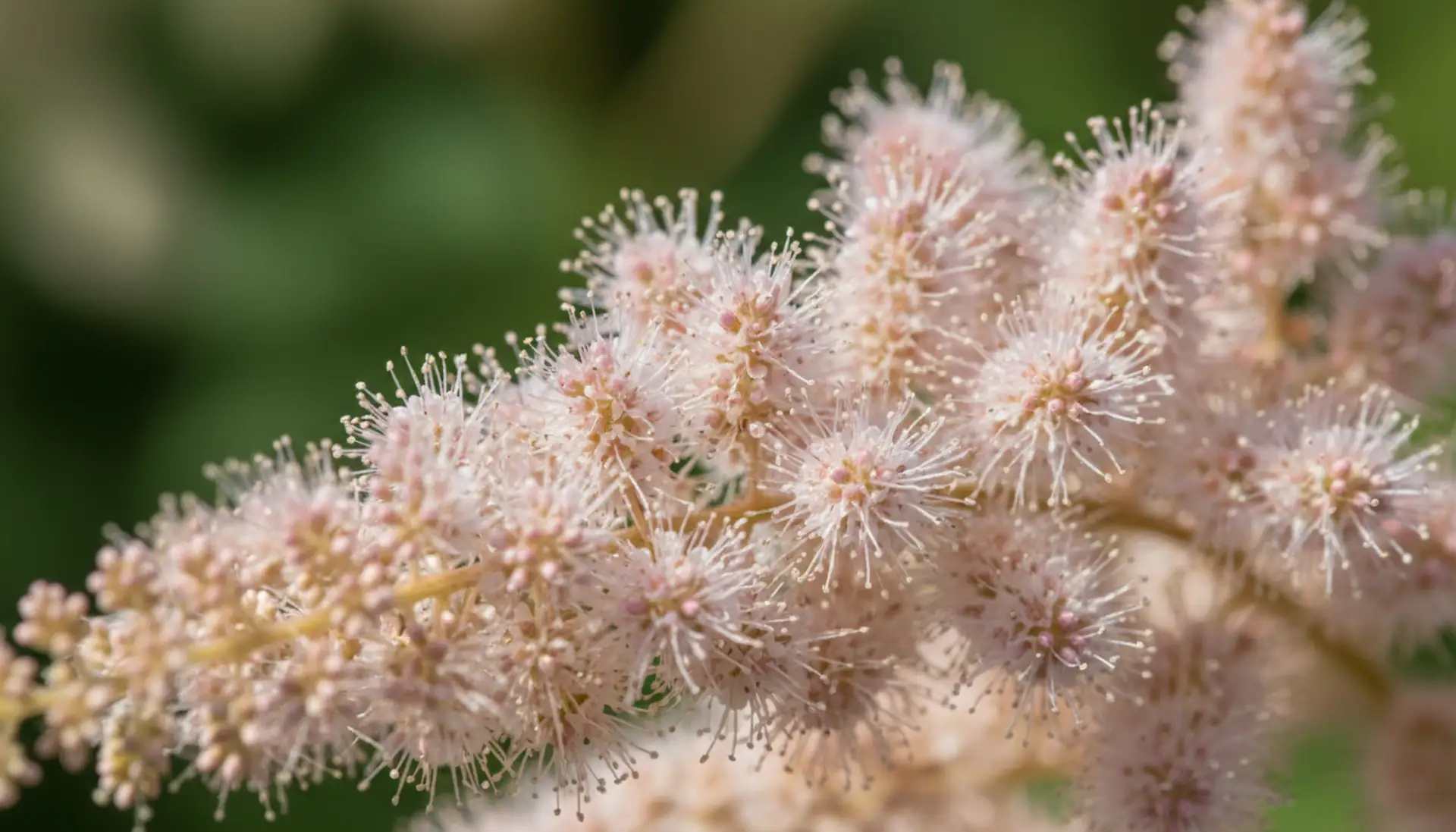
Within the astilbe’s broader symbolic palette, individual colours carry distinct meanings that follow the Victorian colour-coding tradition:
Stop missing your zone's planting windows.
Select your US zone and month — get a complete checklist of what to plant, prune, feed, and protect right now.
→ View My Garden Calendar- White — pure patience and spiritual love; white astilbe in memorial plantings represents peaceful endurance and the soul’s continued journey; ‘Deutschland’ and ‘Bridal Veil’ are the classic white varieties
- Pink — romantic patience and gentle endurance; the most common choice for wedding floristry, it bridges the enduring-love meaning with soft romantic warmth; available across all four main species groups
- Red — passionate love that transcends ordinary limits; the deep crimson of ‘Fanal’ carries the “love beyond death” meaning most directly; the most emotionally intense colour in the astilbe palette
- Lilac and purple — deep patience and spiritual transcendence; purple astilbe connects to Victorian spiritualist traditions in which purple represented communication with and memory of those who have passed
- Salmon and peach — warm patient love and affection that endures without demanding; a gentler message appropriate for anniversaries and enduring friendships
The Language of the Dried Plume
Astilbe does not disappear after bloom. After the flowers fade in late summer, the plumes dry on the stem to produce papery, feathery seed heads in rust-brown, tan, and coppery tones that persist through autumn into winter. They hold their structure through frost and snow in a way that most spent perennial flower heads do not.
In dried flower arrangements and winter wreaths, dried astilbe plumes carry a specific meaning: the memory of love that endures. The plume that remained long after the bloom passed became a natural symbol of lasting remembrance. Dried astilbe is increasingly used alongside pampas grass, lunaria, and statice in contemporary winter dried-flower arrangements precisely because it carries this quality of graceful, beautiful persistence through cold.
Astilbe for Weddings

Astilbe is a leading choice in romantic summer wedding floristry, and its role is specific: it softens. Bouquets built on garden roses, sweet peas, or ranunculus achieve a different character when astilbe is woven among them — the feathery plumes add movement, airiness, and the impression that the arrangement has been gathered from a romantic summer garden rather than assembled on a workbench.
Wedding florists prize this quality above its colour. Astilbe does what no hard-edged flower can: it gives the impression of breath, of light caught in something weightless. This makes it particularly effective in cascading bouquets and garden-style arrangements where the goal is organic, living spontaneity.
The patience meaning resonates specifically in a wedding context. Marriage is, among other things, an act of patience — a commitment to endure through difficult seasons, to wait for the flowering to return, and to trust the arrangement will bloom again. Astilbe in a wedding bouquet carries this message for those who know the language of flowers. For those who do not, it simply adds beauty. Both uses are valid.
How to Give Astilbe
The occasions that call for astilbe are more specific than for most flowers:
- A wedding or significant anniversary — patient, enduring love; love that has already demonstrated it can wait through difficult conditions and continues to bloom
- A memorial garden planting — among the most symbolically grounded choices for a remembrance garden; historically appropriate at grave sites and in spaces of ongoing remembrance
- For someone who has waited long for something good — a long-anticipated promotion, a resolved health situation, a completed difficult project; astilbe acknowledges the patience that made the outcome possible
- For someone with quiet, persistent strength — the person who handles difficulty without drama; astilbe’s bloom-in-darkness quality is a precise symbolic acknowledgement of this character
- A shaded garden as a practical and meaningful gift — for a gardener with a difficult shady corner; astilbe solves the horticultural problem and delivers a symbolic message simultaneously
Frequently Asked Questions
What does astilbe mean?
Astilbe’s primary flower meaning is patience, derived from its ability to bloom spectacularly in deep shade and difficult growing conditions where most flowering plants cannot succeed. Its secondary meaning is love that reaches beyond death, linked to the visual language of its plumes rising upward from darkness — an image the Victorians associated with souls ascending and with love that persists past loss.
What does astilbe symbolise at a wedding?
In wedding floristry, astilbe symbolises enduring love and patient commitment — the love that waits through difficulty and continues to bloom. Its feathery plumes also carry an aesthetic role: they soften arrangements, add movement, and create the impression of a garden-gathered bouquet still alive with a summer breeze. Both the symbolism and the visual quality make it a natural, resonant wedding flower.
What do different astilbe colours mean?
White astilbe means pure patience and spiritual peace. Pink carries romantic patience and gentle endurance. Red — particularly the deep crimson of ‘Fanal’ — represents passionate love that transcends ordinary limits. Lilac and purple connect to spiritual transcendence and deep patience. Salmon and peach carry warm affectionate patience suited to long friendships and anniversaries.
Is astilbe suitable for a memorial garden?
Yes, and historically it is one of the most appropriate choices. Victorian memorial gardens planted astilbe deliberately for both practical and symbolic reasons: it thrives in shaded conditions beneath cemetery trees, and its upward-reaching plumes expressed love continuing past death. Dried astilbe persisting through winter adds an additional layer of “memory that endures” to its meaning in the garden.
Sources
- Missouri Botanical Garden. Astilbe × arendsii — Plant Finder. Missouri Botanical Garden.
- Royal Horticultural Society. Astilbe — RHS Plant Guide. Royal Horticultural Society.
- Greenaway, Kate. Language of Flowers. Frederick Warne & Co., 1884. Primary Victorian floriography record; Project Gutenberg ebook #31591.
- Victoria and Albert Museum. The Language of Flowers. V&A Publishing, 2013. Historical flower symbolism documentation, London.
- North American Native Plant Society. Native Astilbe species documentation. NANPS horticultural records.


