

How to Prune Tomato Plants: Suckers, Topping, and the Mistake That Cuts Your Harvest

Learn how to prune tomato plants correctly: identify suckers, know which types to leave alone, and avoid the cut that quietly costs you fruit.
Before you make a single cut, check one thing: is your tomato determinate or indeterminate? Pruning a determinate variety the way you’d prune an indeterminate one is the single most common mistake home gardeners make with tomatoes — and it can cost you a meaningful share of your harvest, according to Purdue University’s Vegetable Crops Hotline [3]. Get that one decision right, and everything else in this guide is straightforward.
This guide walks through how to identify suckers, why removing them actually works at a biological level, exactly how and when to cut, and the trade-offs almost no other guide quantifies. For the full tomato care guide, including watering, feeding, and problem diagnosis, start there — this article goes deep on pruning alone.
Step 1: Confirm Your Tomato Type Before You Cut
Check the plant tag or seed packet first — it will say “determinate” or “indeterminate” outright. No tag? Watch the growth habit for a week: determinate (bush) types grow to a set height, form a terminal bud, and stop — all their flower clusters appear in a tight window. Indeterminate (vining) types keep growing and setting new flower trusses until frost kills them.
This distinction decides almost everything else in this guide:

Skip the guesswork — get a pre-planned 4×8 kitchen garden bed
Free printable planting plan: what goes where, when to plant it, and how to keep it alive. Plus two bonus flower bed plans.
- Determinate: minimal pruning only. Removing suckers beyond the first flower cluster doesn’t increase yield and can reduce it, because the plant has already committed to a fixed, terminal amount of fruiting wood [1][3].
- Indeterminate: benefits from regular, season-long pruning, since it keeps producing new vegetative growth that competes with fruit for the plant’s energy [2].
If you’re not sure and you’d rather not risk it: prune conservatively. You can always remove more sucker growth later. You can’t put a stem back once you’ve cut a determinate plant’s main fruiting wood.
Why Removing Suckers Actually Works
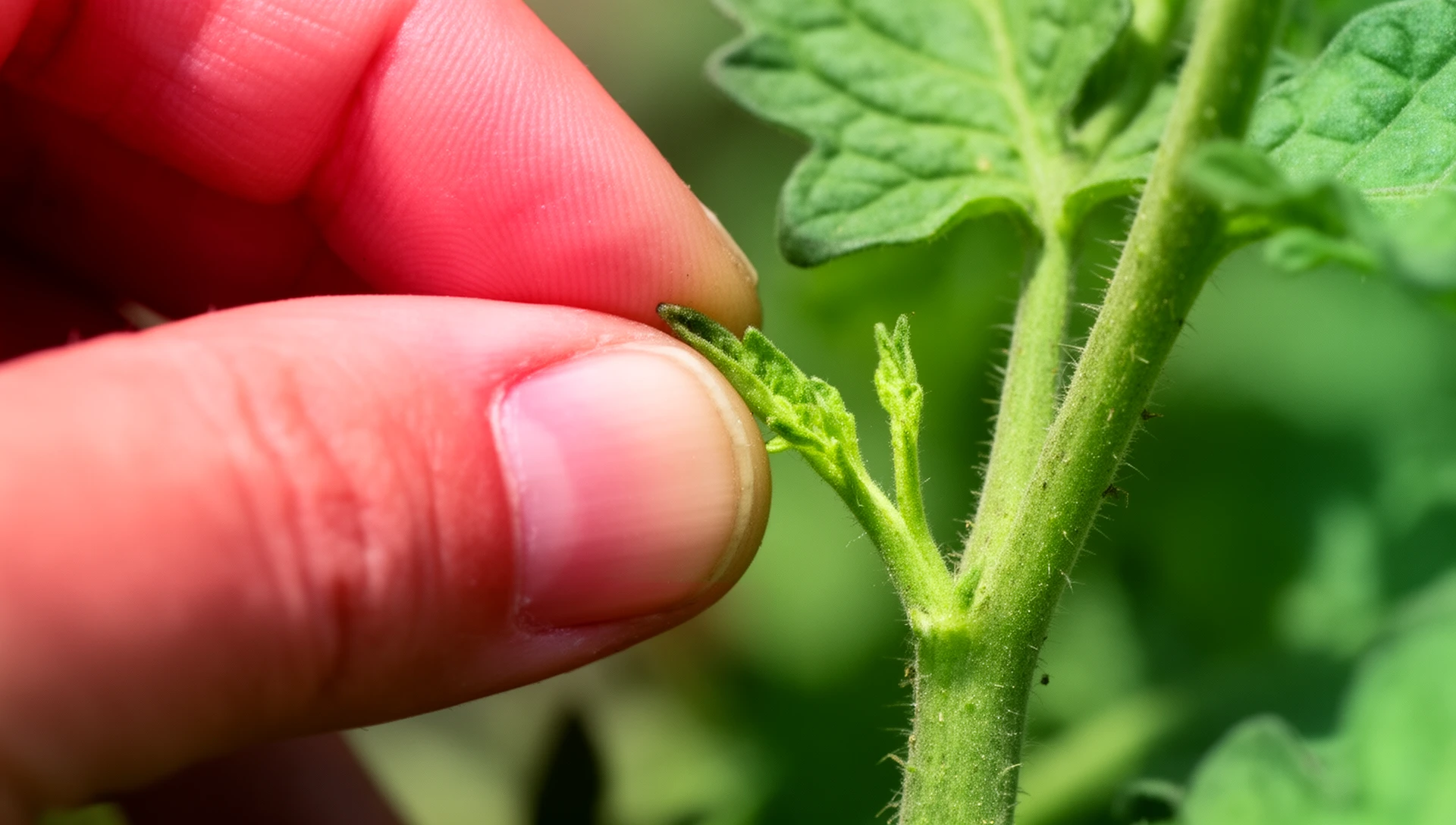
A sucker is a new stem that forms in the axil — the V-shaped junction where a leaf branches off the main stem. Left alone, every sucker grows into a full stem with its own leaves, flowers, and fruit, competing with the rest of the plant for water, light, and sugars.
The reason suckers form at all — and the reason cutting the growing tip changes the plant’s behavior — comes down to a hormone called auxin. The apical bud (the growing tip) produces auxin that flows down the stem and suppresses the growth of axillary buds below it, a mechanism plant biologists have studied for over a century [6]. Remove or damage that tip, and auxin levels drop, releasing the buds beneath it to grow out as new shoots. This is also the biology behind the “topping” technique covered later: when you cut a tomato’s growing tip near the end of the season, you’re deliberately triggering the same auxin drop to redirect the plant’s remaining energy toward ripening fruit instead of new growth.
The evidence on tomato hormone signaling specifically is older but consistent with this general model — early tomato research by Tucker and Mansfield found that far-red light treatment raised abscisic acid (ABA) levels in tomato tissue, supporting ABA’s role as a secondary signal that helps relay the auxin message to suppress bud growth [6]. Practically, this is why pinching a sucker at 2 inches works the same way as cutting a full stem: you’re removing the same competing growth point, just earlier.
There’s a second, more practical mechanism at work too: an open canopy from routine sucker removal improves airflow, which lowers humidity around the leaves and reduces the conditions that fungal and bacterial diseases need to spread [2].
How to Remove Suckers, Step by Step
Find the main stem and trace it from the base of the plant. At each point where a leaf meets the stem, check the V-shaped junction for a new shoot forming — that’s the sucker [1].
- Small suckers (under 2 inches): pinch them off between your thumb and forefinger. No tool needed, and the wound is small enough to dry quickly on its own [1].
- Larger suckers: switch to clean bypass pruners or scissors rather than snapping them — a torn wound is slower to heal and more vulnerable to infection than a clean cut [1][2].
- Timing: start when the first flower cluster opens — typically late June or early July in most US zones — and repeat every 10 to 14 days through the season [2].
- Time of day: prune on a dry, sunny morning. The cut needs dry weather to callus over cleanly; pruning right before rain or in overcast, humid conditions leaves the wound open to pathogens for longer [3].
- Sanitation: disinfect pruners with 70% isopropyl alcohol for at least 30 seconds between plants, and wash or sanitize your hands too, especially if anyone handling the plants uses tobacco — tobacco mosaic virus spreads readily this way [1][2].
One caution that’s easy to miss: don’t strip every sucker on the plant just because you can. Removing too much foliage opens the canopy so far that ripening fruit loses its leaf shade, and green shoulders can scald in direct sun [1][4]. Leave enough leaf cover over developing fruit clusters, even on a well-pruned plant.
The Sucker Rule, by Tomato Type
Once you know your type, the actual rule is short:
| Type | What to remove | What to keep | Why |
|---|---|---|---|
| Determinate | Suckers below the first flower cluster only | Everything above the first cluster, including the sucker directly beneath it | That first sucker develops into a strong shoot that carries a large share of the plant’s total fruit set — removing it costs yield for no gain [3] |
| Indeterminate | All suckers along the main stem, continuously, all season | The single sucker just below the lowest flower/fruit cluster (if training to two leaders) | Keeps energy focused on fruit production instead of endless new vegetative growth [1][2] |
Indeterminate growers also choose a leader system: single-leader (remove every sucker, train one stem) is simplest and works well with tight spacing or a single stake; double-leader (keep that one sucker below the lowest cluster) roughly doubles the plant’s fruiting wood and suits a Florida weave or larger cage. In the UK, this same single-stem approach is usually called “cordon” training, and it’s the default method for greenhouse tomatoes.
Topping: The End-of-Season Cut
Late in the season, cut off the growing tip of each main stem. This stops the plant from setting new flowers it has no time left to ripen, and redirects its remaining sugars into the fruit already on the vine — the same auxin-drop mechanism described above, deployed deliberately [2][6]. Topping only makes sense for indeterminate plants; determinate types stop growing on their own once they set a terminal bud, so there’s no tip left to remove [3].
Exactly when to make this cut depends on your first frost date, your variety’s days-to-maturity, and how many green tomatoes are already on the vine — enough variables that it deserves its own walkthrough. See when it’s too late to prune tomatoes for the full zone-by-zone timing.
Bigger Tomatoes or More Tomatoes? The Real Trade-off
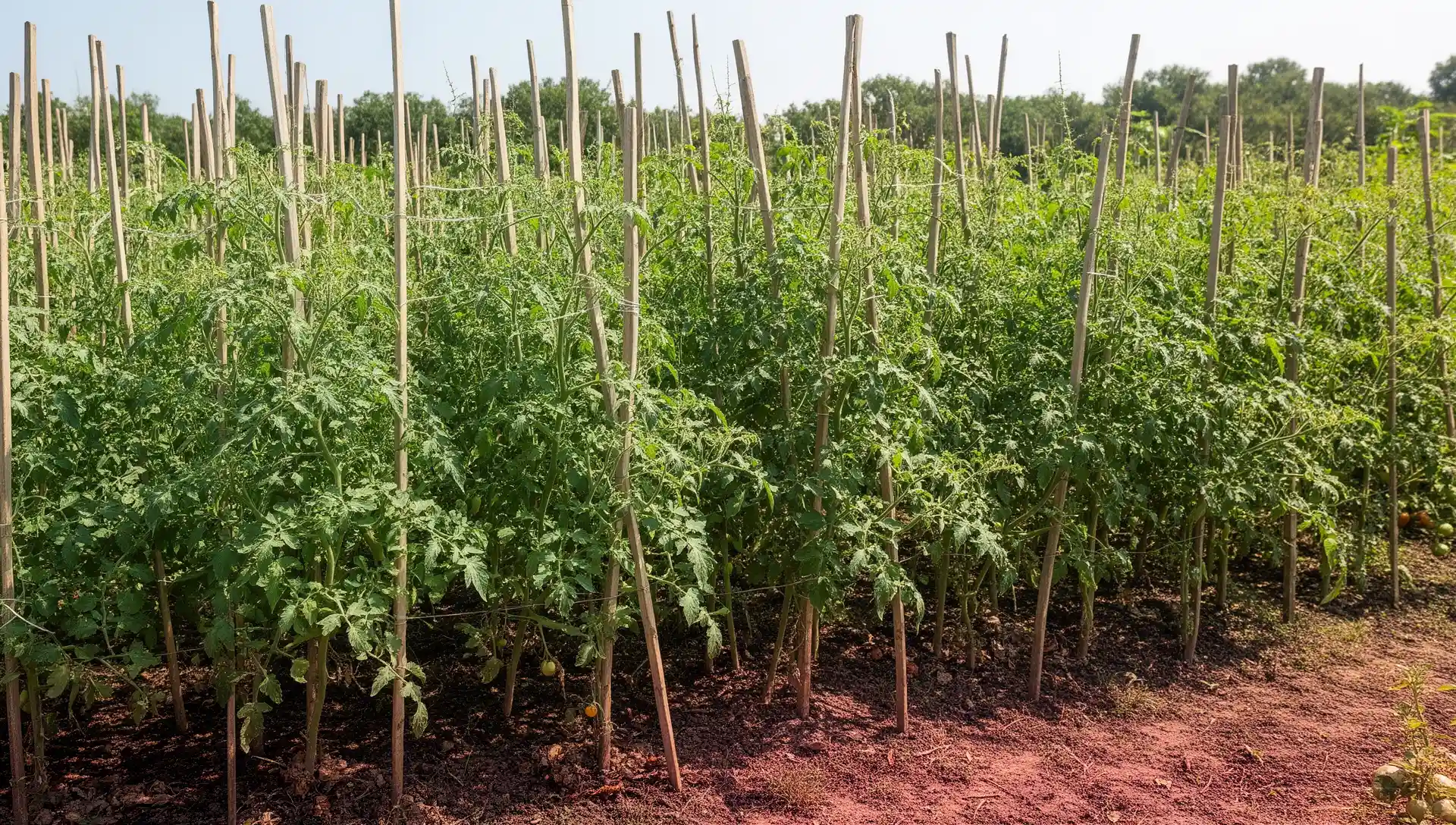
Pruning isn’t free — it’s a trade, and the direction of that trade is measurable. A controlled field trial on indeterminate lines at Sokoine University of Agriculture tested no pruning against single-, two-, and three-stem systems: two-stem plants produced the highest number of marketable fruit per plant, while unpruned plants produced the most non-marketable fruit — undersized or blemished — per hectare [7].
In other words: unpruned plants give more total fruit, but a larger share falls short of usable size or shape. Pruned plants trade raw volume for a higher proportion of fruit worth harvesting. Which side you want depends on your goals:
- Want fewer, larger fruit for slicing? Prune to a single leader and keep the canopy open.
- Want more total fruit for canning or sauce, and don’t mind smaller or more variable size? Prune more lightly, or let a couple of extra suckers run.
- Growing in a short season (Zone 5 or colder)? Lean toward pruning — earlier-maturing fruit matters more than total volume when frost cuts the season short.
For staking to match your pruning system: a single stake suits a single-leader plant, while a Florida weave or a wide cage (at least 3 feet across) gives a two- or three-leader plant room to spread [4]. Pepper plants face a nearly identical trade-off between branch count and fruit size — see our guide to pruning pepper plants if you’re growing both.
Stop guessing if your garden pays.
Log what you grow and harvest — see total yield weight, estimated retail value, and season-on-season progress in one place.
→ Track My HarvestThe Overlooked Risk of Over-Pruning
Two specific problems trace back to pruning too hard, and neither gets much attention outside extension literature. The first is sunscald, already mentioned above: strip too much foliage and exposed fruit shoulders can develop pale, papery patches from direct sun [1][4].
The second is catfacing — the puckered, scarred blossom-end deformity that shows up on some tomatoes. Its primary cause is unrelated to pruning: a run of cool nights below 52–54°F during flowering interferes with pollination and distorts fruit development, regardless of how the plant was cut [5]. But University of Maryland Extension notes a secondary contributing theory: heavy pruning of indeterminate varieties may increase catfacing risk by reducing auxin levels in the plant [5]. This is flagged explicitly as a theory rather than settled science — the evidence here is thinner than the sunscald link, and cool weather remains the dominant cause by far. Still, if you’re pruning hard during a cool, wet stretch, it’s a reasonable extra reason to ease off.
Tools and Sanitation, Briefly
Use bypass pruners, not anvil-style — bypass blades slide past each other like scissors for a clean cut, where anvil blades crush and bruise the stem [3][4]. Sterilize between plants with 70% isopropyl alcohol for at least 30 seconds, and prune on a dry morning so the wound has time to callus [1][2][3]. For specific pruners worth buying, see the best tomato pruning tools.
Key Takeaways
Start with the determinate/indeterminate check — it decides whether you prune at all. Indeterminate growers: sucker every 10 to 14 days starting at first flower, and pick a leader system that matches your goal — fewer/bigger fruit or more/smaller fruit. Determinate growers: remove suckers below the first flower cluster, then leave the rest alone.
Frequently Asked Questions
Should I remove all the leaves below the first fruit cluster?
Removing the lowest leaves once they’re established (and especially once they touch the soil) reduces soil-splash disease, since many tomato pathogens overwinter in soil and reach leaves via rain or watering splashback [4]. Don’t strip leaves the plant still needs for photosynthesis higher up the stem.
Can I root the suckers I remove?
Yes — tomato suckers root readily in water or moist soil within a week or two, giving you a genetically identical clone of the parent plant for free rather than wasting healthy cuttings.
Sources
- Iowa State University Extension — Pruning Tomatoes in the Home Garden
- University of Wisconsin-Madison Extension — Tomato Pruning
- Purdue University Vegetable Crops Hotline — Prune Determinate Tomatoes
- University of Georgia Cooperative Extension — Staking and Pruning Tomatoes in the Home Garden
- University of Maryland Extension — Catfacing Problems in Tomato
- Journal of Experimental Botany (PMC) — Lessons from a Century of Apical Dominance Research
- International Society for Horticultural Science — Assessment of the Effect of Pruning Systems on Plant Developmental Cycle, Yield and Quality of Selected Indeterminate Tomato Lines


