Peperomia Obtusifolia vs Rosso: Which Handles Low Light Without Dropping Leaves?

Peperomia obtusifolia and Peperomia Rosso look similar on the shelf but differ in leaf structure, watering needs, and growth habit. This side-by-side comparison covers light, water, propagation, and which one fits your conditions.
Peperomia obtusifolia and Peperomia Rosso both carry the “radiator plant” label and sit in the same genus, but they are not the same species. Obtusifolia belongs to Peperomia obtusifolia, a thick-stemmed semi-succulent native to Florida and the Caribbean. Rosso is a cultivar of Peperomia caperata, a deeply corrugated species from Brazil’s Atlantic Forest floor. That species-level split drives every care difference between them — from how they store water to how they respond to low light.
The distinction matters because watering advice that keeps obtusifolia alive can slowly kill a Rosso, and the bright windowsill that brings out Rosso’s red undersides can scorch obtusifolia’s glossy leaves. Understanding which species you actually have changes everything about how you care for it.
This comparison breaks down the differences that affect daily care: leaf structure, light, water, propagation, and which plant fits your specific growing conditions.
Quick Comparison: Obtusifolia vs Rosso
| Feature | P. obtusifolia (Baby Rubber Plant) | P. Rosso |
|---|---|---|
| Mature size | 6–12 in. tall, 12–24 in. spread | 6–8 in. tall, 6–8 in. spread |
| Leaf shape | Rounded, spoon-shaped, blunt-tipped | Pointed, lance-shaped, deeply ridged |
| Leaf color | Solid dark green (variegated forms available) | Dark green top, crimson underside |
| Light | Bright indirect; excellent low-light tolerance | Bright indirect; good low-light tolerance |
| Watering | Let soil dry almost completely | Let top 1–2 in. dry |
| Humidity | Average home humidity (30–40%) fine | Prefers 40–50% |
| Difficulty | Easy — forgiving of neglect | Easy-moderate — needs consistent moisture |
| USDA zones | 10a–11 | 11a–12b |
| Pet-safe | Yes (ASPCA-confirmed) | Yes (ASPCA-confirmed) |
| Average cost (4 in. pot) | $8–15 | $12–22 |
The Leaves Tell the Whole Story
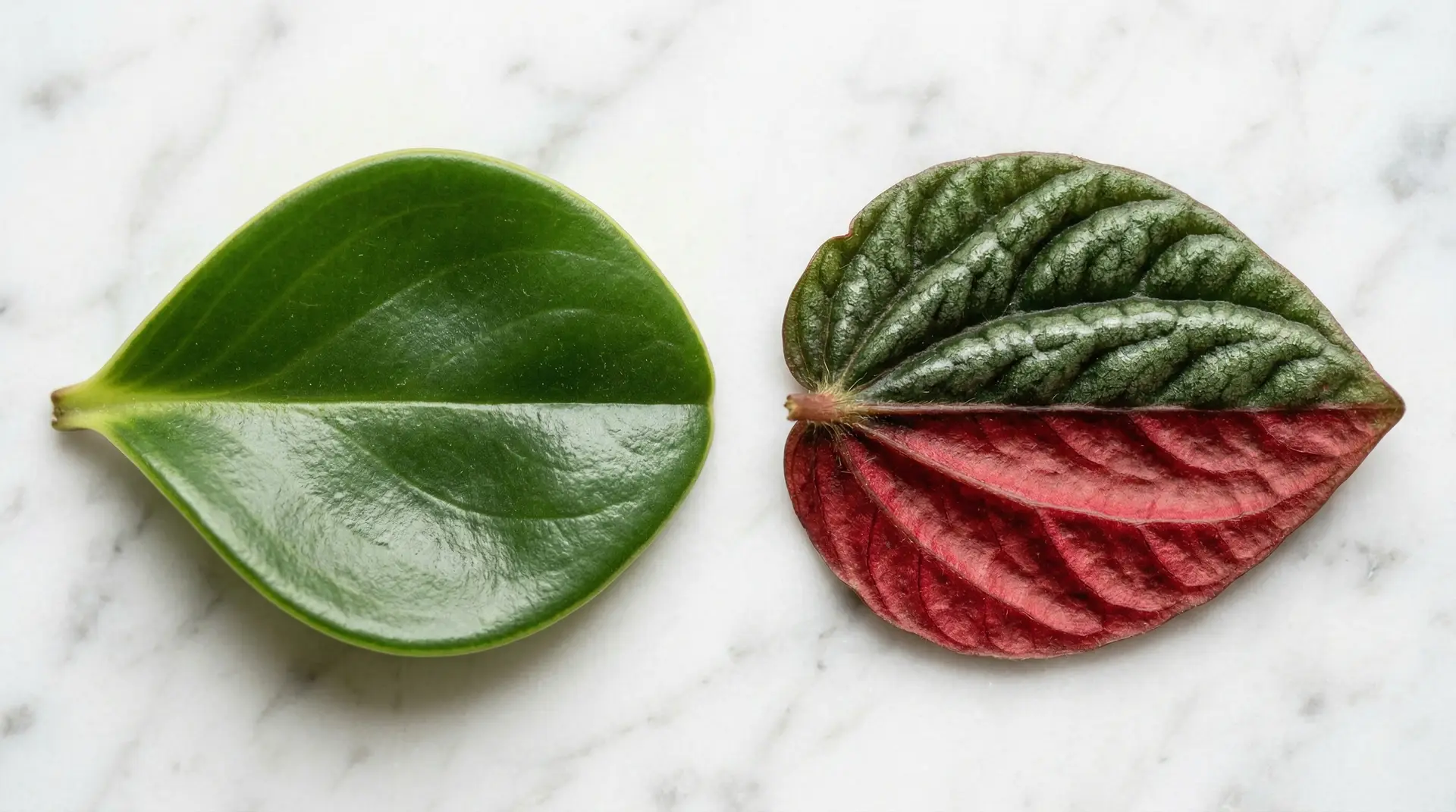
Pick up a leaf from each plant and the difference is immediate. Obtusifolia leaves are thick, smooth, and glossy — almost rubbery to the touch, which earned it the common name “baby rubber plant.” Those fleshy leaves function like miniature water reservoirs. According to the University of Missouri’s Integrated Pest Management program, obtusifolia is classified as a “highly succulent type” of peperomia, meaning the leaves store enough moisture to survive extended dry periods without wilting.

Three pre-planned garden beds, free
Stop staring at empty beds: printable plans with exact layouts, plant lists and planting calendars — yours free from the Garden Library.
Rosso leaves are the opposite experience. They are thinner, pointed, and covered in deep corrugations that create a quilted or rippled texture across the surface. Flip a Rosso leaf over and you will see its signature feature — a vivid crimson underside that gives the cultivar its name. That textured surface is not decorative. The ridges increase the leaf’s surface area, which helps the plant absorb ambient humidity in its native understory habitat.
This leaf anatomy is the single most important thing to understand about these two plants, because it explains why their watering needs differ so sharply.
Light Requirements
Both plants thrive in bright indirect light, but their tolerances diverge at the extremes.
Obtusifolia handles low light better than almost any peperomia. According to NC State Extension, it tolerates relatively dim conditions for extended periods, especially the solid-green forms. Variegated cultivars (such as Peperomia obtusifolia ‘Variegata’) need brighter light to maintain their cream-and-green patterning, but the species itself is remarkably shade-tolerant. It does well under fluorescent office lighting, which makes it one of the easiest houseplants to keep alive in workspaces with limited natural light.
Rosso also tolerates medium-low light, but with a trade-off. In dim conditions, the red coloring on the leaf undersides gradually fades toward a dull maroon or brownish green. If the dramatic two-toned foliage is the reason you bought a Rosso, you need to keep it in bright indirect light — an east-facing window or a few feet from a south-facing window filtered through a sheer curtain.
Neither plant tolerates direct sun. The University of Florida IFAS Extension notes that direct sunlight burns peperomia leaves, causing pale or scorched patches that do not recover.
Watering and Drought Tolerance
This is where the species-level difference matters most.
Obtusifolia’s thick, succulent-like leaves store significant water reserves. You can let the soil dry almost completely between waterings and the plant will show no distress. Clemson University’s Home and Garden Information Center notes that overwatering is the single most common cause of death in peperomia — and obtusifolia’s thick stems and fleshy leaves make it especially vulnerable to root rot if kept consistently wet.
Rosso needs slightly more attention. Its thinner, corrugated leaves store less water, so you cannot let the soil bake dry the way you can with obtusifolia. The target is letting the top inch or two of soil dry before watering again. That said, Rosso is still a peperomia — overwatering kills it faster than underwatering. The margin is just narrower than with obtusifolia.
A practical test: stick your finger into the soil up to the second knuckle. For obtusifolia, water only when the soil feels dry at that depth. For Rosso, water when the top inch feels dry but before the deeper soil loses all moisture. Both plants benefit from terracotta pots, which wick excess moisture through their porous walls.
Temperature, Humidity, and Soil
Temperature requirements overlap almost completely. Both prefer 65–80°F and suffer below 50°F. Neither tolerates frost. Keep them away from cold drafts near windows and doors during winter, and never place them directly above or below heating vents.
Humidity is where they split. Obtusifolia handles typical home humidity (often 30–40% in winter) without complaint. Rosso prefers 40–50% and may develop crispy leaf edges in dry air. If your home runs dry, group Rosso with other humidity-loving plants or place it on a pebble tray filled with water. A small humidifier nearby also helps, especially through the heating season.
We put these side by side in calathea orbifolia vs medallion.
Soil requirements are similar: both need well-draining mix that prevents water from sitting around the roots. A standard houseplant potting mix amended with perlite works for obtusifolia. Rosso benefits from a slightly more customized blend — two parts peat-free potting soil, one part perlite, and one part orchid bark — which improves both drainage and aeration around its finer root system. Both prefer small pots with drainage holes and do not mind being slightly root-bound.
Stop killing plants with wrong watering.
Select your plant, pot size, and climate zone — get a precise watering schedule with amounts and timing.
→ Build Watering SchedulePropagation
Obtusifolia is one of the easiest houseplants to propagate. Clemson Extension specifically notes that it “roots easily in water” from stem cuttings — cut a 4–6 inch section with a few leaves, place the cut end in a jar of water, and roots typically appear within 2–4 weeks. You can also propagate from individual leaf cuttings: remove a leaf with about an inch of petiole attached, insert it into moist potting mix, and a new plantlet will emerge from the base within several weeks. If you enjoy houseplant propagation projects, obtusifolia is one of the most rewarding starter plants.
Rosso propagation works but requires more patience. Stem cuttings root more reliably in soil than in water — the thinner stems tend to rot in standing water before roots develop. Leaf cuttings also work: cut a mature leaf with about an inch of petiole, insert it into well-draining soil, and cover with a plastic bag or humidity dome to maintain moisture. Expect 3–6 weeks for roots to develop and several more weeks before you see new growth. Division of mature rosettes during repotting is the fastest method for Rosso.
Common Problems
Both plants share the same primary vulnerability: root rot from overwatering. Yellowing leaves that drop easily are the classic warning sign for both species. If you catch it early, unpot the plant, trim any brown or mushy roots, let the root ball dry for a day, and repot in fresh well-draining mix.
Pest pressure is low for both. Mealybugs, spider mites, and fungus gnats are the most common visitors. NC State Extension notes that peperomia generally has “no serious pest or disease problems.” Inspect leaf undersides periodically and treat any infestations with insecticidal soap or neem oil before they spread.
The main aesthetic issue differs by species. Obtusifolia can become leggy in very low light — the stems stretch toward the light source and spacing between leaves increases. Pruning back the stretched growth encourages bushier regrowth. Rosso rarely gets leggy because of its compact rosette form, but it loses its red coloring intensity if light is too low. Moving it to a brighter spot restores the color within a few weeks of new growth.
Not sure which one to pick? croton vs coleus compares the key differences.
Toxicity and Pet Safety
Both plants are confirmed non-toxic to cats and dogs by the ASPCA. Peperomia obtusifolia is listed under “Blunt Leaf Peperomia” and Peperomia caperata (Rosso’s parent species) is listed under “Emerald Ripple Peperomia” — both with a clean non-toxic status. This makes them excellent choices for households with curious pets. If you are building a collection of pet-safe houseplants, both peperomias belong on the shortlist.
Which Should You Choose?
The right pick depends on your conditions and what you want from the plant.
Choose obtusifolia if:
- You are a beginner or tend to forget watering — its succulent-like leaves handle neglect exceptionally well
- Your space has limited natural light (a north-facing window or interior room)
- You want a plant that trails or spreads to fill a shelf or small space
- You enjoy propagation — obtusifolia roots in water faster than almost any houseplant
- You want a lower price point and easy availability at any garden center
Choose Rosso if:
- You want visual drama — the dark green and crimson two-toned leaves are far more striking than obtusifolia’s solid green
- You need a truly compact plant for a desk, terrarium, or small shelf (6–8 inches max)
- Your home maintains moderate humidity (40–50%) naturally or you are willing to provide it
- You prefer a tidy, rosette-shaped plant that stays put rather than spreading outward
- You are an experienced plant owner comfortable with the narrower watering window
If you are still deciding between peperomia and similar round-leaved houseplants, the Pilea Peperomioides vs Peperomia comparison covers another common pairing worth considering.
Frequently Asked Questions
Can I keep obtusifolia and Rosso in the same pot?
It is possible but not ideal. Their watering needs differ enough that one plant will always be slightly over- or under-watered when sharing soil. Obtusifolia wants drier conditions than Rosso. Keeping them in separate pots next to each other gives you the visual pairing without the care compromise.
Why is my Rosso losing its red color?
Insufficient light is the most common cause. The red pigmentation on Rosso’s leaf undersides is driven by anthocyanins, which the plant produces in higher concentrations under brighter indirect light. Move the plant closer to a window and the newest leaves should develop stronger red coloring within a few weeks.
Is Peperomia obtusifolia actually a succulent?
Not technically, but it behaves like one. Its thick, fleshy leaves and stems store significant water, and it tolerates drought far better than most tropical houseplants. The University of Missouri classifies it as a “highly succulent type” of peperomia, which means you should water it on a succulent-like schedule — deeply but infrequently.
Do peperomias flower?
Yes, both species produce narrow, spike-like inflorescences called spadices (often compared to rat tails or pipe cleaners). The flowers are not showy — they are small, greenish-white, and grow on thin stalks above the foliage. Most growers trim them off to redirect energy back into leaf production, though they are harmless if left on the plant.
Which peperomia grows faster?
Obtusifolia grows at a medium pace and will fill out a 6-inch pot within a year under good conditions. Rosso grows more slowly and stays compact, rarely outgrowing its pot for two to three years. If you want a plant that fills space quickly, obtusifolia is the better choice.
Sources
- NC State Extension. Peperomia obtusifolia. North Carolina Extension Gardener Plant Toolbox.
- NC State Extension. Peperomia caperata. North Carolina Extension Gardener Plant Toolbox.
- Clemson University HGIC. Peperomia: Indoor Plant Care and Growing Guide. Clemson Cooperative Extension.
- University of Florida IFAS Extension. Florida Peperomia. Gardening Solutions.