

Your ‘Madagascar Palm’ Is Actually a Succulent — Here’s How to Keep It Thriving Indoors

Your ‘Madagascar palm’ is actually a succulent — Pachypodium lamerei care guide covering light, water, winter dormancy, and blooming.
Walk into almost any garden center and you’ll find this plant mislabeled with confidence. The tag says “Madagascar Palm.” The visual cues agree — silvery trunk, tropical leaf crown, exactly the silhouette you’d expect from a small palm tree. The name feels right. It isn’t.
Pachypodium lamerei belongs to Apocynaceae, the dogbane family — the same botanical family as plumeria (frangipani), oleander, and desert rose (Adenium). True palms sit in Arecaceae, a completely separate plant order with no close relationship to Pachypodium. The “palm” in its name refers only to the leaf-crown silhouette, nothing more.
This misidentification matters for care. Pachypodium lamerei is a stem succulent shaped by Madagascar’s seasonally dry forests — a plant that stores months of water in its trunk and photosynthesizes through its bark even after every leaf has fallen. Understanding that is the foundation for every care decision that follows.
What You’re Actually Growing
Pachypodium — pronounced pack-ee-POE-dee-um — translates from Greek as “thick foot,” a reference to the swollen base of the trunk. There are 23 Pachypodium species; 18 are endemic to Madagascar, where they evolved in seasonally dry, rocky forests and cliff faces. The remaining five species grow in southern Africa and Namibia. Every species in the genus is listed on CITES Appendix I or II, meaning international trade in wild-collected plants is tightly controlled.

Free printable garden plans for when you’re ready to grow outside too
Three pre-planned beds — pollinator, kitchen and cut-flower — from the free Blooming Expert Garden Library.
P. lamerei is a stem succulent — the trunk is the plant’s primary organ for both water storage and photosynthesis. This dual function separates it fundamentally from true palms, which store no significant water in their trunks and derive all photosynthesis from their frond canopy.
In its native Madagascar, P. lamerei can reach 6 meters (nearly 20 feet). Grown indoors, expect a slower trajectory: 4 to 6 feet over many years, adding roughly 4 to 12 inches per year under good conditions. Growth is genuinely slow — this is not a plant you’ll outgrow in a season.
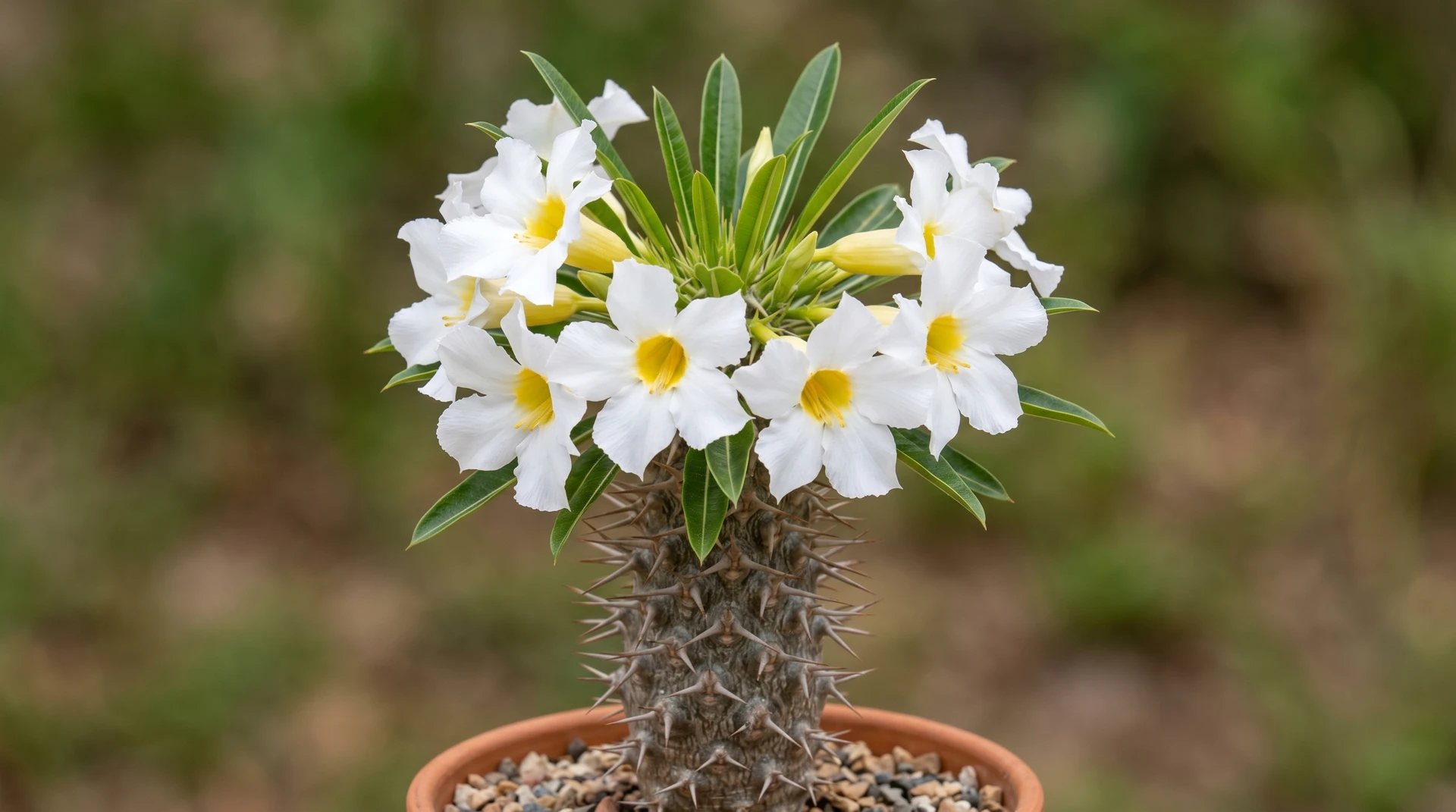
The trunk is covered in spines up to 5 cm (2 inches) long, arranged in groups of three at almost right angles to the stem. This perpendicular grouping isn’t only defensive — the spines condense dew from air and channel it toward the roots, a secondary water-capture mechanism from the plant’s arid homeland. The leaves grow exclusively from the apex of the trunk, explaining why a fully leafless dormant plant still looks structurally intact rather than dead.
The closest plant relatives of your Madagascar palm are the frangipani flowers used in Hawaiian leis and the oleander shrubs lining Mediterranean roads. If care advice ever seems backwards compared to what “palm” implies, that’s why: you’re growing a distant cousin of an ornamental flowering shrub, not a tropical coastal tree. For more on how plants with misleading palm names actually differ from true palms, see our ponytail palm vs. yucca comparison.
Light: The Non-Negotiable
Madagascar palm needs full sun — at least six hours of direct sunlight daily. A south-facing or west-facing window is the minimum for indoor success. East-facing windows may keep the plant alive but suppress growth, prevent blooming, and make the trunk more susceptible to rot because the soil stays cooler and dries more slowly.
The demand for direct sunlight connects to the plant’s trunk-based CAM (Crassulacean Acid Metabolism) photosynthesis system. Even during dormancy, after all leaves have dropped, the green bark tissue continues to photosynthesize using solar energy — it absorbs CO₂ at night, stores it, and processes it during the day with stomata closed to prevent water loss. Without adequate direct light, the trunk can’t fuel this system efficiently, which compounds the stress of winter water restriction. Low light in winter isn’t restful for a Madagascar palm; it’s metabolic starvation on top of drought.
If you can, move the plant outdoors to a full-sun position from late spring to early fall, returning it indoors when nighttime temperatures consistently drop below 55°F. Outdoor light intensity — even on an overcast summer day — exceeds even the strongest south-facing indoor window, and plants that spend summers outdoors are significantly more likely to bloom.
Watering: Trunk Logic
The watering rule for Pachypodium lamerei is the same as for any stem succulent: soak thoroughly, then wait until the soil dries properly before watering again. The interval changes dramatically by season.
Growing season (spring through early fall): Water thoroughly until it drains from the pot base. Then wait until the top half of the soil is dry before watering again — typically every two to three weeks depending on temperature and light. A finger pushed 2 to 3 inches into the soil should come out dry.
Winter: Reduce to every four to six weeks, or whenever the trunk shows the faintest sign of shriveling — the plant’s built-in signal that reserves are running low. The trunk’s water-storage capacity is substantial, and in a cool indoor winter environment the plant uses very little. The critical rule: do not water a plant that is actively shedding leaves. A dormant, leafless Pachypodium has almost no transpiration occurring. Water sitting in cold, inactive soil is a direct path to root rot.
Root rot is the most common way Madagascar palm dies indoors. Signs include a soft or spongy trunk base, yellowing leaves unrelated to normal seasonal shedding, and mushy brown roots rather than firm white ones. If you suspect root rot: remove the plant from the pot immediately, cut all rotten material back to clean white tissue, and let the plant dry completely for at least one week before repotting into fresh, bone-dry cactus mix.
Soil Mix and Potting
Commercial cactus-and-succulent mix works well straight from the bag. To mix your own: two parts standard potting soil with one part coarse horticultural sand or perlite. The goal is soil that soaks up water completely and drains within minutes, leaving no lingering moisture in the root zone. Standard all-purpose potting mix alone retains too much moisture for Pachypodium roots.
The pot must have drainage holes. Unglazed terracotta is preferable over plastic because the porous walls allow some evaporation through the sides, keeping roots drier between waterings.
Repot every three to four years in spring, going up one pot size only. Pachypodium lamerei is content in snug pots — the root system is modest relative to trunk volume. Repot only when roots are emerging from the drainage holes or growth has clearly stalled despite good conditions. Always wear thick leather gloves during any handling; consider gripping the trunk with folded newspaper or a rubber foam pad to protect your hands from the triple-grouped spines.
Stop missing your zone's planting windows.
Select your US zone and month — get a complete checklist of what to plant, prune, feed, and protect right now.
→ View My Garden CalendarFeeding
A cactus or succulent fertilizer at half the recommended strength, applied every four to six weeks from spring through late summer — that is the complete feeding schedule. Pachypodium evolved in nutrient-poor, rocky soils and doesn’t respond to heavy fertilizing with faster growth. It responds with soft, vulnerable tissue.
Stop fertilizing entirely when temperatures drop in autumn. Never feed during winter dormancy, and never feed a plant that has shed its leaves. Excess fertilizer salts in inactive soil concentrate around roots and cause chemical burn. If you fed into fall, flush the soil with plain water once before dormancy begins to clear any salt buildup.
Temperature and the Winter Leaf Drop
Active growing temperatures for Pachypodium lamerei are 65 to 85°F — typical indoor conditions. The hard minimum is 55°F; below that, leaf drop accelerates and root rot risk rises even at conservative watering rates.
Outdoors, this plant is reliably hardy only in USDA zones 10 and 11. In zone 9, it survives mild winters with protection but may defoliate. In zones 8 and below, it must come indoors when nights consistently fall below 55°F.
When autumn arrives and indoor temperatures drop, the plant will begin shedding leaves — sometimes all of them. First-time owners often interpret a leafless, spiny stick as a plant in crisis. It isn’t.
Here’s what’s actually happening: after leaf drop, the trunk activates its CAM photosynthetic pathway in the bark tissue, according to Oxford University Plants 400. Carbon dioxide is absorbed through the bark at night when stomata open, stored as malic acid, and then processed through photosynthesis during the day with stomata closed to prevent water loss. The trunk is genuinely alive and metabolically active — not dormant in the way a deciduous tree is dormant. This bark-based photosynthesis is an adaptation to Madagascar’s dry season, which regularly lasts five months or more without meaningful rainfall.
The return to normal: new leaves emerging from the apex in late winter or early spring, triggered by rising temperatures and increasing day length. That is your cue to gradually resume regular watering and begin feeding again.
Will It Bloom Indoors?
Pachypodium lamerei produces white flowers with five rounded petals and a yellow throat, clustered at the very tip of the trunk’s apex in summer. According to the University of Arkansas Cooperative Extension, the flowers are funnel-shaped and mildly fragrant, produced from a terminal scape — the same growing point that produces the leaf crown.
The honest answer about indoor blooming: it rarely happens, and there is no shortcut to force it.
Flowering requires the plant to reach sufficient maturity — at least five years from a rooted cutting, often longer from seed. The trunk needs to reach enough height before the apex can produce a reproductive scape instead of just leaves. Beyond maturity, conditions must align: maximum direct sunlight through the growing season, a proper cool-dry winter, and consistent health across multiple years. A plant that has been kept in medium light or overwatered periodically is unlikely to flower regardless of age.
The most practical step is outdoor placement in full sun from late spring through early fall. Outdoor sunlight intensity far exceeds indoor window light, and plants that summer outdoors and winter in a cool, bright room bloom far more reliably than those kept inside year-round. When flowers do appear, they last several weeks — a reward for years of patient, correct care.
Common Problems
| Symptom | Likely Cause | Fix |
|---|---|---|
| Yellowing leaves in fall or winter | Normal seasonal dormancy; leaf drop is expected | No action needed. Reduce watering immediately; do not water a plant actively shedding leaves |
| Yellowing leaves in spring or summer | Overwatering; root stress | Stop watering; check roots; let soil dry completely for two weeks before resuming |
| Soft or spongy trunk base | Root rot from overwatering or cold-wet conditions | Remove from pot immediately; cut mushy roots and soft trunk tissue to clean white; dry for one week; repot in fresh dry cactus mix |
| Plant leaning strongly toward the window | Insufficient light on all sides | Move to south-facing window or outdoors; rotate pot 90° monthly to encourage upright growth |
| No new growth for four or more months in spring or summer | Too cool, too little light, or pot-bound roots | Check temperature (minimum 65°F active), improve light, consider repotting if roots are circling the pot base |
| White cottony patches at leaf bases | Mealybugs | Wipe with 70% isopropyl alcohol on a cotton swab; treat weekly for one month; neem oil spray as a preventive follow-up |
| Brown leaf tips on otherwise healthy leaves | Fertilizer salt buildup or excessively dry air | Flush the soil with plain water; ensure full drainage; avoid misting the plant (Pachypodium thrives in dry air) |
Safety, Spines, and Pets
The primary hazard is physical, not chemical: the spines are up to 2 inches long, triple-grouped, and positioned to point outward at right angles from the trunk. They are not decorative. Wear thick leather gloves for any handling task, and place the plant where curious children or large dogs cannot brush against the trunk. A raised shelf or a room with limited access works well.
On toxicity: Pachypodium contains a latex sap that causes skin irritation on contact with broken plant tissue. The ASPCA does not list Pachypodium lamerei as toxic to dogs or cats — but the spines provide their own deterrent to most animals. If a spine punctures skin, clean the wound with soap and water; the spines themselves are clean but any puncture site can introduce environmental bacteria.
For households weighing indoor plant options for pet safety, our complete guide to indoor plant care covers which plants require the most caution around pets.
Seasonal Care at a Glance
| Season | Watering | Feeding | Key Tasks |
|---|---|---|---|
| Spring | Every 2–3 weeks when top half dry; increase gradually as new leaves appear | Resume at half-strength cactus fertilizer every 4–6 weeks when growth restarts | Repot if needed; move outdoors once nights are reliably above 55°F |
| Summer | Every 2–3 weeks; check more often in heat waves | Continue half-strength monthly; switch to low-nitrogen formula if plant is mature | Full outdoor sun; monitor for mealybugs; rotate pot quarterly |
| Fall | Begin tapering; extend intervals to every 3–4 weeks | Stop by end of summer; do not feed into autumn | Bring indoors when nights drop to 55°F; do not fertilize |
| Winter | Every 4–6 weeks; stop completely if plant is actively shedding leaves | None | Cool, bright location (south window); do not repot; do not feed; watch for trunk firmness |
Frequently Asked Questions
Why are the leaves dropping off my Madagascar palm?
Leaf drop in fall and winter is normal seasonal behavior, not a distress signal. The trunk activates CAM bark photosynthesis to sustain the plant through the dormant period. Unless the trunk itself is softening or yellowing is occurring in summer, leaf drop is not an emergency. Reduce watering and wait for spring leaf-out.
How long does it take to bloom?
Most indoor plants need at least five years of maturity before the apex can produce a flowering scape. Many take considerably longer, especially if light has been suboptimal at any point. Moving the plant outdoors for full-sun summers is the most reliable way to accelerate the process.
My trunk is soft and spongy at the base — what do I do?
This is root rot, and it moves quickly. Remove the plant from the pot immediately. Cut all brown, mushy root tissue back to clean white. Let the plant dry for at least one week in open air before repotting into fresh, completely dry cactus mix. If the softness extends more than a few inches up the trunk, recovery is unlikely.
Can it live outside year-round?
Only in USDA zones 10 and 11 without frost protection. In zone 9 it survives mild winters with a frost cover. In zones 8 and below, treat it as a container plant: outdoors in summer, indoors before the first frost. Curious how true palms actually hold up in colder zones? See our comparison of parlor palm versus areca palm for details on genuinely cold-sensitive species.
Is it related to real palm trees?
Not at all. Pachypodium lamerei is in Apocynaceae — the same family as plumeria and oleander. True palms are in Arecaceae, a separate plant order. The resemblance is convergent evolution: unrelated plants developing similar silhouettes as an adaptation to similar growing environments. For a broader look at care for succulent plants in this group, see our succulent care guide.
Sources
1. Oxford University Plants 400, “Pachypodium lamerei” — herbaria.plants.ox.ac.uk (cited in article)
2. University of Arkansas Cooperative Extension, “Plant of the Week: Pachypodium” — uaex.uada.edu (cited in article)
3. Kew Plants of the World Online — Pachypodium lamerei Drake
4. Wikipedia — Pachypodium lamerei
5. OurHouseplants — Pachypodium lamerei Guide
6. Guide to Houseplants — Madagascar Palm Care
7. Wikipedia — Apocynaceae (cited in article)


