

Hilling Potatoes: A 3-Stage Schedule With Exact Heights to Maximize Tuber Count

Hill potatoes 2–3 times using exact height targets per stage. Covers stolon biology, determinate vs. indeterminate variety differences, materials, and what to do if you miss a round.
Pull up a Yukon Gold plant in August after three rounds of hilling and you’ll find one neat cluster of potatoes right above the seed piece — exactly where they formed the day you planted. Add a fourth mound of soil on top and nothing changes. Those are determinate genetics at work, and the extra labor was wasted. Pull up a Russet Burbank from the same garden, treated identically, and you’ll find tubers in two or three stacked layers — each one created by a separate hilling event. Same seed potato size. Same bed. Completely different result from identical effort.
Most hilling guides treat all potatoes as one type. They’ll tell you to mound up three times, stop at flowering, leave a few inches of foliage showing — all correct advice — but they skip the single most useful thing you can know before you pick up the hoe: what variety you’re growing determines whether each hilling adds a new tuber layer or just adds more soil above tubers that have already finished forming.

This guide covers both types. You’ll learn why hilling works (the stolon biology behind it), how to tell determinate from indeterminate with a glance at your seed packet, the exact height targets for each of the three stages, what to hill with, and how to recover if you missed a round. You’ll also get the mechanism behind green potato formation, which matters more than most gardeners realize.
What Hilling Actually Does Underground
Potatoes don’t grow on roots. They grow on stolons — thin horizontal stems that branch off the main stem and push outward through the soil. Tubers form at the tips of those stolons, and here’s the part that makes hilling click: stolons only emerge from stem tissue that is underground.
The University of Minnesota Extension puts it plainly: “Tubers will form on thin stems, also called stolons, which emerge from the main stems. The longer the underground portion of the plant, the more stolons the plant may grow.” [1] That single sentence explains everything. Bury more stem, get more stolon origin points, produce more tubers.
This is also why deep planting alone doesn’t replicate the effect of hilling. If you plant a seed potato 8 inches down and walk away, the plant sends up one main stem and puts out stolons at whatever depth the buried nodes happen to sit. Hilling works differently — you plant at 4 inches, let the stem grow upward, then progressively bury additional nodes as the plant climbs. Each new batch of buried nodes is a fresh opportunity for stolon production.
Leave the foliage above the mound untouched throughout. Those leaves are doing the photosynthesis that feeds tuber bulking — burying them does nothing useful and stresses the plant.
Determinate vs. Indeterminate Potatoes — The Hilling Difference Most Guides Skip
Before you reach for a hoe, check your seed packet for one word: maturity. It tells you whether your variety is determinate or indeterminate, and that distinction changes how many times you should hill.
Determinate varieties (also called early-season types) set tubers at a fixed level above the seed piece, in a single horizontal band. They mature in 70–90 days. Common examples include Yukon Gold, Norland, Red Pontiac, Fingerling types, and Superior. [4] Because tubers form at one depth only, adding a third or fourth mound of soil above that zone creates space where no tubers will ever appear. For determinate varieties, hilling Stage 1 and Stage 2 protect developing tubers from greening; Stage 3 adds minimal additional yield.
Indeterminate varieties (mid- and late-season types) keep producing new layers of stolons as the main stem elongates, as long as that stem remains buried. They mature in 110–135 days. Common examples include Russet Burbank, Kennebec, German Butterball, and Snowden. [4] For these, every hilling session you complete — as long as it happens before flowering — is potentially another layer of tubers added to the harvest.
A practical shortcut: if your seed packet says 70–90 days, assume determinate and plan for two hillings. If it says 100 days or more, assume indeterminate and plan for three. When in doubt, three hillings hurts nothing — it just matters more for one type than the other.
The 3-Stage Hilling Schedule
The goal at every stage is the same: bury enough new stem to create additional stolon nodes while leaving enough foliage above the mound to keep photosynthesis running. Work in the morning when stems stand most upright — wet foliage is also more brittle, so avoid hilling after rain.
Stage 1: First Hilling — Plants 6–8 Inches Tall
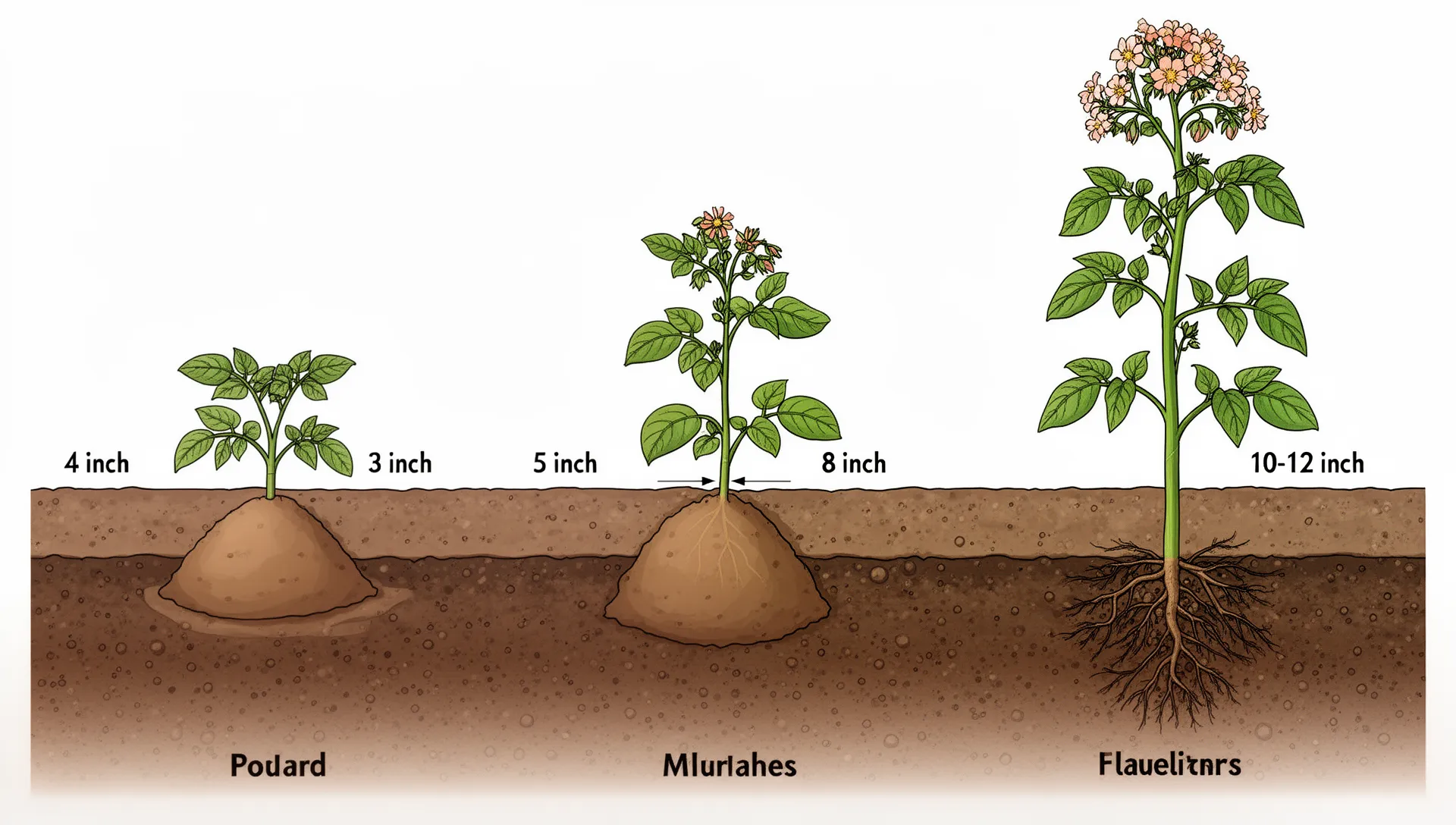
This is the most important hilling of the season. By the time shoots reach 6–8 inches above ground, the first stolons have already started extending from the buried seed piece. Burying the lower portion of the stem now gives those earliest stolons a deeper, darker environment, and adds new stem nodes that can generate their own stolons over the next two weeks.
- Trigger: Shoots 6–8 inches above soil surface (roughly 3–4 weeks after emergence)
- Action: Pull soil from the pathway to build a mound, burying the bottom 3–4 inches of stem
- Foliage remaining: Leave 3–4 inches of leaves and stem visible above the mound
- Applies to: All potato varieties — never skip Stage 1
The University of Maine Cooperative Extension recommends beginning hilling “when plants are about six inches tall” and notes up to three hillings may be needed. [2] After Stage 1, your mound should stand about 4 inches high.


Stage 2: Second Hilling — Plants Grown Another 6 Inches
Wait until the plant has grown roughly 6 more inches above the Stage 1 mound — usually 2–3 weeks later. At this point, the stem you’re about to bury has had time to harden slightly, and new nodes are ready to generate additional stolons. Stolons from Stage 1 are now extending and beginning to form tuber swellings.
- Trigger: Plant has grown 6 inches above Stage 1 mound (often 12–15 inches total above original soil level)
- Action: Add another 3–4 inches of soil, compost, or straw
- Foliage remaining: Leave 4–6 inches visible above the new mound height
- Applies to: All varieties; indeterminate types benefit most
After Stage 2, your mound should be approximately 7–8 inches high. If you’re growing a determinate variety, this can serve as your final hilling — additional soil won’t create new tubers because the genetics have already set where tubers will form.
Stage 3: Final Hilling — Before First Flower Buds Open
For indeterminate varieties, the final hilling happens when you spot the first flower buds forming — before they open, not after. This timing matters because stolon initiation in the uppermost buried nodes happens in the 7–14 days leading up to flowering. Once flowers are open, the plant shifts its hormonal balance toward tuber bulking rather than new stolon formation. Additional hilling after flowering won’t hurt, but it won’t generate new tubers either. [3]
- Trigger: First flower buds are visible but closed
- Action: Add 2–3 more inches of soil
- Foliage remaining: Leave 4–6 inches above the mound; the plant is now large enough to handle slightly less exposure
- Final mound height: 10–12 inches for indeterminate; 7–8 inches for determinate
| Stage | Plant Height Trigger | Soil to Add | Foliage Left Showing | Skip If… |
|---|---|---|---|---|
| Stage 1 | 6–8 in above soil | 3–4 in | 3–4 in | Never skip |
| Stage 2 | 6 in above Stage 1 mound | 3–4 in | 4–6 in | Determinate: optional after this |
| Stage 3 | First flower buds forming | 2–3 in | 4–6 in | Stop here for all types |
What to Hill With
The material you use affects more than just structure — it influences soil temperature, drainage, and even pest pressure.
Garden soil from the pathway is the traditional choice and works well in loam. Avoid pulling from heavy clay areas; clay-dominated mounds compact in rain, reducing the oxygen that potato roots need and slowing stolon growth. If your beds are clay-heavy, cut in compost before hilling season begins.
Compost is the best all-round option. It stays loose even after rain, adds fertility as it breaks down, and keeps the mound at an even temperature. A 50/50 mix of compost and garden soil gives you structure with the drainage benefits of organic matter.
Straw or shredded leaves are excellent for Stage 3 and work particularly well in hot climates where keeping root zones below 80°F matters for tuber size. SDSU Extension notes that light-colored straw may help reduce aphid and thrips pressure by reflecting light away from the base of the plant. [6] Use straw in layers of 4–6 inches — it compresses, so add more than you think you need.
In containers and grow bags, the same principle applies but the geometry is vertical. Start with 4–6 inches of potting mix over the seed potato, then add 4–6 inches as the plant grows. By the time you reach the top of a 15-gallon grow bag, you’ve effectively completed three stages automatically. The bag’s sides keep moisture consistent and the dark walls block light from reaching tubers.
Three Benefits Beyond Yield
Preventing Green Potatoes
Green potato skin is the most visible reason to hill, and the underlying mechanism is worth understanding. When light hits a potato tuber, two processes trigger simultaneously: chlorophyll forms (causing the green color) and solanine — a bitter, mildly toxic glycoalkaloid — begins accumulating in the skin. According to the University of Alaska Fairbanks Cooperative Extension, these are technically separate biochemical processes, but both are driven by light exposure. [5] The greener a potato looks, the more likely it carries elevated solanine. Hilling creates a physical barrier that keeps developing tubers in darkness even as they grow upward.
Warmer soil temperatures accelerate greening — exposure at 68°F produces more chlorophyll than the same exposure at 41°F — which is one reason mulching with straw (which cools the soil surface) adds an extra layer of protection on top of the physical mounding. [5]
Stop buying the wrong pot size.
Enter plant type and growth goal — get exact pot diameter, depth, and volume before you spend a cent.
→ Find the Right PotLate Frost Insurance
In zones 4–6, last frost dates can run through mid-May, and a late cold snap can kill young potato foliage overnight. A well-built soil mound insulates the crown and lower stem of the plant, keeping the soil temperature a few degrees warmer than exposed ground during a light frost event. If a frost warning hits and your plants are mid-Stage 1, hill immediately rather than waiting — the extra soil around the crown gives you insurance without costing you a scheduled hilling.
Note that a hard frost (28°F or below for more than a few hours) can still damage or kill exposed foliage even over a hilled row. In that case, row cover over the hill is the right response, not additional soil.
Weed Suppression
Each time you pull soil up from the pathway to build the mound, you’re also disturbing the top inch of soil in the pathway — which disrupts germinating weed seeds there. The mound itself buries any seeds that blow onto the slope under several inches of soil, well past the germination depth for most weeds. Consistently hilled rows need significantly less hand-weeding than flat-planted potatoes.
What to Do If You Miss a Stage
Missing a stage isn’t a disaster, but knowing how to recover helps you get the most from a late start.
Missed Stage 1 (plants are already 12–15 inches tall): Hill immediately. You’ll cover fewer primary stolon nodes than ideal, but you’ll still protect the tubers forming below and give the plant a chance to initiate secondary stolons from the newly buried section. Add 4–5 inches even if it buries a few lower leaves — the plant can handle it.
Missed Stage 2 (plants are taller than 18 inches, but not yet flowering): Hill gently. Avoid burying foliage above the lowest fully open leaf set. The benefit decreases as the plant matures, but preventing any exposed tubers from greening is still worth the effort.
Missed all hilling, plants are now flowering: Hill as soon as you notice, but don’t expect new tubers. Your priority now is keeping existing tubers below the soil surface and out of light. When harvest time approaches, see our guide on when to harvest potatoes — skin-curing and vine die-back timing matter more at this point than mounding.
Noticed green patches mid-season: Mound soil or straw directly over the exposed area, even mid-season. It stops additional light from reaching the tuber, though solanine already formed won’t disappear. At harvest, slice away the green portions — they’re the issue, not the entire potato.
Signs You’re Hilling Correctly
Good signs: You’ll often see the soil surface crack around the base of the mound between hillings — that’s a tuber pushing outward and upward through loose soil. This is your cue to add more material before the tuber reaches light. Healthy dark green foliage sitting well clear of the mound top and no visible skin at the mound edges are both good indicators.
Warning signs:
- Wilting within 24 hours of hilling — you buried too much foliage. Gently scrape back 2–3 inches of the newest soil to uncover the lower leaves. The plant recovers quickly once foliage can photosynthesize again.
- Mound collapsing after rain — soil is too sandy or lacks organic matter. Mix in compost before your next hilling.
- Yellowing leaves at the base of the mound — if you’re using clay-heavy soil, it may be trapping water around the stem. Check drainage; switching to straw for subsequent stages often resolves this.
For the broader context of what your potato plants are doing through the season — from planting to dormancy — the year-round planting guide has a full vegetable calendar with timing by zone.

Frequently Asked Questions
How high should potato hills be at the end of the season?
For indeterminate varieties (Russet Burbank, Kennebec, German Butterball), aim for 10–12 inches of accumulated soil. For determinate varieties (Yukon Gold, Norland, Fingerling), 6–8 inches is sufficient. [1] Going higher than 12 inches rarely adds yield and can make harvest more difficult.
How many times should you hill potatoes?
Two to three times covers most home garden situations. Determinate varieties typically need two hillings (Stages 1 and 2); indeterminate varieties benefit from all three stages. The University of Maine Cooperative Extension notes that “up to three hillings may be needed depending on conditions.” [2]
Can you over-hill potatoes?
Yes. Burying more than two-thirds of the visible stem at any single hilling reduces the foliage available for photosynthesis and can stress the plant. Always leave at least 3–4 inches of leafy growth above the mound. If you’re working with plants that have already developed a lot of foliage, a smaller addition — 2 inches rather than 4 — keeps the roots covered without shocking the plant.
Should you water after hilling?
A light watering helps settle new soil around the stem without compacting it. Don’t drench — the goal is contact between the new soil and the buried stem, not saturation. Morning hilling followed by a gentle water at the base is the practical routine most gardeners find easiest. [7]
Does hilling potatoes in a raised bed work differently?
The timing and foliage-remaining rules are identical. The difference is material: most raised beds have limited excess soil to pull from the sides, so compost or straw added from outside the bed is the typical approach. Deep raised beds (12+ inches) let you start seed potatoes low and hill upward without running out of vertical space. Shallower beds need straw or leaf mulch to extend the effective depth.
Key Takeaways
Hilling works because buried stem produces stolons, and stolons produce tubers. The more stem you bury before flowering, the more yield potential you create — but only if your variety is indeterminate. Check your seed packet maturity date before committing to a three-stage schedule: 70–90 days means determinate (two stages is enough); 100+ days means indeterminate (hit all three stages).
Stage 1 at 6–8 inches is the most important hilling you’ll do. Stage 2 locks in the gains. Stage 3 maximizes the harvest for late-season varieties. Stop hilling once flowers open — the window for new tuber formation is closed. When harvest time comes, the potato harvest timing guide walks you through skin tests and vine die-back signals that tell you exactly when to dig.
Sources
- Growing Potatoes in Home Gardens — University of Minnesota Extension
- Potato Facts: Growing Potatoes in the Home Garden — University of Maine Cooperative Extension
- How to Hill Potatoes for Bountiful Harvests — Gardening Know How
- Determinate vs. Indeterminate Potatoes — Gardening Know How
- Greening of Potatoes — University of Alaska Fairbanks Cooperative Extension
- Potatoes: How to Grow It — SDSU Extension
- How and When to Hill Potatoes for Bigger Yield — Harvest to Table


