

Zone 4 Lettuce: Exact Planting Dates, Cold-Hardy Varieties, and Techniques to Extend Your Short Season

Zone 4 lettuce growers can get two full harvests — if they know the exact windows. Get specific planting dates, cold-hardy varieties with maturity days, and tricks that add 4–6 weeks.
Most zone 4 gardeners treat lettuce as a brief spring bonus — a few heads before the heat shuts everything down. In reality, zone 4’s cool shoulder seasons are almost perfect for lettuce. The plant evolved in the Mediterranean, where mild springs and autumns define the calendar. Zone 4’s May and early June, plus the entire month of September, fall right in that sweet spot.
The problem is summer. Between mid-June and late July, zone 4 temperatures regularly push past 68°F — the threshold where lettuce begins preparing to bolt. Miss this and succession planting becomes guesswork. Work with it deliberately and you get two full harvests: spring heads ready before the Fourth of July and fall crops running well into October.
This guide covers exact planting dates calibrated to zone 4’s frost windows, the biology behind bolting so you can actually predict it, the best varieties for short northern seasons, and season-extension techniques that can add four to six productive weeks on either end.

Skip the guesswork — get a pre-planned 4×8 kitchen garden bed
Free printable planting plan: what goes where, when to plant it, and how to keep it alive. Plus two bonus flower bed plans.
Zone 4’s Real Lettuce Window
Zone 4 covers USDA minimum temperatures of -30°F to -20°F — most of Minnesota, Wisconsin, Montana, Vermont, and the northern Midwest. Average last spring frost runs May 1–15 in southern parts of these states and May 16–June 1 farther north. First fall frost typically arrives September 15–October 1.
That gives you a frost-free window of roughly 110–140 days. But lettuce does not want July. Temperatures regularly topping 80°F through the zone’s peak summer weeks push lettuce past its bolting threshold within days of exposure.
The real lettuce seasons are:
- Spring: Late April through mid-June — cool temperatures, soil warming slowly, days still tolerable in length
- Summer gap: Mid-June to late July — too hot for lettuce; pivot to tomatoes, peppers, and beans
- Fall: August 1 through early October — temperatures drop back into range; days shortening, which removes one of lettuce’s two bolting triggers
This two-season structure is everything. Planting in the gap means fighting the plant’s core biology — and losing.
Why Lettuce Bolts: The Mechanism Behind the Problem
Most guides say lettuce bolts because of “heat and long days.” That is accurate but incomplete. Understanding what actually happens helps you choose better varieties and time plantings more precisely.
When air temperatures consistently exceed 68°F (20°C), lettuce activates its gibberellin (GA) pathway — specifically the GA20OX1 gene responsible for gibberellin biosynthesis. A 2022 peer-reviewed study published in BMC Genomics found visible stem elongation within eight days of lettuce being exposed to 33°C daytime temperatures, with GA3 and GA4 hormone levels peaking in leaf tissue on day six of heat treatment. Gibberellin is the hormone that initiates stem elongation — the physical start of bolting. PMC / BMC Genomics
Simultaneously, the photoperiod pathway activates. Constans (CO) and phytochrome-interacting factor (PIF) genes respond to long summer days, amplifying the bolting signal. Both heat and day length work together, which is why early June in zone 4 — warming temperatures combined with 15-hour days — ends spring lettuce so abruptly.
Three practical takeaways from this:
- Harvest spring lettuce before June 15. By then, internal bolting signals are already active regardless of visible flower stalks.
- Choose slow-bolt varieties. Buttercrunch and Winter Density carry genetics that delay the GA pathway response — you get days or even a week more before they go to seed.
- Fall crops last longer than spring. Shortening days from August onward remove the photoperiod trigger entirely. Fall lettuce typically runs two to three weeks longer before bolting than an equivalent spring planting at the same temperature.
Zone 4 Lettuce Planting Calendar
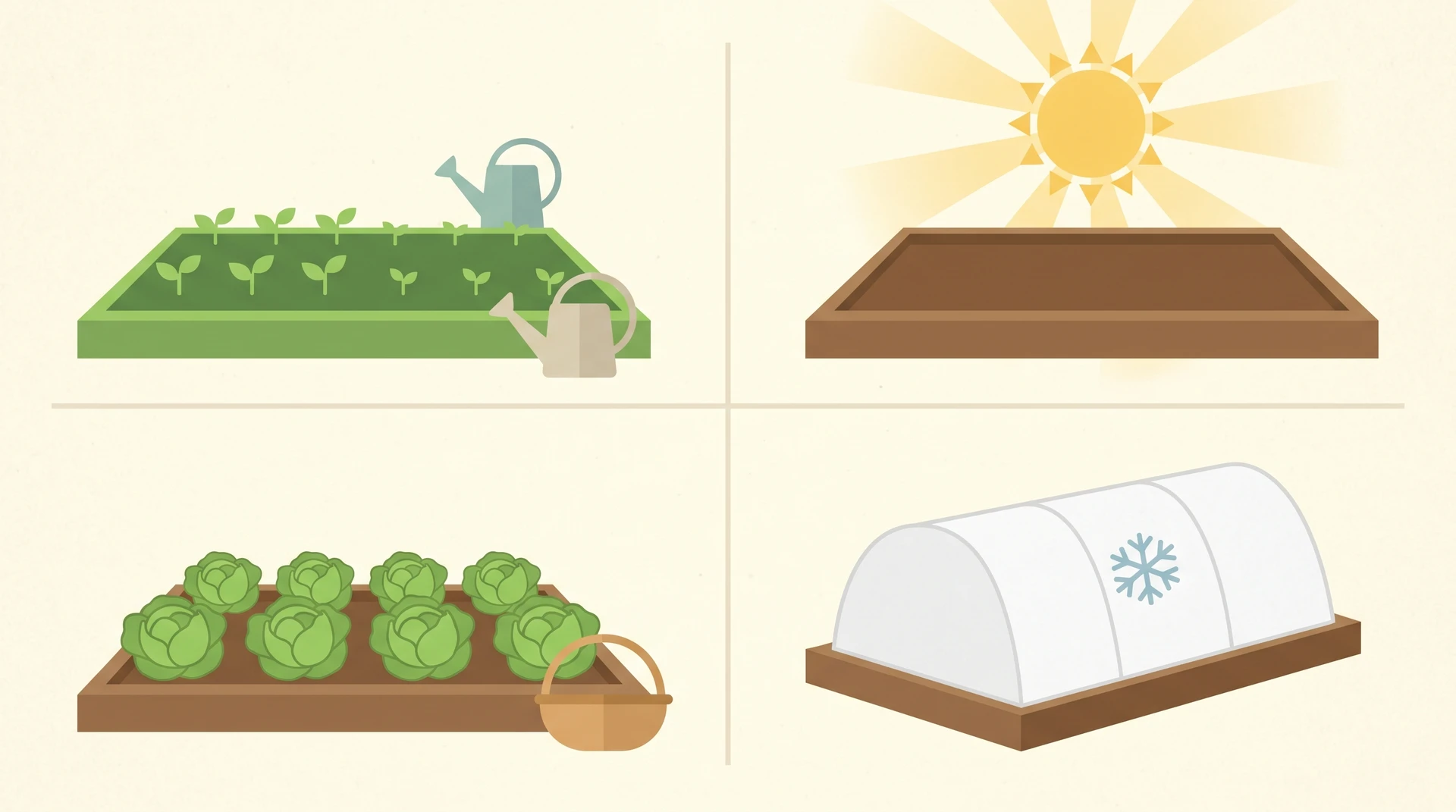
According to the University of Minnesota Extension, soil temperature is the most reliable planting trigger for lettuce — more reliable than calendar dates, which can shift by two or more weeks depending on the year. Lettuce germinates between 40°F and 70°F, with the fastest germination near 60°F. A basic soil thermometer checked at 2-inch depth takes the guesswork out of early-spring decisions.
| Period | Action | Notes |
|---|---|---|
| Late March | Start butterhead and romaine indoors | 6–8 weeks before transplanting; use 70°F germination heat |
| April 1–15 | Direct sow leaf lettuce under row covers | Soil must reach 40°F at 2-inch depth; cover protects against late frosts |
| April 15–May 1 | Transplant indoor-started heads | Harden off for 5–7 days before transplanting |
| May 1–June 1 | Succession-sow every 2 weeks | Each sowing adds 2 weeks of harvest; stop by June 1 to avoid bolting season |
| July 1–15 | Start fall transplants indoors | Outdoor soil too hot for germination (77°F+ stops it); indoor start essential |
| August 1–15 | Transplant outdoors; direct-sow leaf types | Evening temperatures should be below 70°F before transplanting |
| August 15–Sept 1 | Second fall succession | Extends harvest into first week of October |
The University of Minnesota Extension lettuce guide confirms that June, July, and August conditions are too hot for lettuce in Minnesota — making the transition from spring to fall crop the defining challenge for zone 4 growers. The solution is not fighting summer but bridging it: finish spring crops by mid-June and have transplants ready to go out in early August.
Best Lettuce Varieties for Zone 4
Short-season performance depends on two things: days to maturity (you need varieties that finish before summer heat builds) and bolt resistance (how long the plant holds edible quality once temperatures rise). The following varieties have solid track records in zone 4 states, based on University of Wisconsin Extension recommendations and university trial data.
For more named variety options beyond this table, the lettuce varieties guide covers a broader range across types and seasons.
| Variety | Type | Days to Maturity | Key Zone 4 Trait | Best Use |
|---|---|---|---|---|
| Buttercrunch | Butterhead | 49 days | Slow-bolt genetics; 1963 AAS winner; tender leaves hold quality longer in heat | Spring and fall heads; best for beginners |
| Simpson Elite | Loose-leaf | 48–58 days | Improved bolt resistance over Black Seeded Simpson; vigorous in cool soil | Cut-and-come-again spring harvests |
| Winter Density | Romaine | 50–54 days | Compact, dense heads; bolt-resistant; tolerates light frosts without cover | Fall crop; takes brief frost events to 28°F |
| Red Sails | Loose-leaf | 45 days | Fastest maturity on this list; heat-tolerant for a leaf type; red pigment adds antioxidants | Early spring sowing; also good for fall |
| Waldmann’s Dark Green | Loose-leaf | 48–52 days | Reliable in cold, wet springs; performs well when other varieties stall | Early spring; cold soil starter |
| Nevada | Crisphead | 50–60 days | LMV (Lettuce Mosaic Virus) resistant; good heading under variable conditions | Spring head crop; disease pressure areas |
I’ve grown Buttercrunch and Winter Density side by side in a zone 4 Minnesota garden and found Winter Density consistently holds quality a full week longer into June than most romaine types — the compact head seems to shield inner leaves from heat better than looser heads.
Avoid large crisphead varieties like Iceberg in zone 4 — their 75–100 day requirement means they need a frost-free window that zone 4 cannot consistently provide in spring without season extension.
Stop missing your zone's planting windows.
Select your US zone and month — get a complete checklist of what to plant, prune, feed, and protect right now.
→ View My Garden CalendarSoil Preparation and Planting
Lettuce is a shallow-rooted, fast-growing crop. It responds well to a well-prepared bed but does not need deep soil amendment — most of its root activity happens in the top 6 inches. Target pH 6.0–6.8; below 6.0, manganese toxicity can cause tip-burn on inner leaves, which is often misdiagnosed as calcium deficiency.
The UMN Extension recommends applying a balanced fertilizer such as 10-10-10 at 2 pounds per 100 square feet before planting, then side-dressing with 1 pound per 25 feet of row once plants reach 4 inches tall. Incorporate compost before planting rather than fresh manure, which can carry pathogens and adds excessive nitrogen that pushes leafy growth while delaying head formation in head types.
Spacing varies by type:
- Loose-leaf: 4–6 inches in-row; allows cut-and-come-again harvesting without crowding
- Butterhead and romaine: 8–10 inches; tighter than most packages suggest, which is fine for zone 4’s short windows
- Crisphead: 12–15 inches; needs room for full head development
Water consistently at 1 inch per week — either rainfall or irrigation. Lettuce has shallow roots that dry out quickly; inconsistent moisture is one of the top causes of tip-burn and premature bolting in early summer. A layer of straw or shredded leaf mulch 3 inches deep conserves moisture and keeps soil cooler during warm spells, which delays bolting by several days in late-spring plantings.
Season Extension: Adding 4–6 Weeks
Zone 4’s short season makes every additional week of harvest significant. Two tools add the most productive weeks for the least investment: floating row covers in spring and cold frames for fall.
Floating row covers in spring allow direct sowing two to three weeks earlier than unprotected soil. According to a University of Wisconsin Extension guide, floating row covers provide 4–8°F of frost protection and can extend productive seasons by three to four weeks. A heavyweight row cover (½ oz to 1.5 oz per square yard) protects lettuce down to 28°F, which covers most late April frost events in zone 4. Drape directly over seedlings; no frame needed until plants push against the fabric.
MSU Extension research confirms temperature gains of at least 10°F under single-layer tunnel covers — enough to make late March or early April sowing reliable even in colder zone 4 locations like northern Minnesota or Vermont. MSU Extension row covers guide
Cold frames in fall extend harvest from late September into October and even early November in mild falls. A simple cold frame — four boards with an old storm window on top — keeps temperatures inside 10–15°F warmer than outside air on clear nights. Plant fall crops inside a cold frame in early August and you shift the harvest window by nearly a month.
North-facing slopes as a summer buffer: For any lettuce that must grow through warm spells, positioning rows on the north side of a taller structure (a fence, a corn row, a trellis) provides afternoon shade that can lower leaf temperatures by 5–10°F on hot afternoons — enough to slow bolting for a few additional days.
Harvesting and Common Problems
Loose-leaf lettuce is best harvested using the cut-and-come-again method: remove outer leaves at 5–6 inches tall, leaving the growing center intact. This is covered in detail in the cut-and-come-again harvesting guide. Head types are harvested once the head feels firm under light pressure; do not wait for the head to look “full” by supermarket standards — zone 4’s shorter growing season means smaller heads that are still fully edible and flavor-complete.
Common zone 4 lettuce problems
| Symptom | Cause | Fix |
|---|---|---|
| Center stalk elongating by late May–June | Bolting; heat + long days activating GA pathway | Harvest immediately; switch to fall crops; choose slower-bolt varieties next year |
| Brown leaf edges on inner leaves (tip-burn) | Calcium deficiency under rapid growth or heat stress; inconsistent watering | Even irrigation; avoid high-nitrogen fertilizer mid-season; choose tip-burn resistant varieties like Nevada |
| Yellow mosaic patterns on leaves | Lettuce Mosaic Virus (LMV), aphid-transmitted | Remove infected plants; choose LMV-resistant varieties (Nevada, Sierra, Prizehead); control aphids with reflective mulch |
| Seedlings damping off at soil line | Fungal pathogens in cold, wet soil; overwatering in early spring | Improve drainage; wait for soil above 40°F; avoid overhead watering in seedling stage |
| Bitter flavor before visible bolting | Lactucin concentration rises ahead of stalk emergence | Harvest sooner; bitter leaves signal the bolting process has begun internally |
FAQ: Zone 4 Lettuce
Can lettuce survive frost in zone 4?
Yes. Mature lettuce plants tolerate light frosts down to 28°F (-2°C) without damage, especially once hardened off. Seedlings are more vulnerable. A floating row cover drops the effective frost threshold to around 22°F for established plants, making late April and early May planting safe in most zone 4 locations.
When is it too late to plant lettuce in zone 4?
For spring crops, stop direct sowing by June 1. For fall crops, the last safe transplant date is around August 15–20 — any later and heads may not fully develop before hard frost. Leaf varieties can be direct-sown as late as September 1 for a baby-leaf harvest before the season closes.
What is the fastest lettuce for zone 4?
Red Sails at 45 days is the fastest on this list. For a head-forming type, Buttercrunch at 49 days is the best combination of speed and quality for zone 4 conditions. Both fit comfortably inside zone 4’s spring window even in colder subzones.
How do I stop lettuce from bolting in zone 4?
You cannot stop it permanently — bolting is triggered by heat and long days, both outside your control. You can delay it by three to five days by harvesting outer leaves consistently (reduces plant stress), mulching to keep soil cooler, providing afternoon shade, and choosing slow-bolt varieties like Buttercrunch or Winter Density. Plan to be done harvesting spring lettuce by June 15 regardless.
For the full zone-by-zone growing framework and tips on preventing bolting across all climates, see the complete lettuce growing guide.
Sources
- University of Minnesota Extension: Growing Lettuce, Endive and Radicchio in Home Gardens
- UW-Extension Wisconsin Horticulture: Growing Salad Greens in Wisconsin
- University of Minnesota Extension: Planting the Vegetable Garden
- BMC Genomics (PMC): Molecular basis of high temperature-induced bolting in lettuce
- MSU Extension: Row Covers for Frost Protection and Earliness in Vegetable Production
- University of Maryland Extension: Growing Lettuce in a Home Garden


