

Companion Plants for Beets: 7 Pairings That Deter Leaf Miners and Boost Root Development

Discover 7 proven companion plants for beets that deter aphids, flea beetles, and leaf miners — plus 3 plants that stunt root development and how to avoid them.
Beets are forgiving vegetables — they tolerate poor soil, handle light frost, and grow well in both spring and fall — but they do have a few consistent pest problems that companion planting can genuinely help with. The challenge is that most companion planting guides online are long lists of plant names with vague claims and no explanation of how anything works. Some of the most widely repeated pairings, like planting marigolds right next to beets for nematode control, only work if you follow steps that almost no guide mentions.
This guide covers the 7 most effective companions for beets with specific mechanisms for each, explains what to avoid and why, and corrects three widespread misconceptions about beet companion planting. For everything about growing beets from seed to harvest — soil preparation, thinning, watering, and variety selection — see the complete beet growing guide.
Quick Reference: Beet Companion Plants at a Glance
| Companion | Primary Benefit | Plant It |
|---|---|---|
| Garlic & onions | Repel aphids and flea beetles | 6–8 in. from beet rows |
| Lettuce | Living mulch, weed suppression | Between beet rows |
| Radishes | Soil aeration + trap crop | Interplanted, harvest early |
| Bush beans | Nitrogen fixation | Bed ends, 2–3 plants per row |
| French marigolds | Nematode suppression (pre-plant only) | Same location, 2 months before beets |
| Sweet alyssum | Attracts parasitoid wasps | Bed border |
| Summer savory | Repels aphids and flea beetles | Interplanted or border |
How Companion Plants Actually Help Beets
Beets face three real threats in the vegetable garden: aphids and flea beetles targeting seedlings, leaf miners tunneling through foliage in summer, and soil nematodes deforming roots. Companion planting can address all three — but only if you understand how each mechanism works and how close a companion needs to be to do its job.


Three mechanisms are worth understanding before you start planting:

Skip the guesswork — get a pre-planned 4×8 kitchen garden bed
Free printable planting plan: what goes where, when to plant it, and how to keep it alive. Plus two bonus flower bed plans.
Pest confusion through volatile organic compounds (VOCs). Aromatic plants — garlic, onions, summer savory — release sulfur-containing compounds and terpenes that mask the scent profile of beet foliage. Aphids and flea beetles find host plants primarily by smell. When that scent is disrupted, fewer pests land. The catch: this only works at close range. Research on aromatic companions consistently shows that plants need to be within 12–18 inches of the target crop to concentrate VOC compounds at effective levels. A row of garlic on the opposite side of the garden provides almost no protection.
Living mulch for soil health. Shallow-rooted neighbors like lettuce and radishes act as a ground cover, keeping soil cool, retaining moisture, and suppressing weeds — without competing with beet taproots. Beet roots descend 12–18 inches into the soil; most companion plants sit in the top 4–6 inches. There is genuine root-zone separation when you pair them correctly.
Nitrogen fixation and soil structure. Bush beans fix atmospheric nitrogen through a symbiosis with Rhizobium bacteria in the soil. West Virginia University Extension notes that beet taproots also benefit neighboring plants by breaking up compacted subsoil layers, improving drainage and root penetration for shallow-rooted neighbors.
One honest caveat before diving in: Illinois Extension (2025) notes that most specific companion planting recommendations rely on anecdotal evidence rather than replicated field trials. Nitrogen fixation from legumes and trap cropping are well-supported. Most pest-deterrence claims fall into the ‘widely practiced, limited formal proof’ category. That does not make them useless — it means setting realistic expectations rather than expecting companion plants to solve every pest problem.
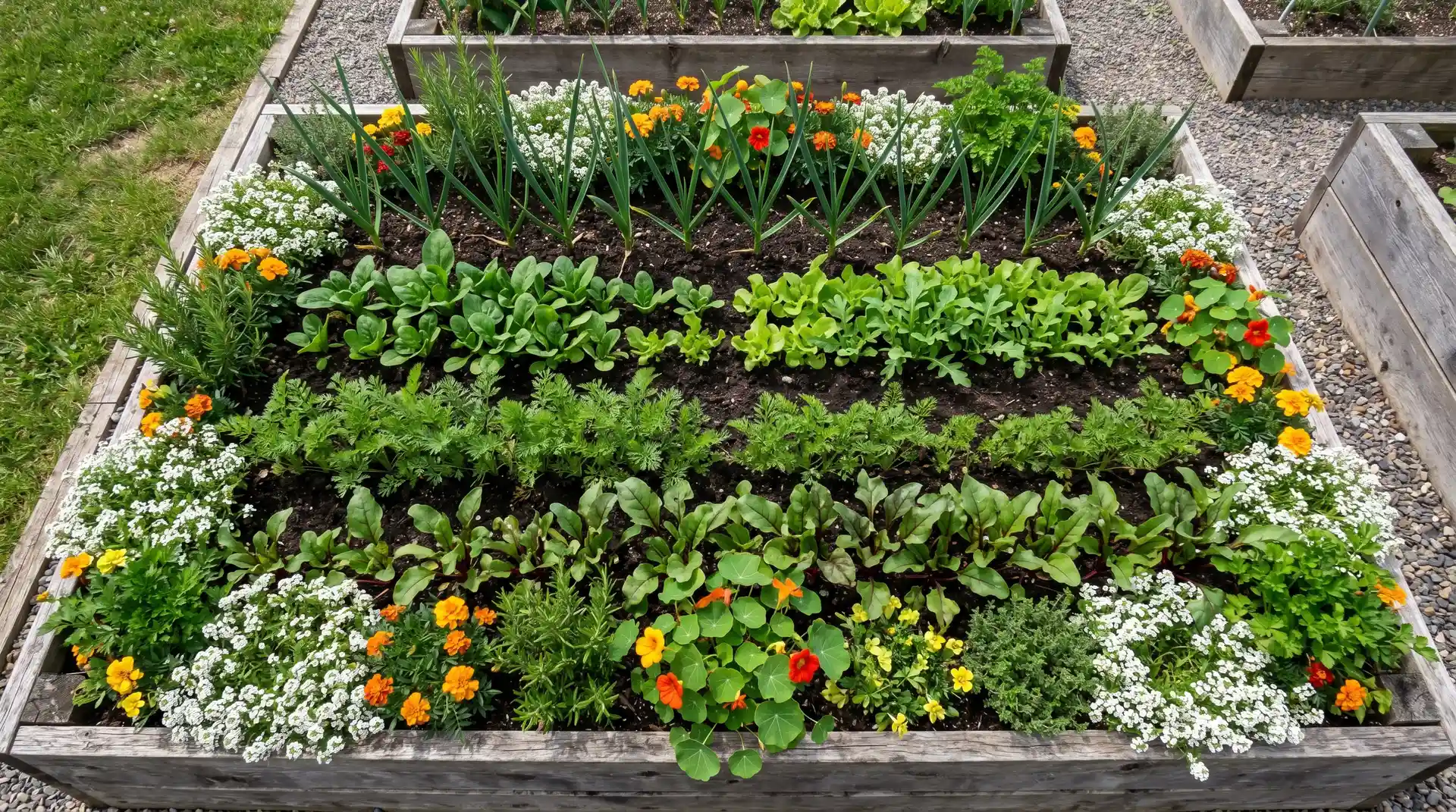
The 7 Best Companion Plants for Beets
1. Garlic and Onions
Alliums are the most reliable pest deterrents for a beet bed. Garlic and onions release allicin and other sulfur compounds through their roots and foliage, and these compounds actively confuse the insects most likely to damage beet seedlings: aphids, flea beetles, and armyworms. Flea beetles are a specific early-season problem for beets — they chew small holes in the soft leaves of young seedlings, which can stunt germination-stage plants if populations are high. Interplanting garlic or onions between beet rows concentrates sulfur scent directly in the zone where flea beetles forage.

Unlike the situation with beans (where allicin disrupts the Rhizobium bacteria that legumes depend on for nitrogen fixation), beets do not fix nitrogen. There is no compatibility concern with alliums — they are simply good neighbors. Plant them 6–8 inches from beet rows for the best scent coverage. Garlic planted in fall also marks the bed as productive spring planting space for beets, since both enjoy cool soil.
2. Lettuce
Lettuce and beets are one of the most practical combinations in a small-space vegetable garden because they solve each other’s problems. Lettuce roots sit in the top 4–6 inches of soil; beet taproots work their way down to 12–18 inches. There is no root competition. Lettuce leaves spread low and wide, shading out weeds between beet rows and keeping soil temperatures cooler and moisture levels higher during the critical root-swelling stage.
The timing also works in your favor. Lettuce matures in 45–60 days; beets take 55–70 days to reach full size. By the time beet tops begin to shade the lettuce row, you can harvest the lettuce and free up the space. In warmer climates (USDA zones 7 and above), starting lettuce between beet rows gives it the shade protection it needs as summer heat builds. West Virginia University Extension specifically lists lettuce as a compatible companion for beets, noting that root-depth differences prevent resource competition.
3. Radishes
Radishes serve a dual function next to beets: they loosen the soil for developing beet roots and they act as a trap crop for flea beetles. On the soil side, radish roots penetrate and break up surface compaction in the first 6–8 inches of topsoil ahead of beet root development. Harvesting radishes after 25–30 days leaves a network of small channels that improve drainage and aeration right where beet roots are expanding.
On the pest side, flea beetles strongly prefer radishes to beets. Planting a row of radishes at the edge of a beet bed draws flea beetles toward the trap crop. The radish roots still develop normally (flea beetle damage is mostly cosmetic on radish leaves), so you sacrifice nothing. This is a straightforward application of trap cropping, one of the few companion planting strategies with genuine research support according to Illinois Extension.
Sow radishes 2–3 weeks before beets to establish the trap crop before beet seedlings emerge.
4. Bush Beans
Bush beans are a nitrogen source for the beet bed — with two important caveats. First, the benefit comes primarily after harvest, when bean roots and plant residue decompose and release fixed nitrogen into the soil. There is no real-time nitrogen transfer from a growing bean plant to a beet root next to it. Second, this only applies to bush beans. Pole beans fix more nitrogen than bush beans, their vines shade beets from above, and their aggressive growth produces nitrogen levels that push beets toward leafy top growth at the expense of root development. Keep pole beans out of the beet bed entirely.
A note on conflicting advice: West Virginia University Extension lists beans generally as plants to avoid near beets. Other sources promote bush beans specifically. The consensus among organic vegetable growers is that 2–3 bush bean plants per 4-foot bed row produce a modest nitrogen benefit without crossing into excess. Planting bush beans at the ends of beet rows rather than mixed in minimizes any chance of shading young beet leaves.
5. French Marigolds — With a Critical Caveat
French marigolds (Tagetes patula) suppress soil nematodes through alpha-terthienyl, a naturally occurring compound produced by their roots that inhibits nematode egg hatching. Nematodes that deform root crops like beets, carrots, and parsnips are a genuine problem in sandy, warm soils. So the pairing makes sense in theory. But almost every gardening guide gets the technique wrong.
Stop missing your zone's planting windows.
Select your US zone and month — get a complete checklist of what to plant, prune, feed, and protect right now.
→ View My Garden CalendarAccording to UF/IFAS Extension, border-planting marigolds alongside a growing beet crop provides no meaningful nematode suppression. For marigolds to work, they must be planted at dense spacing (less than 7 inches apart) in the exact location where the beet crop will grow, at least two months before beets go in. The roots need extended time in the soil to build up alpha-terthienyl concentrations in the surrounding zone. A ring of marigolds planted at the same time as beet seedlings does essentially nothing for nematode control.
If nematodes are a confirmed problem in your beet bed (look for knobby, forked, or stunted roots), plan a marigold pre-plant cover the season before or grow beets in a different bed while marigolds occupy the original location for a full season. If nematodes are not a confirmed problem, plant marigolds for their flowers and pollinator value — but do not expect them to protect beet roots.
6. Sweet Alyssum
Sweet alyssum (Lobularia maritima) is the most underused companion plant in the beet garden. Its tiny white flowers bloom from late spring through first frost and provide nectar for parasitoid wasps, syrphid flies, and other beneficial insects that use garden pests as hosts for their larvae. Clemson Cooperative Extension lists sweet alyssum among the most effective insectary plants for vegetable gardens, noting that its small flower structure makes it especially attractive to the tiny parasitic wasps that attack leaf-mining flies.
Beet leaf miners (Pegomya hyoscyami) are a real pest in the beet garden — the RHS notes they create irregular blotch-shaped mines in beet, spinach, and chard leaves between April and September, with 2–3 generations per season. The larvae tunnel inside leaves and pupate in soil over winter. Parasitoid wasps naturally attack these larvae, and sweet alyssum keeps those wasps in the vicinity by providing a reliable nectar source.
Here is the honest context though: UMN Extension specifically notes that it is not necessary to treat spinach leafminers when they attack the leaves of a root crop such as beets. The miners eat foliage, not roots. Cosmetically damaged leaves look alarming but do not reduce root harvest under normal pest pressure. Sweet alyssum still earns its place in the beet garden — it supports the beneficial insect population that keeps multiple pests in check — but you are building overall garden ecosystem health, not running a crisis-response operation against leaf miners. Plant alyssum at bed borders; 6 inches of height means it never shades beet rows.
7. Summer Savory
Summer savory (Satureja hortensis) is a traditional European kitchen garden companion for beets, listed directly by WVU Extension as a compatible plant for beet beds. The annual herb grows to about 18 inches, produces small pink-white flowers in late summer, and releases aromatic oils — primarily carvacrol and thymol — that are known to deter aphids and flea beetles when concentrated near a target crop.
Summer savory’s practical advantage is that it fills the middle space in a beet bed without competing aggressively. It is not as drought-tolerant as sage or rosemary, so it shares beets’ preference for consistent moisture. Both go in the ground at the same time in spring and wrap up at first frost. If you want to keep it simple — one companion plant for the beet bed that covers pest deterrence, fills space usefully, and comes with historical backing from university extension guidance — summer savory is the choice.
3 Plants to Keep Away from Beets
Pole Beans
The problem with pole beans is excess nitrogen combined with physical competition. Pole varieties fix significantly more nitrogen than bush beans and, in a small beet bed, this creates soil nitrogen levels that push beet energy toward producing large leafy tops rather than swelling roots. The vines also shade beet rows as they climb — beets need full sun for root development, and even partial shading from a pole bean trellis reduces yields noticeably. Keep pole beans in a separate part of the garden from beets. Bush beans in modest numbers (2–3 plants per row section) are a different story, as covered above.

Fennel
Fennel is allelopathic — it releases anethole and other volatile terpene compounds from its roots that inhibit seed germination and root development in most vegetables. A peer-reviewed review published in PMC documents the biochemical mechanisms of plant allelopathy, confirming that volatile compounds released into surrounding soil significantly reduce germination rates and root mass in sensitive species. Beets are among the crops most sensitive to fennel’s root exudates. Direct planting within 3 feet of an established fennel plant can reduce beet germination and stunt young root development.
Fennel does have value in the broader garden — Clemson HGIC notes that its flowers attract parasitoid wasps and beneficial flies. Grow fennel in its own bed or in a container, at least 3 feet from the beet row. The biological benefits reach the garden without the allelopathic roots making contact.
Field Mustard and Wild Brassicas
A clarification worth making: some companion planting guides say brassicas are bad companions for beets, while others say they are good ones. Both are correct depending on what ‘brassica’ means. Cultivated brassicas — cabbage, broccoli, kale, cauliflower — share beets’ cool-season growing window, have complementary root depths, and are generally fine in the same bed. What to avoid is field mustard (Brassica rapa) and charlock (Sinapis arvensis), weedy wild brassicas with aggressive root systems that compete directly with beet roots for water and nutrients in the same soil zone. These are often found growing as volunteers in vegetable beds after a brassica crop. Pull them out promptly if they appear near beets.
Planting Layout: Turning Pairings into Practice
In a standard 4×4-foot raised bed or a 3-foot-wide ground bed, a practical beet companion layout works like this. Beet seeds go in central rows 4–6 inches apart. Garlic or onion sets go in between beet rows or at the outer edge, close enough that their sulfur compounds concentrate in the beet zone (within 12–18 inches). Lettuce and radishes fill the gaps between beet seedlings in the early weeks — radishes are harvested at 25–30 days, lettuce at 45–60 days, both clearing space before beet roots start to swell. A border of sweet alyssum along one or two edges keeps parasitoid wasps in the area without shading the bed. Summer savory can be interplanted at one end of the bed or grown in an adjacent row.

For larger plots: bush beans work at the bed ends, not mixed through the middle — their roots should not be in direct contact with developing beet roots. French marigolds belong in the rotation plan, not the current bed — grow them this season in the location where you plan to grow beets next spring.
One spacing rule worth keeping: aromatic companions (garlic, onions, savory) lose most of their pest-deterrent effect beyond 18 inches from the target crop. If your bed is wider than 3 feet, plant aromatics on both long sides rather than relying on a single border row.
Frequently Asked Questions
Does companion planting actually improve beet root size?
Not directly. Beet root development is primarily determined by soil preparation, consistent watering (1 inch per week), spacing (3–4 inches between plants), and the absence of soil compaction. Companion plants contribute by reducing pest pressure on seedlings, improving soil moisture retention, and providing modest nutrient support — but they do not substitute for the fundamentals. Our beet growing guide covers the soil preparation and spacing details that drive root size.
Can I grow beets near strawberries?
Yes. WVU Extension lists beets as compatible with strawberries, and the pairing makes practical sense: strawberries are shallow-rooted ground cover with a spreading habit; beets grow straight down. There is no root competition, and both crops appreciate well-drained, fertile soil. See our strawberry growing guide for strawberry spacing details if you are planning a mixed bed.
Can I plant beets near tomatoes?
Yes. WVU Extension lists tomatoes as compatible with beets. In warm-climate gardens (USDA zones 7 and above), tomato plants provide late-season shade that protects beet rows from summer heat and extends the harvest window into late summer. Keep spacing generous (12 inches from tomato stems) so tomato roots do not compete with beet taproots for water and nutrients. For a full overview of the best plant families to combine in the vegetable garden, see our companion planting guide.
Sources
- Leafminers in Home Gardens — University of Minnesota Extension
- Beet Leaf Miner — Royal Horticultural Society
- Marigolds (Tagetes spp.) for Nematode Management — UF/IFAS Extension
- Companion Planting — West Virginia University Extension
- Attracting Beneficial Insects to Your Vegetable Garden — Clemson Cooperative Extension
- Companion Planting: Combining Plants for a Healthy Garden — Illinois Extension (2025)
- Research Progress on the Use of Plant Allelopathy in Agriculture — PMC

