

Zone 4 Monstera Care: The Exact Outdoor Planting Window, Best Varieties, and Frost-Proof Winter Plan

Zone 4 monstera care guide: exact outdoor dates (late May–early Sept), the biology behind the 50°F limit, variety comparison for cold-climate homes, and a complete winter indoor strategy.
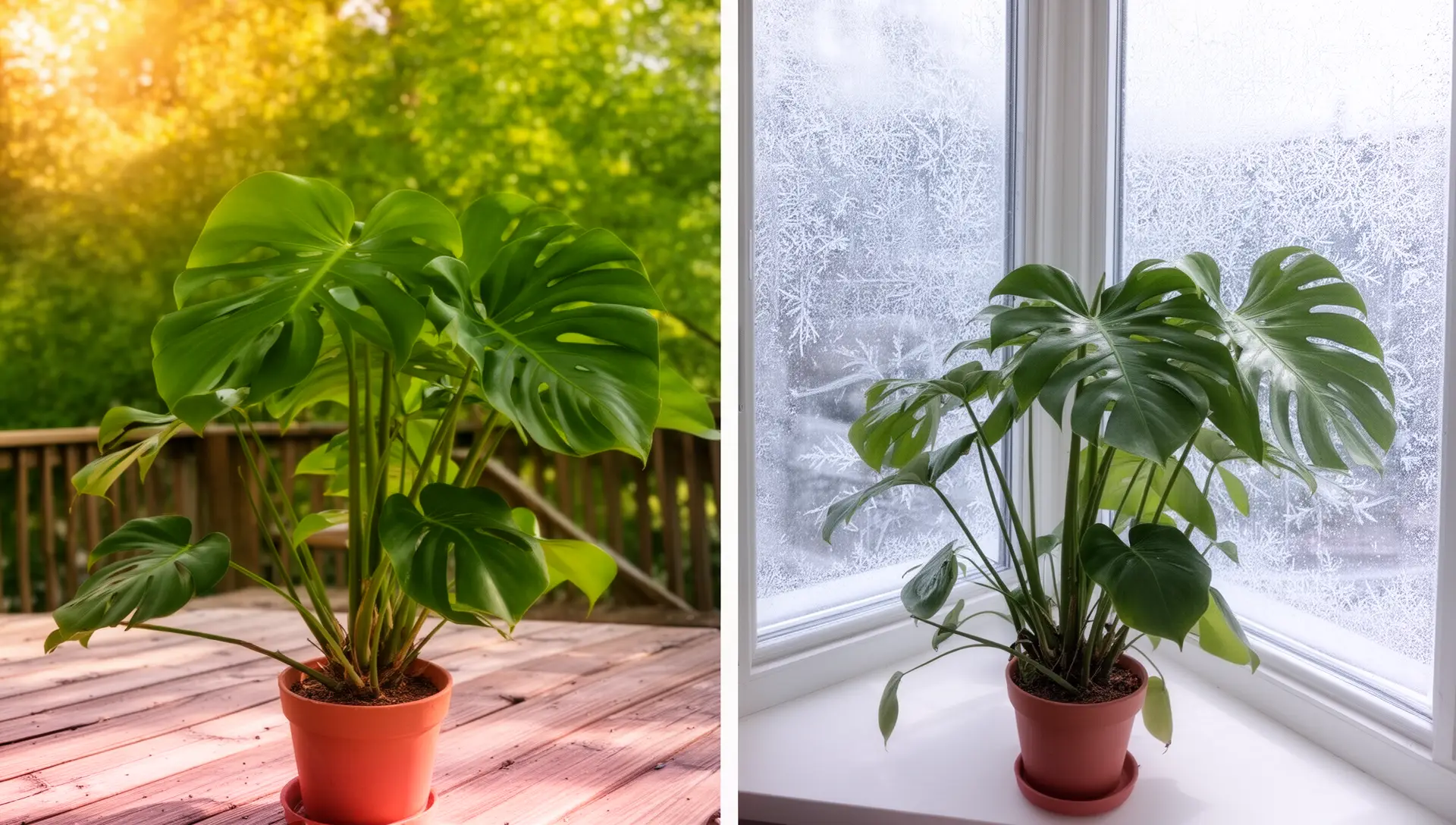
Zone 4 gardeners already know the container-plant routine: get it outside when summer finally arrives, pull it back in before the cold wins. Monstera deliciosa fits that system well — better, in fact, than most tropical houseplants. Moved outdoors in late May, it receives the humidity, warmth, and airflow that trigger its fastest annual growth. New leaves arrive every two to three weeks instead of every four to six. The outdoor season supercharges it; the indoor winter maintains it.
The challenge is managing the transitions precisely. Move your monstera outside too early and a single cold night below 50°F causes chilling injury — cellular damage that shows up as blackened leaf patches days later. Bring it indoors too late and spider mites arrive in your living room. Get both transitions right and Zone 4 turns out to be a workable climate for this tropical plant. For a full breakdown of monstera care beyond zone-specific topics, see the Monstera growing guide.

Why 50°F Is a Hard Biological Limit
The 50°F (10°C) rule is not a conservative estimate — it reflects a physical change in plant tissue. Research published in Frontiers in Plant Science documents what happens when tropical plants drop below this threshold: cell membrane lipids undergo a phase transition, shifting from fluid to semi-rigid. In warm-adapted species like monstera, that membrane change disrupts electron transport on the oxidizing side of photosystem II and reduces activity in the Calvin cycle enzymes responsible for carbon fixation. The photosynthetic machinery effectively locks up, and reactive oxygen species accumulate faster than the plant’s defenses can neutralize them. [5]
For growers, this translates to a visible timeline: expose your monstera to temperatures below 50°F for a few hours, and within 24–-48 hours you’ll see blackened or water-soaked patches at leaf edges and growing tips. That tissue is dead and won’t recover. New leaves from an undamaged growing point will be healthy, but the damaged leaves are permanent.
Zone 4 winters reach −20°F to −30°F, which is obviously lethal. But the more relevant risk is the spring and fall shoulder seasons. Even in June, a cold front pushing through Duluth or Bemidji can bring overnight lows into the upper 40s°F. This is why the safe outdoor date is not simply the last frost date but the point at which overnight lows are consistently above 55°F — with a 5-degree buffer above the damage threshold.
The Zone 4 Monstera Seasonal Calendar
Zone 4 covers much of northern Minnesota, Wisconsin’s northwoods, Michigan’s Upper Peninsula, northern New England, and parts of Montana and the Dakotas. The last spring frost falls between late May and early June; the first fall frost typically arrives in mid-September to early October. That gives a frost-free growing season of roughly 100–120 days. [6]
For monstera, the practical outdoor window is narrower than the frost-free calendar: roughly 14 weeks, from when overnight lows stabilize above 55°F to when they begin dipping below that mark in late summer. University of Minnesota Extension notes that heat-loving crops in Minnesota are typically ready for outdoor planting in late May to early June, once soil temperatures reach 65°F or warmer. [7] Use that same warm-soil trigger as your monstera move-out cue.
| Month | Zone 4 Monstera Action |
|---|---|
| January–March | Indoor maintenance: bright south-facing window, water every 10–14 days, no fertilizer |
| April | Resume fertilizing every 4 weeks; check if repotting is needed; supplement light if new leaves are unfenestrated |
| Late May (Zone 4b) / Early June (Zone 4a) | Begin hardening off when overnight lows consistently above 55°F; start 2 hours per day in deep shade |
| June–July | Peak outdoor growth; water every 1–2 days; fertilize every 3–4 weeks; stake or moss pole in place |
| August | Monitor 10-day forecast nightly; begin reducing outdoor fertilizing in the second half |
| Early September | Move indoors when two or more forecast nights drop below 55°F — do not wait for a frost warning |
| October–December | Transition to indoor light; reduce watering; hold fertilizer until April |
Hardening Off: The 10-Day Outdoor Transition
Your monstera has spent winter in 200–400 foot-candles of indoor filtered light. A shaded outdoor position on a June afternoon delivers 1,000–3,000 foot-candles — even under a tree canopy. Move the plant directly outside and the leaves develop bleached, papery burn patches within a week as the chloroplasts are overwhelmed by light intensity they’re not calibrated for. [4]
The acclimation process takes 10–14 days:
- Days 1–3: Two hours of morning outdoor time in deep shade (north side of a fence or building). Bring back inside for the rest of the day.
- Days 4–7: Extend to four to five hours; move to bright shade under a porch overhang or large tree canopy.
- Days 8–14: Leave outdoors in dappled shade for the full day; bring in overnight until temps stay above 60°F reliably.
Never place monstera in direct summer sun outdoors, even after full acclimation. Zone 4’s lower-humidity summer air causes rapid moisture loss from leaf tissue under intense direct radiation. Dappled shade that delivers two to three hours of indirect bright light is the correct outdoor position.
Outdoor Summer Care in Zone 4
Once settled outdoors, monstera puts on noticeably faster growth than it does indoors. Zone 4 summers deliver the warm nights and moderate humidity that approximate Central American cloud-forest conditions — the environment monstera evolved in.
Watering: Container soil in a Zone 4 summer can dry out in one to two days during July heat waves. Check the top two inches of soil daily and water thoroughly when dry. [2] Always empty the saucer within 30 minutes of watering — standing water in the saucer causes root rot in well-aerated outdoor conditions where the roots are more active. If you see signs of overwatering, see the guide on monstera root rot.
Fertilizing: Apply a balanced water-soluble fertilizer (20-20-20 or similar) every three to four weeks during the outdoor season. Wisconsin Horticulture Extension recommends fertilizing monstera regularly from spring through fall. [1] In Zone 4’s 14-week outdoor window, that gives you three to four feeding cycles — skip none. For product recommendations, see our guide to the best fertilizers for monstera.
Wind and support: Zone 4 summer thunderstorms bring gusts that snap monstera petioles at the stem junction. A support stake or moss pole is essential once the plant is outdoors. Aerial roots attach naturally to a rough or moss-covered surface and significantly strengthen the overall structure.


The Fall Transition: Act Before the First Frost Warning
The most common mistake Zone 4 growers make is waiting until a frost warning appears before moving monstera indoors. By that point, several nights may already have dropped below 50°F — each one causing incremental chilling injury that only becomes visible days later as blackened leaf sections.
Start watching the 10-day forecast in mid-August. When two or more nights below 55°F appear in the forecast, move the plant indoors even if the days are still warm and sunny. The outdoor season is over.
Before re-entering the house, complete these three steps:
- Pest inspection: Spider mites, scale insects, and fungus gnats are all present in Zone 4 summer gardens. Every leaf surface, axil, and the top inch of soil should be inspected. Wipe all leaf surfaces with a damp cloth. Hold the plant in an unheated space — a garage or enclosed porch — for 48 hours before moving to the main living area, and watch for any pest activity. [3]
- Irrigation reset: Switch to indoor watering frequency (when top one to two inches are dry) for the week before the move, so you’re not overwatering a plant transitioning to lower light.
- Indoor spot prepared: Have the winter position chosen before move-in day. A plant relocated from bright outdoor shade to a dim indoor corner will drop leaves within two weeks.
Zone 4 Winter Indoor Care
Zone 4 homes in winter present two specific challenges for monstera: short days with very limited natural light, and low humidity from forced-air heating systems.
Light: Zone 4 locations receive fewer than nine hours of daylight in December, and much of it is cloud-filtered. A monstera placed near a south-facing window may receive only one to two hours of useful direct light. When plants produce multiple consecutive leaves that are smaller than average and lack fenestrations, they are light-starved — not just slow. A full-spectrum LED grow light positioned 12–18 inches above the canopy, running 10–12 hours per day, restores adequate light without overheating the plant. See our guide to the best grow lights for monstera for specific product options.
Humidity: Forced-air heating drops indoor relative humidity to 20–30% in a Zone 4 January — well below the 50–60% monstera prefers. Leaf edge browning and curling leaves are the first visible symptoms. A room humidifier near (not aimed directly at) the plant is the most effective correction; target 50% relative humidity near the canopy. Pebble trays with water add modest humidity in very dry rooms but are not sufficient on their own during a Zone 4 winter.
Watering: In low light and cool indoor temperatures, watering frequency drops significantly. The top one to two inches of soil drying is your trigger — not a calendar schedule. In a Zone 4 winter, that may mean watering every 10–14 days depending on pot size and room temperature. [2] Overwatering in winter low-light conditions is the primary cause of root rot in Zone 4 monstera.
Cold drafts: Keep monstera leaves 6 inches from cold window glass. A south-facing window that provides useful light during the day can have glass surface temperatures below 40°F on a Zone 4 January night. Leaf tissue touching or resting against that glass can develop chilling injury — the same cellular damage as cold outdoor exposure — even inside a heated room.
Best Monstera Varieties for Zone 4 Conditions
No monstera species is cold-hardy in Zone 4; the variety choice is entirely about matching indoor winter performance to your home’s light availability and humidity. The varieties that handle low-humidity, short-day winters best are the same ones best suited for beginners. For a complete comparison of all 12 types, see our guide to monstera varieties.
| Variety | Size | Humidity needed | Zone 4 suitability | Best for |
|---|---|---|---|---|
| M. deliciosa | 6–10 ft | 40–60% | Excellent | Best all-rounder; tolerates typical heated-home humidity |
| M. borsigiana | 5–8 ft | 40–60% | Excellent | Faster growth than deliciosa; same low-maintenance care |
| M. adansonii | 3–5 ft | 40–60% | Good | Compact; ideal for smaller spaces, trailing planters |
| Thai Constellation | 6–8 ft | 50–65% | Good | Slower growth suits short season; stable variegation |
| M. obliqua | 2–4 ft | 75–85% | Poor | Not practical without dedicated humidity equipment |
For most Zone 4 gardeners, M. deliciosa or M. borsigiana are the best starting points. Both tolerate the 30–40% humidity typical in a heated northern home, grow well in bright indirect light, and respond dramatically to the outdoor summer season with larger, more deeply fenestrated leaves. Thai Constellation’s slower growth pace is actually an advantage in Zone 4’s compressed outdoor season — each leaf develops fully rather than arriving mid-cycle when you’re about to move the plant indoors. M. obliqua requires sustained 75–85% humidity and is not a practical choice unless you have a dedicated plant room with humidity control.
Stop missing your zone's planting windows.
Select your US zone and month — get a complete checklist of what to plant, prune, feed, and protect right now.
→ View My Garden CalendarFrequently Asked Questions
Can I plant monstera outside permanently in Zone 4?
No. Monstera cannot survive temperatures below 50°F without damage, and Zone 4 winters regularly reach −20°F or colder. In Zone 4, monstera is permanently a container plant — outdoors from late May to early September, indoors the rest of the year.
When exactly should I move monstera outside in Zone 4?
Wait until overnight lows are consistently above 55°F, not just past the average last frost date. In northern Zone 4 locations (Duluth, International Falls, Marquette), this typically means early June. In Zone 4b areas near the southern boundary (Twin Cities fringe, central Wisconsin), late May is often safe.
What does chilling injury look like on monstera?
Irregular blackened or brown-water-soaked patches on leaf surfaces, most visible at edges and growing tips, appearing 24–48 hours after cold exposure. The patches are permanent — the cell tissue is dead — but the plant continues producing healthy new leaves once temperatures recover.
My monstera grew well outdoors but produces small leaves indoors. What’s happening?
Reduced winter light, not temperature stress. Low light prevents monstera from producing full-size, fenestrated leaves. A south-facing window plus a supplemental grow light running 10–12 hours per day resolves this within one or two leaf cycles.
How many new leaves should I expect during a Zone 4 outdoor season?
With consistent fertilizing and correct placement, expect 4–8 new leaves over a 14-week outdoor season. Indoor-only plants in good conditions typically produce 4–6 leaves per year.
Sources
- Wisconsin Horticulture Extension (UW-Madison). “Swiss-Cheese Plant, Monstera deliciosa.” hort.extension.wisc.edu/articles/monstera-deliciosa/
- University of Minnesota Extension. “Propagating Monstera Deliciosa.” extension.umn.edu/houseplants/propagating-monstera-deliciosa
- Plant Addicts. “Growing Monstera Outdoors.” plantaddicts.com/growing-monstera-outdoors/
- Planet Houseplant. “Can Monstera Live Outside.” planethouseplant.com/can-monstera-live-outside/
- Peng T et al. “Effects of Chilling on the Structure, Function and Development of Chloroplasts.” Frontiers in Plant Science, 2018. PMC6262076.
- UF Seeds. “Zone 4 — Vegetable Planting Calendar Guide.” ufseeds.com/zone-4-planting-calendar.html
- University of Minnesota Extension. “A Minnesota Guide to Garden Timing.” extension.umn.edu/yard-and-garden-news/minnesota-guide-garden-timing


