

Cucumber Propagation: Why Saved Seed Stays Viable for 25+ Years (and What Rooting Vine Cuttings Actually Takes)

Saved cucumber seed can outlast its packet by 25+ years — here’s how to save it right, and why rooting vine cuttings rarely beats a $3 packet of seed.
Cucumber propagation splits into two very different paths, and most guides blur them together: saving your own seed from a fruit you grew, and rooting a piece of live vine to start a genetically identical new plant. Only one of those is a reliable home-garden technique. Properly dried and stored cucumber seed has been shown to stay viable for more than 25 years [1] — far longer than the vague “3 to 4 years” figure most seed-saving guides repeat. Rooting cucumber vine cuttings, on the other hand, is a real technique, but the research behind it comes from breeders working inside high-humidity propagation chambers [2], not from a windowsill jar of water. If you’re still getting your plants established in the first place, start with our Cucumber Growing Guide — this article picks up after the vines are already producing.
Should You Save This Cucumber’s Seed? (Hybrid vs. Open-Pollinated)
Check the tag on the plant, or the seed packet it came from, before you scoop a single seed. Most cucumber varieties sold at garden centers today are F1 hybrids — a deliberate cross of two specific parent lines bred for traits like disease resistance and uniform fruit — and those traits are not fixed in the hybrid’s own seed [7]. Plant a hybrid’s saved seed next year and you’ll get a real cucumber plant, just not a predictable one: fruit shape, yield, and disease resistance can all drift from what you grew this year.
Open-pollinated and heirloom varieties are the ones worth the effort. Their seed breeds true, generation after generation, as long as you’ve kept the variety from cross-pollinating with a different cucumber variety nearby [7]. There’s one more trap that even some experienced gardeners miss: parthenocarpic varieties (container and greenhouse types like Diva or Beit Alpha types, covered in our cucumber types and varieties guide) are bred to set fruit without pollination at all, and they’re sold as hybrids [9]. Growers pick the fruit young, before mature seed has a chance to develop — that’s part of what keeps them seedless in the kitchen [9], and it leaves nothing worth collecting even if you let one grow on.
| Seed Type | What Grows From Saved Seed | Worth Saving? |
|---|---|---|
| Open-pollinated / heirloom | True to the parent plant | Yes |
| F1 hybrid | Unpredictable mix of traits | No — buy fresh seed instead |
| Parthenocarpic (Diva, Beit Alpha types) | Harvested before seed matures; also a hybrid | No — nothing to collect |
The short version: if the tag doesn’t say “open-pollinated” or name a specific heirloom, assume it’s a hybrid and skip saving that one.

Three pre-planned garden beds, free
Stop staring at empty beds: printable plans with exact layouts, plant lists and planting calendars — yours free from the Garden Library.
How to Harvest, Ferment, and Dry Cucumber Seed
Leave your seed-saving fruit on the vine well past the point you’d normally pick it for eating — the skin needs to turn yellow, orange, or tan before the seeds inside are mature [3]. That overripe cucumber will be tough, bitter, and useless in the kitchen; that’s expected.
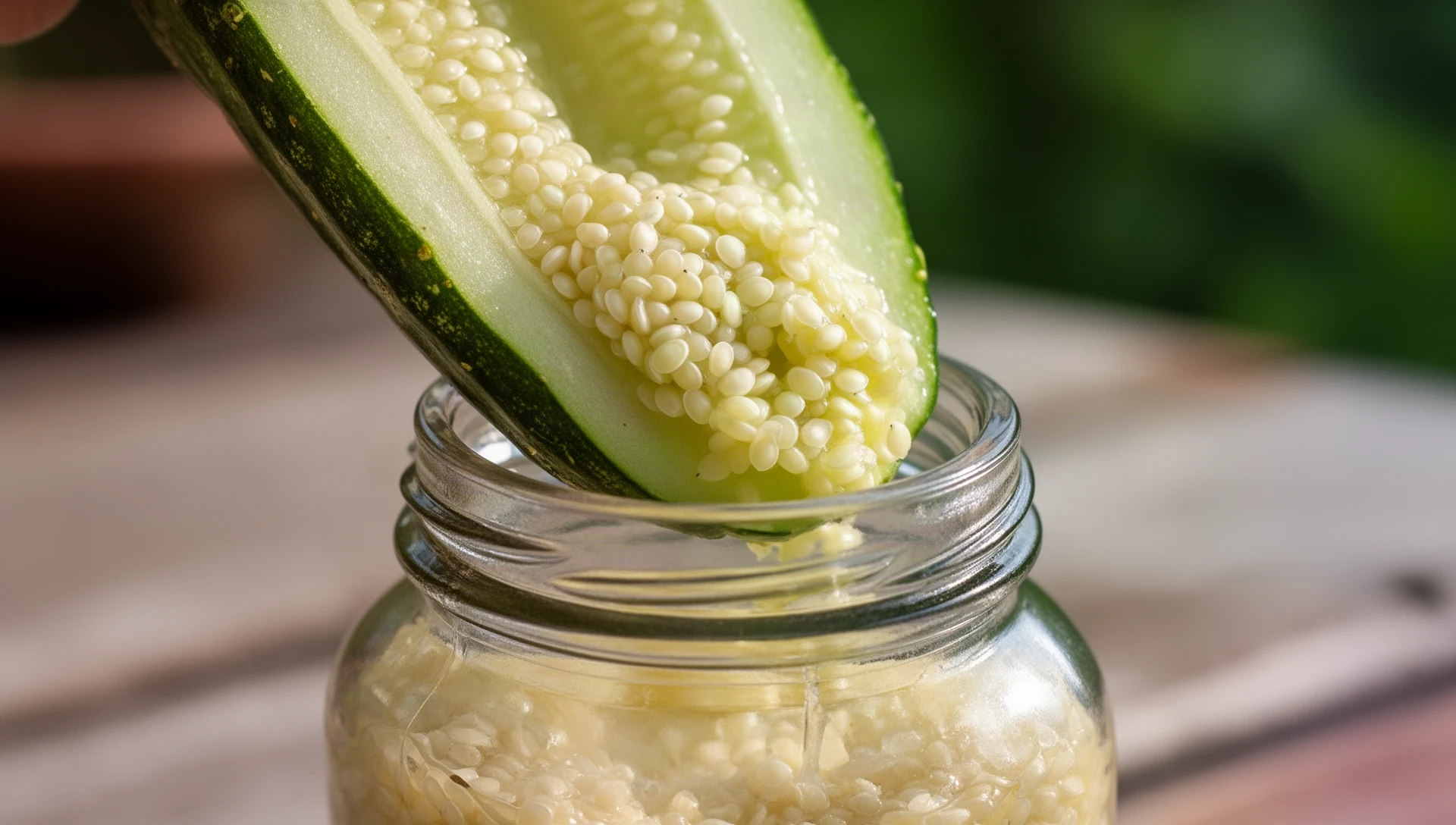
Slice it lengthwise and scoop the seeds and surrounding pulp into a jar or bowl, then add enough water to cover them and set it somewhere warm, out of direct sun, for two to four days [3]. This is fermentation, and it does two real jobs at once: it strips the gelatinous coating around each seed (the same coating a seed extraction machine removes mechanically in commercial production [4]), and it kills off some seed-borne pathogens in the process. The first time I fermented cucumber seed, the sour smell and the film of grayish mold on day three had me convinced I’d ruined the batch — that’s the normal sign fermentation is working, not a failure.
Once fermentation is done, fill the container with water and stir. Viable seeds sink; pulp, mold, and hollow seeds float to the top and can be poured off [3]. Repeat that rinse-and-skim step until the water runs mostly clear, then spread the clean seeds on a coffee filter, paper towel, or screen to dry. They’re ready to store once they snap cleanly instead of bending [3].
Isolation and Hand-Pollination: Keeping Varieties True
Cucumbers only cross-pollinate with other cucumbers, not with squash, zucchini, or melons growing nearby, despite that being a persistent garden myth [3]. If you’re growing just one cucumber variety, there’s nothing to isolate. Growing two or more varieties at once is where seed purity gets complicated: commercial open-pollinated seed fields are isolated by at least a mile from other cucumber plantings [4], and home gardening extension guidance puts the practical minimum at a half mile to a mile between varieties [3] — well beyond what most backyard gardens can manage.
Two realistic home workarounds exist. Stagger planting dates so your varieties bloom at different times, or hand-pollinate and immediately bag a few female flowers before bees can reach them. To do that, you need to recognize what you’re looking at: standard cucumber plants are monoecious, meaning they carry separate male and female flowers on the same vine, with male flowers opening first and true female flowers (identifiable by the tiny immature fruit at the base of the bloom) following about a week later [10]. Gynoecious varieties, bred to produce almost all-female flowers for a concentrated early harvest, need a monoecious pollenizer plant nearby — which is why gynoecious seed packets often include a small packet of dyed pollenizer seed [5]. If you’re hand-pollinating for seed purity, dust a soft brush inside an open male flower, then transfer that pollen directly into a bagged female bloom.
Don’t Save Seed From a Sick Plant
A cucumber can look perfectly fine while carrying a seed-borne infection. Angular leaf spot, caused by the bacterium Pseudomonas syringae pv. lachrymans, overwinters inside the seed coat itself and infects the cotyledons the moment that seed germinates next spring [6]. It’s one of the reasons a new planting can show disease symptoms within the first few weeks, before any outside infection source would explain it.
| Symptom on This Year’s Plant | Seed-Borne? | Save the Seed? |
|---|---|---|
| Angular, water-soaked leaf spots that dry to brown/straw with ragged holes | Yes — bacterial, seed-transmitted [6] | No |
| Dark, sunken lesions on fruit or vines (anthracnose) | Yes — fungal, seed-transmitted | No |
| Healthy foliage all season, no lesions or spotting | N/A | Yes, if otherwise open-pollinated |
Our full cucumber diseases guide covers identification for both of these in more depth. The rule for seed savers is simple even without a firm diagnosis: if a plant showed any leaf spotting or fruit lesions this season, don’t collect seed from it, even from fruit that looks clean. Hot water and chemical seed treatments only reduce seed-borne bacteria, they don’t eliminate it, so prevention at the harvest stage matters more than any treatment after the fact.
How Long Does Saved Cucumber Seed Actually Stay Viable?
Stored in a sealed container in typical room or refrigerator conditions, expect saved cucumber seed to germinate reliably for three to four years [3] — that’s the realistic planning number for most home gardeners. But that’s a conservative floor, not a hard ceiling. In cold-storage research trials, cucumber seed kept at 40°F and 17% relative humidity still showed over 90% germination and produced vigorous seedlings after 31 years in storage, and 25-year-old seed germinated (if more slowly) with no change to how the resulting plants grew [1]. A separate long-term study found little drop in germination after nine years at 50°F and 50% relative humidity [1].
The gap between “3-4 years” and “25+ years” comes down entirely to storage conditions, not seed quality. Moisture is the seed’s enemy far more than time is — cool and genuinely dry (well below typical refrigerator humidity unless the container is airtight) is what buys you decades instead of years.
Rooting Cucumber Vine Cuttings: What the Research Actually Shows
Cucumber vines will root from a stem cutting — the biology isn’t in question. When a stem is cut, auxin and ethylene levels rise in the basal tissue within about an hour, and that auxin accumulates in cells near the vascular tissue, triggering them to switch identity and start forming new root tissue [8]. That mechanism has been documented directly in tomato cuttings, a related vining crop, and is the same general pathway rooting hormone products are designed to accelerate; it hasn’t been specifically studied in cucumber, so treat it as the likely mechanism rather than a cucumber-confirmed one.
What’s missing from most propagation articles is what actually happens when someone tries this. The one detailed rooting study on cucumber cuttings wasn’t a home-gardening technique at all — it was breeders rooting field-cut gynoecious cuttings to speed up greenhouse seed production [2]. Their setup was a custom chamber holding 96% relative humidity with continuous mist, controlled day and night temperatures, and a 12-hour photoperiod, and even under those conditions, survival topped out at 85% [2]. I rooted a handful of cucumber vine cuttings on a windowsill one summer out of curiosity — two out of six actually took root, and both stalled out once the days started shortening, without setting a single flower. That’s roughly the gap between a research mist chamber and an ordinary kitchen window.
If you want to try it anyway: take a 4 to 6 inch cutting early in the morning, just below a leaf node, from a healthy vine with two to three leaves left on it. Strip the lower leaves, dip the cut end in rooting hormone, and set it in moist seed-starting mix under a humidity dome, out of direct sun, at 65-75°F. Expect a materially lower success rate than a lab mist chamber without one of your own, and don’t expect flowering fruit the same season — the real reason almost nobody propagates fruiting cucumbers this way is that a $3 seed packet gets you a productive plant in about 55-65 days with near-guaranteed success, and a cutting doesn’t preserve any trait a seed from the same open-pollinated plant wouldn’t already give you.

Frequently Asked Questions
Can you grow a new cucumber plant from a cutting instead of seed?
Yes, cucumber vine cuttings can root, but published rooting research used a 96% humidity mist chamber and still measured an 85% survival rate for breeding stock — a home cutting without that equipment should be expected to succeed far less often, and won’t reliably produce fruit the same season.
How long do saved cucumber seeds actually stay good?
Plan on 3-4 years in typical home storage, but properly dried seed kept cool and genuinely dry (around 40°F and low humidity) has been shown to stay viable for 25 to 31 years in cold-storage research trials.
Stop guessing if your garden pays.
Log what you grow and harvest — see total yield weight, estimated retail value, and season-on-season progress in one place.
→ Track My HarvestDo you have to ferment cucumber seeds before saving them?
Yes. Fermenting the seed and pulp in water for 2-4 days strips the gelatinous coating around each seed and helps separate viable seed (which sinks) from hollow seed and pulp (which floats), the same principle commercial seed producers use at scale.
Sources
- Robinson, R.W. Longevity of Cucumber Seed. Cucurbit Genetics Cooperative
- Rooting Cucumber Cuttings When Water Quality Is Poor. Cucurbit Genetics Cooperative
- Saving Seed of Pumpkins, Squash, Cucumbers, Melons and Gourds. South Dakota State University Extension
- Seed Production. NC State University Cucurbit Breeding Program
- How Do Gynoecious Cucumber Varieties Differ From Other Varieties? Iowa State University Yard and Garden Extension
- Angular Leaf Spot of Cucumber. Virginia Cooperative Extension, Virginia Tech
- Open-Pollinated vs. Hybrid: An Important Distinction When Saving Seeds. University of Illinois Extension, Good Growing
- Auxin Regulates Adventitious Root Formation in Tomato Cuttings. BMC Plant Biology
- What You Need to Know About Cucumber Varieties for High Tunnel Production. Purdue University Vegetable Crops Hotline
- The Birds and The Bees of Cucurbit Flowers. BYGL, Ohio State University Extension


