

Zone 8 Crepe Myrtle: Plant March 15 or September 20, Skip the Winter Mulch — 5 Varieties Matched by Size and Bloom Season

Zone 8 crepe myrtles stay woody in winter — but fall planting beats spring. Plant March 15 or September 20, pick size not color, and skip the winter mulch.
Most crepe myrtle advice treats zone 8 as a warm zone where the plant merely survives. That undersells it. Zone 8 is the sweet spot — your plant stays woody year after year, builds a stronger framework with each passing season, and can deliver five months of bloom from June through October. The trade-off: zone 8 also brings specific challenges most general guides skip, from a new invasive pest spreading through the South to a planting calendar where summer is the one window to avoid. This guide covers what matters specifically to zone 8 gardeners: exact planting dates, variety sizing, and the two disease windows you need to plan around.
Zone 8’s Two Sub-Zones and What They Mean
Zone 8 spans a wide geographic range: coastal Georgia and South Carolina (zone 8b, lows 15–20°F), through most of Mississippi, Alabama, and interior Texas (zone 8a, lows 10–15°F), and into parts of Oregon and Washington on the Pacific Coast. Both sub-zones sit comfortably within crepe myrtle’s hardiness range of zones 6a through 9b, according to NC State Extension. On the West Coast, zone 8 gardeners in the Pacific Northwest face a different challenge: mild wet winters rather than humid summers, which shifts the disease pressure but doesn’t change the plant’s basic hardiness advantage.

The key point for zone 8 gardeners is what the plant does not do here. In zones 6 and 7, crepe myrtles routinely die back to the ground after hard winters, forcing gardeners to wait for regrowth each spring and losing the structural benefit of an established woody framework. Zone 8 winters are mild enough that established trees keep their structure intact from one year to the next. What you’re managing in zone 8 is heat stress at planting time and humidity-driven fungal disease in spring and fall — not winter survival. That distinction changes what you need to prioritize. For a broader introduction to this plant, see our guide on what is a crepe myrtle and its essential characteristics.
Zone 8 Planting Dates — Why Fall Beats Spring
Zone 8 gives you two reliable planting windows:

Three pre-planned garden beds, free
Stop staring at empty beds: printable plans with exact layouts, plant lists and planting calendars — yours free from the Garden Library.

- Spring: March 15–May 15 — after the last frost, which averages late February to early March in zone 8a and early February in zone 8b
- Fall: September 20–November 15 — at least six weeks before the first expected frost
Both windows work, but fall planting has a practical advantage specific to zone 8. In September and October, soil temperatures remain warm from summer (above 65°F, the threshold for active root growth) while air temperatures cool. That combination — warm soil and mild air — drives faster root establishment with none of the heat stress that can stall a spring planting by late May. An October planting spends the winter quietly building roots and emerges in spring with a head start on bloom.
If you plant in spring, aim for March 15–April 15 in zone 8a and late February in zone 8b. Planting after May 1 puts the tree directly into summer heat before roots have established — survivable, but it means watering every 2–3 days for the first 3–4 months rather than the once-weekly schedule a fall planting requires.
Avoid planting mid-June through mid-August when soil temperatures exceed 90°F and heat stress competes directly with root establishment. The exception is a container-grown tree with consistent deep watering and 3 inches of mulch to moderate soil temperature — possible, but it demands more effort and care than planting in the designated windows.
Regardless of season, wait until soil temperature at 6-inch depth is consistently above 65°F before planting. Below that threshold, root growth stalls and the tree sits in the ground without establishing — vulnerable to opportunistic disease.

Choosing the Right Crepe Myrtle — Match Size to Space First
Crape murder — the practice of topping trees back to thick stubs each winter — persists almost entirely because gardeners planted the wrong size variety for the space. A 25-foot ‘Natchez’ in a 10-foot border will always invite drastic cutting. The solution is choosing a variety whose mature height fits your site, then pruning only for structure. Bloom color is a secondary choice; size is the primary one.

All five varieties below are L. indica × fauriei hybrids developed at the U.S. National Arboretum. The disease resistance comes from L. fauriei genetics and is the primary reason to choose hybrid cultivars over older straight species selections.
| Variety | Mature Height | Bloom Color | Mildew Resistance | Best For |
|---|---|---|---|---|
| Natchez | 20–30 ft | White | High | Large specimen tree; attractive exfoliating bark |
| Muskogee | 20–25 ft | Lavender-pink | High | Large informal screen; long bloom season |
| Tuscarora | 12–18 ft | Coral-pink | High | Mid-size patio tree; vivid red-orange fall color |
| Tonto | 8–10 ft | Fuchsia-red | Very good | Small borders; foundation planting; tight spaces |
| Acoma | 6–10 ft | White | High | Weeping, spreading form; containers; under power lines |
For spaces under 8 feet, dwarf varieties like ‘Chickasaw’ (3–5 ft) or ‘Pocomoke’ (2–3 ft) will never need structure pruning. If you’re unsure about timing, our guide on when crepe myrtles bloom by variety and region can help you choose based on your target season.
Planting Step by Step
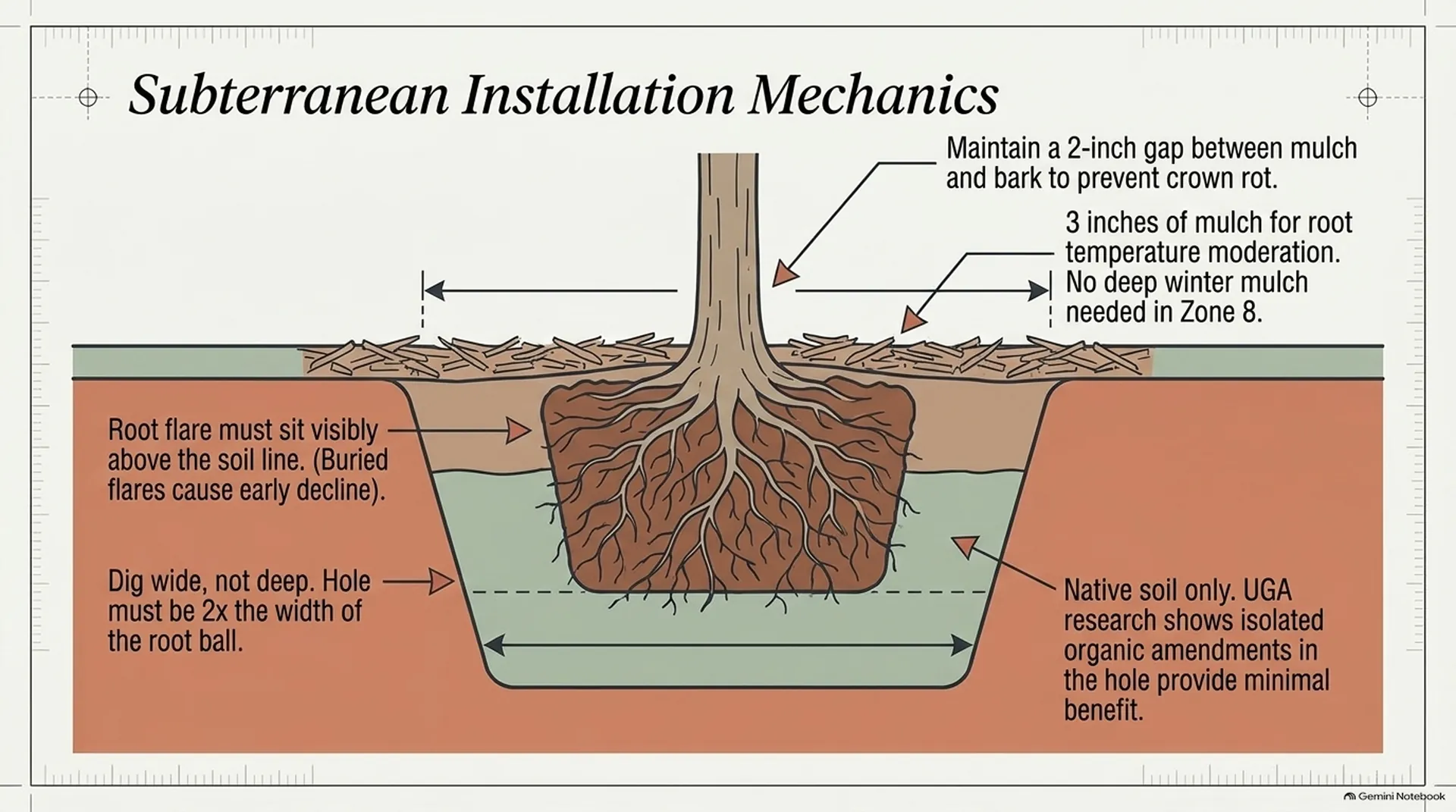
- Dig wide, not deep. Dig a hole at least twice as wide as the root ball and no deeper than the container. Planting too deep buries the root flare — the main cause of early decline in established trees.
- Backfill with native soil. University of Georgia research shows organic amendments placed only in the planting hole provide minimal benefit. If you want to amend, incorporate compost into a wider area around the site rather than just the hole.
- Mulch 3 inches deep, keeping it 2 inches away from the bark to prevent moisture-related rot at the crown. Crepe myrtles in zone 8 don’t need deep winter mulch for cold protection — a standard 3-inch layer is sufficient year-round for moisture retention and root temperature moderation.
- Water at planting, then once a week for the first two months if rainfall is under 1 inch per week. After the first full growing season, established plants are remarkably drought-tolerant, though they bloom longer and more consistently with irrigation during dry spells.
Seasonal Care Calendar
| Period | Task |
|---|---|
| January–February | No pruning yet. Remove any crossing or rubbing branches if clearly needed, but hold structural pruning for late winter. |
| Late February–March | Annual pruning window: select 3–5 main trunks, remove crossing and inward-growing shoots, limb up to one-third of plant height. Remove prior year’s seed heads. Avoid topping — it ruins the tree’s natural form and promotes weak, fast-growing sucker shoots. See our full guide on pruning crepe myrtle without crape murder for specific cuts. |
| March–May | Fertilize established plants with a complete fertilizer: 10-10-10 at 1 lb per 100 sq ft, or 12-4-8 at 0.5 lb per 100 sq ft. New plants: 1 teaspoon of complete fertilizer per gallon container size, monthly through August. |
| June–July | First bloom flush begins. Deadhead spent flower clusters by cutting the spent panicle back to the first branch junction to encourage a second or third flush. Zone 8b may see bloom begin in early June; zone 8a typically from early July. |
| August | Stop fertilizing. Nitrogen applied after August forces tender new growth that may not harden off before cooler weather arrives. Avoid the temptation to feed for a bigger fall flush. |
| September–October | Second and third bloom flushes continue. Zone 8’s long warm season supports bloom well into October on reblooming varieties. This is also the ideal window for fall planting of new trees. |
| November–December | Leaves drop. Do not prune — UGA Extension specifically warns against fall pruning, which can stimulate growth vulnerable to cold snaps and prevent proper dormancy. |
Pests and Diseases: What Zone 8 Gardeners Face
Zone 8’s climate creates two distinct disease windows and one increasingly serious pest that most general guides haven’t caught up with.
Powdery Mildew: The Spring and Fall Threat
Powdery mildew (Erysiphe lagerstroemiae) behaves counterintuitively in zone 8. The fungus actually stops growing when leaf temperatures exceed 90°F — which means the peak of zone 8 summer is not its danger window. The pathogen thrives on warm days combined with cool nights at 60–80°F, conditions typical of zone 8 springs (March–May) and fall (September–October).
Prevention is more effective than treatment. Choose hybrid varieties from the National Arboretum program (Natchez, Muskogee, Tuscarora, Tonto, Acoma all show high resistance per Clemson HGIC), plant in full sun with good air circulation, and maintain adequate spacing. Chemical treatment with myclobutanil or propiconazole is rarely needed when cultural conditions are right.
Crape Myrtle Bark Scale: The Pest Most Guides Miss
Crape myrtle bark scale (CMBS, Eriococcus lagerstroemiae) is an invasive scale insect first detected in the United States in Texas in 2004. It has since spread across most zone 8 states; Mississippi State University Extension documented its arrival in Mississippi in 2015, and it is now established in more than 20 Mississippi counties alone. For zone 8 gardeners in the Southeast, it is the single most serious crepe myrtle pest.
Identification: look for white, felt-like patches on the bark of branches and trunks. Press a patch with your fingernail — it bleeds pink. Heavy infestations produce black sooty mold on leaves and stems from the scale’s honeydew secretion. Unlike aphid infestations, which typically self-limit, CMBS damage compounds year after year without treatment.
Treatment: apply a soil-drench systemic insecticide (imidacloprid or dinotefuran) once per year in late March through May, targeting first-generation nymphs. One spring application is typically effective for the full season. Avoid applying in summer when trees are in full bloom — systemic neonicotinoids in bloom period can affect pollinators visiting flowers.
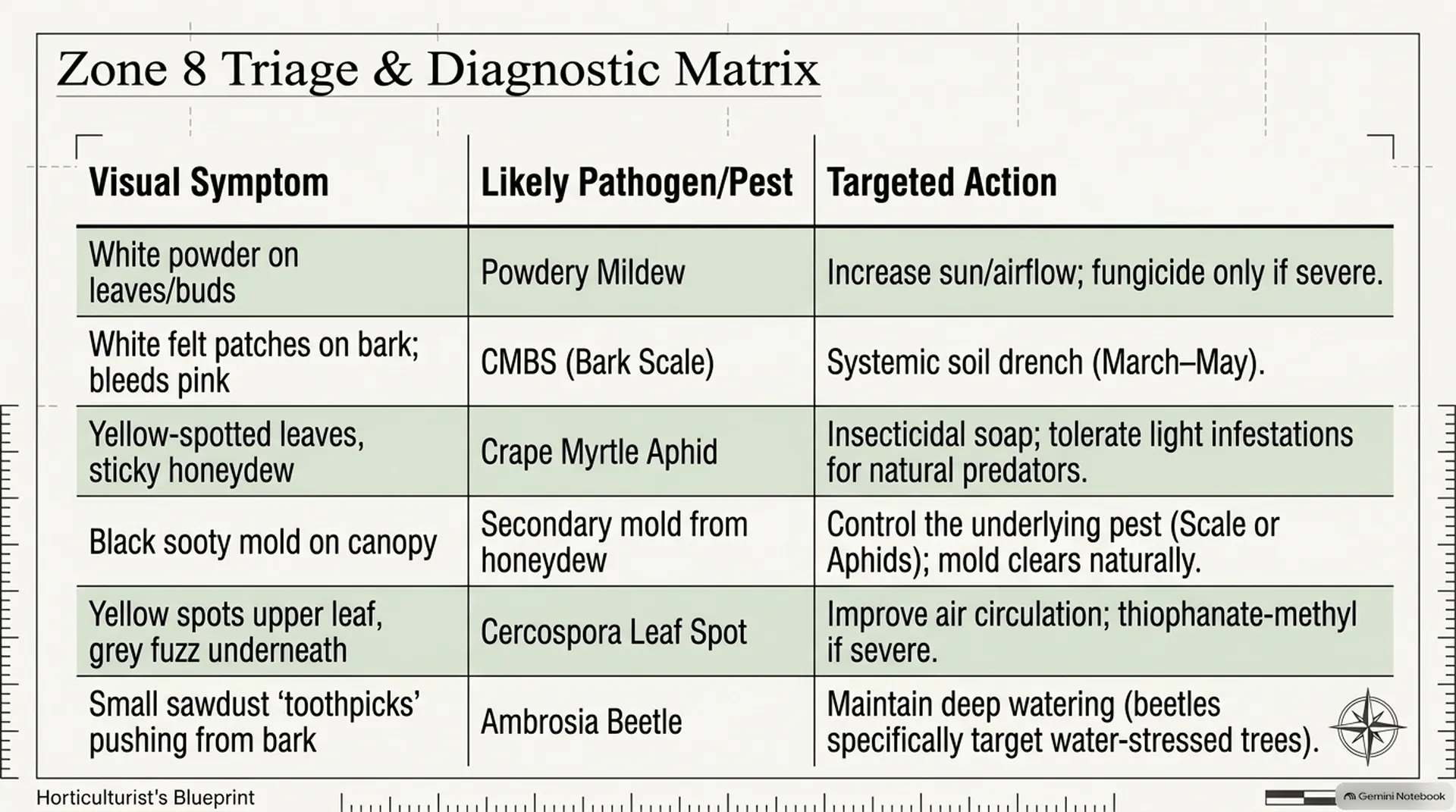
Pest and Disease Diagnostic Table
| Symptom | Likely Cause | Action |
|---|---|---|
| White powder on leaves and buds | Powdery mildew | Choose resistant variety; increase sun and airflow; fungicide if severe |
| White felt patches on bark; bleeds pink | Crape myrtle bark scale (CMBS) | Imidacloprid or dinotefuran soil drench, March–May |
| Black sooty mold on leaves and stems | Aphid or scale honeydew | Control the underlying pest; mold clears as population drops |
| Yellow-spotted leaves, sticky honeydew | Crape myrtle aphid (Sarucallis kahawaluokalani) | Insecticidal soap or horticultural oil; tolerate light infestations (natural predators help) |
| Yellow spots on upper leaf, grey fuzz underneath | Cercospora leaf spot | Full sun and air circulation; thiophanate-methyl if severe |
| Small sawdust “toothpicks” from bark | Ambrosia beetle | Maintain consistent watering; beetles target water-stressed trees |
Frequently Asked Questions
Do crepe myrtles die back in zone 8?
Established crepe myrtles in zone 8 do not normally experience winter die-back. Zone 8 minimum temperatures (10–20°F) are well within the plant’s hardiness range of zones 6a–9b. After an unusually severe cold event — similar to the 2021 Texas freeze — some die-back is possible, but recovery from the roots is typical even after that scale of cold. New plantings in their first winter benefit from a light 3-inch mulch layer over the root zone as extra insurance.
Stop missing your zone's planting windows.
Select your US zone and month — get a complete checklist of what to plant, prune, feed, and protect right now.
→ View My Garden CalendarCan I plant crepe myrtle close to a wall or fence?
Yes, as long as you match the variety’s mature width to the available space. ‘Acoma’ and ‘Tonto’ work in 6–8 foot planting strips; ‘Natchez’ and ‘Muskogee’ need 15–20 feet of width at maturity. Walls and fences also trap humidity, so choose mildew-resistant varieties in tight spaces.
Should I prune off the seed heads in fall?
No — leave them on through winter and prune them in late February along with any structural work. Autumn pruning removes energy the plant has stored and can trigger new growth that gets damaged in a cold snap. The University of Georgia Extension specifically warns against early fall pruning for this reason.
When does crepe myrtle bloom in zone 8?
Most varieties begin blooming in early June (zone 8b) to early July (zone 8a). With consistent deadheading of spent panicles, bloom continues in two or three flushes through October. Zone 8’s long warm season is genuinely one of the advantages of growing crepe myrtle in this region.
Sources
- Crape Myrtle — Clemson Cooperative Extension HGIC
- Crape Myrtle Culture — University of Georgia CAES
- Lagerstroemia indica — NC State Extension Gardener Plant Toolbox
- Crape Myrtle Pruning — Clemson Cooperative Extension HGIC
- Crape Myrtle Diseases and Insect Pests — Clemson Cooperative Extension HGIC
- Crapemyrtle: Identify and Manage Problems — University of Maryland Extension
- Powdery Mildew on Crape Myrtles — Texas A&M Plant Disease Diagnostic Lab
- Crape Myrtle Bark Scale Identification and Control — Mississippi State University Extension


