

Astilbe vs Heuchera: Which Shade Perennial Wins in Dry Soil vs Wet?

Astilbe and heuchera look similar on the label, but dry soil kills one and wet soil kills the other. Learn which shade perennial your conditions favor.
The most common shade garden advice — try astilbe or heuchera — skips the question that actually decides which one survives past its second season: does your soil stay consistently moist, or does it dry out between rains?
Get that right and either plant thrives for decades. Get it wrong and you will watch astilbe foliage brown and crisp by midsummer, or find heuchera rotting at the crown after a wet winter. This guide covers the real differences — moisture tolerance, bloom strategy, zone performance, and the heuchera crown heaving problem that most comparison articles never mention.
They look similar but grow very differently — phlox vs astilbe explains.
Quick Comparison: Astilbe vs Heuchera
| Feature | Astilbe | Heuchera (Coral Bells) |
|---|---|---|
| USDA Zones | 3–9 | 3–9 |
| Mature Height | 6–46 in | 6–24 in |
| Light | Part shade (best); tolerates full shade | Part shade to full sun |
| Water Needs | High — consistent moisture essential | Moderate — drought tolerant once established |
| Soil | Moist, humus-rich, well-drained | Well-drained; wet soil causes crown rot |
| Winter Interest | None — fully dormant | Semi-evergreen foliage persists |
| Bloom Display | Feathery plumes, 2–3 weeks per variety | Bell flowers in spring; foliage is the main show |
| Deer & Rabbit | Resistant | Resistant — tannins deter grazing |
| Difficulty | Moderate | Easy–Moderate |
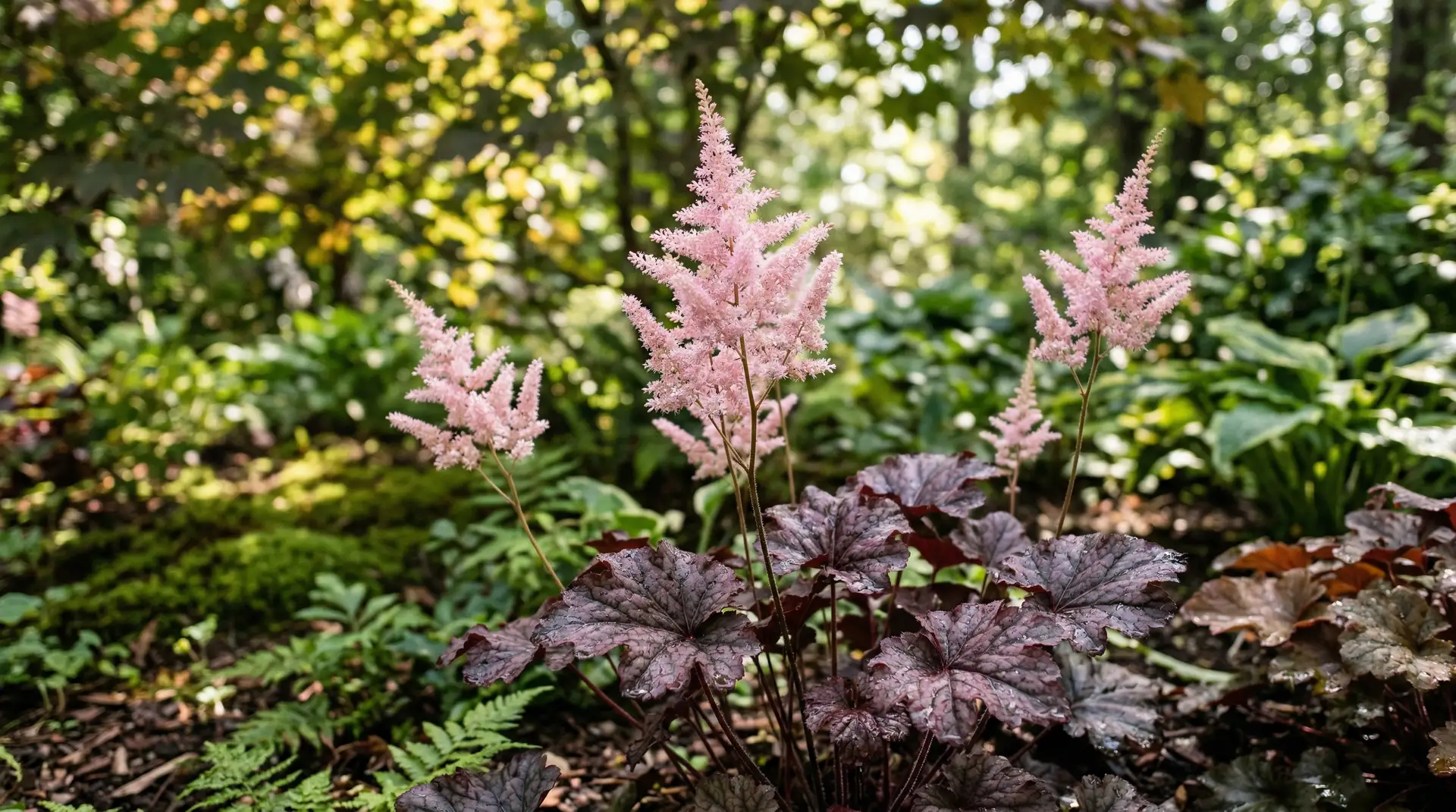
Astilbe: Why Consistent Moisture Is Non-Negotiable
Astilbe’s rhizomes have lower water storage capacity than hostas or heuchera. The plant depends on surrounding soil staying moist because water loss from the leaves exceeds what the roots can supply the moment the soil dries out. The result is progressive leaf-margin browning that advances from tip burn to full foliage collapse within two weeks of drought stress, according to Clemson Cooperative Extension. Unlike wilting from heat stress, drought-browned astilbe foliage does not recover when watering resumes — the damaged leaves stay brown for the rest of the season.

Three pre-planned garden beds, free
Stop staring at empty beds: printable plans with exact layouts, plant lists and planting calendars — yours free from the Garden Library.


This makes siting astilbe correctly more important than any other maintenance decision. In zones 3–6, where summers are cooler and rainfall more consistent, astilbe usually meets its moisture requirement without supplemental irrigation. In zones 7–9, high summer temperatures accelerate soil drying fast enough that keeping astilbe presentable through August requires regular watering, afternoon shade, and heavy organic mulch to slow evaporation.
The flower payoff is what heuchera cannot match. Each variety blooms for two to three weeks, but cultivar selection extends that window across three months. Early cultivars like ‘Deutschland’ (white, late May) and ‘Peach Blossom’ (pale pink, early June) open the season. Mid-season types like ‘Fanal’ (deep red, June–July) carry the middle. Late bloomers like ‘Purple Lance’ (42–46 inches, late July to August) close it out. A bed with early, mid, and late selections runs a continuous plume display from late May to August, per Iowa State University Extension.
Height range is wide. Dwarf ‘Sprite’ stays at 6–12 inches for containers and front-of-border use. Standard hybrid astilbes (Astilbe x arendsii) typically reach 24–36 inches tall with an 18–24 inch spread, per NC State Extension. Tall background types like ‘Purple Lance’ approach 4 feet — more structural than most gardeners expect from a shade perennial.
Divide clumps every four to six years in early spring when foliage emerges, or in fall. Center die-out is the sign that division is overdue. Annual compost top-dressing extends the interval. Astilbe is reliably resistant to deer and rabbits. Japanese beetles and powdery mildew are the main pest and disease concerns. For detailed care instructions, see the complete astilbe growing guide.
Heuchera: Year-Round Foliage — With One Hidden Catch
Heuchera’s primary value is not its flowers. The small bell-shaped blooms in spring and early summer are attractive, but the reason to grow coral bells is the mounded foliage that persists nearly year-round. In zones 6 and warmer, heuchera is semi-evergreen — leaves stay through winter even after hard frosts. Where astilbe disappears entirely from October to April, a heuchera planting provides structure and color through the dullest months of the garden year.

Foliage options are exceptional: deep burgundy (‘Palace Purple’), silver-mottled (‘Dale’s Strain’), neon lime (‘Citronelle’), peachy apricot (‘Caramel’). The tannins responsible for many of these pigments are also what make heuchera genuinely unpalatable to deer and rabbits — a biochemical deterrent backed by leaf chemistry, not just anecdotal tolerance, per NC State Extension. In high deer pressure areas, heuchera holds up better than most shade perennials.
We put these side by side in phlox vs astilbe.
The crown heaving problem. Heuchera has a shallow root system that makes it vulnerable to frost heaving — the freeze-thaw cycle that progressively lifts the crown above the soil surface through winter. A heaved crown exposed to dry winter air desiccates and dies. Prevention is straightforward: apply 2–3 inches of mulch around the base each fall to insulate the soil and dampen freeze-thaw cycling. If crowns have already heaved, replant them in early spring before they dry out, per University of Vermont Extension. Skip fall mulching in zones 4–6 and plant loss is likely — a detail nearly every shade garden comparison omits.
Related: never bury heuchera’s woody crown at planting. The crown must sit at or just above soil level. Covering it causes crown rot — the same outcome as poorly drained winter soil. Heuchera tolerates drought far better than astilbe, but wet soil around the crown is fatal. Well-drained soil is a harder requirement for heuchera than consistent moisture is for astilbe.
In zones 7–9, cultivar selection determines whether heuchera succeeds or declines. Standard hybrid heucheras often deteriorate under high summer humidity. Varieties with Heuchera villosa in their parentage — including ‘Caramel’ and ‘Citronelle’ — handle heat and humidity significantly better, per Clemson Cooperative Extension HGIC. In the Southeast or any humid zone 7–9 climate, check for H. villosa ancestry on the tag before buying.
Divide every three to four years in early spring. For companion planting ideas, see heuchera companion plants or the full heuchera growing guide for complete care details.
How to Choose: A Decision Framework by Garden Conditions
Three factors determine which plant is right for a specific spot: soil drainage, climate zone, and what you want from the planting visually.

Soil drainage test. Dig a 12-inch hole, fill it with water, and time how long it takes to drain. Under 30 minutes: well-drained — both plants work, but heuchera is the easier choice. One to four hours: moderately drained — astilbe with compost amendment is workable; heuchera is better without amendment. Still standing 12 hours later: neither plant will succeed without raised beds or significant soil improvement.
| Your Conditions | Best Choice | Why |
|---|---|---|
| Consistently moist soil, zones 3–6 | Astilbe | Meets moisture requirement without irrigation |
| Dry to moderately dry shade | Heuchera | Drought tolerant once established |
| Hot, humid summers (zones 7–9) | Heuchera — H. villosa cultivars | ‘Caramel’ and ‘Citronelle’ handle heat and humidity |
| Want a flowering plume display | Astilbe | Heuchera flowers are a minor feature |
| Want year-round or winter foliage | Heuchera | Semi-evergreen in zones 6 and warmer |
| Beginner gardener | Heuchera | More forgiving of missed waterings |
| Pond margin or reliably wet site | Astilbe | Heuchera crown rots in standing moisture |
| Container planting | Either | Dwarf astilbe or any heuchera work well |
Zone-by-zone: Zones 3–5, astilbe thrives in average-rainfall summers with minimal intervention; heuchera works but needs reliable fall mulching to prevent crown heaving. Zone 6 is the sweet spot where both perform reliably with little extra effort. Zones 7–9, astilbe needs consistent summer irrigation; H. villosa heucheras are better adapted and lower maintenance.
Stop missing your zone's planting windows.
Select your US zone and month — get a complete checklist of what to plant, prune, feed, and protect right now.
→ View My Garden CalendarGrowing Astilbe and Heuchera Together
These two plants are effective companions because their habits contrast without competing. Astilbe’s tall vertical plumes rise above heuchera’s low mounds, creating a layered look in a single shade bed. Heuchera’s semi-evergreen presence covers bare soil through the months when astilbe is fully dormant — from October through April in most zones, heuchera is doing all the visual work.

For the combination to succeed, the soil needs to satisfy both plants: moist, well-drained, and rich in organic matter. A 3-inch organic mulch layer stabilizes moisture for astilbe while protecting heuchera’s crowns over winter — the two maintenance requirements happen to align. Position astilbe in the slightly lower, moister sections of the bed and heuchera at the edges where drainage is sharper.
For planting partners beyond these two, see astilbe companion plants and heuchera companion plants. If you’re weighing heuchera against hostas for the same spot, our hosta vs heuchera comparison covers that decision in detail.
Frequently Asked Questions
Can astilbe and heuchera grow in the same bed?
Yes, with the right soil preparation. Both need well-drained soil; astilbe additionally needs consistent moisture. In zones 3–6 with average summer rainfall, conditions typically suit both without conflict. In zones 7–9, manage irrigation carefully — enough moisture to keep astilbe healthy without waterlogging heuchera’s crown. A sloped bed where astilbe occupies the lower, wetter section and heuchera sits higher resolves most of this tension.
Which is more deer resistant — astilbe or heuchera?
Both are reliably deer resistant. Heuchera’s resistance is biochemical: tannins in the leaves are genuinely bitter and unpalatable to deer and rabbits, per NC State Extension. Astilbe is also listed as deer resistant by Clemson Cooperative Extension, though the mechanism is less well documented. Under extreme deer pressure in late winter when food is scarce, neither is fully guaranteed — but both are far safer choices than most flowering perennials.
Which is easier to grow for beginners?
Heuchera, in most situations. It tolerates inconsistent watering better than astilbe, adapts to a wider light range, and tends to decline slowly with visible warning signs. The main beginner trap is skipping fall mulching in zones 4–6, which leads to crown heaving and plant loss by spring. Astilbe is straightforward once correctly sited, but it punishes missed waterings faster and can decline without much warning time.
Do astilbe and heuchera grow in full shade?
Both tolerate full shade, but with trade-offs. Astilbe in full shade produces fewer flowers, per Iowa State University Extension. Heuchera in full shade loses its most vivid foliage colors — deep burgundies and purples typically fade toward green without a few hours of indirect light. For both plants, dappled shade or a spot with morning sun and afternoon shade gives the best combination of flowering performance, foliage color, and manageable moisture conditions.
Sources
- Clemson Cooperative Extension HGIC. How to Grow and Care for Astilbe. Home & Garden Information Center.
- Iowa State University Extension. Growing Astilbe in Iowa. Yard and Garden.
- NC State Extension Plant Toolbox. Astilbe x arendsii (Hybrid Astilbe). NC State University.
- Clemson Cooperative Extension HGIC. Heuchera — Coral Bells. Home & Garden Information Center.
- NC State Extension Plant Toolbox. Heuchera (Alumroot, Coral Bells). NC State University.
- University of Vermont Extension. Heuchera: A Versatile Landscape Plant. UVM.
- NC State Cooperative Extension, Carteret County. Planting Coral Bells (Heuchera). NC State University.


