

Ajuga Companion Plants: Ground Cover Pairings That Suppress Weeds and Add Spring Colour in Shade

Ajuga — also called bugleweed or carpet bugle — is one of the most versatile shade ground covers in the American garden. But its real power emerges when you treat it as a layer rather than a solo performer. The right companions turn a simple carpet of blue flower spires into a structured, weed-suppressing, pollinator-friendly border that looks sharp from April through October.
This guide focuses on the why behind each pairing, not just the what. Ajuga’s shallow, fibrous root system is the key to unlocking its companion potential: because it forages just 2–4 inches into the soil, it shares growing space peacefully with virtually any deep-rooted perennial, bulb, or shrub — leaving nutrients and moisture available at every other depth. Understanding that mechanism makes it easy to design pairings that work rather than guess at combinations that might compete.
Why Ajuga Works So Well as a Companion Plant
Most ground covers compete aggressively with their neighbors. Ajuga is different. Its stoloniferous growth runs horizontally across the soil surface, filling gaps while sending roots only into the uppermost layer — typically 2–4 inches deep. Research compiled by the University of Georgia Cooperative Extension on ground covers in landscape use notes that established stoloniferous carpets can suppress a significant proportion of annual weed germination by physically blocking light reaching bare soil, and without the allelopathic chemicals that make some ground covers hostile to nearby plants.
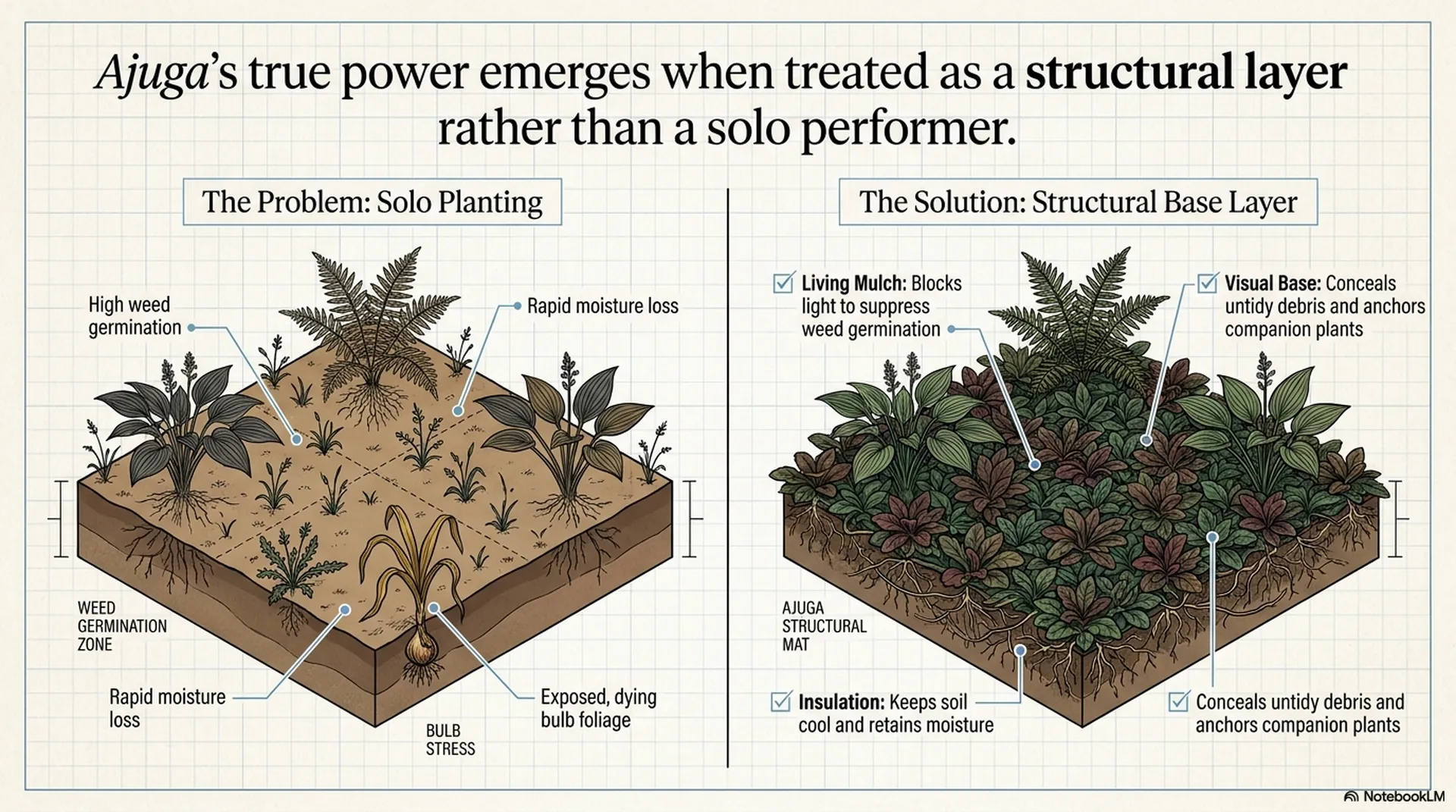
That weed-suppression effect means ajuga acts as living mulch. It keeps soil cool and moist in summer, protects bulb necks from frost-heave in winter, and provides a continuous visual base layer that makes every companion plant look more intentional. For shade border design, that is an enormous design asset.

Three pre-planned garden beds, free
Stop staring at empty beds: printable plans with exact layouts, plant lists and planting calendars — yours free from the Garden Library.
The flip side: ajuga spreads steadily — typically 18–24 inches per plant per season in moist, partial shade. Choose companions that are either large enough to hold their own space (hostas, established shrubs) or that occupy a vertical zone ajuga cannot reach (tall perennials, spring bulbs that root 6–8 inches deep).
The Best Ajuga Companion Plants by Growth Habit
Hostas: Bold Foliage Above, Ajuga Below
The ajuga–hosta pairing is the classic shade combination for good reason. Hostas send thick, fleshy roots 12–18 inches deep — well below ajuga’s root zone — so there is no nutrient competition. Their broad, paddle-shaped leaves emerge in spring just as ajuga’s blue flower spikes fade, providing a seamless visual handoff from flower display to foliage interest.

For maximum contrast, match dark ajuga foliage with a golden or chartreuse hosta. Try Ajuga reptans ‘Black Scallop’ — nearly black, glossy leaves — against hosta ‘Sum and Substance’ or ‘August Moon’ in warm gold. The light-against-dark pop is dramatic even in low light. For a quieter echo, pair Ajuga ‘Catlin’s Giant’ (large, bronze-green leaves) with the blue-grey hosta ‘Halcyon’: the cool tones mirror each other while the leaf sizes and textures diverge completely.
Hostas also provide summer shade that naturally slows ajuga’s spread in the hottest months, reducing how far it creeps without requiring manual edging. In practice, the two plants form a self-limiting system — hostas spread slightly each year while ajuga fills beneath them, with minimal intervention needed once the planting is established.
Heuchera (Coral Bells): A Colour-Echo Pairing
Heuchera’s ruffled, often wine-red or amber foliage creates the most visually sophisticated colour echo available in the shade garden. Pair Ajuga ‘Burgundy Glow’ — which combines cream, pink, and burgundy in a single leaf — with a heuchera in a single tone from that same palette. Heuchera ‘Palace Purple’ pulls out the dark burgundy; ‘Caramel’ pulls the warm amber. Either approach gives the planting internal visual logic: one plant picks up a thread from the other’s palette rather than introducing a new colour entirely.

Both plants prefer similar conditions: dappled shade, consistently moist but well-drained soil, and protection from afternoon sun in USDA zones 5–9. Their root systems complement rather than compete — heuchera has fibrous roots concentrated in a shallow crown, but that crown sits slightly elevated above the soil surface, physically separating it from ajuga’s stolons. Space heuchera plants 12–15 inches apart and allow ajuga to fill between them; within two seasons the result is a seamless foliage tapestry with no bare soil visible.
Heuchera also blooms on tall, airy stems in late spring through early summer, providing vertical interest after ajuga’s April–May flower display ends. This is one of the strongest year-round companion planting combinations available for partial shade: the two plants flower in sequence and then hold the border through foliage contrast for the rest of the season.
Ferns: Textural Contrast in Deep Shade
Where hostas provide bold simplicity, ferns add intricate complexity. The feathery fronds of Japanese painted fern (Athyrium niponicum var. pictum) — silver, green, and burgundy — arc gracefully above an ajuga carpet, creating a layered woodland feel that hostas alone cannot achieve. The fine texture of fern fronds against ajuga’s rounded, solid leaves is a compelling visual contrast that reads well even in low-light conditions.
Ferns are particularly useful in the deepest-shade spots where ajuga may flower sparsely. In those conditions, ajuga still provides solid foliage coverage but its bloom display is limited; ferns keep the composition interesting through textural variation alone. Autumn fern (Dryopteris erythrosora) adds a seasonal dimension with coppery-orange new fronds in spring that age to glossy green by summer — creating colour change through the season without a single flower.
Root competition is negligible: most shade ferns root at 6–12 inches depth, well below ajuga’s 2–4 inch forage zone. In practice, ajuga carpets around established ferns without disturbance, filling the bare soil between fronds that would otherwise require mulching.
You might also find ajuga problems: crown rot, invasiveness helpful here.
Astilbe: Summer Flower Sequencing
Ajuga peaks in April–May with its candles of blue, white, or pink flowers. Astilbe peaks from June through August with feathery plumes in red, pink, lavender, or white. Together they deliver continuous flowering across the full warm season from a single mixed planting — no deadheading, no replanting, just two perennials doing their jobs at different times.
The sequencing is precise: as ajuga’s flower spikes collapse in late May, astilbe’s expanding foliage fills the visual space. By late June, astilbe plumes rise 18–36 inches above the ajuga carpet, creating a strong vertical element in what is otherwise a low border. After astilbe finishes, its attractive seed heads persist through autumn, giving the border a final season of interest before cut-back.
Use ‘Fanal’ (deep red) or ‘Amethyst’ (lilac-pink) against bronze-leaved ajuga cultivars for vivid contrast. Space astilbe crowns 18 inches apart and allow ajuga to fill between them — no mulching is needed. Our guide to growing astilbe covers soil preparation and variety selection in detail.
Stop missing your zone's planting windows.
Select your US zone and month — get a complete checklist of what to plant, prune, feed, and protect right now.
→ View My Garden CalendarSpring Bulbs: Underplanting for a Two-Season Display
Ajuga’s low carpet makes it one of the best natural covers for spring bulb plantings. The problem with bulbs in formal borders is cosmetic: after flowering, bulb foliage must be left in place until fully spent — typically six weeks of yellowing leaves that look untidy. Ajuga solves this. As bulbs decline, ajuga grows up around them, concealing the yellowing foliage beneath expanding green leaf coverage.

Small to medium bulbs work best. Plant daffodils at 6–8 inch depth, species tulips at 4–5 inches, Siberian squill (Scilla siberica) at 3 inches, or glory-of-the-snow (Chionodoxa) at 3 inches through an existing ajuga carpet. Simply push a bulb planter through the shallow root mat — there is no need to remove ajuga first. The bulbs root below ajuga’s zone and push through in March–April, creating the impression of flowers emerging from a living carpet rather than bare soil.
Avoid large, late-season hybrid tulips: their foliage is too bulky and takes too long to die back, creating a dead zone in the ajuga for six or more weeks. Stick to species tulips and small narcissus that finish quickly and leave a minimal footprint. The combination of early bulb colour followed by ajuga’s bloom followed by the lush summer carpet is a three-act display from a single planting.
Bleeding Heart (Dicentra): Shade Drama With Easy Care
Fringed bleeding heart (Dicentra eximia) is a functional partner for ajuga that earns its place in two ways. First, its ferny, blue-green foliage and arching clusters of heart-shaped pink or white flowers appear in spring alongside ajuga’s blooms, giving the border simultaneous floral and foliage interest. Second, fringed bleeding heart often reblooms in early autumn after a summer rest — providing a second flowering at the same time ajuga’s foliage is at its richest color.
The classic bleeding heart (Lamprocapnos spectabilis) goes summer-dormant more abruptly and leaves a larger gap. Position it behind a mass of ajuga with a front-row hosta; as the bleeding heart fades in July, the hosta’s expanding leaves cover the gap while ajuga provides the continuous carpet. Three plants, one zone, no bare soil from April through October.
Ajuga Companion Pairs at a Glance
| Companion | Best Ajuga Cultivar | Design Benefit | USDA Zones | Light |
|---|---|---|---|---|
| Hosta ‘Halcyon’ | ‘Catlin’s Giant’ | Cool-tone echo; deep roots never compete | 3–9 | Part to full shade |
| Hosta ‘Sum and Substance’ | ‘Black Scallop’ | Maximum light/dark foliage contrast | 3–9 | Part shade |
| Heuchera ‘Palace Purple’ | ‘Burgundy Glow’ | Colour echo; sequential bloom and foliage | 4–9 | Part shade |
| Heuchera ‘Caramel’ | ‘Chocolate Chip’ | Warm amber tones; fine-textured carpet | 4–9 | Part shade |
| Japanese Painted Fern | ‘Burgundy Glow’ | Silver-burgundy textural tapestry in deep shade | 3–8 | Part to full shade |
| Autumn Fern | ‘Catlin’s Giant’ | Coppery spring fronds above bold carpet | 5–9 | Part shade |
| Astilbe ‘Fanal’ | ‘Bronze Beauty’ | Red-bronze colour sequence; June–Aug bloom | 4–8 | Part shade |
| Astilbe ‘Amethyst’ | ‘Burgundy Glow’ | Lavender plumes above cream-pink carpet | 4–8 | Part shade |
| Daffodils (small narcissus) | Any cultivar | Spring bulb layer; dying foliage masked by carpet | 3–8 | Part shade |
| Siberian Squill | Any cultivar | Blue-on-blue spring effect; bulbs root below | 2–8 | Part shade |
| Fringed Bleeding Heart | ‘Chocolate Chip’ | Spring co-bloom; ajuga fills summer dormancy gap | 3–9 | Part to full shade |
| Lungwort (Pulmonaria) | ‘Catlin’s Giant’ | Early spring interest; spotted foliage contrast | 3–8 | Part to full shade |
What NOT to Plant With Ajuga
Understanding incompatible combinations is as important as knowing what works. Avoid these pairings:

You might also find onions companion plants helpful here.
Other aggressive spreaders. Planting ajuga alongside creeping Jenny (Lysimachia nummularia), mint, or pachysandra creates a dominance battle where neither plant displays well. These species spread at similar rates via different mechanisms — stolons, runners, and rhizomes — and one will eventually overwhelm the other depending on soil moisture and light. The boundary management work is constant and the result is rarely attractive. Choose one ground cover per zone and edge it cleanly against lawn or hard surfaces.
Shallow-rooted annuals. Impatiens, begonias, and similar bedding plants compete directly with ajuga in the top 2–4 inches of soil. Ajuga will outcompete them over a full season, smothering annuals by midsummer as its carpet thickens. If you want seasonal colour above an ajuga carpet, use deep-rooted spring bulbs or tall perennials that root well below ajuga’s zone.
Drought-tolerant plants requiring excellent drainage. Ajuga prefers consistent moisture and tolerates wet soil better than drought. Pairing it with lavender, sedums, or Mediterranean herbs — which need sharp drainage and dry summers — creates a watering conflict. Both plants perform poorly when the other’s needs are met. For dry, sunny spots, the lawn alternatives guide covers more suitable ground covers for those conditions.
Shallow-rooted, drought-stressed trees. Silver maple and Norway maple create intense surface root competition and deep canopy shade simultaneously. Ajuga can survive here but often becomes sparse and patchy; it performs far better under deeper-rooted trees like oaks, serviceberry, and redbud, whose roots forage well below the soil surface and whose canopy provides dappled rather than dense shade.
Ajuga Varieties and Their Best Companion Matches
Different ajuga cultivars offer distinct foliage tones that change which companions work best. Matching cultivar to companion achieves the most cohesive look:

‘Black Scallop’ — nearly black, glossy, scalloped leaves. The darkest ajuga available. Works best with golden or chartreuse companions (gold hostas, chartreuse heuchera) that create a maximum light-against-dark contrast. This is the high-drama approach to shade gardening.
‘Burgundy Glow’ — tricolour leaves mixing cream, pink, and burgundy. The most decorative cultivar for foliage interest. Pairs best with mid-tone companions that pick up a single colour from its palette rather than competing with all three tones simultaneously. Heuchera ‘Palace Purple’ pulls the burgundy thread; Pulmonaria ‘Sissinghurst White’ pulls the cream.
‘Catlin’s Giant’ — extra-large bronze-green leaves, the most vigorous spreader of the standard cultivars. Better suited for covering large areas under established trees than for intimate companion plantings. Pair with bold companions that will not be overwhelmed — large hostas, mature astilbe clumps, or established deciduous shrubs.
‘Chocolate Chip’ — small, narrow, milk-chocolate-brown leaves. The most delicate-looking cultivar. Excellent for planting between stepping stones or in the foreground of a border where its fine texture contrasts with broad-leaved companions. Works beautifully with Japanese painted fern and fringed bleeding heart for a refined woodland aesthetic.
‘Multicolor’ (also sold as ‘Rainbow’) — bronze, pink, and cream variegation. Similar pairing logic to ‘Burgundy Glow’ but with a softer, warmer palette. Pairs well with pale pink astilbe or white-flowered woodland perennials like Solomon’s seal (Polygonatum).
Designing a Shade Border With Ajuga as the Base Layer
The most successful ajuga companion plantings treat it explicitly as the ground layer in a three-tier structure. Each tier occupies a distinct vertical zone, so competition between plants is minimal:

Ground layer (0–6 inches): Ajuga carpet, spring bulbs planted through the mat.
Mid layer (12–36 inches): Heuchera, ferns, bleeding heart, astilbe, small to medium hostas.
Canopy layer (3–8 feet): Large hostas, deciduous shrubs like oakleaf hydrangea or native serviceberry — their elevated canopy provides dappled shade without the brutal surface root competition of shallow-rooted shade trees.
When establishing this layered system, plant canopy and mid-layer plants first and allow them one full growing season to establish before introducing ajuga. Install ajuga plugs or divisions in early autumn of the second year, spacing 12 inches apart. Ajuga will fill the gaps within one to two seasons, eliminating the need for mulching in subsequent years.
For larger-scale plantings — converting lawn to a shade border, for example — ajuga is one of the most cost-effective and low-maintenance solutions available once established. For a full comparison of options including cost per square foot and establishment timelines, the lawn alternatives hub covers the full range of ground cover choices.
Once the layered border is established, ongoing maintenance is minimal: cut back dead fern fronds in early spring, divide hostas every 3–4 years when crowded, and edge ajuga along hard surfaces once a season. No mulching is needed — the carpet does that job permanently. For ajuga-specific care including soil preferences, division timing, and managing invasiveness, see the complete Ajuga growing guide.
Frequently Asked Questions
What grows well with ajuga in full shade?
Ferns (Japanese painted fern, autumn fern), hostas, and fringed bleeding heart all perform well in full shade alongside ajuga. In deep shade, ajuga may produce fewer flowers but its foliage colour is retained, making it a reliable foliage companion year-round without flowering plants being necessary.
Will ajuga choke out other plants?
Ajuga can overwhelm small annuals, seedlings, and delicate perennials if not managed. It is not a threat to established perennials with deep root systems or to any shrub. The solution is to plant robust, deep-rooted companions and install a physical edging barrier along lawn or path boundaries to control lateral spread.
Can you plant ajuga with hostas?
Yes — it is one of the most widely recommended combinations in American shade gardening. Hostas root at 12–18 inches depth while ajuga roots at 2–4 inches, so there is no competition for nutrients or water. Ajuga acts as living mulch, keeping hosta crowns cool and moist while suppressing weeds between plants.
Does ajuga spread too aggressively among companion plants?
In moist, part-shade conditions, ajuga spreads 18–24 inches per plant per season. Contain spread by installing a physical edging barrier, planting alongside large established companions that hold their space, and dividing the carpet every 2–3 years in early spring. Most perennial companions are robust enough to coexist without requiring intervention.
What are the best ajuga companions for attracting pollinators?
Astilbe is the top choice — its midsummer blooms attract bumblebees and hoverflies when few other shade plants are in flower. Combine with heuchera (whose tubular flowers attract hummingbirds) and fringed bleeding heart for a pollinator-friendly shade sequence from April through August.
Sources
- Chappell, M. University of Georgia Cooperative Extension. Ground Covers for Georgia Landscapes. UGA Extension Publication C1055
- NC State Extension Plants. Ajuga reptans — Bugleweed. North Carolina State University
- Clemson University Home and Garden Information Center. Ajuga. HGIC 1101


