

How to Dog-Proof Your Vegetable Garden Without Giving Up Half Your Yard

Garlic and onion plants cause hemolytic anemia in dogs — yet both are common in vegetable gardens. How to fence smart and avoid the plants that matter.
The conversation around gardening with dogs almost always runs one direction: how do you keep your dog out of the vegetable garden? That’s a fair question — a determined Labrador can dismantle a raised bed in an afternoon. But there’s an equally important question most gardeners miss entirely: which plants in a standard vegetable garden could actually harm your dog?
Both problems are real, and both are solvable. This guide covers physical barriers with specific sizing by dog breed, design strategies that redirect natural dog behavior, and the part most articles skip — a clear breakdown of which common vegetable garden plants are toxic to dogs and why. Several will surprise you.
If you’re building out your plot from scratch, our complete guide to vegetable gardening covers the growing fundamentals. This article handles the dog problem specifically.
Why Dogs Make Such a Mess of Vegetable Gardens
Before reaching for the fencing catalog, it helps to understand what’s driving the behavior. Dogs dig for several instinctual reasons: cooling their bodies in warm weather, tracking scents embedded in loose soil, and carrying out predatory sequences that culminate in digging. A freshly prepared vegetable bed — loose soil, rich organic amendments, possibly fresh compost or fertilizer — is a full sensory experience. It smells interesting, it’s soft underfoot, and it invites exploration.

Three pre-planned garden beds, free
Stop staring at empty beds: printable plans with exact layouts, plant lists and planting calendars — yours free from the Garden Library.
Young seedlings wave in the breeze like prey. Root vegetables near the soil surface broadcast scent signals. Organic fertilizers smell like food. None of this is misbehavior — it’s normal dog behavior directed at the wrong target. Understanding the motivation matters because the best solutions follow from the cause. A dog digging to cool down needs shade and water nearby. A dog targeting compost needs the source removed or secured. A dog that chews seedlings needs either reliable physical exclusion or carefully redirected instincts.
Physical Barriers: What Actually Works
The most reliable protection is a physical barrier that removes the choice entirely. In my experience, dogs don’t respect low or flexible fencing — they’ll push through sagging chicken wire if there’s nothing more substantial anchoring it. The following specs hold up to real-world use.
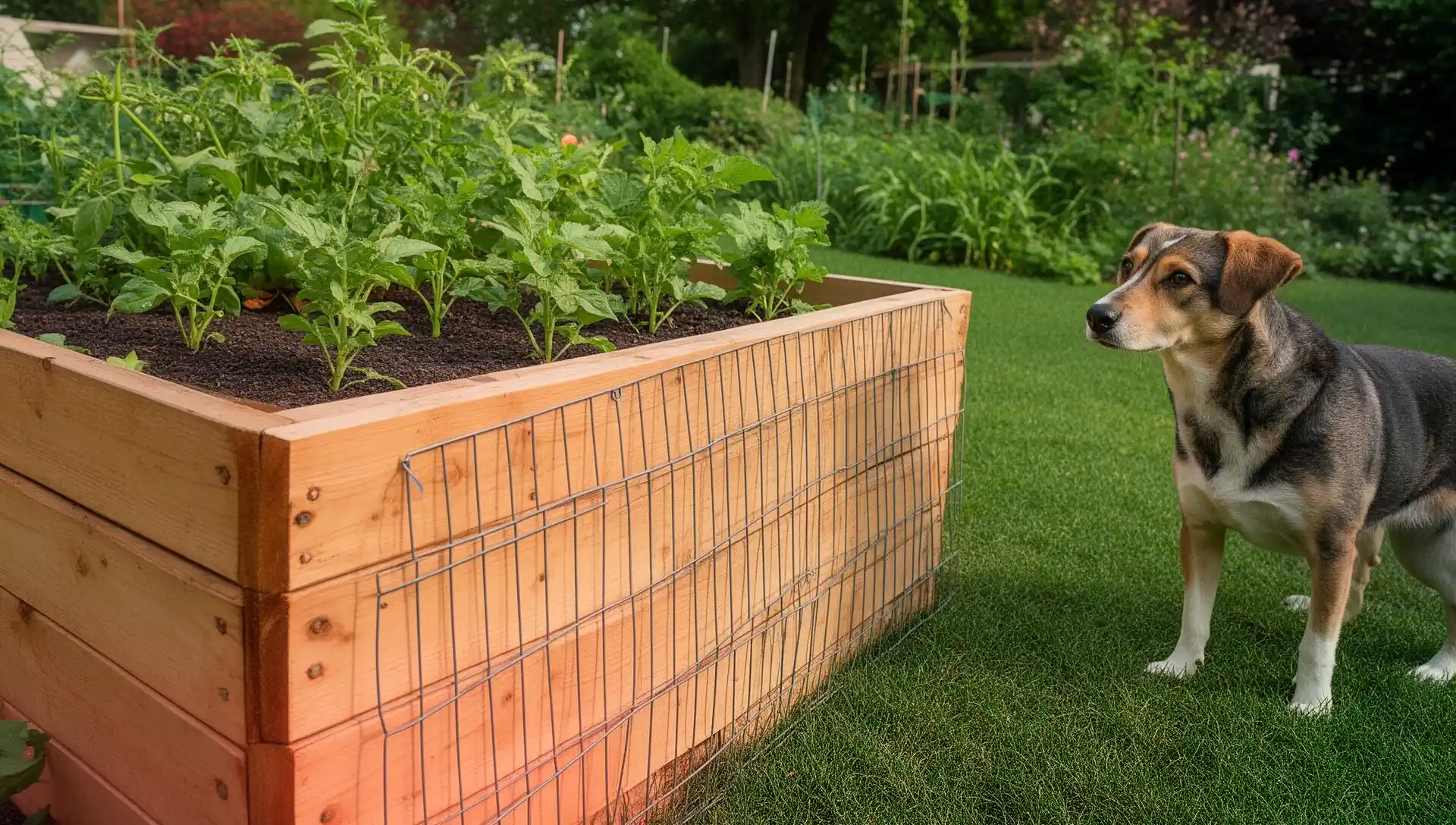
Perimeter fencing. For most medium-sized dogs, a 3-foot-tall fence around the vegetable plot is sufficient. Athletic or large breeds may need 4 feet. Space posts 6 to 8 feet apart and bury the bottom 6 inches underground to stop dogs that try to dig under rather than jump over. Bending the fence base outward at a 90-degree angle at ground level — creating an “L” of hardware cloth — stops the most persistent excavators.
Penn State Extension recommends a 2-to-3-foot buffer zone between the fence line and the nearest bed, giving dogs room to patrol the perimeter without being able to reach plants through the fence.
Raised bed height by dog size.
| Dog size | Approximate shoulder height | Recommended bed height |
|---|---|---|
| Small (under 25 lbs) | Under 14 inches | 18 inches minimum |
| Medium (25–60 lbs) | 14–22 inches | 18–24 inches |
| Large (60–90 lbs) | 22–28 inches | 24–30 inches |
| Extra-large (90+ lbs) | 28+ inches | 30 inches with perimeter fence |
Raised beds present a hard vertical edge rather than flat ground, which most dogs won’t attempt to climb. For extra-large breeds, pair a 24-inch bed with a 12-inch perimeter fence — the combined barrier height deters most dogs without requiring a full garden enclosure.
Designing the Garden to Work With Your Dog
Barriers solve the access problem, but dogs need outlets for digging, exploring, and resting. If the yard offers nothing interesting, the vegetable garden stays the most compelling destination.
Create a designated dig zone. A 4-by-4-foot sand-filled pit in a shaded corner gives dogs a sanctioned place to excavate. Bury a few toys or chews initially to make it attractive. Most dogs redirect naturally once they discover the approved outlet.
Make the garden edge unappealing. Pine cones, large river rocks, or rough gravel placed around bed perimeters create an uncomfortable walking surface that discourages casual entry. These physical deterrents consistently outperform scent-based repellents — Piedmont Master Gardeners notes there is no definitive research supporting the effectiveness of scent deterrents as garden barriers. Save the money and spend it on better fencing instead.
Choose your mulch carefully. Use cedar or pine bark inside raised beds, not cocoa shell mulch. Cocoa mulch contains theobromine — the same compound that makes chocolate toxic to dogs — and the sweet smell attracts dogs to exactly the areas you want them to avoid. Cedar and pine are safe alternatives that perform well as bed mulch.
Plant aromatic border plants. The outer edge of your vegetable garden is a good place for plants dogs find unpleasant to walk through: rosemary (USDA zones 7–10), lavender (zones 5–9), rue (zones 4–9), and marigolds (zones 2–11). These won’t stop a highly motivated dog, but they add friction as a soft outer layer before the fence.
Protecting Your Dog From the Vegetable Garden
Most dog-gardening guides stop after the physical barriers. This section runs the problem in the other direction: which plants in a standard vegetable garden pose genuine risk to dogs, and why?
Risk guide to common vegetable garden plants
| Plant | Risk level | Toxic parts | Primary symptoms |
|---|---|---|---|
| Onions, garlic, chives, leeks | High — all forms | All parts including dried and cooked | Lethargy, pale gums, weakness (delayed 3–5 days) |
| Rhubarb | High | Leaves (stalks are safe) | Drooling, vomiting, kidney failure |
| Grapes and grapevines | High | All parts | Vomiting, kidney failure |
| Tomato plant | Medium — plant only | Leaves, stems, vines, unripe fruit | GI upset, weakness (ripe fruit is safe) |
| Potato plant | Medium — plant only | Green tubers, leaves, stems | GI upset, CNS signs |
| Carrots | Safe | — | — |
| Green beans and peas | Safe | — | — |
| Zucchini and cucumber | Safe | — | — |
| Broccoli, kale, cabbage | Safe in moderation | — | GI upset in large amounts only |
Why Allium plants are the most dangerous group in any vegetable garden. Onions, garlic, chives, and leeks all contain organosulfur compounds — specifically thiosulfates — that oxidize the membranes of red blood cells. This triggers the formation of Heinz bodies: abnormal protein clumps that cause the immune system to target and destroy those cells, producing hemolytic anemia. The process begins within 24 hours of ingestion, but visible symptoms — lethargy, pale or yellowish gums, rapid breathing, weakness — typically don’t appear until 3 to 5 days later.
Stop guessing if your garden pays.
Log what you grow and harvest — see total yield weight, estimated retail value, and season-on-season progress in one place.
→ Track My HarvestTwo details that matter for gardeners: garlic is 3 to 5 times more toxic than onion by weight, and dried or powdered forms are just as dangerous as fresh. A dog casually chewing garlic chive leaves in the herb section is a genuine veterinary risk, not a minor inconvenience. According to the Merck Veterinary Manual, clinical signs occur in dogs that consume roughly 15–30 grams per kilogram of body weight in raw onion — approximately one medium onion for a 25-pound dog. Smaller dogs reach that threshold faster.
If your dog has eaten any Allium plant, contact the ASPCA Animal Poison Control Center at 888-426-4435 immediately — don’t wait for symptoms to appear.
Tomatoes: dangerous plant, safe fruit. Ripe red tomatoes are generally safe for dogs in moderation. The risk comes from the green parts: leaves, stems, vines, and unripe tomatoes all contain tomatine and solanine — glycoalkaloid compounds that cause gastrointestinal upset and, in larger exposures, muscle weakness, tremors, and cardiac effects. As the tomato ripens and turns red, toxin levels drop significantly.
Practically: a dog that snatches a ripe tomato from the ground faces minimal risk. The same dog chewing vines or stealing green tomatoes does not. Trellised tomatoes with lower foliage removed reduce the accessible risk surface considerably. At harvest, don’t leave green tomatoes or vine trimmings where dogs can access them — compost them only in a secured bin.
Rhubarb: the leaf-only hazard. Rhubarb stalks are safe to eat. The large ornamental leaves contain oxalic acid at levels that can cause kidney failure in dogs. Since rhubarb leaves are typically composted at harvest, the main risk is dogs accessing the plant itself or the compost pile. Fence the rhubarb and secure the bin.
What You Can Grow Safely Around Dogs
With the risk picture clear, here’s the positive side: a substantial list of vegetable garden plants that are safe in areas dogs can reach.
Safe vegetables: carrots, green beans, peas, zucchini, yellow squash, cucumber, corn, lettuce, spinach, sweet potatoes (cooked), broccoli, and cauliflower. Carrots and green beans can also be offered directly as treats — most dogs will eat them happily.
Safe herbs: rosemary, thyme, basil, sage, and fennel are all non-toxic to dogs and serve double duty as aromatic border plants in the vegetable garden.
A practical planting strategy: group high-risk plants — onions, garlic, chives, rhubarb, tomatoes — in a fenced section with a secure gate. Use open, accessible beds for safe crops. Even if a dog gets through the outer perimeter, the highest-risk plants stay behind a secondary barrier. Our guide to raised bed gardening covers how to set up compartmentalized layouts that make this kind of sectioning straightforward.
Training Your Dog to Respect the Garden
Physical design does the heavy lifting. Training adds an essential layer — particularly during garden construction, seasonal transitions, or when a new section isn’t yet fenced.
“Leave it” is the single most useful command for garden situations. Teach it away from the garden first, using low-value objects, then work up to practicing near the beds with higher-distraction stimuli. Mark and reward immediately when the dog disengages from a plant or bed edge. Consistency matters more than session length: a boundary enforced six times but overlooked on the seventh keeps the dog testing indefinitely.
Realistic expectations: training alone rarely holds against a highly motivated digger in summer when instincts run high. The most reliable outcome combines physical barriers, a designated dog zone, and the “leave it” foundation. Each layer reinforces the others; none replaces the others.
Hidden Hazards: Chemicals, Compost, and Mulch
A few non-plant risks in the vegetable garden are worth addressing:
Fertilizers and organic amendments. Bone meal, blood meal, and fish emulsion smell like food to dogs. Store bags securely, and keep dogs out of recently fertilized areas until the product has been fully watered in or dried. Chemical pesticides and herbicides carry obvious risks — follow manufacturer re-entry intervals strictly.
The compost bin. An open compost pile is one of the highest-risk spots in the garden for dogs. Compost regularly contains grapes or raisins, onion and garlic scraps, coffee grounds, and moldy material — all of which are dangerous to dogs. A latching lid or enclosed tumbler composter is non-negotiable if your dog has unsupervised garden access.
Cocoa shell mulch. Already mentioned under design, but worth repeating: dogs are drawn to the smell, and eating enough of it can cause vomiting, diarrhea, tremors, and seizures — the same signs as chocolate poisoning. Use cedar or pine bark instead.
Slug pellets. If you use slug bait, switch to iron phosphate-based products such as Sluggo — effective against slugs and non-toxic to dogs. Traditional metaldehyde pellets are extremely dangerous to dogs even in small quantities and should not be used in any garden where dogs have access.
FAQ
Can dogs eat ripe tomatoes from the vine?
Ripe, red tomatoes are generally safe for dogs in small amounts. The hazard comes from the green parts of the plant — leaves, stems, vines, and unripe tomatoes — which contain tomatine and solanine. Once the fruit is fully ripe, toxin levels drop significantly. Keep the plant fenced regardless, even if the ripe fruit is low-risk.
My dog ate garlic leaves. Should I be worried?
Yes — call the ASPCA Animal Poison Control Center at 888-426-4435 right away, even if your dog appears completely fine. Allium toxicity produces delayed symptoms: the hemolytic anemia it causes takes 3 to 5 days to become visible. By the time a dog looks sick, red blood cell damage is already in progress. Early veterinary intervention significantly improves outcomes.
Do scent repellents actually keep dogs out of gardens?
The evidence is inconclusive. Citronella, cayenne pepper, and bitter apple products are widely sold but there is no definitive research confirming their effectiveness as garden deterrents. Treat them as a supplemental layer at best. Physical barriers — fencing and raised beds — are the only reliably effective tools.
Sources
- ASPCA — Pets and Produce: Top Tips on Vegetable Garden Safety
- American Veterinary Medical Association — Household Hazards
- Merck Veterinary Manual — Garlic and Onion (Allium spp) Toxicosis in Animals (linked inline above)
- Pet Poison Helpline — Are Tomatoes Poisonous to Dogs?
- Penn State Extension — Petscaping: Creating a Pet-Friendly Garden
- Piedmont Master Gardeners — Dogs in the Garden


