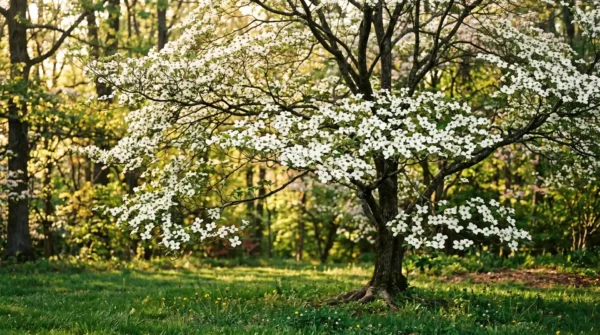
Which White-Flowering Tree Fits Your Zone? 18 Picks From Zone 3 Japanese Lilac to Zone 10 Sweetbay Magnolia

Find the right white-flowering tree for your USDA zone — 18 picks from zone 3 Japanese lilac to zone 10 sweetbay magnolia, sorted by bloom window from February through September.
Every spring, Bradford pears blanket American neighborhoods in white clouds — for about 10 days. Then the smell arrives, the narrow branch crotches begin splitting under their own weight, and birds scatter the seeds into fields and roadsides where the seedlings form dense, thorny thickets that crowd out native vegetation. Four states have now banned its sale. The alternatives below are better in every measure.
White-blooming trees work alongside any house color, soften bold spring plantings, and carry the landscape from February all the way to September. The 18 species here cover every USDA zone from 3 to 10 and every bloom window from late winter through early fall, organized so you can match the right tree to your zone and yard size.
How to Use This Guide
Zone determines survival; height tells you whether a tree fits your space; bloom window tells you when you get white flowers. Three questions answer the choice: What is my USDA zone? How tall can my tree grow? When do I want color? For a full multi-season flowering tree sequence beyond white, the complete flowering tree timeline maps 18 species from late winter through late summer across the color spectrum.
| Tree | Zones | Height | Bloom Window | Best For |
|---|---|---|---|---|
| Star Magnolia | 4–8 | 15–20 ft | Feb–Mar | First bloom of year, small gardens |
| Serviceberry | 4–9 | 15–40 ft | Mar–Apr | Edible fruit, wildlife gardens |
| White Fringe Tree | 3–9 | 12–30 ft | Apr–May | Widest zone range, native |
| Flowering Dogwood | 5–9 | 15–25 ft | Mar–May | Classic native, understory |
| Carolina Silverbell | 4–8 | 10–40 ft | Apr–May | Woodland gardens, wet sites |
| Pagoda Dogwood | 3–7 | 20–30 ft | Late May | Zone 3–4, layered branching |
| Japanese Snowbell | 5–9 | 20–30 ft | Apr–May | Elegant, city gardens |
| Kousa Dogwood | 5–8 | 20–30 ft | May | Late spring, disease-resistant |
| Washington Hawthorn | 4–7 | 25 ft | May–Jun | Wildlife, multi-season interest |
| American Yellowwood | 4–8 | 30–45 ft | May | Dramatic panicles, specimen |
| Northern Catalpa | 4–8 | 40–70 ft | May–Jun | Large properties, difficult sites |
| Pekin Lilac | 4–7 | 15–20 ft | Jun | Small yards, pest-free |
| Japanese Tree Lilac | 3–7 | 25–30 ft | Jun | Zone 3–4, June bloom |
| Sweetbay Magnolia | 5–10 | 10–35 ft | May–fall | Wet sites, longest bloom |
| Southern Magnolia | 6–10 | 60–80 ft | May–Jun | Large landscapes, zones 7–10 |
| Sourwood | 5–9 | 20–30 ft | Jun–Jul | Summer bloom + best fall color |
| Japanese Stewartia | 5–8 | 12–40 ft | Jun–Aug | Year-round interest, bark |
| Seven-Sons Flower | 5–9 | 15–20 ft | Aug–Sep | Season-extender, fall color |

Spring Bloomers: February to May
Star Magnolia (Magnolia stellata) — Zones 4–8, 15–20 ft. The earliest deciduous magnolia to flower, star magnolia opens its 12–18 strap-like petals in February or March in zone 7 and March or April in zone 5, before any leaves emerge. A late frost can brown those open flowers overnight, so in zones 4 and 5 plant it on a north-facing slope or in light shade to delay bloom by a week and reduce that exposure. At 15–20 feet mature height, it is one of the few white-blooming trees compact enough for a small city garden where a full-size specimen would overwhelm the space.

Three pre-planned garden beds, free
Stop staring at empty beds: printable plans with exact layouts, plant lists and planting calendars — yours free from the Garden Library.
Serviceberry (Amelanchier arborea) — Zones 4–9, 15–40 ft. Serviceberry delivers four-season value from one plant: white star-shaped flowers in March or April, edible blueberry-like fruit in early summer that birds strip within days, brilliant orange-red fall foliage, and clean branch structure through winter. The fruit is genuinely tasty — rich in iron and copper, with a mild blueberry flavor — if you get to it before the robins do. It tolerates part shade better than most flowering trees, making it the default choice for the woodland edge or under a power line where taller trees cannot fit. For gardens where ornamental and edible value both matter, our guide to edimentals covers serviceberry alongside other dual-purpose plants.
White Fringe Tree (Chionanthus virginicus) — Zones 3–9, 12–30 ft. No other white-blooming tree covers as wide a zone range. In April and May, fringe tree produces ivory flower clusters 4 to 8 inches long that appear to float in the air before the leaves fill in. Male plants carry showier flowers; females produce ornamental blue-black berries that attract songbirds through late summer. It accepts part shade, tolerates drought once established, and is native to eastern North America. For any zone 3 or zone 9 gardener struggling to find a white-blooming tree that actually survives their climate, fringe tree is the first answer to consider.
Flowering Dogwood (Cornus florida) — Zones 5–9, 15–25 ft. The iconic eastern native blooms from March through May with horizontal layers of white bracts — those bracts are modified leaves, not petals, which explains why they persist for several weeks rather than the two or three days true petals would last. Part shade mimics its native woodland understory habitat and reduces summer heat stress in zones 7 through 9. Native pollinators, red fall berries that feed songbirds, and reliable fall foliage color make this a complete four-season tree. For gardeners building a habitat planting around a dogwood, zone-matched pollinator plants complete the picture.
Carolina Silverbell (Halesia carolina) — Zones 4–8, 10–40 ft. Silverbell hangs white bell-shaped flowers downward in clusters from late April into May, framing the branches from below rather than above — an unusual quality among spring-blooming trees. Native to the Great Smoky Mountains, it thrives in moist, acidic soil typical of woodland gardens in zones 4 through 8. Height varies from 10 feet on dry exposed sites to 40 feet in deep woodland soils, which makes it adaptable to a range of garden scales. The four-winged seed pods that follow the flowers add interesting texture through fall and winter.
Pagoda Dogwood (Cornus alternifolia) — Zones 3–7, 20–30 ft. For zone 3 and 4 gardeners who cannot grow native flowering dogwood, pagoda dogwood fills the cold-climate gap. It blooms in late May with flat-topped clusters of creamy-white flowers on a tree with distinctly horizontal, layered branching that creates architectural presence through all four seasons. The pagoda dogwood’s natural range extends across cold-climate eastern North America, making it reliably hardy in zones 3 and 4 where most white-blooming trees fail.
Late Spring and Early Summer: May and June
Japanese Snowbell (Styrax japonicus) — Zones 5–9, 20–30 ft. Snowbell hangs white bell-shaped flowers beneath the branches in late spring on short lateral shoots, with foliage positioned at branch tips so the flowers remain clearly visible from below. The effect is refined rather than showy, which makes it the right choice for contemporary or Japanese-inspired gardens where most flowering trees would look out of place. It prefers moist, acidic, well-drained soil and does not tolerate heat or drought well; in zones 7 through 9, afternoon shade is important.
Kousa Dogwood (Cornus kousa) — Zones 5–8, 20–30 ft. Kousa dogwood blooms nearly a month after native flowering dogwood, with white bracts emerging in May nestled among fresh green leaves rather than on bare branches. This later timing largely avoids the late frost damage that catches Cornus florida in zone 5 and 6 gardens. It is also more drought-tolerant, more cold-hardy within its zone range, and significantly more resistant to dogwood anthracnose, the fungal disease that has reduced native dogwood populations across the eastern United States. For zone 5 or 6 gardeners whose flowering dogwoods have consistently struggled, kousa is the practical alternative.
Washington Hawthorn (Crataegus phaenopyrum) — Zones 4–7, 25 ft. In late May and June, Washington hawthorn opens small white flower clusters replaced by persistent red berries that feed birds through winter. The multi-season payoff is exceptional: spring flowers, glossy summer foliage, fall orange-red color, and winter fruit that extends the wildlife value long after other trees have become invisible. A dense thorny canopy provides effective wildlife shelter and a low-maintenance security barrier along property lines. Size stays at about 25 feet, keeping it in the medium-tree range compatible with most residential lots.
American Yellowwood (Cladrastis kentukea) — Zones 4–8, 30–45 ft. When yellowwood blooms, it is genuinely spectacular: drooping white panicles up to 12 inches long cascade from a smooth gray-barked canopy in May. The complication is the blooming cycle — yellowwood blooms heavily only every two to three years. In off years, it is a handsome shade tree with golden yellow fall color, which has real value in its own right, but that is not the reason most people plant it. Accept the irregular schedule and a flowering year on a mature yellowwood is breathtaking; plant something more reliably annual if consistent white flowers are the priority.
Northern Catalpa (Catalpa speciosa) — Zones 4–8, 40–70 ft. Catalpa is the boldest tree on this list. In May and June it produces large white flowers with yellow and purple patterns on the interior, held in upright clusters above coarse, tropical-looking foliage. At 40 to 70 feet tall, it demands space — this is not a small-garden tree. It tolerates wet, dry, and poor soils that would stress most other flowering trees, making it the reliable choice for difficult large-scale sites. It also serves as a host plant for two native sphinx moths, which makes it a wildlife asset on properties large enough to accommodate its size.
Pekin Lilac (Syringa pekinensis) — Zones 4–7, 15–20 ft. Pekin lilac delivers the fragrant June bloom of a common lilac in a compact tree form with significantly better heat and pest resistance. Creamy-white panicles appear in June on a plant that stays at 15–20 feet — a smaller footprint than the Japanese tree lilac’s 25–30 feet, useful in tighter spaces. Powdery mildew, the persistent problem with common lilacs in humid climates, rarely affects Pekin lilac. It works well as a specimen or grouped along a property line as a flowering screen.
Japanese Tree Lilac (Syringa reticulata) — Zones 3–7, 25–30 ft. Japanese tree lilac is the most trouble-free lilac available: resistant to powdery mildew, borers, and scale. In June it carries creamy-white fragrant panicles 6 to 12 inches long, about two weeks after common lilacs have finished. The smooth reddish-brown bark with horizontal lenticels resembles cherry bark and adds winter interest when nothing else is happening. For zone 3 and 4 gardeners, this is one of the few late-blooming white trees that reliably survives severe cold — fringe tree and pagoda dogwood deliver earlier in the season, but Japanese tree lilac extends white flowers into June even in the far north.

Summer Bloomers: June Through September
Sweetbay Magnolia (Magnolia virginiana) — Zones 5–10, 10–35 ft. Sweetbay magnolia has the longest bloom season on this list: it begins in May and continues sporadically until first frost, producing 2 to 3-inch creamy-white cup-shaped flowers with a vanilla-lemon fragrance through summer. It also tolerates wet, boggy, and swampy soils that would kill most other flowering trees — genuinely useful for rain gardens and low spots with persistent drainage problems. Mature height ranges from 10 feet in northern gardens to 35 feet in zone 9 conditions, making it both a small-garden option and a substantial specimen depending on where you garden.
Southern Magnolia (Magnolia grandiflora) — Zones 6–10, 60–80 ft. The flowers are the largest here — 8 to 12 inches across, intensely fragrant, produced from May into summer on a tree that reaches 60 to 80 feet tall. That size demands a large property; in a typical suburban yard, a southern magnolia will eventually dominate every sight line and drop enormous leathery leaves year-round. NC State Extension recommends compact cultivars like ‘Little Gem’ (20–25 feet) for smaller spaces. In zone 7 through 10, no other white-blooming tree delivers the architectural presence of a mature southern magnolia.
Stop missing your zone's planting windows.
Select your US zone and month — get a complete checklist of what to plant, prune, feed, and protect right now.
→ View My Garden CalendarSourwood (Oxydendrum arboreum) — Zones 5–9, 20–30 ft. Sourwood blooms in June and July with white lily-of-the-valley-like flowers along arching racemes, while most neighboring trees have finished for the season. In fall it produces crimson-red foliage color among the most intense of any native tree in the eastern United States. Summer flowers and spectacular fall color from one plant at 20–30 feet makes sourwood one of the most efficient space investments on this list. It requires acidic soil and does not tolerate compacted or alkaline conditions; it succeeds best when established before soil modification, not added to a prepared site after the fact.
Japanese Stewartia (Stewartia pseudocamellia) — Zones 5–8, 12–40 ft. Stewartia has the most ornamental bark of any tree here: exfoliating panels of gray, orange, and reddish-brown through winter that look hand-painted. Camellia-like white flowers with golden stamens open from June through August — unusual among trees, which normally concentrate blooming into a two-week window. Slow-growing and long-lived, it rewards patience with four-season interest: spring buds, summer flowers, fall yellow and burgundy foliage, and winter bark. Plant it where that bark remains visible from a window or along a path you use year-round.
Seven-Sons Flower (Heptacodium miconioides) — Zones 5–9, 15–20 ft. Seven-sons flower blooms in August and September, when essentially nothing else of tree-scale is flowering. Small, fragrant white flowers appear in whorls across the upper branches, and after the petals drop, the persistent calyxes turn rosy-pink and continue the display into October. For the gardener who wants white bloom presence through early fall, this is the only tree-sized option available in zones 5 through 9. The peeling tan-and-cream bark also provides winter structure similar to stewartia.
The One Tree to Skip: Bradford Pear
The Bradford pear (Pyrus calleryana ‘Bradford’) produces attractive white spring flowers and little else of value. Different Callery pear cultivars cross-pollinate when planted near each other, birds distribute the seeds, and the seedlings form dense thorny thickets that eliminate native understory vegetation — a pattern NC State Extension documents across the eastern and midwestern United States. The tree is now banned in Ohio, South Carolina, Pennsylvania, and Kansas, and classified as invasive or problematic in at least 25 states. The ‘Bradford’ cultivar also has narrow branch crotch angles that become structurally critical with age, leading to catastrophic splitting as the tree matures. Every tree on this list outperforms it in longevity, ecological value, and long-term landscape contribution.
Frequently Asked Questions
Which white-flowering tree has the longest bloom season?
Sweetbay magnolia (Magnolia virginiana, zones 5–10) blooms from May until the first frosts, making it the longest-blooming tree on this list. Seven-sons flower is the best option for late-season presence specifically, extending color into September and October through its ornamental rosy calyxes after the petals drop.
What white-flowering trees survive zone 3?
Three trees here are reliably hardy in zone 3: white fringe tree (Chionanthus virginicus, zones 3–9), pagoda dogwood (Cornus alternifolia, zones 3–7), and Japanese tree lilac (Syringa reticulata, zones 3–7). White fringe tree gives zone 3 gardens the widest hardiness range of any white-blooming native tree on this list.
What is the best white-flowering tree for a small yard?
Star magnolia (15–20 ft), Pekin lilac (15–20 ft), and white fringe tree (as small as 12 ft) all fit restricted spaces. Carolina silverbell stays as small as 10 feet on dry exposed sites. Japanese snowbell at 20–30 feet works in slightly larger urban yards while remaining elegant and non-invasive. All five tolerate part shade, which is a common constraint in urban gardens.
Sources
- NC State Extension. Cornus florida: Flowering Dogwood. NC State University Plant Toolbox.
- NC State Extension. Amelanchier arborea: Downy Serviceberry. NC State University Plant Toolbox.
- NC State Extension. Magnolia grandiflora: Southern Magnolia. NC State University Plant Toolbox.
- NC State Extension. Chionanthus virginicus: White Fringetree. NC State University Plant Toolbox.
- NC State Extension. Styrax japonicus: Japanese Snowbell. NC State University Plant Toolbox.
- NC State Extension. Cladrastis kentukea: American Yellowwood. NC State University Plant Toolbox.
- NC State Extension. Magnolia stellata: Star Magnolia. NC State University Plant Toolbox.
- NC State Extension. Syringa reticulata: Japanese Tree Lilac. NC State University Plant Toolbox.
- NC State Extension. Halesia carolina: Carolina Silverbell. NC State University Plant Toolbox.
- NC State Extension. Cornus kousa: Kousa Dogwood. NC State University Plant Toolbox.
- NC State Extension. Oxydendrum arboreum: Sourwood. NC State University Plant Toolbox.
- NC State Extension. Magnolia virginiana: Sweetbay Magnolia. NC State University Plant Toolbox.
- NC State Extension. Catalpa speciosa: Northern Catalpa. NC State University Plant Toolbox.
- NC State Extension. Stewartia pseudocamellia: Japanese Stewartia. NC State University Plant Toolbox.
- Iowa State University Extension and Outreach. Summer Blooming Trees. Yard and Garden — Iowa State University.
- University of Wisconsin Division of Extension. Summer Flowering Trees, Shrubs and Vines. Wisconsin Horticulture.
- NC State Extension. Callery Pear: Bradford Pear, Other Varieties, and Their Invasive Offspring. NC State University Extension Publications.