

15 Shallow-Rooted Perennials for Thin, Rocky Soil and Under Trees

Most “shallow soil” perennial lists get it wrong. Here are 15 plants whose roots genuinely stay shallow — and the popular picks that secretly don’t.
Search “shallow-rooted perennials” and most lists hand you the same names: butterfly weed, coneflower, catmint, black-eyed Susan. Half of those plants have taproots that run two or three feet down — they tolerate rocky, poor soil not because their roots stay shallow, but because a single deep root can push through cracks to find moisture other plants can’t reach. That distinction matters enormously if your actual problem is soil that’s only 4 to 8 inches deep over bedrock, hardpan, a tree’s root mat, or a septic drain field liner. There simply isn’t room for a taproot to develop there, no matter how drought-tolerant the plant is on paper.
I learned this the slow way, replanting a strip of soil along our garage foundation where a concrete footing sits about six inches down. Every “tough, low-maintenance” perennial I tried from a typical drought list sat there and sulked for two seasons. The fifteen perennials below are different: their root systems are built to stay shallow by nature, not just to tolerate hardship, and they’re sorted by which specific shallow-soil problem you actually have.
Why “Shallow Soil” Isn’t One Problem
Gardeners searching for shallow-rooted perennials are usually dealing with one of four distinct situations, and they don’t call for the same plants: a rock ledge or hardpan layer that leaves only a few inches of true topsoil, the root zone under an established tree where a bigger plant already claims the deep soil, a septic drain field where deep roots risk clogging pipes, or a raised bed sitting on pavers with no soil beneath it at all.
Root architecture research backs up why the plant choice differs by situation. A 2022 meta-analysis in Frontiers in Plant Science compared how fibrous- and taproot-dominant species respond to water stress: fibrous root systems increased root hair density by nearly half (49.4%) and root hair length by over a third (35.8%) under drought, concentrating their absorptive surface in the topsoil layer where fibrous roots naturally live[1]. Taproot systems responded differently, investing more heavily in a single deep channel instead of surface hair density[1]. Fibrous and rhizomatous roots are built to extract everything they can from a thin layer of soil; taproots are built to escape a thin layer of soil by going around or under it.

Three pre-planned garden beds, free
Stop staring at empty beds: printable plans with exact layouts, plant lists and planting calendars — yours free from the Garden Library.
That’s the flaw in a lot of “shallow soil” plant lists. A well-known guide from Missouri Botanical Garden recommends butterfly weed (Asclepias tuberosa) and blue false indigo (Baptisia australis) for shallow, rocky soil[2] — both genuinely thrive there, but both do it with a taproot several feet long threading through rock cracks. Plant either where there’s truly only 6 inches of soil over solid bedrock or a concrete slab, and that taproot has nowhere to go. For real depth-limited situations, you want a plant built to stay shallow, not a general drought-tolerant perennial pick.
Match Your Spot to the Right Root Type
Start by identifying which situation you actually have. The table below maps each to the root type it calls for and a few of the safest picks, all covered in more depth further down.
| Your Situation | Soil Depth | Root Type Needed | Good Picks | Skip These |
|---|---|---|---|---|
| Rock ledge or hardpan | 4-8 in. | Mat-forming fibrous or succulent | Creeping thyme, sedum, sea thrift | Butterfly weed, baptisia, other taprooted natives |
| Under an established tree | Variable; roots compete at every depth | Shallow rhizomatous, shade-tolerant | Coral bells, foamflower, lady’s mantle | Anything needing yearly deep cultivation |
| Under a black walnut specifically | Variable, plus juglone present | Juglone-tolerant and shallow | Ajuga, hosta, daylily, coral bells | Peonies, lilies, most vegetables |
| Over a septic drain field | 6 in. minimum to pipe | Shallow herbaceous, drought-tolerant | Yarrow, black-eyed Susan, daylily | Willows, poplars, any water-seeking shrub |
15 Perennials With Genuinely Shallow Root Systems
These fifteen keep the bulk of their roots in the top few inches of soil by nature, not by force — including the ground-hugging types within genera that also include much deeper-rooted upright cousins. Moss phlox, for example, is the shallow, mat-forming relative of upright garden phlox; see how the two compare directly. The same split shows up in hardy cranesbill geraniums, where spreading groundcover types stay shallow while some upright cultivars root deeper. USDA zones below are minimums for winter hardiness — check yours before planting.
| Perennial | Root Type | Light | USDA Zone | Best For |
|---|---|---|---|---|
| Creeping thyme | Fibrous mat | Full sun | 4-9 | Rock ledges, path edges |
| Moss phlox | Fibrous mat | Full sun | 3-9 | Slopes, rock gardens |
| Sedum / stonecrop | Shallow fibrous, succulent | Full sun | 3-9 | Thinnest soil, green roofs |
| Sea thrift | Shallow fibrous clump | Full sun | 4-8 | Sandy or coastal, rocky soil |
| Yarrow | Shallow rhizomatous | Full sun | 3-9 | Septic fields, poor soil |
| Cranesbill geranium | Shallow fibrous mat | Sun to part shade | 4-8 | Slopes, edging |
| Coral bells | Shallow fibrous clump | Part shade | 4-9 | Under trees, septic-safe |
| Foamflower | Shallow rhizome | Shade | 3-8 | Under trees |
| Barrenwort (Epimedium) | Shallow rhizome | Dry shade | 4-8 | Under trees, walnut-safe |
| Lady’s mantle | Shallow fibrous clump | Part shade | 3-8 | Under trees |
| Ajuga (bugleweed) | Shallow rhizomatous mat | Part shade | 3-9 | Walnut zones, erosion control |
| Wild ginger | Shallow rhizome | Full shade | 4-8 | Under walnut trees |
| Hardy cyclamen | Shallow tuber | Part to full shade | 5-9 | Under trees |
| Black-eyed Susan | Fibrous, moderate depth | Full sun | 4-9 | Septic fields, sunny thin soil |
| Daylily | Shallow fleshy-fibrous | Sun to part shade | 3-9 | Septic fields, slopes |
Five Standouts, and Why Their Roots Work
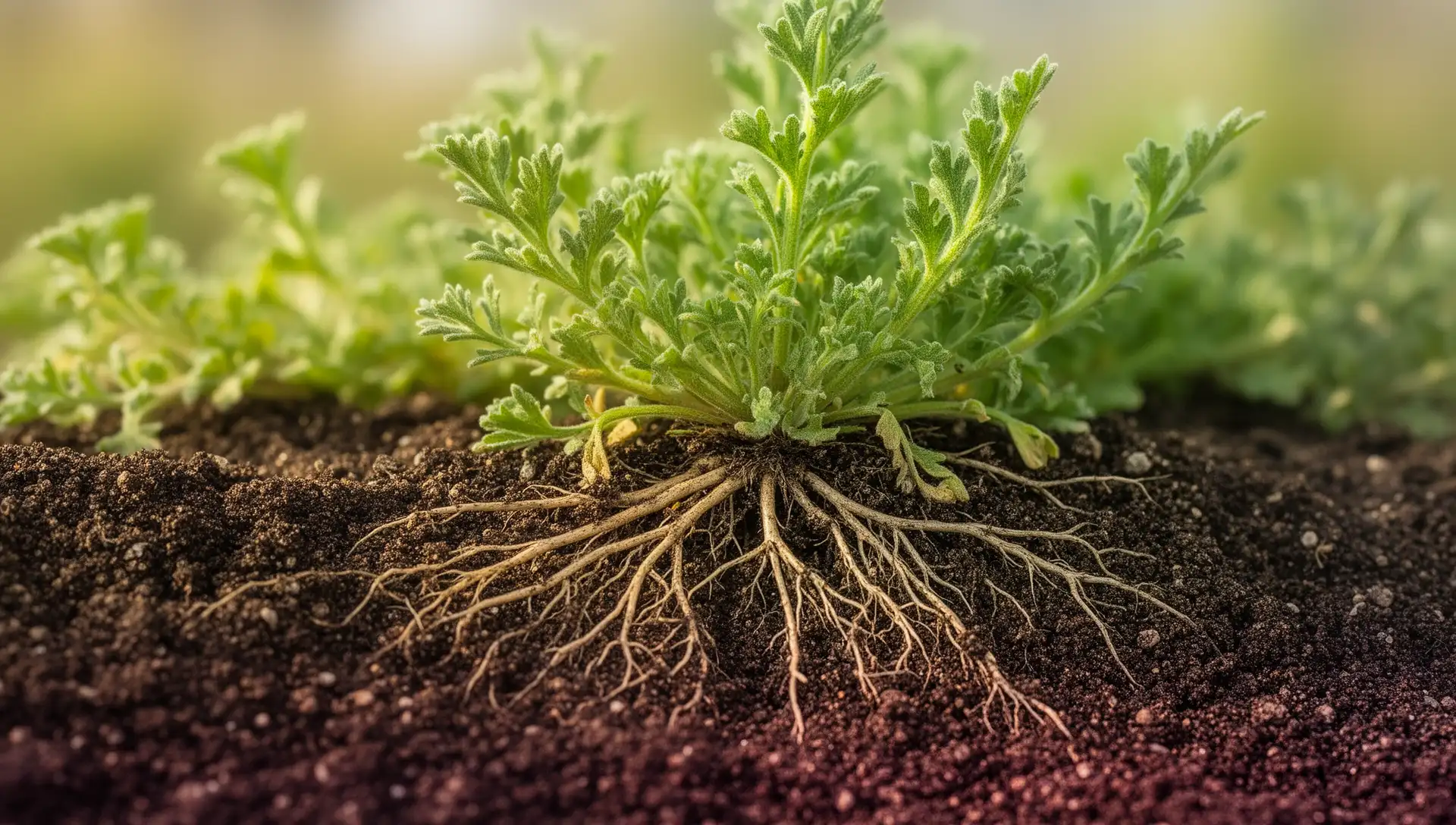
Creeping thyme forms a mat rarely more than 2 to 3 inches thick, with fine fibrous roots that spread sideways through cracks and rubble instead of down. That’s the same drought response the Frontiers meta-analysis describes: more root hairs, more surface area, all concentrated near the top[1]. It’s the best choice for soil measured in inches rather than feet, and unlike most groundcovers, it tolerates being walked on occasionally. Full spacing and mowing-alternative use is in the creeping thyme groundcover guide.
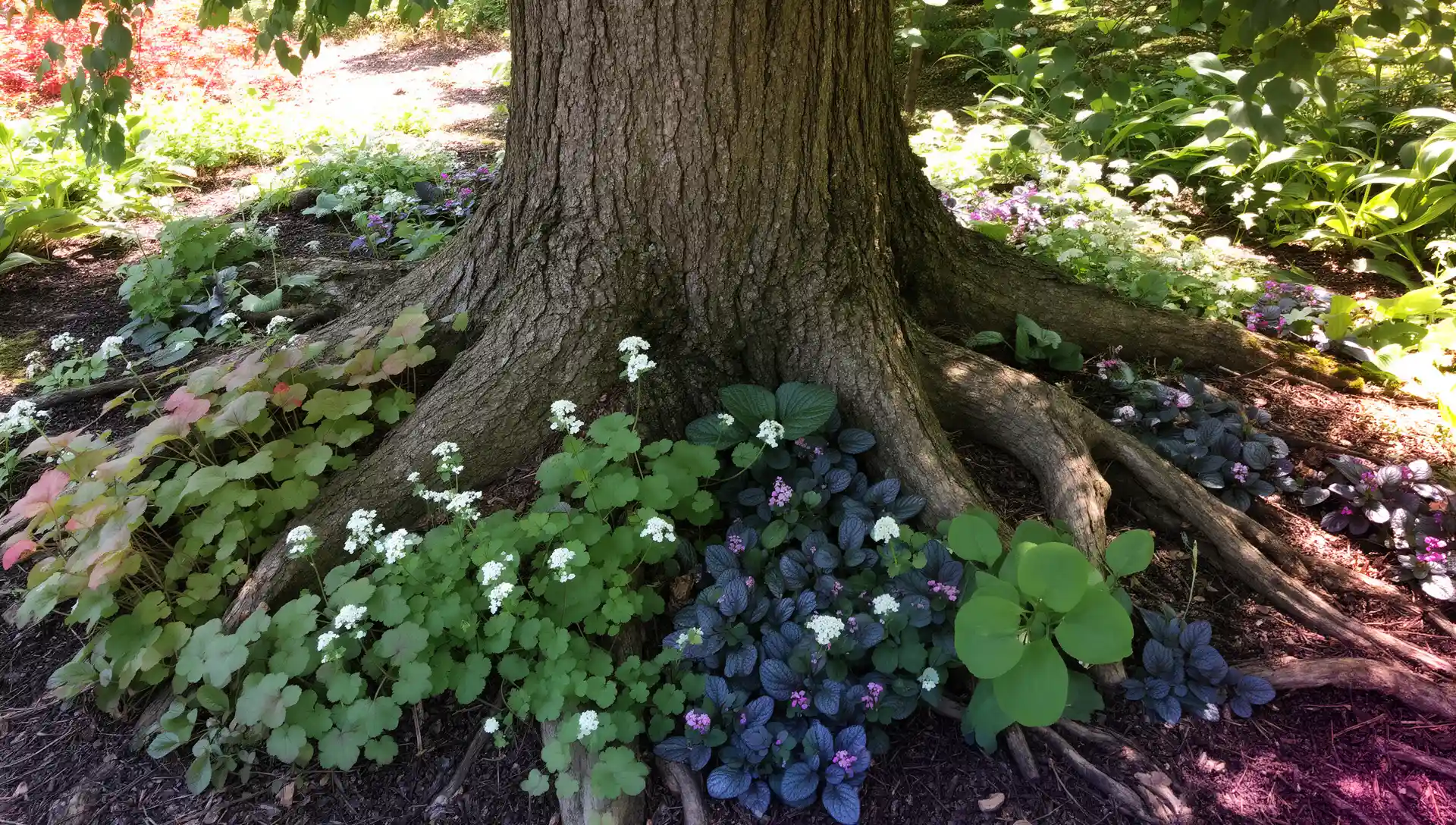
Coral bells (Heuchera) and foamflower (Tiarella) are close relatives that solve the same problem: a fibrous, shallow crown that tucks into the gaps between a tree’s surface roots instead of competing at depth. Penn State Extension specifically recommends this pairing, along with Lenten rose and Epimedium, for underplanting trees where deeper cultivation would damage roots[3]. Neither needs more than an inch or two of loosened soil to establish, in line with the extension’s guidance to add no more than 2 inches of soil over an existing root zone[3]. See how the two compare directly in the coral bells vs. foamflower guide.
Ajuga (bugleweed) is one of the few groundcovers reliably listed as juglone-tolerant, which matters because black walnut and other Juglans species secrete juglone from their roots — a compound that’s poorly soluble in water and barely travels through soil, but inhibits respiration in sensitive plants that make contact with it[5]. In my own yard, ajuga was the only groundcover that didn’t yellow and stall by midsummer under a mature walnut, while peonies planted 15 feet away struggled for two years before I gave up on them. Spacing and division timing is in the ajuga care guide.
Yarrow spreads by shallow rhizomes and tolerates the dry, unirrigated conditions a septic drain field needs. Clemson Cooperative Extension lists it among the safe herbaceous perennials for planting over a drain field, where lines sit as little as 6 inches deep and aggressive, water-seeking roots are the real risk[6]. It also needs no irrigation once established, which matters directly, since extra watering near a drain field pushes moisture toward pipes that are already handling wastewater. Growing conditions and bloom color options are in the yarrow growing guide.
Sedum (stonecrop) takes the shallow-root strategy furthest. Its fibrous roots sit in the top inch or two of soil, and its succulent leaves store enough water that it survives on soil barely deeper than a green roof, conditions that would kill almost anything else on this list. Where even the other fourteen picks here need 4 to 6 inches of soil to establish, sedum manages on less. Planting and division steps are in the sedum growing guide.
Planting Shallow-Root Perennials the Right Way
Getting these plants established depends more on technique than fertilizer. Use hand tools, a trowel or hori-hori rather than a shovel, near any existing tree roots — a shovel cut through a structural root can do more damage to the tree than a season of drought would[3][4]. If you’re adding soil over an existing root zone, keep it to 2 inches or less and never mound it against the trunk; anything deeper smothers the root flare and invites bark rot over the following seasons[3].
Where the limiting factor is bedrock or hardpan rather than tree roots, the RHS recommends breaking up the top 30 inches (75cm) where that’s physically possible, so roots have somewhere to establish before hitting solid rock; where it isn’t possible, a thin chalk cap, a slab, a rock ledge, bringing in topsoil for a shallow raised bed is the more realistic fix[7]. Either way, water deeply once a week through the first one to two growing seasons rather than lightly and often. Shallow, frequent watering trains roots to stay even shallower than they need to, which works against the plant once summer heat arrives[4].
Mistakes That Undo a Shallow-Soil Planting
- Picking a “tough” plant instead of a shallow-rooted one. Drought tolerance and shallow roots aren’t the same trait — see the taproot problem above.
- Piling on topsoil to fix a tree’s root zone. More than 2 inches smothers roots that need to breathe; it’s a slow way to weaken the tree you’re trying to landscape around[3].
- Assuming juglone disappears once a walnut is removed. Because it barely moves through soil, juglone from decaying roots can linger for years after the tree itself is gone[4][5].
- Planting anything moisture-seeking near a septic field. Willows, poplars, and most water-loving shrubs will find and clog a drain line regardless of how far away they start[6].
Frequently Asked Questions
Do shallow-rooted perennials need more frequent watering than deep-rooted ones? Generally yes, especially in the first year. Fibrous roots pull moisture from a smaller volume of soil, and the drought-response research above shows they compensate by growing more root hairs rather than growing deeper[1]. Once established, sedum and thyme especially need less supplemental water than a typical perennial border, but they still dry out faster during a heat wave simply because there’s less soil around the roots to hold moisture.
Can I just add topsoil to make a shallow bed deeper? Away from existing tree roots, yes — a raised bed with 8 to 12 inches of good soil solves most shallow-soil problems outright. Over an established tree’s root zone, stick to 2 inches or less[3]; over bedrock or a chalk cap, break up what rock you can to about 30 inches deep, and bring in soil for a shallow raised bed where that isn’t realistic[7].
Will ajuga or creeping thyme take over the rest of my garden? In genuinely thin, dry soil, no — both stay far more contained than they would in rich, moist ground, since there isn’t enough soil moisture to fuel aggressive spread. Ajuga can still travel in a part-shade bed with decent soil nearby, so give it a hard edge, a path or a stone border, if it’s planted next to a lawn or bed you don’t want it entering.
What about UK gardens with chalky or thin soil? The same shallow-soil-depth logic applies. The RHS recommends breaking up the chalk layer to increase usable depth where feasible, and choosing plants suited to low fertility and sharp drainage rather than fighting the soil[7]. Expect chalk-grown plants to take a season or two longer to establish than the same variety in deeper loam.
Stop killing plants with wrong watering.
Select your plant, pot size, and climate zone — get a precise watering schedule with amounts and timing.
→ Build Watering ScheduleKey Takeaways
Match the plant to the specific shallow-soil problem, not to a generic “tough plant” list — a taproot and a fibrous mat solve different problems, even when both get labeled drought-tolerant. Start with creeping thyme or sedum for true rock-and-hardpan situations, coral bells or foamflower under trees, ajuga where juglone is a factor, and yarrow or daylily over a septic field. Get the planting technique right, hand tools near roots, 2 inches of added soil at most, deep weekly watering the first season, and most of these fifteen perennials need very little from you after that.
Sources
1. Root system architecture responses to water stress: a meta-analysis — Frontiers in Plant Science
2. Plants for Shallow, Rocky Soil — Missouri Botanical Garden
3. Underplanting Trees — Respect the Roots — Penn State Extension
4. Planting Under Trees — University of Vermont Extension
5. Landscaping and Gardening Around Walnuts and Other Juglone-Producing Plants — Penn State Extension
6. Landscaping Over Septic Drain Fields — Clemson Cooperative Extension HGIC
7. Chalky Soils: Plants For — Royal Horticultural Society


