

The Real History of Lavender: A Trip Through France, Spain, and Italy

To really understand lavender, you have to go back in time and space to the sun-baked hills and rugged coasts of the Mediterranean. When we say a plant is “from the Mediterranean,” we often mean something vague and catch-all. But that label conceals a vast and varied story — a narrative of terroir that spans three distinct countries: France, Spain, and Italy, each with its own species, cultural history, and botanical legacy.
This is not just a story about a gorgeous purple flower. It is a story about the powerful interplay of soil, climate, altitude, and culture that shapes a plant right down to the chemical composition of its precious essential oil. We will venture far beyond the famous pictures of Provence to discover Spain’s wild, original lavender populations and Italy’s ancient, often-overlooked heritage.
When you understand where lavender truly comes from, you will not only appreciate its long and fascinating history — you will become a dramatically better grower of it.
From experience: When I stopped thinking of “lavender” and started thinking of “Alpine lavender” or “coastal Spanish lavender,” everything clicked. Their origin is the best care guide, telling you everything you need to know about the soil, sun, and water they need.
Get a free pre-planned flower bed (vase-worthy from June to frost)
Printable planting plans for a cut-flower bed and a cottage pollinator bed — plant list, spacing, and calendar included.

France: The Heart of Haute-Provence and the Fine Lavender Tradition
When most people picture lavender, they picture France. The rolling purple fields of Provence are one of the most iconic horticultural images in the world, and for excellent reason. France, especially Haute-Provence, is the historical and spiritual centre of the quality lavender industry. But the French story is far more nuanced than a single iconic image.
Lavandula angustifolia, known as True Lavender or — confusingly — English Lavender, is the defining plant of the French landscape. It produces the sweet, rich, floral fragrance with minimal camphor overtones that perfumers prize above all others. It is the scent of high-end perfumes, of quality aromatherapy products, of childhood sachets in grandmother’s wardrobe. But not all French lavender is equal, and understanding why requires a quick lesson in altitude.
The Terroir of the French Alps
The finest True Lavender grows in a very specific environment: the dry, stony, limestone slopes of the French Alps between 800 and 1,400 metres above sea level. The harsh conditions here are not a disadvantage — they are the entire point. Poor soil, cold winters, and intense summer sun create precisely the physiological stress that causes the plant to produce elevated concentrations of the fragrant esters responsible for its extraordinary aroma.
This is where “Fine Lavender” lives, protected by the prestigious AOP (Appellation d’Origine Protégée) “Huile essentielle de lavande de Haute-Provence.” This certification confirms the oil came from Lavandula angustifolia grown from seed (not cloned cuttings) in a designated high-altitude zone, guaranteeing a unique chemical profile and the highest possible quality. It is the lavender equivalent of a Grand Cru wine designation.
The growth of the perfume industry in the nearby town of Grasse in the 19th century transformed the region. As the “parfumeurs” of Grasse developed an insatiable appetite for quality lavender, the plant shifted from a wild-foraged herb to one of France’s most important agricultural crops.
If you encounter “Fine Lavender” or “Population Lavender,” you are looking at lavender grown from seed at high altitude in France. The genetic diversity of seed-grown plants is precisely what creates the nuanced, layered aroma that makes this oil irreplaceable — unlike the uniform, more camphor-heavy lavandin fields at lower elevations. It is the difference between a fine Burgundy and an industrial table wine.
Lavandin: The Productive Hybrid of the Lower Slopes
Much of what is sold commercially as “lavender” essential oil is actually lavandin — a natural hybrid between Lavandula angustifolia and Lavandula latifolia (spike lavender). Lavandin (Lavandula x intermedia) grows at lower altitudes, is hardier, produces far more oil per hectare, and is far more economical to cultivate. The trade-off is a sharper, more camphoraceous scent profile.
Varieties like ‘Grosso’, ‘Super’, and ‘Abriali’ dominate the commercial fields of Provence visible from the famous Routes de la Lavande. They are spectacular to look at and perfectly fine for cleaning products, soaps, and potpourri — but they are not the same thing as Fine Lavender from the alpine heights. Knowing this distinction saves considerable money and disappointment when purchasing essential oils.
Provence Today: Tourism, Conservation, and Climate Pressure
The lavender fields of Valensole plateau and the Luberon are now as much tourist destinations as agricultural landscapes. The July bloom draws hundreds of thousands of visitors annually. However, French lavender farming faces genuine pressures: Candidatus Phytoplasma infection (spread by a leafhopper insect) has devastated plantings across Provence since the 1990s, and climate change is shifting the ideal altitude zones upward year by year. Farmers and researchers are actively developing resistant varieties to preserve the industry.
Spain: The Wild, Rugged Home of Spike and Spanish Lavender
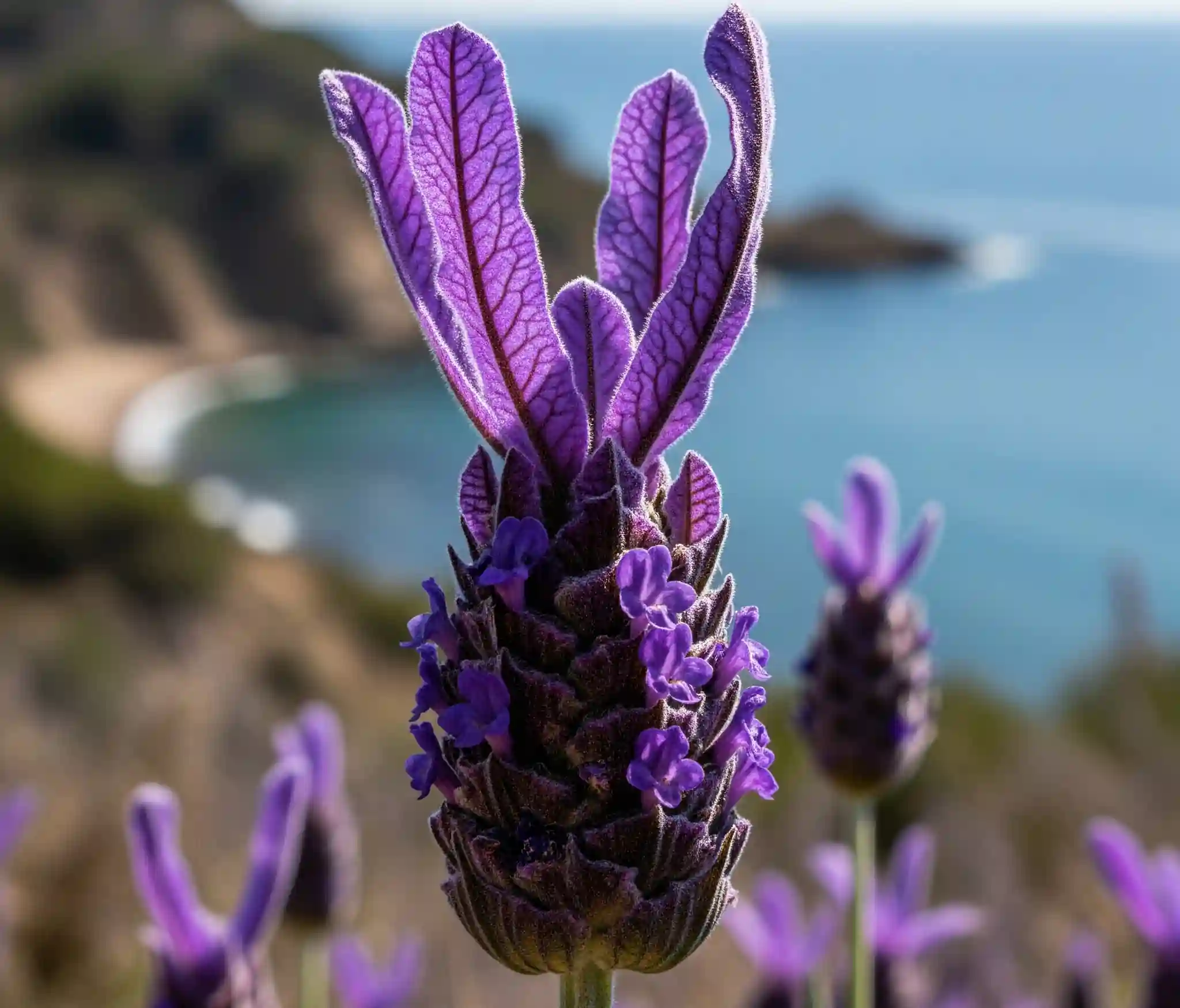
France is where the refined, high-altitude lavender grows. Spain is where the wild, rugged lavender grows. The Spanish landscape — from the Pyrenees to the sun-scorched plains of Andalusia — is home to several powerful and historically important lavender species that are markedly different from their French counterparts.
Lavandula stoechas: Spanish Lavender
This is the most visually distinctive lavender in existence. The large, showy purple bracts — often called “rabbit ears” or “butterfly wings” — that perch on top of its pineapple-shaped flower heads make Lavandula stoechas unmistakable. It grows abundantly along Spain’s coastal regions on acidic, sandy soils, in the garrigue scrublands of the Mediterranean littoral, and throughout the Iberian Peninsula’s lower elevations.
The name “stoechas” itself is ancient — it derives from the Greek “Stoechades,” the name the ancient Greeks gave to the islands off the French and Spanish coasts (modern day Îles d’Hyères) where this species was first collected. Its documented use stretches back to Dioscorides and Pliny, who described it as a valuable medicinal plant in the first century AD.
For the gardener, L. stoechas behaves quite differently from L. angustifolia. It prefers neutral to slightly acidic soil rather than the alkaline conditions English lavender demands. It is more tolerant of humidity and heat. It also blooms earlier in spring — sometimes as early as March in mild climates — making it an invaluable early-season source of nectar for pollinators.
Lavandula latifolia: Spike Lavender
Lavandula latifolia, or Spike Lavender, is the other major Spanish species. Unlike the delicate floral scent of L. angustifolia, spike lavender has a sharp, medicinal, camphoraceous odour that makes it highly valued in pharmaceutical and industrial applications but unsuitable for the perfume trade.
Stop missing your zone's planting windows.
Select your US zone and month — get a complete checklist of what to plant, prune, feed, and protect right now.
→ View My Garden CalendarIt grows on the hot, dry, rocky hillsides of Spain’s interior at lower altitudes than True Lavender — typically below 600 metres. Its broad, grey-green leaves (latifolia means “broad-leaved”) and multiple flower spikes make it botanically distinct. Historically, spike lavender oil was widely used as a solvent for artists’ pigments before synthetic alternatives became available, and it remains a component in some traditional oil-based paints today.
Spike lavender is also the parent plant that, when naturally hybridised with L. angustifolia, produces lavandin — the commercially dominant hybrid of the French fields.
The Brihuega Lavender Fields: Spain’s Hidden Purple Landscape
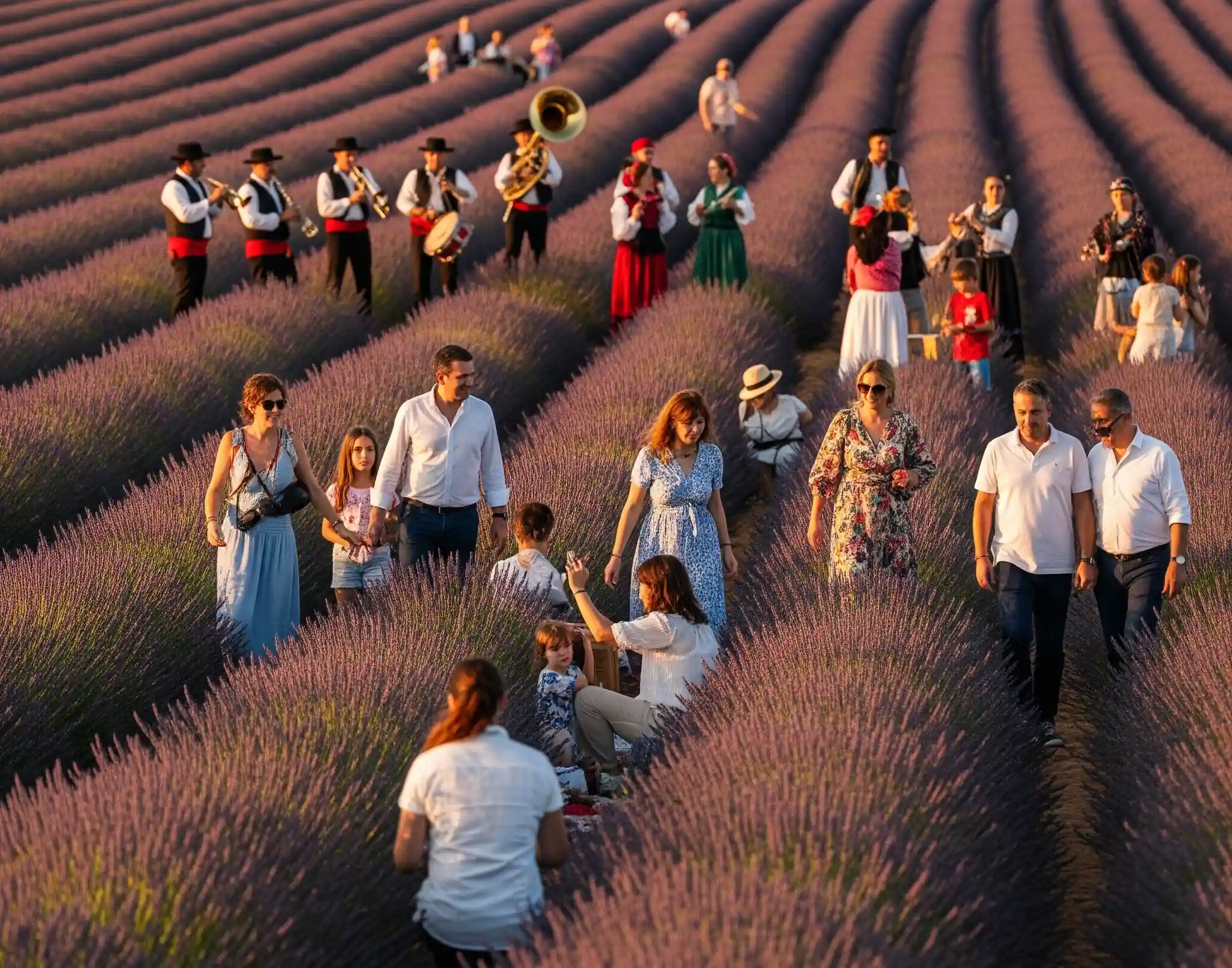
Most visitors to Spain’s lavender landscapes head to Provence first — unaware that one of Europe’s most spectacular lavender landscapes lies in the Spanish interior. The town of Brihuega in Guadalajara province hosts an annual Lavender Festival in July when its surrounding fields of L. latifolia and cultivated varieties are in full bloom. The scale is extraordinary: hundreds of hectares of purple stretching to the horizon, far less visited than Provence, and genuinely breath-taking.
Spain is also the world’s largest exporter of spike lavender essential oil — a fact that surprises many people who associate lavender production exclusively with France. The pharmaceutical and cosmetics industries rely heavily on Spanish spike lavender as a base ingredient.
Italy: The Ancient Origins and Forgotten Heritage
Italy’s role in lavender history is the least celebrated of the three countries, yet it is arguably the oldest. The ancient Romans were among the first civilisations to systematically cultivate and use lavender at scale — and it was largely through Roman conquest and trade that lavender knowledge spread across Europe.
The Roman Legacy
The very word “lavender” almost certainly derives from the Latin lavare, meaning “to wash.” The Romans used lavender extensively in their famous bathing culture — adding it to bath water, using it to scent laundry, and burning it as an insect repellent in the warm Mediterranean summers. Roman legions carried lavender across their empire, introducing it to Britain, Gaul, and the Germanic territories — which is partly why Lavandula angustifolia became so thoroughly naturalised in the British climate that it was eventually renamed “English Lavender.”
Roman physicians used lavender medicinally too. The Dioscorides De Materia Medica — the foundational text of Western herbal medicine, written in the first century AD — describes lavender’s properties in detail, noting its value for digestive complaints, headaches, and as a wound treatment. This medical tradition persisted through the medieval period, with lavender appearing in virtually every monastic herb garden in Europe.
Italian Lavender in the Wild: The Ligurian and Tuscan Populations
Italy has its own wild Lavandula angustifolia populations, primarily in the rocky limestone highlands of Liguria and the Apennines. These populations are botanically distinct from the French Alpine varieties — subtle genetic differences accumulated over millennia of isolation produce slightly different aroma profiles that perfumers and researchers find genuinely interesting.
The Italian Maritime Alps, in particular, harbour some of the most genetically diverse wild lavender populations on the continent. Conservation botanists are studying these populations as potential sources of disease-resistant genetics to help address the phytoplasma epidemic affecting French plantations.
Italy and the Pharmaceutical Tradition
While France dominates the perfume trade and Spain the pharmaceutical market, Italy has historically held a unique position in lavender’s medical applications. The ancient tradition of erboristeria (Italian herbalism) maintained detailed knowledge of lavender’s therapeutic properties through centuries when much of Northern Europe’s herbal knowledge was lost or suppressed. Many of the modern clinical studies examining lavender’s anxiolytic (anti-anxiety) effects — including the research underpinning the licensed oral preparation Silexan — draw on this long Mediterranean tradition of medicinal use.
A Practical Comparison: Growing Each Species Successfully
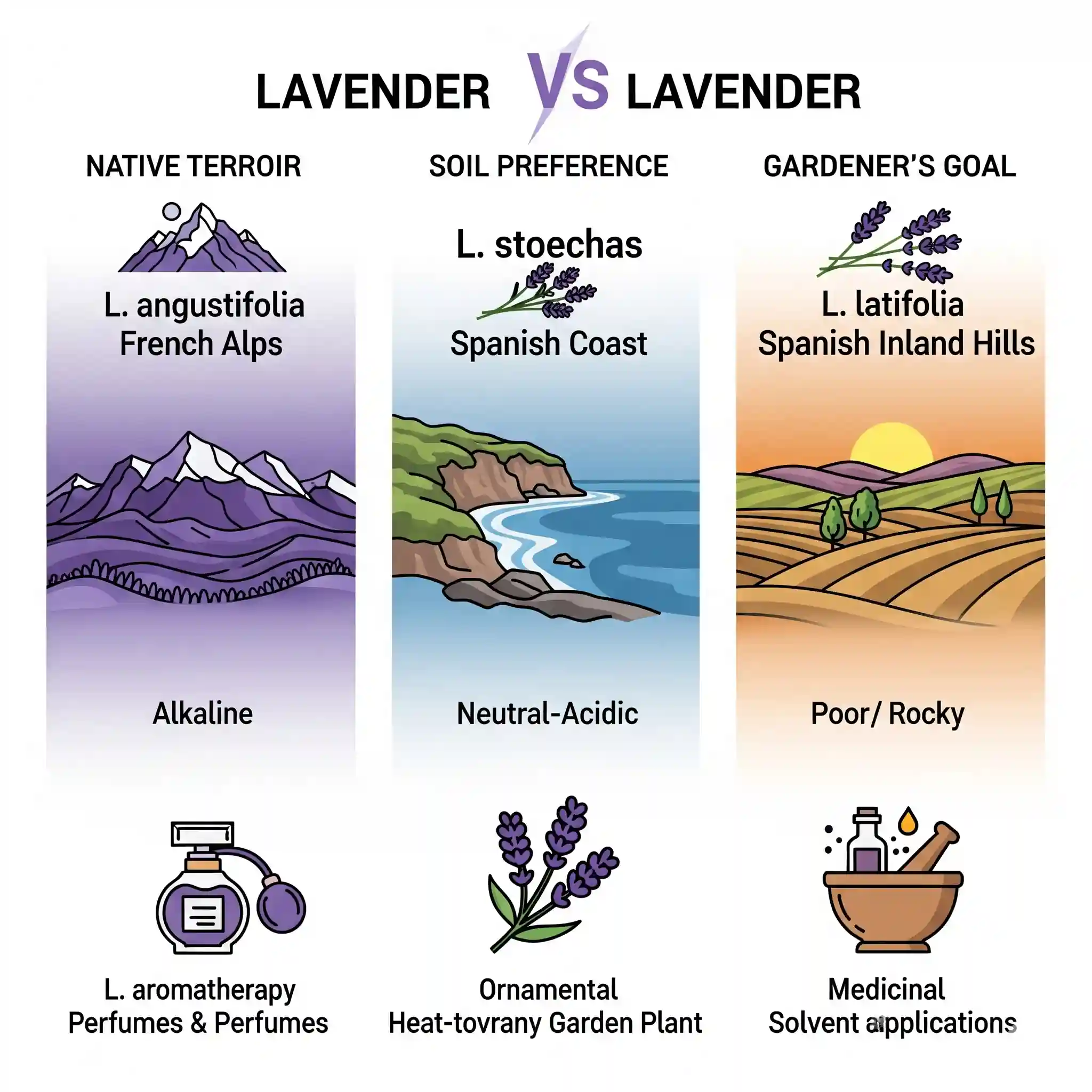
Understanding where each species evolved gives you an immediate, reliable care guide. Here is how to translate that terroir knowledge into practical growing advice:
| Species | Native Terroir | Soil Preference | Gardener’s Goal | Common Mistake |
|---|---|---|---|---|
| L. angustifolia | High, rocky limestone slopes in France and Italy (800–1400m) | Alkaline, poor, and very well-drained | Recreate a lean environment — add grit or sand, full sun, minimal water | Overwatering and planting in rich, fertile soil — causes root rot and weak, leggy growth |
| L. stoechas | Coastal, sandy, and rocky areas of Spain and Portugal | Neutral to slightly acidic, sandy and free-draining | Good airflow and drainage — more tolerant of heat and light humidity than English lavender | Treating it like English lavender and using strongly alkaline soil; cutting too deeply into old wood |
| L. latifolia | Hot, dry hillsides of Spain’s interior at lower altitude | Rocky, poor, free-draining soils | Plant it in the hottest, sunniest position you have — excellent for drought-prone gardens | Buying it for a sweet floral fragrance — its scent is sharp and medicinal, not perfume-like |
The Single Most Important Growing Principle
Across all three species, one principle holds absolutely firm: lavender does not tolerate wet roots. Every species described here evolved in environments where winter rainfall drains rapidly through thin, rocky soils. None of them developed the root architecture to cope with prolonged waterlogging. Root rot (usually caused by Phytophthora or Fusarium) is by far the most common cause of lavender death in gardens — and it is almost always a drainage failure, not a watering failure in the traditional sense.
Before planting any lavender, assess your drainage honestly. On heavy clay soil, either build a raised bed with added grit and sharp sand, or grow in containers where you have full control over the mix. A 1:1 ratio of grit to compost is not too much for L. angustifolia. These are plants that evolved to grow in what most gardeners would consider almost unusably poor soil.
Lavender Through the Ages: Key Moments in Its History
Ancient Civilisations (3000 BC – 400 AD)
Evidence of lavender use appears in ancient Egypt, where it was used in the mummification process — archaeologists have identified lavender residue in ancient burial sites. Ancient Greeks and Romans used it medicinally and cosmetically. The Roman transport network then spread both the knowledge and the plant itself across the known world.
The Medieval Monastery Gardens (500 – 1400 AD)
After the collapse of the Roman Empire, the preservation of herbal knowledge fell largely to Christian monasteries. Lavender was a fixture of every monastic physic garden in Europe. It was used to treat everything from insomnia and headaches to digestive complaints and “melancholy” — what we would now recognise as depression and anxiety. The Benedictine abbess Hildegard of Bingen, writing in the 12th century, gave detailed guidance on lavender’s medicinal applications that remains surprisingly consistent with modern clinical findings.
The Renaissance and the Birth of Modern Perfumery (1400–1700 AD)
The development of modern distillation techniques during the Renaissance transformed lavender from a medicinal herb into a perfumery ingredient of the first order. The establishment of the Grasse perfume industry in France during the 16th and 17th centuries began the systematic cultivation of high-altitude L. angustifolia that continues today. Queen Elizabeth I of England reportedly drank lavender tea for her migraines — a use that reflects the well-established European tradition of lavender as a remedy for headaches and nervous complaints.
The Industrial Era and Commercial Farming (1800s – present)
The 19th century saw lavender cultivation become a genuinely industrial enterprise in Provence. The development of steam distillation equipment allowed large-scale extraction of essential oil. By the early 20th century, Provence was producing lavender oil on a commercial scale sufficient to supply the global perfume and soap industries. The introduction of lavandin hybrids in the mid-20th century — which produce three to five times more oil per hectare than True Lavender — revolutionised the economics of the industry but created the quality stratification that exists today.
Lavender in Your Garden: Choosing the Right Species for Your Climate
The terroir history translates directly into climate suitability. Here is a quick guide:
- Cold, wet climates (UK, Pacific Northwest, northern Europe): Lavandula angustifolia is your most reliable choice. It evolved in alpine conditions with cold winters and is the hardiest species available. Choose varieties like ‘Hidcote’, ‘Munstead’, or ‘Vera’ for proven hardiness. Drainage is still critical — amend heavy soils generously.
- Mild, Mediterranean-type climates (California, Australia, Southern Europe): All three species will grow, but L. stoechas and L. latifolia will thrive in the heat in ways that L. angustifolia may not. L. stoechas in particular loves these conditions and will bloom almost year-round in a frost-free climate.
- Hot, humid climates: This is genuinely difficult territory for lavender. Your best bet is L. stoechas with excellent drainage and airflow. Avoid any situation where humidity settles around the foliage for extended periods — this promotes the fungal diseases that kill lavender in humid conditions. Raised beds and gravel mulches help significantly.
- Containers in any climate: Growing in containers gives you total control over drainage and soil pH, making it possible to grow lavender successfully in climates that would otherwise be marginal. Use a very free-draining mix (at least 30% perlite or horticultural grit) and terracotta pots that breathe and evaporate moisture through their walls.
Frequently Asked Questions
What is the difference between English lavender and French lavender?
The names are botanically misleading. “English lavender” (Lavandula angustifolia) actually originates from the alpine regions of France and Italy — it was simply grown so extensively in England that the name stuck. “French lavender” most commonly refers to Lavandula stoechas with its distinctive rabbit-ear bracts, though the term is sometimes also applied to lavandin. L. angustifolia is hardier, has a sweeter fragrance, and tolerates colder winters. L. stoechas is more heat-tolerant, flowers earlier, and needs slightly different soil conditions.
Why does my lavender smell different from the one in the shop?
Because it almost certainly is a different species or hybrid. The majority of commercial lavender products use lavandin (Lavandula x intermedia) oil, which has a sharper, more camphoraceous scent. Fine lavender oil from L. angustifolia grown at high altitude in France has a sweeter, more floral, more complex scent profile. If you want your garden lavender to match the delicate perfume of high-end aromatherapy products, grow L. angustifolia from a reputable seed source or buy named cultivars from specialist nurseries.
Is lavender native to England?
No. Despite the common name “English lavender,” Lavandula angustifolia is not native to Britain. It was introduced by the Romans and later brought back into cultivation by returning Crusaders and Renaissance-era herbalists. It naturalised so well in the English climate, particularly in chalk and limestone areas, that it became thoroughly associated with English cottage gardens — but its origins are firmly Mediterranean.
How long do lavender plants live?
With correct growing conditions and regular pruning, L. angustifolia can live for 20 to 30 years. Most gardeners find plants decline and become unproductive after 10 to 15 years as the woody base enlarges. The key to longevity is annual pruning — cutting back by one-third immediately after flowering prevents the plant becoming a woody, sprawling, unproductive mound. Never cut into old brown wood below the green growth, as lavender does not regenerate from bare wood.
Can I grow lavender from the seeds of a plant I already own?
Yes, but with caveats. Named cultivars like ‘Hidcote’ and ‘Munstead’ are often propagated by cuttings rather than seed because seed-grown plants show genetic variation — some will be slightly different from the parent. This is actually the characteristic that makes French “population lavender” so aromatic (genetic diversity), but it means your seed-grown plants may not be identical to the parent. For most home gardeners, this is not a problem — the variation is subtle. Take semi-ripe cuttings in late summer if you want exact copies of a favourite plant.
Bringing the Mediterranean Home: Practical Tips for Success
The single best thing you can do for your lavender is to study where it comes from and recreate that environment as closely as possible. Here is a practical summary:
- Drainage above everything else. If your soil does not drain within seconds of watering, amend it aggressively before planting. A raised bed or container is always preferable to heavy clay.
- Poor, alkaline soil is a feature, not a problem. For L. angustifolia, add horticultural lime to raise pH if your soil is acidic. A pH of 6.5 to 7.5 is ideal.
- Full sun is non-negotiable. Six hours of direct sun daily is the minimum. More is better.
- Water sparingly. Established lavender survives on rainfall alone in most UK climates. In the first year, water to establish roots, then step back. The greatest risk to lavender is kindness.
- Prune every year. After flowering finishes, cut back by one-third. This single annual task is the difference between a plant that thrives for 20 years and one that becomes woody and straggly within five.
- Match species to site. If your garden is hot and dry, L. latifolia will outperform everything else. If you have a mild coastal climate, try L. stoechas for spectacular spring colour. If you want fragrance and hardiness, L. angustifolia is your foundation plant.
Final Thoughts: Terroir as a Gardening Philosophy
The real lesson of lavender’s history is not about any one plant — it is about the principle of terroir as a gardening philosophy. Every plant that struggles in our gardens is telling us something about the mismatch between where it evolved and where we have put it. Lavender’s story, spread across the alpine peaks of France, the wild coasts of Spain, and the ancient hillsides of Italy, is a vivid illustration of this principle.
When you understand that Lavandula angustifolia evolved to thrive in conditions most gardeners would consider hostile — thin soil, cold winters, blazing summers, minimal water — you stop trying to coddle it and start giving it what it actually needs. That shift in understanding is the difference between a lavender plant that limps along for three years before dying and one that grows into a magnificent, fragrant cloud of purple that fills your garden with the scent of the Mediterranean summer.
Sources
- Cavanagh, H.M.A., and Wilkinson, J.M. Biological Activities of Lavender Essential Oil. Phytotherapy Research, 2002.
- Upson, Tim, and Andrews, Susyn. The Genus Lavandula. Timber Press, 2004.
- INAO (Institut National de l’Origine et de la Qualité). AOP Huile essentielle de lavande de Haute-Provence. INAO.


