

Bindweed Won’t Die? How to Get Rid of It Permanently (Even in Flower Beds)

Pulling bindweed makes it spread. Learn the root biology that makes organic and chemical methods actually work — plus a season-by-season eradication plan.
You pulled it. Three days later it was back. You pulled again, and within a week two new shoots had taken the first one’s place. If bindweed has moved into your garden, that pattern is probably familiar — and deeply demoralising.
The frustration comes from fighting a plant with reserves you cannot see. An established bindweed clump carries root mass extending 20 feet down and 30 feet sideways, packed with enough stored carbohydrates to fuel years of regrowth. Each time you pull or spray the top growth, the plant draws on those underground reserves and sends up a replacement.
Eradication is possible, but it needs three things working together: understanding the root biology (so you stop accidentally making things worse), matching your method to your garden type, and holding to a realistic multi-season timeline. This guide covers both organic and chemical approaches, with specific timing recommendations — including the single most common mistake that almost everyone makes when tackling this weed.
Bindweed is one of the most persistent weeds in North American gardens. For a broader look at identifying the weeds most likely to invade your beds — including annuals you can pull without a multi-year strategy — see our Common Weeds Identification Guide.

Three pre-planned garden beds, free
Stop staring at empty beds: printable plans with exact layouts, plant lists and planting calendars — yours free from the Garden Library.
Why Bindweed Keeps Coming Back: The Root Biology
Killing bindweed without understanding what is happening underground is like trimming a fire’s flames. Here are the six biological facts that explain every method — and every failure.
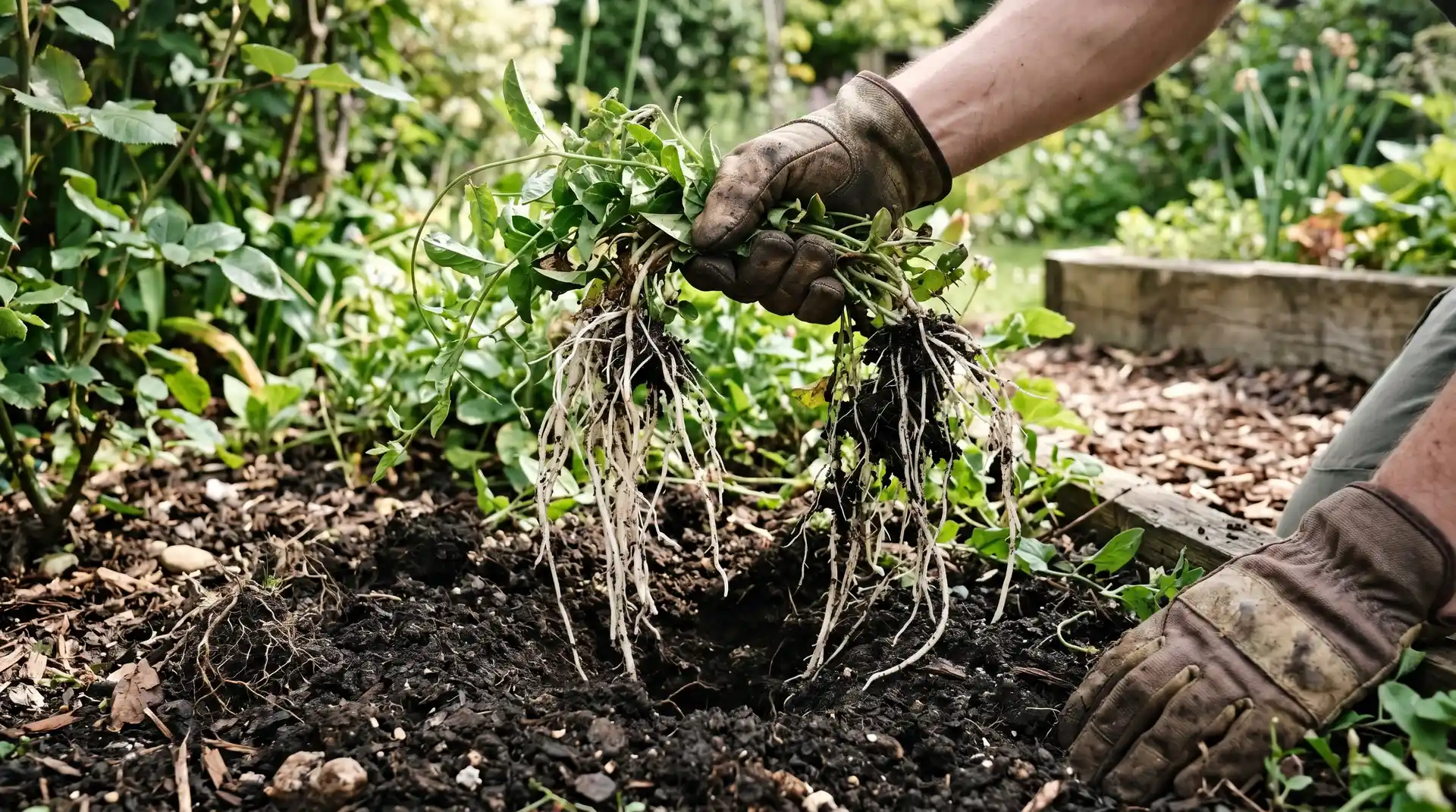
Root depth and mass: Field bindweed roots descend to 20 feet or more. UC IPM research confirms that 70% of the total root mass sits in the top 2 feet of soil — dense enough to make shallow digging feel productive while the deeper root system remains entirely intact. Lateral roots extend 10 feet radially per growing season, which is why bindweed re-emerges far from where you thought you cleared it.
Regeneration from fragments: Root pieces as small as 2 inches regenerate a complete new plant. This is the reason shallow rotovating of an established patch typically makes the infestation worse — it chops the root network into dozens of viable propagules and distributes them across the soil rather than reducing their number.
The autumn digging mistake: Bindweed roots accumulate starch and sugar reserves most intensively in autumn, building up fuel for the following spring. Digging in September or October dislodges energy-rich root fragments — each with full reserves to establish rapidly. Root carbohydrate levels are at their lowest in late spring, around the time bindweed first flowers. That is the window when cultivation does the most damage to the plant’s regenerative capacity.
Allelopathy: Research compiled by eOrganic identifies a further problem: bindweed root exudates suppress germination of surrounding plants. Patches of bare soil around a bindweed infestation are often caused by this allelopathic effect, not just physical competition.
Seed bank longevity: A single bindweed plant produces around 550 seeds, each remaining viable in soil for up to 60 years. After you eliminate the root network, new seedlings will emerge from the stored bank for years. The window to catch them before they establish perennial root buds is three to four weeks post-germination — after that, the plant is perennial and the full eradication challenge begins again.
Field Bindweed vs. Hedge Bindweed: Does It Change Your Strategy?
Two species account for most garden bindweed problems. Both respond to the same suite of controls, but knowing which you have helps set realistic expectations — field bindweed is harder to eradicate due to its deeper root system. If you are unsure whether a plant in your garden is a weed at all, our guide to telling plants from weeds covers the key visual checks.
| Feature | Field Bindweed (C. arvensis) | Hedge Bindweed (C. sepium) |
|---|---|---|
| Flower size | 0.75–1 inch wide, smaller | 1.5–2 inches wide, more showy |
| Leaf shape | Arrow-head with pointed basal lobes | Heart-shaped with rounded lobes |
| Climbing habit | Low and sprawling, climbs 1–3 ft | Climbs aggressively to 6–10 ft |
| Root depth | Up to 20 feet or more | Shallower, typically 6–10 feet |
| Control difficulty | Harder — deeper root system | Slightly easier to eradicate |
| Where it appears | Lawns, open beds, vegetable plots | Hedgerows, fences, shrub borders |
The 3-Season Eradication Framework
The most common reason bindweed survives long-term control efforts is not bad technique — it is quitting too early. Re-sprouts in Year 2 from deep root fragments look discouraging, but they are a sign the method is working: those shoots have depleted reserves and exhaust quickly with consistent removal. Here is what to expect in each season.
Year 1 — Interrupt and Deplete: In early spring, map every bindweed patch before the vines expand and obscure their origin point. From late May through July — when root carbohydrate reserves are at their seasonal low — begin cultivation every 2 to 3 weeks, or every 8 to 12 days for the fastest results according to University of Nevada Reno Extension. Apply your first herbicide treatment at flowering (late June to July) if using chemical controls. In flower beds, lay fabric or cardboard now — the suppression compounds with each passing season.
Year 2 — Press the Advantage: Continue cultivation and herbicide applications at flowering. Expect re-sprouts from root fragments that survived below your cultivation depth — plan for them and remove or treat them promptly. Extend any fabric or mulch barrier two feet beyond where you saw shoots emerge, because lateral roots are already beyond the visible edge of the infestation.
Year 3 — Maintenance and Vigilance: By Year 3, established patches should show near-eradication. Switch to spot treatment for any re-sprouts. The seed bank remains active regardless of root eradication — remove seedlings within three to four weeks of emergence, before they form perennial buds. Oregon State University notes that 3 to 5 years of consistent effort is the realistic range for complete eradication of established stands.
In my experience, the gardeners who succeed long-term are those who treat Year 2 re-growth as confirmation the method is working — not as evidence it has failed.
Organic Methods That Actually Work
Repeated Cultivation
Cultivation starves the root system by forcing the plant to exhaust its carbohydrate reserves sending up new shoots — shoots you remove before they can photosynthesize and restock those reserves. The mechanism only works at sufficient frequency: every 2 to 3 weeks, from late spring through autumn, for a minimum of three to five seasons.
Timing is the factor most articles skip. Cultivation timed at late spring flowering — when root reserves are at their seasonal low — forces the plant to draw down reserves at their most depleted. Autumn cultivation, when those reserves are fully recharged, does comparatively little damage and should be treated as maintenance rather than eradication effort.
Stop missing your zone's planting windows.
Select your US zone and month — get a complete checklist of what to plant, prune, feed, and protect right now.
→ View My Garden CalendarRemove every fragment you dig out. Do not shake the soil back in or leave pieces on the surface to re-root. Dry roots thoroughly before disposal — if you compost, see our guide on how to make compost to understand why fresh bindweed roots and seeds should not go straight onto a cool heap.
Smothering with Fabric or Cardboard
Light exclusion forces bindweed to exhaust its root reserves without replenishing them via photosynthesis. The mechanism is sound, but the timeline catches most people off guard: USU Extension confirms that fabric or black plastic must remain in place for one to five years before complete kill. Cardboard breaks down and needs annual replacement.
For best results, extend coverage at least two feet beyond where you see shoots. The lateral roots are already further than the visible edge. For a direct comparison of options, our weed fabric vs. cardboard guide covers durability, cost, and application in detail.
This method works well for empty beds before planting, but is largely impractical for established flower borders where perennials occupy the ground.
Soil Solarization
For empty beds in summer, clear 6-mil plastic laid flat and left for four to eight weeks raises soil temperatures high enough to kill roots in the top 6 to 8 inches. UNR Extension recommends timing solarization to the hottest, sunniest weeks of the year for maximum effect. Solarization is not a standalone solution for deep-rooted established stands — roots below 8 inches survive — but it dramatically reduces the root volume you need to address through cultivation afterward.
When Organic Methods Alone Are Not Enough
For infestations older than five years in mixed flower borders, organic-only approaches can take seven or more years to achieve full eradication. Fabric is impractical around established perennials, vinegar-based sprays burn foliage but leave the root system fully intact, and repeated hand-pulling alone rarely depletes a mature root system fast enough to outpace its recovery. In these situations, a targeted chemical approach shortens the timeline significantly without requiring removal of valued plants.
Chemical Methods: Matching the Right Herbicide to Your Garden
Systemic herbicides enter through the leaves and translocate via the phloem into the root system — but they do this most effectively when the plant is actively moving carbohydrates downward, which peaks in late summer and early autumn. Research on field bindweed chemical control found that auxin-type herbicides (2,4-D, dicamba, MCPA, and fluroxypyr) achieve 95% control, while glyphosate achieved complete plant destruction in controlled trials.
The practical implication: glyphosate applied at full bloom (late June to August) achieves the highest translocation into root tissue. A single application is rarely sufficient — plan for two to three applications per season during the first two years.
| Garden Context | Best Herbicide Options | Timing | Key Restriction |
|---|---|---|---|
| Lawn or turf | 2,4-D, dicamba, or quinclorac products (SpeedZone, Weed Free Zone) | May through August | Safe for grass; quinclorac most effective in turf |
| Open bed, no desirables nearby | Glyphosate 2% solution | Late June–August at flowering | Non-selective — use a cardboard shield for any nearby plants |
| Flower bed with established perennials | Glyphosate, painted directly onto leaves with a brush | Flowering period | Never spray; direct application only |
| Vegetable garden | Fabric, cardboard, and hand removal only | Spring through summer | No systemic herbicides near edibles |
| Fence line or path edge | Glyphosate plus dicamba combination | Late summer through fall | High drift risk — shield all neighbouring plants |
Protecting pollinators: OSU recommends treating before bindweed flowers fully open, or applying in the early morning or evening when bee activity is lowest. Bindweed flowers attract native bees — timing applications carefully matters even when treating a weed.
A note on picloram: Some extension guides list picloram (Tordon) for field bindweed control. It is a restricted-use pesticide, legal only for licensed applicators in most states, and should not be considered a home garden option. For residential use, 2,4-D, dicamba, and glyphosate are the appropriate choices.
Preventing Bindweed from Coming Back
After successful eradication of the root system, the seed bank is the remaining long-term threat. A single plant produces around 550 seeds that remain viable for decades — seedlings will continue emerging for years even after all root tissue is gone.
- Remove seedlings within three to four weeks of emergence. At this stage, perennial root buds have not yet formed, and the plant can be pulled or hoed cleanly. Wait longer and you restart the full eradication process.
- Inspect new topsoil, compost, and plant divisions before introducing them to your garden. Contaminated material is the most common re-introduction vector for bindweed.
- Never allow it to set seed. One flowering plant that completes its cycle adds 550 seeds to a bank that persists for 60 years.
- Maintain dense planting. Bare soil is an open invitation. Ground well covered by established plants gives bindweed seedlings less opportunity to establish.
- Skip edge barriers. Plastic or metal edging does not stop bindweed — roots travel 20 feet down and pass under any reasonable barrier depth. Focus on monitoring and early seedling removal instead.
Frequently Asked Questions
Will pulling bindweed make it worse?
Shallow pulling without removing the root does not directly worsen the infestation, but it accomplishes very little. Any root fragment left in the soil — including pieces as small as 2 inches — generates a new plant. The correct approach is deeper cultivation timed to coincide with the plant’s low-energy state in late spring and early summer, removing and disposing of all fragments.
How long does it really take to eradicate bindweed?
Oregon State University Extension cites 3 to 5 years of consistent effort as the realistic range for established stands. Seedlings caught within their first four weeks can be eliminated in a single season. Established patches with mature root networks require the multi-season approach described here — shortcuts tend to result in resurgence rather than eradication.
Can I compost bindweed?
Fresh bindweed roots and seeds can survive a cold or cool compost heap and resprout or germinate when the compost is applied to beds. Hot composting (above 130°F consistently throughout the pile) will kill them, but if you are not confident your heap reliably reaches those temperatures, bag and bin the material instead.
Does bindweed harm other plants?
Yes, in two ways. It climbs and smothers neighbouring plants by blocking light. Its root exudates are also allelopathic — they suppress germination of surrounding plants, which is why bare patches often appear where bindweed is established. Prompt control protects the rest of your garden from both effects.
Sources
- UC IPM Pest Notes — Field Bindweed (cited inline)
- eOrganic — Field Bindweed: Why it’s so Hard to Manage (cited inline)
- University of Nevada Reno Extension — Managing Field Bindweed (cited inline)
- Oregon State University — Controlling perennial bindweed takes persistence (cited inline)
- USU Extension — Tips on Controlling Bindweed (cited inline)
- OSU SolvePestProblems — Field Bindweed (cited inline)
- UC IPM — Field Bindweed, Home and Landscape
- PubMed — Vegetative reproduction and chemical control of field bindweed (Convolvulus arvensis)


