

Container Vegetable Gardening: 15 Crops That Produce More Per Square Foot Than a Raised Bed

Learn which vegetables thrive in containers, the right pot sizes, and pro techniques — fabric grow bags, self-watering planters, and NPK stage-shifting — for a big harvest.
Most container vegetable gardening failures come down to three mistakes: wrong container size, garden soil instead of potting mix, and watering on a fixed schedule rather than reading the plant. Fix those three things and a 10-square-foot patio can produce enough tomatoes, peppers, and greens to cut your grocery bill from June through October.
Container gardening is not a compromise forced on people without yards. For warm-season crops, it is genuinely superior in one key way: containers warm faster in spring than in-ground soil, which means tomatoes and peppers planted in 10-gallon grow bags can go into fruit production weeks ahead of their ground-planted counterparts at the same latitude. Add full control over soil quality, zero soilborne disease carryover, and the ability to chase sunlight across a patio, and containers become a legitimate first choice — not a fallback.
This guide covers what to grow, what sizes to use, how to feed and water, and the specific techniques that separate mediocre container harvests from exceptional ones.
Why Containers Can Outperform the Ground for Vegetables
The root zone temperature advantage is real. Container soil in black or dark fabric bags sitting on a sun-warmed patio reaches 65°F — the minimum for tomato root function — days to weeks before the surrounding soil does after last frost. Peppers, which need 70°F soil to actively grow, benefit even more. The result is earlier fruit set and a longer effective growing season without using a single season-extension device.

Three pre-planned garden beds, free
Stop staring at empty beds: printable plans with exact layouts, plant lists and planting calendars — yours free from the Garden Library.
Beyond temperature, containers give you three advantages you cannot replicate in a garden bed:
- Complete soil control. You choose the potting mix, pH, and drainage characteristics. If your yard has compacted clay or sandy loam that drains like a sieve, none of that matters — your container soil is exactly what you put in it.
- No disease carryover. Soilborne pathogens like early blight, Fusarium wilt, and root knot nematodes accumulate in in-ground beds after repeated plantings of the same crop. A container gets fresh potting mix each season.
- Portability. You can move plants out of a forecast hail storm, position them to catch morning sun in summer, and bring frost-sensitive pots inside when an early cold snap threatens in September.
Choosing Your Container: Size, Material, and Type
Container selection is the decision with the highest yield impact. Undersized containers are the single most common reason container tomatoes produce six fruits instead of sixty.
Container Sizes by Plant Type
According to Wisconsin Horticulture Extension, small plants — leaf lettuce, spinach, radishes, green onions — need a minimum of 2 gallons and 4 to 6 inches of depth. Large fruiting plants — tomatoes, peppers, eggplant, squash, cucumbers, and bush beans — need a minimum of 5 gallons and 12 to 18 inches of depth. Penn State Extension is more specific for tomatoes: a 20-inch-wide pot is the minimum for full-size indeterminate varieties, with pots at least as tall as they are wide. For peppers and eggplant, 14-inch pots work.
A practical note from University of Maryland Extension: large plastic containers filled with moist growing medium and a mature tomato plant can weigh close to 100 pounds. If you need to move them, buy plant caddies with locking wheels before you fill them — not after.
Plastic vs. Fabric Grow Bags: The Air Pruning Advantage
Fabric grow bags produce better vegetable harvests than equivalent-volume plastic pots because of a process called air pruning — and understanding the mechanism explains why the size difference between 5-gallon and 10-gallon bags matters so much for tomatoes.
In a plastic pot, roots grow outward until they hit the container wall. With nowhere to go, they turn and circle the inside of the pot, creating a dense spiral of large structural roots that compete for the same limited space. Nutrient and water uptake happens through fine feeder roots, and a root-bound plant has proportionally fewer of them.
In a fabric grow bag, when roots reach the fabric edge, they encounter the drier, air-exposed zone at the surface. Sensing this air boundary, they stop elongating — and instead, the plant generates new feeder roots branching back inward. The result is a densely fibrous root system with far more surface area for nutrient absorption. Grow bags also regulate root zone temperature: excess heat escapes through the breathable fabric, while plastic traps heat and can push root zone temperatures above the optimal 65 to 75°F range on hot summer afternoons.
For tomatoes, peppers, and cucumbers — the crops that benefit most from a large, efficient root system — fabric grow bags are the better choice. VIVOSUN 5-gallon fabric grow bags work well for peppers and compact tomatoes; for full-size indeterminate tomatoes, use 10-gallon grow bags for the best yield.
Self-Watering Containers: How the Sub-Irrigation System Works
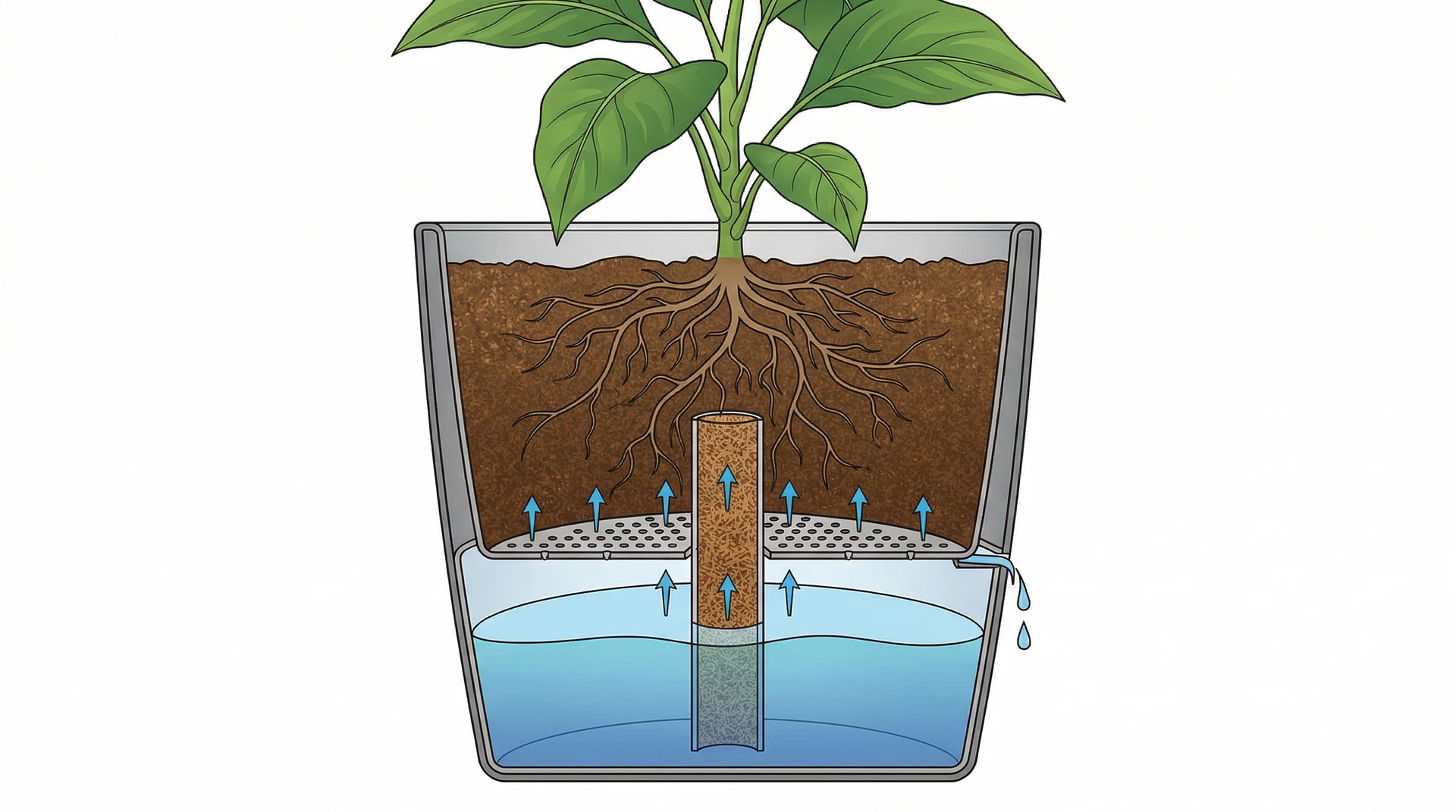
Self-watering containers look like deep planters but function as sub-irrigation systems. The growing medium sits on a perforated platform above a sealed water reservoir at the base. Roots grow down through the medium and directly into the standing water; the rest of the growing medium draws moisture upward through capillary action, keeping the root zone consistently moist without surface watering.
The key design element — and the one most descriptions omit — is the air gap between the water surface and the bottom of the growing medium. This gap is not wasted space. It ensures the lower portion of the root zone has access to oxygen even while the roots directly below are in contact with the reservoir. Without it, roots would sit in saturated anaerobic conditions and die from oxygen deprivation. An overflow hole at the side wall of the reservoir prevents water from rising high enough to eliminate this gap.
The practical benefit is significant: rather than checking soil moisture and watering daily (or twice daily in August), you refill the reservoir every 3 to 7 days depending on plant size and temperature. University of Maryland Extension researchers, who developed a bucket-based sub-irrigated planter design, found that the system conserves water by eliminating surface runoff and reducing evaporation from the soil surface. Self-watering raised bed planters work especially well for lettuce, herbs, and peppers.
Container Size and Variety Quick-Reference Table
| Vegetable | Min Container | Best Varieties for Containers | Notes |
|---|---|---|---|
| Cherry tomato | 5 gal / 10 in deep | Tiny Tim, Tumbling Tom, Sun Gold | 10 gal for best yield; cage before planting |
| Full-size tomato | 10 gal / 18 in deep | Patio, Bush Early Girl, Celebrity | 20-in wide minimum; determinate preferred |
| Peppers | 5 gal / 14 in wide | Lady Bell, Gypsy, Crispy, jalapeño | Heat lovers — containers warm faster in spring |
| Eggplant | 5 gal | Fairy Tale, Hansel, Ichiban | Full sun; compact varieties best |
| Lettuce / mesclun | 2 gal / 6 in deep | Black Seeded Simpson, Oak Leaf, Tom Thumb | Cut-and-come-again; reseed every 3–4 weeks |
| Spinach | 2 gal | Bloomsdale, Tyee, Space | Cool-season; bolt-resistant varieties in heat |
| Kale / Swiss chard | 2 gal | Dwarf Blue Curled Kale, Bright Lights chard | Harvest outer leaves; plant lasts all season |
| Bush beans | 5 gal | Blue Lake Bush, Provider, Contender | Self-pollinating; no support needed |
| Cucumbers | 5 gal | Bush Pickle, Patio Snacker, Spacemaster | Train up a trellis or balcony rail to save space |
| Carrots | 3 gal / 12 in deep | Danvers, Thumbelina, Little Finger | Short varieties only; thin to 2–3 in apart |
| Radishes | 1 gal / 6 in deep | Cherry Belle, Easter Egg, French Breakfast | Ready in 25–30 days; reseed continuously |
| Strawberries | 2 gal / 8 in deep | Albion, Seascape, Eversweet (day-neutral) | Hanging baskets or window boxes work well |
| Basil / herbs | 1–2 gal | Genovese, Sweet Thai, Spicy Globe | Mix with tomatoes in large container |
Skip entirely in containers: sweet corn, full-size watermelon, winter squash, and standard-size zucchini. These require root systems too large to produce satisfactorily in any practical container.
The Best Vegetables to Grow in Containers
Tomatoes

Tomatoes are the most rewarding container vegetable when grown correctly — and the most disappointing when container size is wrong. For balconies and small patios, determinate (bush) varieties are the practical choice: they reach a fixed height of 2 to 4 feet, set fruit, and complete their cycle without the staking and pruning that indeterminate varieties require all season long.
For the smallest spaces, Tiny Tim is a micro-dwarf variety that tops out at 10 to 12 inches tall and 14 inches across in a pot — genuinely suited to a single 1-gallon container or a windowsill planter. It produces clusters of ½-inch cherry tomatoes prolifically from midsummer onward. For 5-gallon containers, Tumbling Tom produces cascading stems loaded with cherry tomatoes and does well in hanging baskets. If you have room for 10-gallon grow bags, Patio and Bush Early Girl give you full-size slicing tomatoes with manageable plant height.
Stop building garden beds by guesswork.
Drag and drop plants into your raised bed grid — see companion pairs, spacing, and full layout before you dig.
→ Plan My Garden LayoutSet the cage or stake before filling the container with potting mix — trying to push a stake through a root-filled container later will damage the root system. For everything you need to grow tomatoes well from transplant to harvest, see our complete tomato growing guide.
Peppers
Peppers may actually perform better in containers than in the ground for gardeners in zones 5 and 6, where soil temperatures in May rarely reach the 65 to 70°F peppers need to begin active root growth. A 5-gallon container on a south-facing patio reaches that temperature weeks earlier, which translates directly into earlier fruit production.
Sweet bell peppers, compact hot peppers (jalapeño, cayenne, Serrano), and ornamental chiles all grow well in 5-gallon containers. Two plants per container is the Illinois Extension recommendation for compact varieties like Lady Bell, Gypsy, and Crispy. Like tomatoes, they are long-season crops — plan to fertilize every two weeks from first flower to final harvest.
New to this plant? how to grow in pots covers all the basics.
Lettuce and Leafy Greens
Leafy greens are the most forgiving and fastest-producing container vegetables. A 2-gallon container of mesclun mix planted in late March can be harvested within four weeks. Unlike fruiting vegetables that need 6 to 8 hours of direct sun, lettuce, spinach, and Asian greens thrive with just 3 to 5 hours — making them the right choice for partially shaded balconies that cannot support tomatoes or peppers.
The key technique for maximizing leafy green production is cut-and-come-again harvesting: take outer leaves at the base while leaving the growing center intact, and the plant regrows. Pair this with succession planting — sowing new seeds every 3 to 4 weeks in the same or additional containers — and a single balcony setup can provide continuous salad greens from April through June and again from September through November.
Herbs
Basil, chives, parsley, thyme, and oregano all grow well in 1 to 2-gallon containers and benefit from regular harvesting that prevents bolting. Basil belongs in every tomato container: planted around the base of a tomato in a large pot, it deters aphids, whiteflies, and spider mites while benefiting from the partial afternoon shade the tomato canopy provides. Our basil growing guide covers variety selection, pinching for bushy growth, and when to harvest.
Strawberries
Day-neutral varieties — Albion, Seascape, and Eversweet — are the right choice for containers because they produce fruit continuously from late spring through fall regardless of day length, unlike June-bearing types that fruit once. They grow well in hanging baskets, window boxes, and terra cotta strawberry planters with pockets. Keep containers consistently moist: strawberry roots in containers dry out faster than any other common container vegetable because of the high surface-area-to-volume ratio in shallow planters. For a complete guide to strawberry varieties and care, see our strawberry growing guide.
Cucumbers and Bush Beans
Compact cucumber varieties — Bush Pickle, Patio Snacker, Spacemaster — produce a full crop in a 5-gallon container when given vertical support. Run a string or wire from the container to a balcony rail or trellis panel and train the vines upward: this keeps fruit clean, improves air circulation (reducing powdery mildew), and makes harvest easier. For more on vertical growing strategies, see our vertical gardening guide.
Bush beans self-pollinate and need no support, making them one of the most hands-off container crops. Blue Lake Bush and Provider both produce heavily in 5-gallon containers. Plant beans in two or three containers two weeks apart for a continuous harvest rather than a single glut.
Potting Mix: Why Garden Soil Fails and What to Use Instead
Never use garden soil in containers — not even high-quality garden soil. In a container, the absence of earthworms, freeze-thaw cycles, and root-following channels means soil particles compact together over watering cycles, gradually eliminating the pore space roots need for oxygen. Compacted container soil develops surface crust that repels water rather than absorbing it, channeling water down the container walls and out the drainage holes without ever wetting the root zone.
Use a quality soilless potting mix. According to Wisconsin Horticulture Extension, commercial potting mixes are preferred because they are lightweight, high in organic matter, and well-drained, and they come free of weed seeds and soil pathogens. Look for mixes containing perlite or vermiculite (for drainage and aeration) and some form of slow-release fertilizer. If your potting mix does not contain fertilizer — Illinois Extension notes that some do not — add a balanced slow-release granular at planting time.
A tested DIY recipe from UNH Cooperative Extension (per bushel): mix 1 bushel of vermiculite with 1 bushel of peat moss, then add 1¼ cups of dolomitic limestone, ½ cup of 20% superphosphate, and 1 cup of 5-10-5 fertilizer. For an organic version, combine equal parts vermiculite, peat moss, and high-quality compost, adding 0.6 oz blood meal, 0.4 oz rock phosphate, and 0.4 oz greensand per gallon.
You might also find gardening gifts 2026: gift helpful here.
Important preparation step: soilless mixes are often very dry from the bag and hydrophobic until wetted. Soak the mix with water at least a day before planting — or submerge the filled container in a tub of water for 20 minutes to ensure even hydration. Once dry potting mix repels water in the container, it channels water along the container wall rather than into the root zone.
For a pre-mixed option, FoxFarm Ocean Forest potting mix is a well-balanced, worm-casting-enriched mix with a pH of 6.3 to 6.8 — in the ideal range for most vegetables — and enough slow-release nutrients to carry transplants through their first 4 to 6 weeks without additional fertilizer.
Do not add lime, wood ash, or gypsum to commercial growing media. University of Maryland Extension advises against this: commercial mixes are already pH-adjusted, and adding these materials disrupts the balance.
Watering Container Vegetables: The Finger Test Over Fixed Schedules
Container soil has no surrounding reservoir of water to draw from. Once the potting mix dries out, there is nothing left — root cells begin to desiccate within hours in hot weather. At the same time, consistently saturated soil blocks oxygen from roots, and saturated bacteria begin converting plant-usable nitrate into gaseous nitrogen that escapes to the atmosphere, a process UMN Extension identifies as denitrification. The goal is consistent moisture — never bone dry, never waterlogged.
The finger test is more reliable than any schedule. Push your finger into the potting mix to ¼ inch depth. If it’s dry there, water thoroughly — until water runs freely from the drainage holes. If it’s still moist, wait. In May and June, this typically means watering every other day. In July and August during hot, dry weather, plan on watering at least once daily, and sometimes twice for large fruiting containers. Smaller containers dry out faster than large ones, and terra cotta dries significantly faster than plastic or fabric.
Additional tips that matter:
- Water at the base, never on leaves. Wet foliage is the primary driver of fungal disease on tomatoes and cucumbers in containers.
- Empty saucers after watering. Standing water in a saucer keeps the drainage holes submerged and creates the anaerobic root zone you’re trying to avoid.
- Containers near buildings do not receive rain. An eave or overhang above a patio means your containers get zero rainfall no matter how much falls — account for this.
- Rehydrate shrunken media. If potting mix has pulled away from the container walls, slowly pour water in rings around the edge until the media rehydrates and returns to contact with the walls. Or submerge the container halfway in a bucket of water until the surface is moist.
Fertilizing Container Vegetables: The NPK Stage Shift
Containers leach nutrients far faster than garden beds. Every watering event pushes water-soluble minerals down through the potting mix and out the drainage holes. A tomato or pepper grown in a container from transplant to final harvest in a 10-gallon pot may receive 50 to 100 gallons of water across the season — each gallon carrying a fraction of the nutrient charge out with it. This is why Penn State Extension states clearly that container plants require more fertilizer than in-ground plants, not less.
The strategy that works is a two-stage approach tied to the plant’s growth phase:
Stage 1 — Establishment to first flower. Mix a slow-release granular fertilizer into the potting mix at planting. After 3 to 4 weeks (when the slow-release supply begins depleting), add liquid fertilizer weekly. UNH Cooperative Extension recommends 1 oz of 20-20-20 per 4 gallons of water, or 1 to 2 tablespoons of fish emulsion per gallon. At this stage, balanced to slightly nitrogen-forward nutrition drives root development and canopy growth — the plant is building the structure it will need to carry fruit.
Stage 2 — First flower to harvest. When tomatoes, peppers, or cucumbers begin setting flowers, switch to a fertilizer formulation higher in potassium and phosphorus relative to nitrogen — a tomato food or bloom-booster formula. Potassium regulates the stomata that control water and carbon dioxide exchange, and it directs the plant’s energy toward fruit development rather than vegetative growth. Phosphorus supports root development and the flower-to-fruit conversion process. Continuing to push a high-nitrogen fertilizer at this stage is the mechanism behind the common complaint of “lots of foliage, very little fruit.” According to UMN Extension, fruiting crops need this phosphorus- and potassium-forward nutrition to produce a continuous harvest.
For long-season crops — tomato, cucumber, eggplant, and pepper — University of Maryland Extension recommends light fertilization every two weeks throughout the fruiting period. For leafy greens, nitrogen-forward liquid fertilizer applied every 2 to 3 weeks throughout the season supports the continuous leaf production you’re harvesting.
Companion Planting in Containers
Containers are easier to companion-plant than beds because you control exactly what goes in each pot. The principle is pairing plants with compatible sun, water, and root-depth requirements so they do not compete. For a complete guide to companion combinations across the vegetable garden, see our companion planting guide.
Three combinations that consistently work in containers:
- Tomato + basil. Plant 2 to 3 basil plants around the base of a tomato in a 10-gallon container. Basil repels aphids, spider mites, and whiteflies — pests that commonly colonize tomato leaves. The tomato canopy provides partial afternoon shade that slows bolting in hot weather, extending basil’s useful season.
- Lettuce under tall tomatoes or peppers. Lettuce in the same large container benefits from the partial shade a mature tomato provides in midsummer, reducing bolting. The lettuce acts as a living mulch — its canopy shades the soil surface, reducing moisture evaporation from the potting mix and cutting watering frequency.
- Peppers + thyme or chives. Both herbs repel common pepper pests including aphids and spider mites. They share identical water and sun requirements, so container management is simple.
- Bush Bean vs Pole Bean: Which Type Gives a Better Harvest?
One combination to avoid: fennel. It inhibits the growth of most vegetables and herbs including tomatoes, peppers, and basil through allelopathic root secretions. Keep fennel in its own container, well separated from other crops.
You might also find top 20 containers helpful here.
Extending the Season and Maximizing Harvests
A well-planned container garden runs from March through November in most of the US — not just June through September. The key is rotating cool-season and warm-season crops through the same containers.
Spring window (March–May): Start with cool-season crops — lettuce, spinach, arugula, radishes, and cilantro — in containers before last frost. These tolerate temperatures down to 28°F (-2°C) and grow actively in cool soil. As warm-season crops (tomatoes, peppers) go in after last frost, the cool-season containers continue producing in shadier spots.
Summer window (May–September): Fruiting crops take the prime sun positions. Use succession planting for herbs and greens: sow new seeds in a spare 2-gallon container every 3 to 4 weeks for continuous production. Illinois Extension notes that staggering leafy green plantings at 1 to 2 week intervals extends harvests through the season without large gaps.
Fall extension (September–November): As nighttime temperatures drop, move warm-season pots inside on forecast frost nights — this alone can extend the harvest by 4 to 6 weeks. Cool-season crops planted in August will produce through the first hard freezes and, in zones 7 to 9, through December.
If vertical space is available, trellising climbing crops like cucumbers, pole beans, and even compact squash varieties doubles the productive square footage of a given container area. See our vertical gardening guide for trellis design and training techniques suited to container setups.
Frequently Asked Questions
How many tomato plants can I grow in one container?
One plant per container is the correct answer for full-size and indeterminate varieties. For micro-dwarf types like Tiny Tim, one plant per gallon is workable. Crowding two full-size plants into one container results in root competition, increased disease pressure from overlapping canopies, and lower total yield than two separate containers would produce.
Can I reuse potting mix from last season?
Yes, with conditions. Remove spent roots and large plant debris, then refresh the mix by adding 20 to 30% by volume of fresh potting mix or compost. Do not reuse mix from containers where soil-dwelling disease was present (wilting, root rot, or fungal crown rot). Replace potting mix completely every 2 to 3 seasons — compaction accumulates over time even with annual topping-up.
What is the minimum sunlight for container vegetables?
Fruiting vegetables — tomatoes, peppers, eggplant, cucumbers — require 6 to 8 hours of direct sun. Root vegetables — carrots, beets, radishes — need at least 6 hours. Leafy greens — lettuce, spinach, arugula, kale, most herbs — are productive with 3 to 5 hours, making them the right choice for north-facing or partially shaded spaces.
Why are my container tomatoes producing flowers but no fruit?
The most common causes are: (1) temperatures above 90°F or below 55°F at night, which prevent pollen release and viability; (2) too much nitrogen fertilizer relative to potassium and phosphorus, driving vegetative growth at the expense of fruiting; and (3) poor pollination from lack of wind or pollinating insects on a screened balcony — shake the plant gently or use a soft brush on open flowers to transfer pollen manually.
How often should I replace my containers?
Quality fabric grow bags last 3 to 5 seasons. Plastic containers crack from UV exposure after 5 to 8 years depending on quality. Terra cotta is indefinite but may crack in hard freezes if left outdoors — store it empty inside over winter. Self-watering containers with reservoirs should be cleaned annually to prevent algae and mineral buildup in the reservoir.
Sources
- Growing Vegetables in Containers — Wisconsin Horticulture Extension
- Container Vegetable Gardening: Four Keys to Success — Penn State Extension
- Self-Watering Containers — University of Maryland Extension
- Growing Vegetables in Containers — University of Maryland Extension
- Maintaining Container-Grown Vegetables — University of Maryland Extension
- Growing Vegetables in Containers — UNH Cooperative Extension
- Growing Vegetables in Containers — Illinois Extension (UIUC)
- Fertilizing and Watering Container Plants — UMN Extension


