Lavender vs Rosemary: Harvest Uses, Hardiness Zones and Which One Belongs in Your Garden

Quick Comparison: Lavender vs Rosemary at a Glance
Both lavender (Lavandula spp.) and rosemary (Salvia rosmarinus, formerly Rosmarinus officinalis) are aromatic, sun-loving Mediterranean herbs that thrive in similar conditions — yet they are surprisingly different plants. One is famous for its soothing purple blooms and calming fragrance; the other for its piney, resinous scent and indispensable role in the kitchen. Understanding the differences between lavender and rosemary will help you choose the right plant — or decide to grow both.

| Feature | Lavender | Rosemary |
|---|---|---|
| Family | Lamiaceae (mint family) | Lamiaceae (mint family) |
| Genus/Species | Lavandula angustifolia (English); L. stoechas (Spanish) | Salvia rosmarinus |
| Flower colour | Purple, violet, pink, white | Blue, white, pink |
| Mature height | 30–90 cm (1–3 ft) | 60–150 cm (2–5 ft) |
| Hardiness zones (USDA) | Zones 5–9 (English); 7–10 (French/Spanish) | Zones 7–11 |
| Scent profile | Floral, sweet, herbaceous, slightly camphorous | Piney, resinous, peppery, eucalyptus-like |
| Culinary use | Desserts, teas, honey, light savoury dishes | Roasts, marinades, breads, soups |
| Soil preference | Sandy, alkaline to neutral, very well-drained | Sandy to loamy, neutral to slightly alkaline, well-drained |
| Water needs | Low (drought-tolerant once established) | Low to moderate (drought-tolerant once established) |
| Deer resistant? | Yes | Yes |
| Pollinator value | Exceptional (bees, butterflies) | Excellent (especially early bees) |
Appearance: How to Tell Lavender and Rosemary Apart
At first glance, lavender and rosemary can fool a beginner — both grow as woody-based shrubby perennials with narrow, aromatic foliage and small flowers arranged along upright stems. Look more closely, though, and the differences are unmistakable.
Lavender’s Appearance
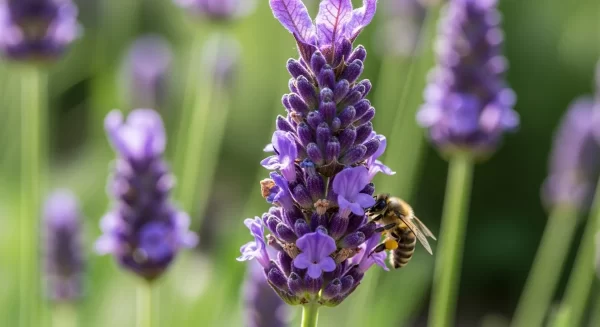
English lavender (Lavandula angustifolia) forms a rounded, mounded shrub typically 45–75 cm (18–30 in) tall. Its leaves are narrow, silvery-grey-green, and covered in fine hairs (trichomes) that give the whole plant a pale, almost frosted look. In summer, slender flower spikes rise 15–30 cm above the foliage, packed with tiny tubular flowers in shades of violet, purple, pink, or white depending on the cultivar. The blooms of popular varieties like ‘Hidcote’ and ‘Munstead’ are a rich, saturated violet-purple — one of the most recognisable colours in any garden.
Spanish lavender (L. stoechas) is easy to identify by its distinctive “rabbit ears” — two large, purple bracts that sit on top of the flower head like a pair of ears, making it look almost tropical compared to its English cousin.

Get a free pre-planned flower bed (vase-worthy from June to frost)
Printable planting plans for a cut-flower bed and a cottage pollinator bed — plant list, spacing, and calendar included.
Rosemary’s Appearance
Rosemary grows larger and more upright than most lavenders, often reaching 90–150 cm (3–5 ft) in warm climates. Its leaves are needle-like, dark glossy green on the upper surface and pale silvery-white underneath — a combination that produces a striking two-tone effect when the plant moves in the breeze. The texture is leathery and resinous, quite different from lavender’s soft, felted foliage.
Rosemary’s flowers are small, two-lipped, and clustered along the stem — typically blue-violet, though white and pink forms exist. They appear in late winter to early spring in mild climates, sometimes re-blooming in autumn. Compared to lavender’s dramatic flower spikes, rosemary flowers are understated, but no less valuable to early-season pollinators.
The quickest identification trick: rub a leaf between your fingers. Lavender smells floral and sweet; rosemary smells piney and resinous. The leaf textures are also distinct — lavender leaves are soft and slightly fuzzy, rosemary leaves are stiff and waxy.
Scent and Flavour: The Sensory Differences
Scent is where lavender and rosemary diverge most dramatically. Both plants contain high concentrations of aromatic essential oils, but their chemical compositions — and therefore their sensory profiles — are completely different.

Lavender’s Fragrance and Flavour
Lavender’s primary aromatic compounds are linalool and linalyl acetate. These create a fragrance that is simultaneously floral, herbaceous, slightly sweet, and faintly camphorous. It is the scent most associated with relaxation and sleep — lavender aromatherapy is one of the most studied botanical interventions for anxiety and insomnia.
In culinary terms, lavender tastes floral and perfumed, with a hint of sweetness and a barely perceptible bitterness. A little goes a long way — overuse quickly makes food taste like soap. It pairs beautifully with honey, cream, citrus, and white chocolate, and appears in classic Provençal herbes de Provence blends alongside thyme, oregano, and savory.
Rosemary’s Fragrance and Flavour
Rosemary’s essential oils are dominated by 1,8-cineole (eucalyptol), camphor, and alpha-pinene — compounds that create a bold, resinous, piney scent with peppery and slightly medicinal undertones. It is a more assertive fragrance than lavender, less universally loved but deeply evocative of Mediterranean cooking.
As a culinary herb, rosemary is powerful and savoury. It holds up to high-heat cooking — roasting lamb, potatoes, and chicken — in a way that lavender cannot. Its robust oils infuse into fats beautifully, making rosemary-infused olive oil, focaccia, and marinades staples of Italian and Greek cuisine. It also pairs well with hearty vegetables like root vegetables and squash.
Growing Conditions: What Each Plant Needs
The good news for gardeners is that lavender and rosemary share broadly similar growing requirements, rooted in their shared Mediterranean origins. Both evolved on rocky, sun-baked hillsides with thin, fast-draining soil — and both will fail in cold, wet, heavy soils.

Sunlight
Both plants demand full sun — at least 6–8 hours of direct sunlight daily. In partial shade, neither will bloom well, growth becomes leggy, and both become vulnerable to the root rot and fungal diseases that are their main killers. Choose the sunniest spot in your garden; a south- or west-facing border is ideal in the UK and Northern Europe.
Soil Requirements
This is arguably the most critical factor for both plants. They must have excellent drainage. Waterlogged soil in winter is the number one cause of death for both lavender and rosemary in temperate climates.
Lavender is particularly demanding about soil pH, preferring alkaline to neutral soil (pH 6.5–7.5). It thrives in sandy or gravelly soil that many other plants find too poor. If your soil is heavy clay, amend it generously with horticultural grit, or grow in raised beds or containers with a gritty compost mix. Avoid fertilising lavender heavily — rich soil produces lush foliage at the expense of flowers and fragrance.
Rosemary is slightly more tolerant of heavier soils, but still requires good drainage. It prefers neutral to slightly alkaline conditions (pH 6.0–7.5) and benefits from grit or sand in heavier soils. Like lavender, it thrives on relative neglect and does not need regular fertilising once established.
Watering
Both plants are drought-tolerant once established, typically after the first growing season. During establishment, water regularly but always allow the soil to dry out between waterings. Once established, most rainfall is sufficient in the UK and similar temperate climates. In prolonged drought, a deep watering once a week is usually adequate.
No more guessing your frost dates.
Enter your US zip code — get your exact last spring frost and first fall frost dates to plan your season.
→ Find My Frost DatesOverwatering is far more dangerous than underwatering for both plants. If in doubt, do less — both lavender and rosemary cope better with dry stress than wet roots.
Temperature and Frost Tolerance
This is where the two plants diverge meaningfully. English lavender (L. angustifolia) is the hardiest lavender, tolerating temperatures down to around -15°C (5°F) when the soil is well-drained. It is fully hardy in UK gardens and USDA hardiness zones 5–8.
Rosemary is generally less cold-hardy than English lavender, reliably surviving to about -10°C (14°F) in well-drained conditions. Standard rosemary is rated for USDA zones 7–11. In zone 6 and colder, it is best treated as an annual or overwintered indoors. The cultivar ‘Arp’ is the hardiest rosemary variety, reportedly surviving to zone 6.
For UK gardeners: English lavender is reliably hardy across the country. Rosemary can be borderline in northern Scotland and exposed upland areas, but survives most UK winters provided drainage is good.
Hardiness Zones: Which Survives Winter Better?
If you garden in a cold climate and can only choose one plant to guarantee survival, English lavender is the safer bet. Here is a zone-by-zone breakdown:

| USDA Zone | English Lavender | Rosemary |
|---|---|---|
| Zone 5 (-29 to -23°C / -20 to -10°F) | Hardy with good drainage and mulching | Usually killed — treat as annual or bring inside |
| Zone 6 (-23 to -18°C / -10 to 0°F) | Hardy, reliable | Borderline — ‘Arp’ cultivar may survive |
| Zone 7 (-18 to -12°C / 0 to 10°F) | Very hardy | Hardy, reliable |
| Zone 8–9 (-12 to -1°C / 10 to 30°F) | Thrives | Thrives |
| Zone 10–11 (above -1°C / 30°F) | Most lavenders struggle in heat and humidity | Thrives |
Note that in zones 10 and 11 — think Southern Florida, Hawaii, tropical climates — the situation reverses. Lavender dislikes high humidity and heat, and struggles where nights stay warm year-round. Rosemary, by contrast, thrives in these warm conditions and can grow into a substantial shrub.
Culinary Uses: Cooking with Lavender vs Rosemary
Rosemary is the far more versatile everyday cooking herb of the two. Lavender is a specialist ingredient that, used correctly, adds extraordinary flavour.
Cooking with Lavender
Culinary lavender — most commonly Lavandula angustifolia — is used in small quantities to perfume sweet and savoury dishes. Classic applications include:
- Lavender honey — drizzle over cheese, yoghurt, or use in baking
- Lavender shortbread and biscuits — a few flower buds in the dough add subtle floral notes
- Lavender lemonade and teas — a refreshing summer drink, widely popular
- Herbes de Provence — the classic Provençal blend includes dried lavender buds alongside thyme and savory
- Lavender-infused cream — for panna cotta, ice cream, and crème brûlée
- Lamb rubs — lavender pairs beautifully with lamb in the Provençal tradition
Use only culinary-grade dried lavender buds or fresh flowers. Avoid lavender that has been treated with pesticides. English lavender (L. angustifolia) has the mildest, most food-friendly flavour; Spanish lavender can taste harsh and medicinal.
They look similar but grow very differently — blueberry vs cranberry explains.
Cooking with Rosemary
Rosemary is one of the most widely used herbs in European cooking, particularly in Italian, French, and Greek cuisines. It withstands heat better than most herbs, making it ideal for:
- Roast lamb, chicken, and pork — tuck sprigs under the skin or into slits in the meat
- Roasted potatoes and root vegetables — a classic combination
- Focaccia and bread — pressed into the dough before baking
- Marinades and infused oils — steep in olive oil for a flavour-packed base
- Soups and stews — add whole sprigs early in cooking and remove before serving
- Skewers — sturdy rosemary stems make aromatic kebab skewers
Use fresh rosemary for raw applications and garnishes; dried rosemary is more potent and better suited to slow-cooked dishes.
Medicinal and Wellbeing Uses
Both plants have long histories in herbal medicine, though modern evidence varies considerably in quality.
Lavender’s Medicinal Uses
Lavender aromatherapy has the strongest evidence base of any herbal intervention for anxiety and mild insomnia. A licensed oral preparation of lavender oil (Silexan) has been shown in multiple randomised controlled trials to reduce generalised anxiety symptoms comparably to low-dose benzodiazepines, without sedation or dependency risk. Topical lavender preparations are widely used in wound care and for minor burns, supported by evidence of antimicrobial and mild analgesic activity.
Common wellbeing uses include:
- Lavender essential oil diffused for relaxation and sleep
- Lavender-filled sleep pillows and sachets
- Dried lavender wands and potpourri for natural fragrance
- Lavender-infused bath salts and body oils
Rosemary’s Medicinal Uses
Rosemary has been used in traditional medicine across Europe and the Middle East for centuries, primarily for digestive complaints, headaches, and as a circulatory stimulant. Modern research has focused on its antioxidant compounds — particularly rosmarinic acid and carnosic acid — which show anti-inflammatory properties in laboratory studies. Rosemary extract is also used commercially as a natural food preservative.
There is emerging research interest in rosemary aromatherapy for cognitive performance — some studies suggest inhalation of rosemary essential oil may improve memory and alertness, though evidence quality is still limited.
Garden Uses and Design
In the garden, lavender and rosemary serve different aesthetic and functional roles, though both are essential Mediterranean-style garden plants.
Lavender in the Garden
Lavender is primarily a flowering ornamental shrub — its purple flower spikes are one of the most visually striking elements in any summer border. Garden uses include:
- Edging and hedges — low lavender hedges along paths are a classic formal garden feature
- Cottage garden borders — lavender is a cornerstone of the English cottage garden style
- Gravel and dry gardens — lavender is a key plant in drought-tolerant, low-maintenance planting schemes
- Container growing — lavender grows well in terracotta pots with a gritty compost mix
- Cut flowers and drying — harvest stems just as flowers open for the best fragrance and longest vase life
Pruning is essential for longevity. Pruning lavender in spring — removing the previous year’s growth down to just above the woody base — prevents the plant from becoming leggy and woody, extending its productive life considerably.
Rosemary in the Garden
Rosemary is both ornamental and functional. In warm climates it grows into a substantial shrub that can be trained as a hedge, topiary, or left as a naturalistic specimen. Garden uses include:
- Specimen shrub — in zones 8+, rosemary grows large enough to anchor a mixed border
- Kitchen garden — a permanent feature that supplies fresh sprigs year-round
- Topiary and formal hedging — rosemary takes well to shaping
- Trailing varieties — prostrate rosemary (e.g. ‘Prostratus’) tumbles beautifully over walls and raised bed edges
- Container growing — rosemary thrives in pots; bring inside in zone 6 and below
Companion Planting: What Grows Well with Each?
Both lavender and rosemary are exceptional companion plants, primarily because their strong aromatic oils confuse and deter a range of insect pests.

Lavender as a Companion
Lavender planted near vegetables, roses, and fruit trees deters aphids, whitefly, and other soft-bodied pests. Its flowers attract huge numbers of bees and other pollinators, which improves fruit set across the whole garden. Good companions for lavender include:
- Roses — the classic pairing; lavender’s scent helps deter aphids from roses
- Alliums (ornamental onions) — similarly pest-deterrent, and bloom at a similar time
- Echinacea (coneflower) — shares lavender’s preference for well-drained, open sunny borders
- Salvia — similar Mediterranean origins; visually complementary
- Catmint (Nepeta) — a classic lavender companion in cottage and formal borders
Avoid planting lavender near heavy feeders or plants that need rich, moist soil — the growing conditions are incompatible and lavender will always lose out in competition for nutrients.
Rosemary as a Companion
Rosemary is particularly valued in the vegetable garden, where its strong scent masks the odour of brassicas and other host plants from specialist pests. Plant it near:
- Brassicas — said to deter cabbage moths and cabbage root fly
- Beans and carrots — traditional companion pairings with evidence of pest suppression
- Sage — grows in the same conditions and creates a classic aromatic herb combination
- Thyme and oregano — the Mediterranean herb trio; all share the same cultural requirements
Which Should You Grow? Lavender, Rosemary, or Both?
The honest answer for most gardeners is: grow both. They occupy slightly different niches and offer complementary rewards. But if you can only choose one, here is how to decide.
Choose Lavender If You:
- Garden in USDA zones 5–6 where rosemary isn’t reliably hardy
- Want maximum visual impact in summer — lavender’s purple flower spikes are unmatched
- Are primarily interested in aromatherapy, fragrance, and wellbeing uses
- Want to attract bees and pollinators in high volume
- Are drawn to cottage garden, formal English garden, or Provençal-style planting
- Want dried flowers for fragrance sachets, wreaths, and crafts
Choose Rosemary If You:
- Cook regularly and want a year-round kitchen herb
- Garden in zones 8+ where rosemary can grow large and dramatic
- Want a plant that doubles as a formal hedge or topiary
- Prefer a more evergreen, structural garden plant with year-round interest
- Are building a productive kitchen garden alongside ornamental planting
- Live in a hot, dry climate where lavender struggles with humidity
Growing Both Together
Since lavender and rosemary share almost identical growing requirements — full sun, alkaline to neutral well-drained soil, low water once established, and poor to moderate fertility — they make excellent neighbours in the garden. Plant them together in a Mediterranean-inspired herb garden or gravel border, where their contrasting textures (lavender’s soft grey-green mounds vs rosemary’s dark, upright needles) create year-round visual interest. The complementary fragrance of the two plants together is one of the great sensory pleasures of any summer garden.
For more detailed guidance on growing lavender, including soil preparation, pruning schedules, and troubleshooting common problems, see the complete lavender growing guide at Blooming Expert. You can also explore lavender plant care in depth, or learn about the different lavender varieties to find the best cultivar for your climate and garden style.
If you’re growing lavender in containers or need guidance on watering lavender correctly, those in-depth guides cover everything you need to avoid the most common mistakes.
Frequently Asked Questions
Can lavender and rosemary be planted together?
Yes — they thrive side by side because they share the same growing requirements: full sun, excellent drainage, poor to moderate soil fertility, and low water once established. They make a classic Mediterranean pairing in herb gardens and gravel borders.
Is lavender or rosemary easier to grow?
Both are relatively undemanding once you meet their core requirement of well-drained soil in full sun. Beginners often find rosemary slightly more forgiving since it tolerates slightly heavier soils. English lavender can be fussier about drainage and soil alkalinity, particularly in wetter climates.
Do lavender and rosemary smell similar?
No — they smell quite different despite both being aromatic Mediterranean herbs. Lavender smells floral, sweet, and calming. Rosemary smells piney, resinous, and invigorating. Rub a leaf from each plant to compare the difference clearly.
Can you cook with lavender the same way as rosemary?
Not interchangeably. Lavender is delicate and floral — best used in small quantities in desserts, teas, and delicate savoury dishes. Rosemary is robust and resinous, built for roasting, grilling, and long-cooked dishes. Substituting one for the other will give very different — and often disappointing — results.
Which herb is better for bees?
Both are exceptional bee plants. Lavender is particularly renowned for its role in supporting honeybees and bumblebees during summer — a single well-established lavender plant in full bloom can have dozens of bees working it at once. Rosemary is especially valuable for early bees in late winter and early spring, when few other flowers are available.
Does lavender or rosemary repel pests?
Both have some pest-repellent properties based on their aromatic oils. Lavender is well-known as a moth repellent — dried lavender sachets in wardrobes are a traditional natural alternative to mothballs. For broader garden pest deterrence, rosemary’s stronger, more volatile scent is often cited as more effective, particularly against cabbage moths and aphids.
Sources
- Koulivand, P.H., Khaleghi Ghadiri, M., & Gorji, A. Lavender and the Nervous System. Evidence-Based Complementary and Alternative Medicine. Hindawi. https://doi.org/10.1155/2013/681304
- Moss, M., Cook, J., Wesnes, K., & Duckett, P. Aromas of rosemary and lavender essential oils differentially affect cognition and mood in healthy adults. International Journal of Neuroscience. Taylor & Francis. https://doi.org/10.1080/00207450390161903
- Royal Horticultural Society. Lavender: cultivation. RHS. https://www.rhs.org.uk/plants/lavender/growing-guide