

5 Mulches That Keep Citrus Trees Healthy — and the Mistake That Causes Root Rot

The wrong mulch placement invites Phytophthora root rot. Compare 5 top picks for citrus trees, learn the correct depth and trunk clearance rules, and avoid the mistake most home growers make.
Most citrus growers eventually hear the advice: mulch your trees. Fewer hear the follow-up: apply it wrong and you will invite the very problem you are trying to prevent.
Citrus roots sit in the top 18 inches of soil, shallow enough to be highly sensitive to moisture fluctuations — but also to water-borne pathogens that thrive when mulch is piled against the trunk. The right mulch in the right place solves five practical problems at once: moisture retention, temperature stability, weed suppression, soil nutrition, and trunk protection. The wrong placement undoes all of it.
This guide covers the five best mulches for citrus trees, the one application rule that determines whether mulch helps or hurts your tree, and several claims you have probably seen repeated elsewhere that do not hold up to university research.
Why Citrus Trees Benefit from Mulch
In their subtropical native habitat, citrus trees grow under a permanent understory of decomposing leaf litter — a natural mulch that never disappears. Home garden citrus on bare, compacted soil faces the opposite: rapid moisture loss, wide daily temperature swings, and far fewer beneficial soil organisms.

Three pre-planned garden beds, free
Stop staring at empty beds: printable plans with exact layouts, plant lists and planting calendars — yours free from the Garden Library.
The practical benefits of mulching stack up quickly:
- Moisture retention: Organic mulch dramatically slows evaporation from the root zone. UF/IFAS researchers studying oak wood chip mulch under citrus trees found measurable improvements in soil moisture retention, reducing the need for irrigation during warm months.
- Temperature stability: Bare soil can swing 21°F or more in daily temperature. A 4-inch wood chip layer cuts that range to roughly 9°F. Stable temperatures protect feeder roots — the fine root hairs that actually absorb water and nutrients — from heat stress even when the canopy looks healthy.
- Weed suppression: Citrus feeder roots extend to the drip line and compete directly with weeds. A 3-inch mulch layer eliminates most annual weed germination without herbicide use.
- Soil nutrition and biology: As organic mulch decomposes, it feeds soil microbes that compete with root pathogens. The UF/IFAS oak mulch study found that after one year of treatment, available potassium and phosphorus in the root zone had increased measurably, and soil biodiversity had improved.
- Trunk protection: String trimmers and lawn mowers cause significant trunk damage in young citrus. A mulched ring around the tree removes the need to bring equipment close to the thin-barked base.
One myth worth addressing before the product list: wood chip mulch does not starve citrus trees of nitrogen. WSU Extension researcher Linda Chalker-Scott reviewed the evidence in detail and found that surface-applied wood chips increase soil nutrient levels over time. The nitrogen tie-up concern applies only when chips are tilled into the soil. Surface mulch creates a slight, localized nitrogen reduction at the mulch-soil boundary — which actually suppresses weed germination — but this depletion does not reach tree roots. It is safe.
The Rule That Overrides Everything: Trunk Clearance
Most mulch advice for citrus ends with “keep mulch away from the trunk.” Almost none of it explains why.
Phytophthora is a water mold — an oomycete, not a true fungus — responsible for both root rot and gummosis in citrus. It reproduces through zoospores: tiny motile spores that swim through liquid water in the soil. When organic mulch sits against the trunk, it keeps the bark at soil level constantly moist. In that moisture, Phytophthora produces oospores, which differentiate into swimming zoospores that move through free water toward plant tissue.
The trunk bark at the base of a citrus tree is thin and easily penetrated. Once Phytophthora reaches it, gummosis follows: amber gummy ooze appears on the bark, the cambium discolors and dies in patches. UC Cooperative Extension notes that Phytophthora gummosis typically appears “around the soil line to a foot or so above” — precisely where piled mulch makes contact with the tree.
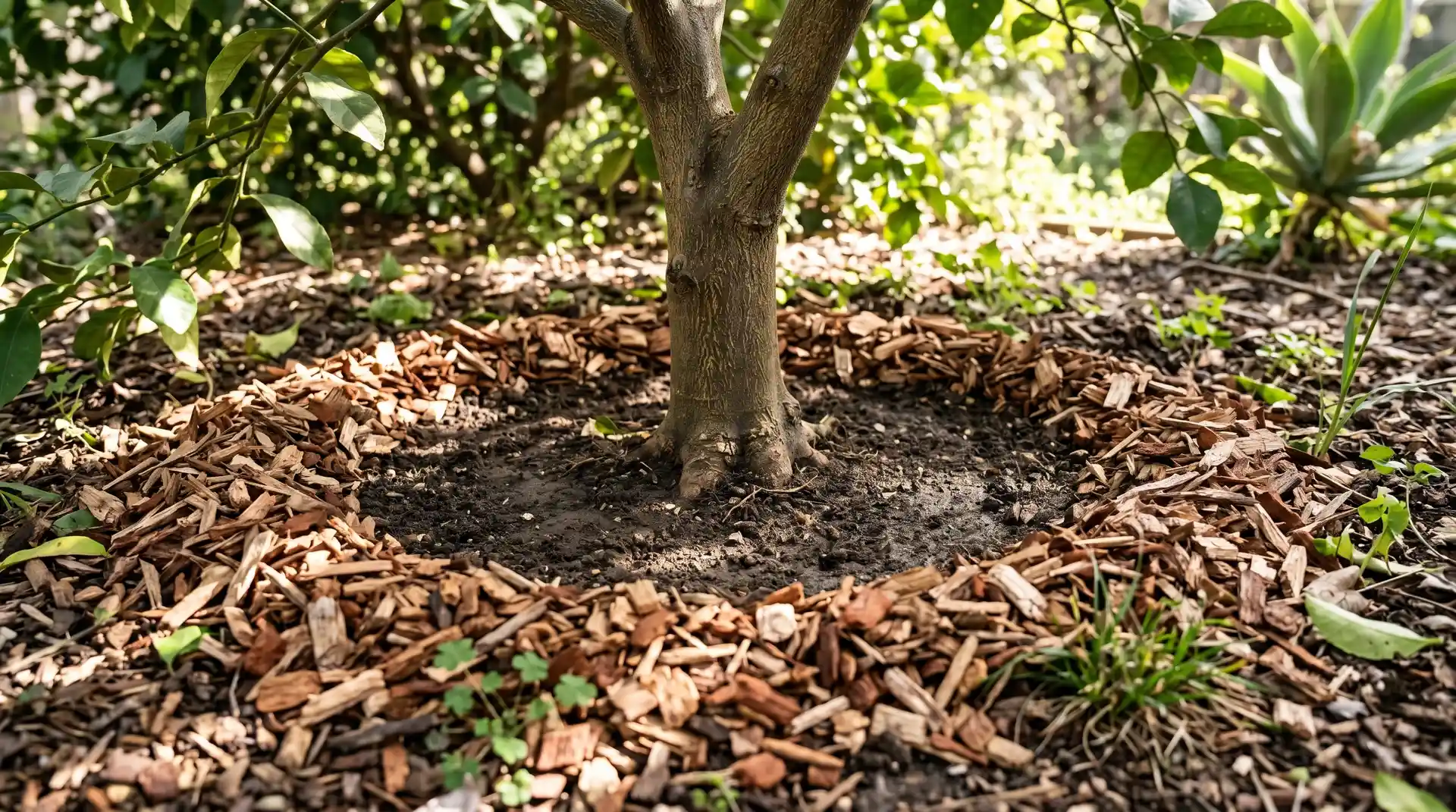
The bare circle you leave around the trunk is not cosmetic. It is the difference between dry bark that zoospores cannot reach and moist bark that they can.
Trunk clearance rules from UF/IFAS and UC Master Gardeners:
- Minimum 8 inches from the trunk; 12 inches is better for established trees
- Inspect the trunk base twice per year; pull mulch back to check for gummosis, scale, or pest activity
- If you find gummy ooze: remove mulch entirely from a 12-inch radius, allow the bark to dry completely (7–10 days), treat with a copper-based fungicide, then reapply mulch with correct clearance
Volcano mulching — piling mulch in a cone against the trunk — is the most common and damaging application error for citrus. Even the best mulch type, applied this way, promotes the disease it is supposed to prevent.
The 5 Best Mulches for Citrus Trees
| Mulch Type | Best For | Price Range |
|---|---|---|
| Wood chips (arborist) | Established trees; maximum soil biology | Free–$30 per cu. yd. (bulk) |
| Pine bark nuggets | Retail buyers; low-maintenance mulching | $3–$6 per 2 cu. ft. bag |
| Straw (seedless) | New plantings; fast organic matter addition | $8–$15 per bale |
| Melaleuca | Florida and Gulf Coast growers (zones 9b–11) | $4–$8 per bag |
| Compost (base layer) | Fertility boost under bark or wood chips | $5–$12 per bag; free from home pile |
1. Wood Chips (Arborist Chips) — Best Overall
Arborist wood chips — the mixed material of bark, wood, leaves, and small branches that tree service companies produce — are the most biologically active mulch for citrus. They decompose slowly, maintain soil moisture, and feed diverse soil microbes as they break down. Those microbes actively suppress Phytophthora and other root pathogens through competition for resources and direct chemical inhibition.
A UF/IFAS field study funded through a $12,000 SSARE grant found oak wood chip mulch increased available potassium and phosphorus in citrus root zones, boosted soil biodiversity, and showed early evidence for improving citrus tolerance to HLB (huanglongbing, or citrus greening) — currently the most destructive disease in commercial citrus production.
WSU Extension confirms that surface-applied wood chips do not cause nitrogen deficiency. They are also free from local arborists or through services like ChipDrop, which makes them the most cost-effective option by a considerable margin. See our wood chips vs. bark mulch comparison for a closer look at the differences.
One caveat for new plantings: Greg Alder, a Southern California garden writer with extensive citrus experience, observed that young citrus in heavy clay soil can show stress under thick wood chip mulch in the first growing year. Clay stays cool and moisture-saturated under a thick layer, and roots that have not yet established may struggle with the reduced drainage. If your soil is heavy clay, apply a lighter 2-inch layer in year one and increase to 3–4 inches once the tree has settled in.
Apply 3–4 inches for established trees; replenish annually.
2. Pine Bark Nuggets — Best Retail Purchase
Pine bark nuggets are the most practical option for growers who prefer bagged mulch from a local garden center. They are widely available, decompose slowly (extending time between top-ups), and provide excellent drainage without packing as densely as shredded bark products.
Skip the cold, slimy compost pile.
Enter your brown and green materials — get a balanced C:N recipe and temperature targets that activate hot composting.
→ Build My Compost RecipeUF/IFAS includes pine bark among recommended organic mulch materials for shallow-rooted plants including citrus. Mini nuggets (roughly 3/4 inch) create a better weed barrier than large nuggets (2–3 inch) and are less likely to shift during irrigation or heavy rain. Large nuggets are a reasonable choice if you prefer the look and don’t mind slightly less weed suppression.
Apply 2–3 inches for established trees. Cost: $3–$6 per 2 cu. ft. bag at most garden centers and home improvement stores.
3. Straw (Seedless) — Best for New Plantings
Straw breaks down in a single growing season, adding organic matter to the soil quickly. That fast decomposition is a limitation for established trees — you will need to refresh it annually — but for newly planted citrus still establishing roots, it is an advantage. A light straw layer provides immediate moisture retention and weed protection without the dense, slow-draining characteristics of bark or chips that can stress young roots in their first season.
Use only seedless straw — wheat or rice straw from a farm supply store. Hay contains grass and weed seeds, which is the opposite of the result you want. Check the label for “seedless straw” or “straw mulch.”
Apply 3–4 inches; refresh each spring. Cost: $8–$15 per bale.
4. Melaleuca Mulch — Best for Florida and Gulf Coast
Melaleuca (paper bark tree) mulch is specifically recommended by UF/IFAS Extension for tropical fruit growers across Florida and the Gulf Coast. Commercially bagged melaleuca is pre-composted and heat-treated, which eliminates weed seeds and disease pathogens — a meaningful advantage over bags of unknown provenance. It also resists compaction better than shredded bark, maintaining the air gaps that citrus roots need even in humid conditions.
In zones 9b–11 where high humidity creates significant Phytophthora pressure throughout the year, starting with a pathogen-free mulch reduces ground-level disease pressure from the outset. This is the most practical locally available option for Florida growers.
Apply 2–3 inches; available at Florida and Gulf Coast garden centers.
5. Compost (Light Base Layer) — Best Fertility Boost
A 1–2 inch layer of finished compost applied as a base before topping with wood chips or pine bark provides an immediate fertility and microbial activity boost. UF/IFAS lists compost among recommended organic mulch materials for citrus and tropical fruit trees.
Compost works best as a base layer rather than as a standalone full-depth mulch. It compacts readily and retains moisture more than bark or chips — at 3-inch depth on its own, it creates more root-zone moisture than citrus tolerates well. Finished compost is critical; fresh or still-active compost applied near roots introduces pathogens. If your compost pile is still hot or smells strongly of ammonia, it is not ready.
Apply 1–2 inches as a base, then top with 2 inches of bark or chips. Cost: $5–$12 per bag, or free from a home pile that has fully matured.
Mulches to Avoid
Rubber mulch: Made from recycled tires, rubber mulch contains zinc and processing chemicals that leach into soil over time. UF/IFAS explicitly recommends against it for edible plantings. Citrus surface roots are efficient absorbers — what goes into the root zone can reach the fruit.
Dyed or treated bark: Colored red, black, or brown mulches often contain artificial dyes. Some treated products have been processed with systemic pesticides. For a fruiting tree, these are straightforward reasons to avoid them.
Cypress mulch: Flagged by UF/IFAS as not recommended due to sustainability concerns around cypress harvesting. It is also denser than most bark options and compacts against trunk bases more readily.
Finely ground mulch in clay or slow-draining soil: Fine-textured “economy” bagged mulch seals out oxygen in heavy clay soils. Citrus roots need oxygen as much as water. A mulch that blocks air exchange in already slow-draining soil amplifies the very conditions that lead to root rot.
The right fertilizer schedule matters here — we explain why in citrus trees best pot.
Weed fabric under mulch: Landscape fabric prevents the soil biology that makes organic mulch worth using. Over time it fills with weed roots growing above the fabric, and decomposed mulch becomes the weed-growing medium on top of it. UF/IFAS recommends against it.
Rocks and gravel: Stone mulch stores heat and radiates it back into the root zone — the opposite of what citrus needs in the zones where it grows. Rocks contribute nothing to soil nutrition or microbial activity and create maintenance complications as debris accumulates in the gaps.
How Deep and How Often
The depth ceiling for citrus is 3 inches, and that number comes from root physiology rather than convention.
Citrus feeder roots occupy the top 12–18 inches of soil and access oxygen through air-filled pores in the soil matrix. Mulch deeper than 3–4 inches restricts oxygen diffusion, especially as it compacts. UF/IFAS holds the upper limit at 3 inches for shallow-rooted species including citrus and avocado.
For wood chips specifically, apply 6–8 inches initially. Fresh chips settle to roughly half their starting depth within a month or two as decomposition begins — a 7-inch application becomes about 3–4 inches by midsummer, which is exactly the target range. Greg Alder notes this settling effect in Southern California and recommends planning for it rather than applying conservatively and ending up with insufficient coverage.
Annual maintenance protocol:
- Early spring (February–March): Pull back mulch and inspect the trunk base for gummosis, scale insects, or other pest activity. This is the most important maintenance step.
- Top up: Bring mulch back to 3 inches. Do not let it fall below 2 inches — weed pressure increases quickly once the barrier thins.
- Extend outward: As trees mature, the active feeder root zone extends to the drip line (the outer edge of the canopy). The mulch ring should follow — extending to the drip line or slightly beyond captures the full benefit for the root system.
Zone and Climate Considerations
The frost risk debate
One genuine disagreement exists in the citrus mulch literature: does mulch help or hurt during frost events?
UC Cooperative Extension has stated that mulch can lower minimum nighttime air temperature, which suggests some frost risk. The California Landscape Contractors Association argues the opposite — that mulch insulates soil and reduces temperature fluctuations, reducing freeze damage.
Fred Hoffman, a longtime Sacramento garden advisor, explored both positions with Chuck Ingels, a late Sacramento County Farm Advisor. Ingels sided with CLCA but was clear-eyed about the magnitude: “Perhaps with just a few citrus trees there may be some benefit… but any difference is generally very miniscule.” His reasoning: in mild climates, citrus roots do not actually freeze. The thermal effects of mulch on trunk-zone temperatures during a frost are small enough that neither position leads to dramatically different outcomes.
For growers in zones 8–9 where hard frost is a real risk, a 2-inch layer is a reasonable compromise — enough moisture retention through warm seasons without meaningfully changing the soil heat radiation that helps warm nights at the surface.
Quick zone guide:
- Zones 9b–11 (southern FL, southern CA, Gulf Coast): Wood chips or melaleuca at 3 inches. Phytophthora pressure is the primary risk; trunk clearance is the critical variable.
- Zones 8–9 (TX, LA, coastal GA, inland CA): Pine bark or straw at 2–3 inches. Pull mulch slightly away from the trunk before a forecast hard freeze to allow bare soil to radiate stored heat overnight.
- Container citrus (any zone): 1–2 inches over the soil surface. Containers drain freely but dry out quickly at the rim; a light mulch layer balances those tendencies without creating excessive moisture accumulation.
If you are planning the planting design around your citrus, our guide to companion plants for citrus trees covers ground cover and understory options that work alongside a mulch layer without competing for the same space.
Frequently Asked Questions
Can I use wood chips from my own yard?
Yes, as long as the chips come from healthy plant material. Avoid chips from wood infected with fungal disease or from plants next to trees that have died from root rot. When the source is uncertain, commercially composted and heat-treated products eliminate the risk.
Is it safe to use grass clippings under citrus?
Only from lawns you know are untreated. Clippings from lawns treated with aminopyralid or clopyralid — common in lawn care services and some commercial herbicide products — can persist in mulch and damage sensitive plants. NC State Extension identifies citrus relatives as susceptible to aminopyralid carryover. Use clippings only from an untreated lawn you manage yourself.
My tree has gummy ooze at the trunk base. Is mulch causing it?
Mulch placed against the trunk creates the moist conditions that allow Phytophthora to infect the bark — but the disease itself causes the ooze. If you see gummosis: remove all mulch from a 12-inch radius around the trunk, allow the area to dry completely (7–10 days), treat with a copper-based fungicide according to label directions, and reapply mulch with correct clearance after 2–3 weeks.
How often do I need to replace mulch?
Pine bark nuggets typically need refreshing every 1–2 years. Wood chips break down in one growing season in humid climates, longer in dry zones. The practical signal: when weed seedlings start germinating in the mulch layer, it has decomposed enough to lose its suppression effect — top up at that point rather than on a fixed schedule.
Does mulch affect soil pH for citrus?
In well-draining soils, surface organic mulch has minimal effect on soil pH beyond the immediately decomposing layer. Citrus prefers a slightly acidic pH of 6.0–7.0, but surface bark or wood chip mulch is not a reliable tool for adjusting pH. If a soil test shows pH is out of range, elemental sulfur or an acidifying fertilizer is the appropriate intervention.
Sources
- UF/IFAS Extension Collier County. Mulching Tropical Fruit Trees.
- UF/IFAS EDIS (EP625). Mulching Herbs, Vegetables and Fruit Trees in the Florida-Friendly Edible Landscape.
- UC Master Gardeners, Santa Clara County. Growing Great Citrus.
- Hoffman, F. Garden Basics. Mulch Under Citrus Trees: Pros and Cons.
- UF/IFAS Indian River Research and Education Center. Oak Tree Mulch Study to Help Suppress Citrus Disease.
- Alder, G. Yard Posts. Using Wood Chips as Mulch for Fruit Trees.
- Chalker-Scott, L. WSU Extension. Using Arborist Wood Chips as a Landscape Mulch.
- UC Cooperative Extension. Phytophthora Diseases of California Citrus.


