

Compact Blueberry vs Standard Blueberry: Which Produces Fruit in a 15-Gallon Pot?

Choosing between a compact blueberry vs standard blueberry for container growing comes down to three things: how much space you have, which USDA hardiness zones you garden in, and how much fruit you actually want to harvest. Both types will thrive in pots—but they require different container sizes, chill hour totals, and long-term commitments. This guide breaks down every variable that matters for patio and balcony growers.
Quick Comparison: Compact vs Standard Blueberry
| Feature | Compact Blueberry | Standard Highbush Blueberry |
|---|---|---|
| Mature height | 1–2 ft (12–24 in) | 4–6 ft |
| Minimum container | 3–5 gallon | 15–25 gallon |
| Root depth needed | 10–12 in | 16–20 in |
| Full sun requirement | 6–8 hours | 6–8 hours |
| Watering frequency | Every 2–3 days (dries faster) | Every 3–5 days |
| Growing difficulty | Beginner-friendly | Moderate |
| Best USDA zones | Varies by variety (3–10) | 4–7 (standard highbush) |
| Chill hours needed | 150–1,000 (variety-dependent) | 800–1,200 |
| Yield per plant/year | 0.5–2 lbs | 5–10 lbs |
| Plant cost | $10–$25 | $15–$40 |
| Self-fertile? | Often yes (variety-specific) | Better with a partner |
What Makes a Blueberry “Compact”?
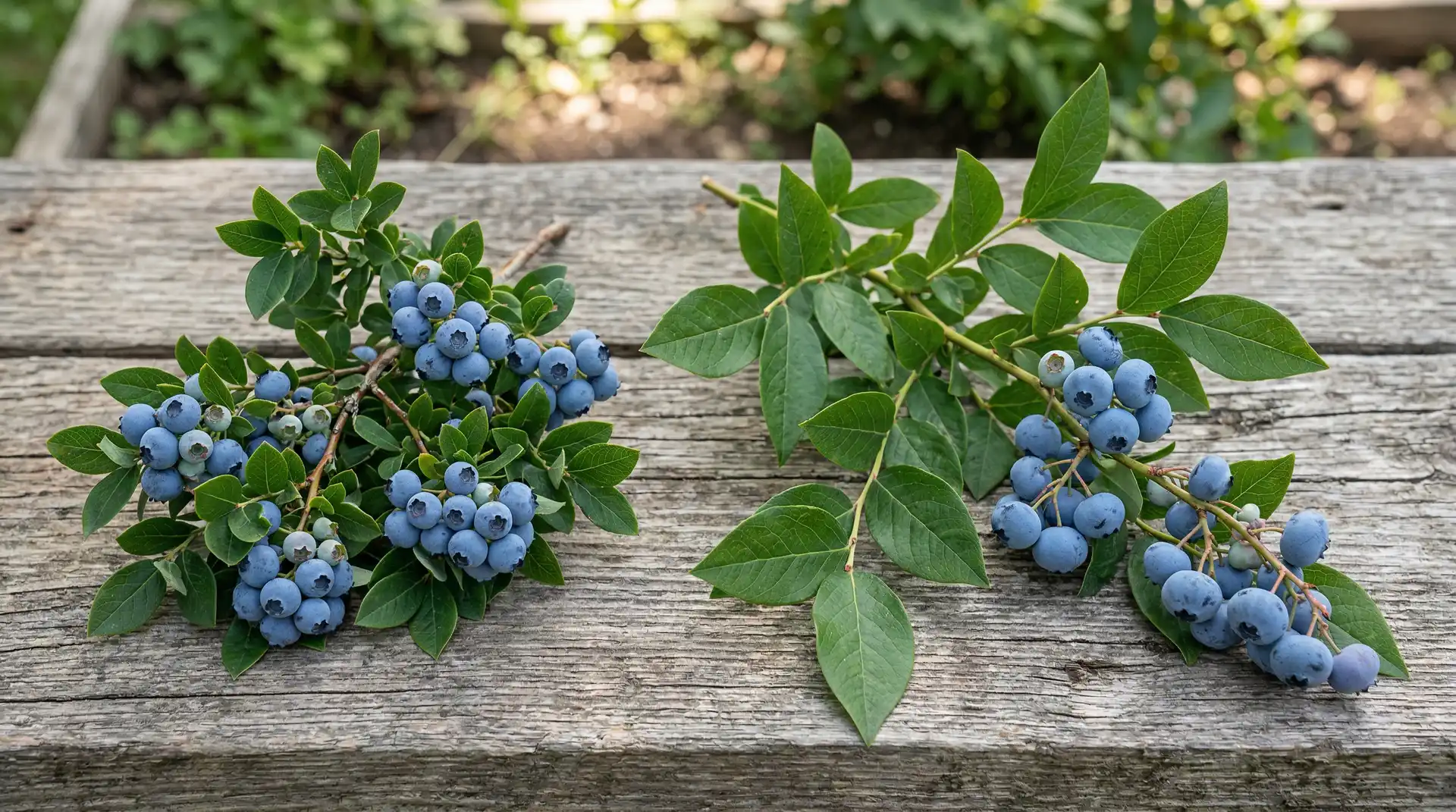
Compact blueberries are not simply young standard plants sold in small pots. They are distinct cultivars—primarily crosses between lowbush (Vaccinium angustifolium) and highbush (Vaccinium corymbosum) species—bred specifically for restricted root zones and small-space growing. University of Michigan breeders developed Top Hat in the 1970s as the first widely available compact cultivar. Since then, commercial breeders have introduced ornamental-fruiting types like Peach Sorbet and Jelly Bean that stay under 24 inches at full maturity regardless of container size.

Standard highbush blueberries, by contrast, are full-size shrubs that happen to adapt well to large containers. They were bred for commercial field production, not container culture. When you grow a standard highbush in a pot, you are working against its natural growth habit rather than with it.
The practical difference: compact blueberries have a shallower, more fibrous root system that genuinely thrives when contained. Standard highbush roots can reach 18–20 inches deep and 24 inches wide in-ground. In a container, that root mass becomes stressed unless the pot is very large and regularly watered.

Three pre-planned garden beds, free
Stop staring at empty beds: printable plans with exact layouts, plant lists and planting calendars — yours free from the Garden Library.
Container Size and Root Depth Requirements
Root depth is the most overlooked container variable. Blueberry roots are shallow compared to trees, but they need width and adequate drainage room.

Compact varieties: A 3-gallon container (approximately 10 inches deep, 10 inches wide) works for first-year growth. For mature, productive plants, move up to a 5-gallon pot (12–14 inches deep). Top Hat, Peach Sorbet, and Jelly Bean all reach full productivity in a 5-gallon container on a balcony or small patio. You can grow two compact plants in a single 10-gallon half-barrel for cross-pollination without taking up much space.
Standard varieties: A 15-gallon container is the practical minimum for a mature standard highbush to produce reliably. Many growers use 20–25 gallon pots or wooden half-barrels (roughly 15 gallons). The pot must be at least 18 inches deep to accommodate root development without circling. Standard plants in undersized containers fruit poorly and are prone to drought stress even with daily watering.
For anyone growing on a balcony, always check the weight limit. A 20-gallon container filled with moist acidic potting mix can weigh 80–100 lbs. Compact plants in 5-gallon containers run 15–20 lbs each—far more manageable for upper-floor spaces.
If you enjoy growing other fruit in pots, our guide to the best dwarf fruit trees for containers covers size-appropriate varieties across multiple species.
Yield: How Much Fruit to Expect
Compact blueberries produce less fruit per plant than standard highbush types, but the comparison changes when you measure yield per square foot of patio space.

A mature Top Hat or Sunshine Blue in a 5-gallon pot yields roughly 0.5–2 lbs of berries per season. A mature standard Bluecrop or Duke in a 20-gallon container yields 5–10 lbs in a good year, but that container takes up four to five times more floor space.
If your goal is to maximize harvest, standard containers win per plant. If your goal is to maximize harvest per square foot of outdoor space—typical for balconies and small patios—two or three compact plants in 5-gallon pots often outperform one standard plant in a 20-gallon tub.
Yield in both types ramps up slowly. Year one is establishment; year two gives a light harvest; year three and beyond is full production. Do not over-harvest in years one and two regardless of type.
Chill Hours and Zone Compatibility
Chill hours—the number of hours below 45°F a plant needs to set fruit the following season—are the most critical zone-compatibility variable for blueberries. Get this wrong and you get vigorous foliage but no fruit.
Compact varieties vary enormously:
- Sunshine Blue: 150 chill hours—ideal for Zones 7–10, Southern California, Gulf Coast, Pacific Northwest lowlands
- Peach Sorbet / Jelly Bean: 200–300 chill hours—Zone 5–9
- Top Hat: 1,000 chill hours—Cold-climate specialist, Zones 3–6, excellent for Minnesota, Wisconsin, upstate New York
- Blueberry Glaze: 400 chill hours—moderate zones (6–9)
Standard highbush varieties:
- Bluecrop: 800–1,000 hours—Zones 4–7
- Duke: 1,000 hours—Zones 4–7
- Patriot: 1,000–1,200 hours—Zones 3–7 (extremely cold-hardy)
- O’Neal (southern highbush): 400–500 hours—Zones 6–9
The key takeaway: if you live south of Zone 7, compact varieties like Sunshine Blue are your safest choice for reliable fruiting. If you live in Zones 3–5 and want a compact plant, Top Hat delivers—but so does a standard Patriot in a large container. Zones 5–7 have the most options in both categories.
Managing Soil pH in Containers
Blueberries require a soil pH of 4.5–5.5. Below 4.5 and manganese toxicity can develop; above 5.5 and iron becomes unavailable, causing chlorosis (yellowing between leaf veins). This requirement is identical for compact and standard types.
Stop guessing if your garden pays.
Log what you grow and harvest — see total yield weight, estimated retail value, and season-on-season progress in one place.
→ Track My Harvest
Here is where container growing is actually an advantage: you can maintain precise pH in an isolated root zone far more easily than in native soil. Mix a dedicated blueberry potting medium (peat moss, pine bark fines, and perlite at a 50:30:20 ratio) and test pH before planting. Organic sulfur amendments lower pH; elemental sulfur works slowly; acidifying fertilizers (ammonium sulfate) help maintain it season to season.
If your tap water is alkaline (pH above 7), this matters. Alkaline irrigation water raises container pH over time. Rainwater is ideal for blueberries; collected rainwater or filtered water with a small amount of citric acid (1/4 teaspoon per gallon, bringing it to approximately pH 5.5–6.0) solves hard-water problems without buying distilled water.
Both compact and standard types need feeding with an acid fertilizer (azalea/blueberry formula) in early spring and again in early summer. Avoid fertilizing after midsummer—late nitrogen pushes soft growth that gets frost-damaged in Zones 3–6.
For companion planting ideas that suit acid-loving blueberries, see our roundup of the best companion plants for blueberries.
Best Compact Blueberry Varieties for Containers
- Top Hat (Zones 3–6, 1,000 chill hrs)
- The classic cold-hardy compact. Stays 18–24 inches. Self-fertile. Very cold-hardy to –30°F if roots are protected. Berries slightly smaller than highbush but sweet. Best in northern states and Canada.
- Sunshine Blue (Zones 5–10, 150 chill hrs)
- The best southern compact. Evergreen in mild winters. Semi-upright to 3 ft. Produces mid-season. Self-fertile. One of the best choices for Zone 7–9 patios.
- Peach Sorbet (Zones 5–10, 200–300 chill hrs)
- Bred as an ornamental—extraordinary fall foliage (orange, red, yellow). Under 24 inches. Good berry flavor, moderate yield. Excellent for decorative containers near entrances.
- Jelly Bean (Zones 4–8, 250 chill hrs)
- Ultra-compact at 12–18 inches. Exceptionally sweet berries. Self-fertile but cross-pollination with another compact increases yield substantially. Works in a 3-gallon pot at maturity.
- Blueberry Glaze (Zones 5–9, 400 chill hrs)
- Upright-mounding to 2 ft. Semi-evergreen in mild climates. Good yield, blue-black berries with firm texture. Performs well on sun-drenched balconies in Zones 6–8.
Standard Highbush Varieties That Work in Large Containers
Standard varieties require the commitment of a 15–25 gallon container, but they reward you with yields that can meet a family’s demand from just one or two plants.
- Duke (Zones 4–7, 1,000 chill hrs)
- Early season (late June). Productive and reliable in containers when given a 20-gallon pot. Firm berries with excellent shelf life. Widely available at garden centers. Needs a pollination partner.
- Bluecrop (Zones 4–7, 800–1,000 chill hrs)
- Mid-season workhorse. The most widely planted highbush variety in North America—consistent large yields, disease resistance, reliable fruiting. In a 20-gallon container, it will produce 5–7 lbs in good years. Self-fertile but cross-pollination improves berry size.
- Patriot (Zones 3–7, 1,000–1,200 chill hrs)
- The cold-hardiest standard highbush. Bred for Zones 3–4 where other highbush types struggle. Large berries, good flavor. Moves indoors to an unheated garage in Zone 3 winters if you want to extend the season.
- O’Neal (Zones 6–9, 400–500 chill hrs)
- Southern highbush—the large-format option for warm climates. Excellent flavor, large berries. Grows to 5–6 ft and needs a big container (20–25 gallon minimum). Best for growers south of Zone 7 who want highbush flavor and yield.
Cost and Long-Term Investment
Compact plants typically cost $10–$25 for a one-gallon nursery pot. Standards run $15–$40 for a one-gallon, up to $60 for a two- or three-gallon established plant that will produce sooner.
Container cost is where standards become expensive. A single 20-gallon fabric grow bag runs $15–$30. A quality 20-gallon ceramic or terracotta planter runs $60–$150. For a compact plant in a 5-gallon pot, total setup cost—plant plus pot—runs $25–$60. For a standard in a 20-gallon pot, budget $75–$200.
Soil mix for a 20-gallon container (peat, pine bark, perlite) costs roughly $20–$30 in materials. The 5-gallon compact mix costs $5–$10. Blueberries are long-lived—a well-maintained plant can produce for 20–50 years, so the per-year container cost becomes insignificant over time.
Both types will need repotting every 3–5 years as roots fill the container. Compact types are far easier to repot alone; a 20-gallon standard plant with two seasons of root growth is a significant job requiring two people.
Which Should You Choose?
Choose a compact blueberry if you have a small patio or balcony, live in Zone 7 or warmer (use Sunshine Blue), want a beginner-friendly plant, prefer ornamental value alongside edibility, or simply want to start growing without investing in large heavy containers.

Choose a standard blueberry in a large container if you have patio or deck space for a 20-gallon pot, live in Zones 4–7 where standard highbush thrives, want maximum harvest from fewer plants, or already grow fruit trees in large containers and have the infrastructure in place.
If you are uncertain, start with two compact plants in 5-gallon pots. They will produce meaningful harvests within two seasons and teach you blueberry care—pH management, watering rhythm, fertilizer timing—before you commit to larger containers. Many experienced growers run both types: compact varieties near doors for easy snacking, a large standard container at the back of the patio for bulk harvest.
Blueberries also fit beautifully into edible landscape designs. For more ideas on productive plants that double as ornamentals, see our guide to edible landscaping.
Frequently Asked Questions
- Can I grow a compact blueberry indoors?
- Temporarily, yes—bring it inside before hard frost if needed. But blueberries need 6–8 hours of direct sun and most indoor spaces cannot deliver that consistently. A south-facing window with supplemental grow light works for overwintering but is not suitable for long-term fruiting indoors.
- Do compact blueberries need a pollination partner?
- Many compact varieties (Sunshine Blue, Jelly Bean) are self-fertile and will set fruit alone. However, all blueberries produce more berries and larger berries when cross-pollinated by a different variety. Even self-fertile types benefit from a companion plant within 6–10 feet.
- What happens if blueberries get root-bound in a container?
- Compact types tolerate root-bound conditions better than standards. A mildly root-bound compact blueberry will slow its vegetative growth and often redirects energy into fruit production—similar to the effect of root-pruning. Standard highbush plants become drought-stressed and fruit poorly when severely root-bound. Repot when roots circle visibly or emerge from drainage holes.
- Why are my container blueberry leaves turning yellow?
- Yellow leaves between green veins (interveinal chlorosis) indicate iron deficiency caused by pH above 5.5. Test your soil mix with a pH meter (not test strips—inaccurate in peat-based media). Lower pH with sulfur amendments or switch to an acidifying fertilizer. Alkaline tap water is the most common cause in container-grown blueberries.
- Can I overwinter container blueberries outside in Zone 4?
- Yes, with protection. Container roots are more exposed to freezing than in-ground roots. In Zones 3–5, move containers to an unheated garage or shelter them against a building wall and insulate the pot with burlap or bubble wrap. Top Hat and Patriot are the most cold-hardy options in containers for northern climates.
Sources
- University of Minnesota Extension. Growing blueberries in the home garden. University of Minnesota Extension Service.
- Michigan State University Extension. Blueberry production in Michigan: variety selection and culture. MSU Extension.
- Strik, B. C. (2005). Blueberry: an expanding world berry crop. Chronica Horticulturae, 45(1), 7–12.
- USDA Agricultural Research Service. Blueberry cultivar development. USDA ARS Small Fruits Research Station, Beltsville, MD.


