

Fresh Basil All Year? Here’s How to Grow It Indoors & Out

Imagine having fresh, aromatic basil at your fingers anytime you need it—for a zesty pesto, a vivid summer Caprese salad, or a cosy winter pasta sauce. No more depressed, drooping grocery store plants! Right now, it sounds like a gastronomic fantasy. Actually, it’s rather doable and simpler than you would have imagined! The good news is that basil, that beautifully scented herb, can be cultivated well both indoors and outside. You can have a continuous supply without a large garden; a sunny windowsill can suffice just as nicely.
For a comprehensive overview of all basil varieties, companion planting, and troubleshooting, see our complete basil growing guide.
Whether Inside or Outside, the Secret to Healthy Basil is Knowledge of a Few Basic Needs.
Lots of sunlight, well-drained soil, and regular watering. If you provide these basics, you will be rewarded with bushy, aromatic plants ready to improve your cooking. Growing basil has amazing advantages. Beyond the ease of having fresh herbs right at hand, you will taste the better flavor that freshly selected basil can produce. Growing a plant from seed to fruition also brings a certain gratification.
This thorough tutorial will demonstrate how to grow basil both indoors and outdoors, therefore guaranteeing a plentiful supply of this much-loved plant. From beginning with seeds or cuttings, to selecting the correct site and soil, covering all you need to know—from proper care to harvesting those aromatic leaves—will be discussed. Prepare to discover the keys to a never-ending supply of mouthwatering, locally grown basil regardless of your living arrangement! We will start from seed (or cutting) all the way to harvest and work through typical issues.

Basil Varieties: Finding the Correct One for You
Basil isn’t a one-size-fits-all herb, hence you need be aware before you start growing. There is a whole universe of basil varietals available, each with distinct flavor, look, and cooking application. Selecting the correct type for your needs and growing environment can help you to be successful. Let’s review some of the most often used choices:
Genovese Basil
The classic Italian basil, the one you most probably image when considering pesto. Large, dark green, somewhat cupped leaves with a rich, sweet, and somewhat peppered taste define Genovese basil. Though it’s also great in Caprese salads, pasta sauces, and sprinkled over pizzas, this is the indisputable champion for making classic pesto. Tip: Since Genovese basil may grow rather big, it’s best for outside gardening or bigger pots.
Thai Basil
Really essential if you enjoy Southeast Asian food. Its pointy, somewhat serrated leaves, purple stems, and unusual licorice-anise taste help one to identify it. Thai curries, stir-fries, noodle dishes, Vietnamese pho get a great fragrant punch from this basil. Thai basil is a fantastic choice for sunny indoor locations or warmer climes since it tolerates heat really nicely.
Lemon Basil
As the name implies, lemon basil provides a vivid, lemony spin. Usually lighter green and more slender than Genovese basil, its taste is a wonderful mix of basil and lemon. It’s ideal for giving teas, salads, fish dinners, and even desserts some reviving zest. Lemon basil can be grown inside under grow lights or in a very sunny window; it thrives in full sun.
Purple Basil
Think about purple basil (variations like “Dark Opal” or “Red Rubin”), for a little visual drama. Its deep purple foliage provide meals and gardens amazing color. With a subdued clove-like undertone, the flavor is rather softer than Genovese basil. Salads, as a garnish, or infused in vinegar taste great. Tip: Although purple basil is lovely, shield it from frost since it may be rather more susceptible to low temperatures.
Bush Basil
Sometimes known as Greek Basil, is your buddy in case of restricted space. These little, thick shrubs with their tiny, brilliant green leaves are compact. Though usually a little less strong, the taste is like Genovese basil. For windows boxes, planters, and edging garden beds, it’s ideal. Tip: Easy grown on a kitchen ledge, bush basil is ideal for little indoor pots.
The Complete Guide for Growing Basil Both Inside and Outside
All set to start your journey in cultivating basil? Growing basil is a satisfying activity whether your dream is of a neat herb garden outside or a handy kitchen windowsill bursting with aromatic leaves. Both indoors and out, this definitive guide will provide you with all you need to effectively cultivate robust, healthy basil plants. See this part as your road map to become a basil master!
This thorough guide offers in-depth information and useful suggestions by dissecting the key actions into sensible chunks. The following is a synopsis of our topics:
- Beginning from seed, we will look at both indoor (for an early start) and outdoor (immediately sowing in the garden) methods of growing basil. We will address everything from selecting the appropriate seed-starting mix to transplanting your plants.
- Beginning from cuttings, learn the quite simple and quick technique of propagating basil. Perfect for increasing your collection or distribution with friends, this method lets you fast produce fresh plants from an existing basil plant!
- Selecting the Correct Location: Sunlight Needs Basil’s success depends on sunlight. We’ll discuss the particular sunlight needs for indoor and outdoor gardening so that your plants get the light they need to flourish.
- Discover the finest soil mixes for both garden-grown and container-grown basil and learn about the need of well-drained soil for Basil. We’ll stress why preventing root rot depends on drainage.
- Basil grows healthily only if one masters the techniques of watering and fertilizing. We’ll go over how often to water, what kind of fertilizer to apply, and how to avoid typical blunders include overwatering.
- Pruning and harvesting basil can help you to maximize your output of this herb! We will show you how to pick leaves for best flavor and ongoing production as well as how to prune your plants to promote bushy development.
- Common Basil Problems and Solutions: Difficulties arise even in the most seasoned gardens. We will discuss typical basil issues including pests, illnesses, and yellowing leaves and offer doable fixes to keep your plants strong.
Whether you have a large garden or a sunny windowsill, following the thorough advice in every one of these sections will help you to produce an abundance of fresh, fragrant basil. Allow us to flourish.
Starting Basil from Seed
One satisfying and reasonably cheap approach to ensure a plenty of this aromatic plant is growing basil from seed. Starting your seeds indoors for an early jump on the season or straight outdoors is not too difficult either way.
Starting Basil Seeds Inside (for an Early Start)
This approach provides a head start so that, once the temperature rises, you can move robust seedlings outside.
Organize Your Resources:
- Basil Seeds: Select from Section II your preferred type.
- Not garden dirt; use a fine, well-draining seed starting mix.
- While small pots work too, seed trays with individual cells are best.
- Optional heat mat gives mild bottom heat to hasten germination.
- Grow lights are optional but highly recommended if your south-facing window is not quite sunny for robust seedling development.
- For a little watering, use a spray bottle or watering can with a fine rose.
Plant the Seeds Carefully:
- Leaving about ½ inch of room below the rim, load your seed trays or pots with the seed starting mix.
- Really moisten the mixture with water.
- Sprinkling two to three basil seeds per cell (or small pot), space them somewhat apart.
- With a very thin layer of seed starting mix—about ½ inch—lightly cover the seeds. Basil seeds germinate in light, hence avoid burying them too far down.
Hydrology: Watering
- To settle the seeds, gently spritz the surface with a spray bottle. Steer clear of overwatering to avoid damping-off—a fungal disease.
- Keep the ground regularly damp, but not waterlogged.
Germination:
- Set the seed trays or pots in a warm spot—ideally between 70 and 80°F / 21 and 27°C. One can help to sustain this temperature with a heat mat.
- To keep humidity, cover the trays with plastic wrap or a dome.
- Usually germinating in five to ten days, basil seeds
- Remove the plastic cover once seedlings show up and provide lots of light—grow lights or a really sunny windowsill.
Thinning of Seedlings:
- Thin the seedlings one seedling per cell or container once they have a few sets of genuine leaves. Instead of dragging the weaker seedlings out—which may damage the roots of the other plants—snip them at the soil line using little scissors.
Transplantation:
- Before moving the seedlings outside, harden them for around a week. This entails exposing them outside for progressively longer daily intervals, therefore progressively acclimating them to outdoor conditions.
- Transplant outdoors when the ground has warmed following the last frost. Choose a sunny spot with reasonably dry ground. Space the plants ten to twelve inches apart.
Starting Basil Seeds Outdoors (Direct Sowing):
Although this approach is easier, it depends on more pleasant temperature.
Wait until following the last frost and the soil temperature has at least 60°F (15°C), preferably 70°F (21°C).
Preparation of Soil:
- Select a sunny spot with reasonably dry ground.
- To raise drainage and fertility, change the soil with compost or another organic material.
Plants the Seeds:
- Space seeds one inch apart and ¼ inch deep.
- Cover just lightly with soil.
Movers:
- To maintain moist soil without making it soggy, gently and regularly water.
Thinning Seedlings:
- Thin the seedlings to 10 to 12 inches apart until they have a few of sets of genuine leaves.

Using Cuttings to Propagate Basil
Want additional basil plants quickly without first starting from seed? The solution is to begin growing basil from cuttings! This is shockingly rapid, quite simple, and generates clones of the original plant, thereby obtaining the exact same taste and qualities. It’s a great approach to grow your basil collection, distribute plants to friends, or guarantee a year-round availability.
Here is a detailed guide on effectively growing basil from cuttings:
- Select a Healthy Stem:
- Select from a robust basil plant a healthy, non-flowering stem. Steer clear of stems displaying symptoms of disease or pest damage or that seem woody. The stem should be four to six inches long at minimum.
- Cut:
- Cut just below a leaf node—that is, the place from which leaves or branches arise from the stem—using neat, sharp scissors or pruning shears. Although a 45-degree angle cut is advised most of the time, a straight cut also looks good. The cutting should run four to six inches in length.
- Eliminate Lower Leaves:
- Strip off the leaves from the cutting’s lowest two inches. This guides the plant’s energy into root development and keeps the leaves from decaying in the water.
- Roots in Water:
- Put the cutting in a spotless glass or jar covered with fresh water. As roots will grow here, make sure at least one node—where the leaves were removed—is submerged in the water.
- Though out of direct sunshine, put the jar in a prominent spot. Direct sunlight might warm the water and compromise the cutting’s integrity.
- Change the water daily or two times to stop bacterial development. Fresh water maintains the cutting in good condition and supplies oxygen.
- Be calm. Within one to two weeks—sometimes sooner—you should begin to notice small white roots growing inside. Before potting, let the roots develop to at least one inch or two long.
- Potting the Rooted Cut-through
- Pot up your fresh basil plant when the roots are sufficiently established.
- Select a small container with drainage holes, around four inches in diameter.
- Potting mix with good drainage. One finds great success with a mix designed for veggies or herbs. For better drainage, you might also use a basic potting mix changed with perlite or vermiculite.
- Though the leaves are not buried, gently insert the rooted cutting in the container such that the roots are covered with soil.
- After planting, completely water.
- Tending to the New Plant:
- Set the freshly planted basil in a sunny spot and progressively expose it to more direct sunlight over a week or so.
- When the top inch of soil seems dry, water.
- After several weeks, start fertilizing moderately with a diluted liquid fertilizer.
- As with a mature basil plant, pinch back the developing tips often to promote bushy growth.

Selecting the Appropriate Location: Sunlight Needed
Arguably the most important element for producing robust, tasty basil is sunlight. This sun-loving herb grows best in lots of light; inadequate light will produce weak, lanky growth and little flavor. Whether you’re growing basil indoors or outdoors, you have to know its sunlight needs. Basil grown outside must get at least six to eight hours of direct sunlight daily. For most of the day, indoors it requires strong, indirect light; else, grow lights provide extra illumination.
An Indoor Growing
Bringing the brightness inside calls for some forethought. Here’s how you offer your indoor basil ideal light:
- South Window is King: In the northern Hemisphere, windows facing south get the most sunlight all day. Your basil plant would be best situated here. If your window faces south, arrange your basil as near to it as you can (avoid touching the glass, which could get either too hot or chilly).
- Grow Lights: Your Arsenal of Secret Weapons Grow lights are absolutely necessary if you lack enough natural light—or during the shorter winter days. Being energy-efficient and with the correct wavelengths of light for plant development, full-spectrum LED grow lights are a great option. Run the lights, a few inches above the plants, for 12 to 16 hours daily.
- Rotation is key: Plants often slant toward the light source even in ideal illumination. To guarantee balanced development on all sides, rotate your basil plant often—every few days. This keeps it from tilting.
Outside Growing
Successful outdoor basil depends on your choosing of a suitable location in your garden.
- The Must is Sunny Spot. Choose a spot in your garden where at least six to eight hours of direct sunlight fall daily. Steer clear of places that trees, buildings, or other vegetation shadow.
- Although basil like daylight, it does not value strong winds, which could damage stems and leaves. Should severe winds affect your garden, think about installing a row cover for protection or planting your basil close to a windbreak—such as a fence, wall, or hedge.
- Growing basil in pots will help you be flexible in moving it about or if you’re not sure where the suniest area in your yard is. This lets you move the plants to follow the sun or shield them from strong winds quite simply.
Whether you grow basil indoors or outside, you will provide your plants the light they need to thrive by closely evaluating the lighting needs and following these guidelines.
Soil and Potting Mix for Basil
As sunlight is essential, so is the correct soil for growing robust basil. Success depends on this. well-drained soil. Basil despises having “wet feet,” or soggy roots, which can rapidly cause root rot and other issues. Both indoor and outdoor growing depend on the right soil or potting mix.
Outdoor Soil
Should you be growing basil straight in your yard, you will probably have to change your current soil to provide the best environment.
- Mostly garden soils gain from the addition of organic matter. Here your best buddy is compost. It works on soil fertility, drainage, and structure. Another great amendment that greatly improves drainage is perlite, a light-weight volcanic glass. Before you start your garden, carefully stir perlite and compost into your soil. Though you should change depending on the texture of your current soil, a decent ratio is about 1/3 compost, 1/3 garden soil, and 1/3 perlite.
- Verify excellent drainage. Test the drainage of your soil before planting. About 12 inches deep, dig a little hole and fill it with water. Your drainage is good if the water empties in an hour. Should it take much more time, you should either consider building raised beds to enhance drainage or further modify the soil with organic matter.
Indoor Potting Mix
Using the correct potting mix is critical for container-grown basil—indoors or outdoors. Use no garden soil in containers. Garden soil compacts too readily in containers, therefore limiting drainage and choking roots.
- Good potting mix is absolutely vital. Get a premium potting mix designed especially for pots. Usually including peat moss, perlite, vermiculite, and occasionally composted bark, these mixtures Search for a blend specifically referencing excellent drainage. One good indicator is the presence of perlite, or vermiculite. These components provide air pockets in the mixture that let water to readily drain.
- Steer clear of “heavy” mixes: Avoid potting mixes that feel dense or heavy since these will probably hold too much water.
pH for Soil
Basil normally prefers a somewhat acidic to neutral pH, ranging from 6.0 to 7.5, however it is not particularly discriminating about soil pH. Most superior potting mixes lie in this spectrum. If you feel your pH is greatly off and you are growing in garden soil, you can do a soil test (usually found at most garden centers) and change the soil. For most home gardeners, though, stressing adequate drainage and organic matter is more important than exactly changing pH for basil.
Whether in containers or in the garden, by giving your basil well-drained soil, you can establish a healthy root system that will enable strong development and many harvests.
Fertilizing and Watering Basil
Maintaining good, fruitful basil plants depends on proper watering and fertilizer. Although basil isn’t very demanding, knowing its requirements can help you stay clear of typical mistakes and maximize your crop. Make sure to check how often to water your indoor plants, because it’s quite important!
Watering Recommendations
Watering basil depends on striking the proper balance—not too little, not too much.
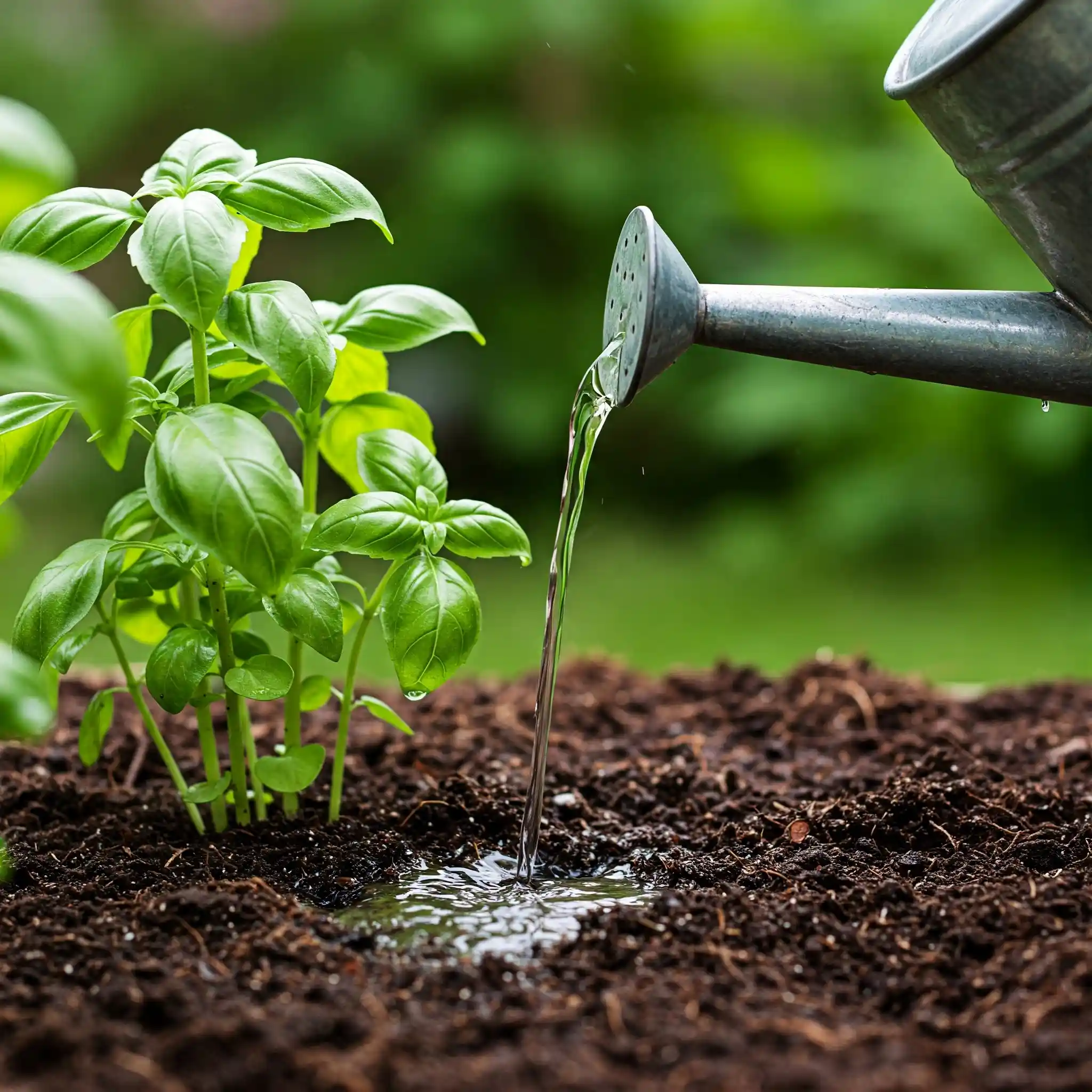
- Aim for heavy watering less often rather than regular, superficial irrigation. Between waterings let the top inch of soil completely dry out. Sticking your finger into the ground will help you to check this. Time to water if your fingertip feels dry.
- Steer clear of overwatering; this is maybe the most prevalent error in basil growing. Root rot brought on by overwatering can rapidly kill a plant. Soggy ground saps oxygen from the roots. Yellowing leaves, wilting—even in a moist soil—and a generally unappealing look are symptoms of overwatering.
- Water at the Base of the Plant: Whenever at all possible, water at the base of the plant instead of wetting the leaves. A humid atmosphere produced by wet leaves invites fungal infections such downy mildew. Better still is to use a soaker hose or a watering can with a small spout.
- Modify for plant size and weather. The size of your plant and the state of the weather will determine how often you water. Hot, dry conditions call for more frequent watering. More water is also needed by bigger plants than by smaller ones. Usually, container-grown basil dries out more quickly than basil planted on ground.
Fertilizing Instructions
Basil gains from consistent feeding during the active growing season, which runs spring and summer.
- For basil, a balanced liquid fertilizer—that is, one with equal proportions nitrogen, phosphorous, and potassium—such as a 10-10-10 formula—works great. Spread the fertilizer half the strength advised on the label. This helps avoid dangerous over-fertilizing.
- Plan to fertilize every two to four weeks. Fertilizer your basil every two to four weeks during the growing season. Should your basil grow really quickly, you might fertilize more often. Should it be slow growth, you can fertilize less frequently. Watch your plants and make necessary changes.
- Steer clear of over-fertilizing. With regard to fertilizer, more is not better. Too much fertilizer can burn the roots and harm the plant. Over-fertilization symptoms include stunted development, browning at the margins, and a salt accumulation in the soil.
- Think about organic alternatives: There are first-rate organic fertilizers accessible if you want organic gardening. Perfect options for basil are fish emulsion and compost tea. Their slow-release nutrients help to lower the risk of over-fertilization.
Following these watering and fertilization rules will help your basil plants get the moisture and nutrients they require to flourish, so producing a plentiful supply of tasty leaves.
Basil Pruning and Harvesting
Maximizing your basil production and maintaining healthy and productive plants depend on the dual activities of pruning and harvesting. Frequent trimming extends the harvest season, promotes bushy growth, and helps to prevent flowering—which can make the leaves bitter.
Pruning Basil
Consider pruning as molding the plant for best development rather than as a means of elimination of portions of it.
- The most crucial trimming method for basil is frequent pinching. This entails just pinching off the top sets of leaves on every stem using little scissors or your fingers.
- Prune always just above a leaf node—that is, the place from which leaves or branches arise from the stem. This motivates the plant to branch out, producing two fresh stems at the cut. A busher, more complete plant results from this.
- Pinch off any flower buds you notice developing—small clusters at the top of the stems—right away. flowered marks the conclusion of the plant’s life cycle, and once flowered leaves may grow bitter. Eliminating the flower buds forces the plant’s energy back toward leaf development.
Basil Harvesting
Though timing and technique important, harvesting basil is a basic operation.
- Harvest basil best in the morning, following the drying of the dew but before the heat of the day. This is the most concentrated state of the essential oils—which provide basil its taste.
- Harvest individual leaves as needed or trim entire stems as desired. As you would while pruning, clip stems slightly above a leaf node.
- Harvest on a regular basis. Frequent collecting promotes fresh development. Though you won’t need a lot of basil right now, don’t hesitate to harvest often. Excess may always be kept.
Basil Storage
Basil tastes finest fresh, but there are numerous techniques to save its taste for next usage.
- First Fresh:
- First method: treat basil as cut flowers in short term. After setting the stems in a glass of water, wrap loosely with a plastic bag and keep at room temperature—not in the refrigerator. Every day, change the water. This will preserve the basil for several days rather fresh.
- Method 2 ( Slightly Longer): Store the basil leaves in a plastic bag after wrapping them in a somewhat moist paper towel. The basil stays fresh for up to one week this way.
- Dried:
- Hang bundles of basil upward in a cold, dry, well-ventilated space. Once totally dry—the leaves crumble readily—strip the leaves from the stems and keep them in an airtight container.
- Turn on a dehydrator.
- Still Frozen:
- Blanch the leaves in boiling water for a few seconds, then straight down into freezing water. Dry completely; then, on a baking sheet, freeze one layer alone. Transfer, after frozen, to an airtight container or freezer bag.
- Puree basil leaves freeze in ice cube trays using a small olive oil drizzle. Freeze then move the cubes to a freezer bag or airtight container. This is ideal for enhancing pesto, soups, and sauces.
Typical Basil Issues and Fix-alls
Basil plants can sometimes run into issues even with the best of care. Maintaining healthy and productive plants depends mostly on early identification of these problems and quick response. Here are few typical basil issues together with solutions:
Pest Is:
Basil can draw some pests, but fortunately most can be managed using natural and organic approaches.
- Aphids: Little, soft-bodied insects called aphids suck sap from leaves, which causes them to coil and twist. Usually, they cluster on fresh growth.
- Aphids can usually be dislocated by a powerful blast of water from a hose.
- Apply insecticidal soap—found at garden centers—as directed on the box.
- Natural pesticide neem oil throws off the life cycle of many pests.
- Bring in beneficial insects: Aphids are naturally predated upon by ladybugs and lacewings.
- Spider Mites: Though they are invisible to the unaided eye, these small insects produce fine webbing on leaves that causes them to appear stippled and yellow. They enjoy hot, dry environments.
- Mist the plants often to raise humidity.
- Apply as advised either insecticidal soap or neem oil.
- Add predatory mites, which eat spider mites.
- Whiteflies: Disturbed, these little white, moth-like insects fly up. Their sucking of sap from the leaves yellow the leaves and weakens them.
- Yellow sticky traps will help you to catch adult whiteflies by surrounding the plants.
- Apply as advised either insecticidal soap or neem oil.
- In extreme infestations, you can gently sweep the undersides of the leaves to eliminate adults.
Make sure to checkout my 3 Simple & Natural Ways to Keep Pests Away from Your Garden
Diseases
The most often occurring disease affecting basil is fungal one.
- The fungal disease downy mildew produces gray, fuzzy growth on the underside of leaves and yellowing on their top surface. It thrives in humidity.
- Soluition:
- Space plants enough and trim to increase ventilation.
- Water near the base of the plant; try not to damp the leaves.
- Remove and toss any contaminated leaves.
- Under severe conditions, a copper-based fungicide can be applied (read label directions carefully).
- Soluition:
- The soilborne fungus Fusarium Wilt produces wilting, yellowing, and finally plant death.
- Prevention is essential: Choose disease-resistant basil plants.
- Plant basil in different locations year after year instead of in the same spot.
- Enhance Soil Drainage: Verify the soil’s drainage capacity.
- Once a plant is contaminated, sadly, there is no good treatment for fusarium wilt. Remove and toss away sick plants.
Yellowing Leaf
Yellowing leaves can indicate various potential issues:
- Most often occurring reason is overwatering. Between waterings let the ground dry out.
- Nutrient shortfall: particularly nitrogen shortage. Use a balanced liquid fertiliser for fertilisation.
- Verify the soil’s drainage quality.
- See above for information on pests or diseases.
Leggy Evolution
Typically, leggy, spindly growth results from:
- Move the plant to a sunnier spot or use grow lights to supply more light.
- Lack of Pruning: To promote busher growth, often pinch back the developing tips.
In Summary
And there you have it! Whether in a little kitchen window or a sunny garden plot, growing your own fresh, aromatic basil is really within reach. Basil is a very flexible and satisfying herb to grow, as we have discussed all throughout this book. With the correct care—enough sunlight, well-drained soil, continuous watering, and frequent pruning—you will have a bumper crop. It basically comes down to knowing those fundamental demands and quick resolution of any issues.
Starting your own path of basil-growing should not scare you! There is nothing like the gratification of cutting fresh leaves to accentuate your preferred cuisine. Whether you are a complete novice or a seasoned gardener, everyone can enjoy growing their own basil.
Knowing how to cultivate basil both indoors and outside will help you to enjoy this flexible herb all year round. Try growing from cuttings, experiment with several types, and find the distinct taste and scent only recently picked basil can offer.
We really would want to hear from you. In the comments below share your basil growing techniques, triumphs, or queries. And for further inspiration and professional guidance, be sure to peruse our other herb gardening pages. Happy growing.
FAQ (Generally Asked Questions)
Here are responses to a few often asked questions concerning cultivating basil:
Does Basil Grow in Water?
While it’s not best for long-term development, you can propagate basil in water (root cuttings). Long-term water growth of basil will finally make it feeble and less tasteful. Root cuttings are best grown in water then transplanted to ground.
Growing Basil at What Ideal Temperature?
Basil likes warm conditions. The perfect temperature range is from 60°F (15°C) to 80°F (27°C). Basil feels cold temperatures and frost quite sensitively.
Is Basil Seasonal or Annual?
Usually planted as an annual, basil finishes its life cycle in one season of growth. It won’t make it through frost. In really warm regions, however, zones 10 and above, it can occasionally act as a short-lived perennial. Though it will probably need additional light, you can also bring potted basil indoors for the winter.
Basil Dries Best How?
There are several ways to dry basil:
- Hang bundles of basil top down in a cool, dry, well-ventilated space.
- Use a food dehydrator according manufacturer directions.
- Spread basil leaves on a baking sheet and, with a little ajar door, dry in an oven at the lowest possible temperature—ideally below 170°F / 77°C.
Can I Grow Basil with Other Herbs?
Basil is indeed a good friend for many other herbs and veggies. Growing with tomatoes, peppers, oregano, parsley, and chamomile, it thrives. Avoid planting basil, though, close to rue or sage.
Why is My Basil Flowering?
The life cycle of a basil plant naturally consists in flowering. It usually starts with stress—such as heat, underwatering, or nutrient shortage—or just from the plant maturing. As blossoming can make the leaves taste unpleasant, pinching off flower buds as soon as they show will extend the leaf harvest.
My Basil has Holes in the Leaves, What Can I Do?
Usually, bugs are the reason basil leaves show holes. Slugs, snails, caterpillars, and Japanese beetles are the most usually offenders.
- Slugs and Snails: Beer traps will help you apply organic slug and snail bait.
- Caterpillars: Handpick them, or use Bacillus thuringiensis (Bt), a naturally occurring bacterium harmless for helpful insects.
- Japanese Beetles: Handpick Japanese beetles or utilize traps.
- Visit your plants often and act right away if you find any harm.
