

Best Plants for Shade: 20 Flowers and Shrubs That Thrive Without Direct Sun

Discover 20 of the best plants for shade gardens, from hostas and astilbe to hellebores and rhododendrons. Includes USDA zones, moisture needs, variety picks, and design tips for full shade, part shade, and dry shade under trees.
Shade does not have to mean a bare, struggling garden. Some of the most beautiful and lush planting combinations — hostas and ferns cascading under trees, hydrangeas glowing against a north-facing wall, bleeding heart arching over cool moist soil — are only possible in shade. The challenge is knowing which plants genuinely thrive without direct sun and which merely survive long enough to look unhappy.
Understanding your shade type is the essential first step. Full shade, part shade, dappled shade, dry shade under trees, and cool moist shade each suit different plants and require different strategies. Get this right and you will discover that shade is one of the most forgiving growing environments available — cooler in summer, moister in soil, and home to a surprisingly wide range of flowering and foliage plants.
This guide covers 20 of the best plants for shade gardens, with USDA hardiness zone ranges, moisture preferences, bloom details, and specific variety recommendations for every plant. Whether you are gardening under dense trees, alongside a north-facing wall, or in the shadow of a fence, you will find proven performers here. For those growing indoors in low-light rooms, our guide to the best plants for north-facing rooms covers the indoor equivalents.
Understanding Your Shade: Five Types That Need Different Plants
The most common mistake in shade gardening is treating all shade as identical. There are five distinct types — and the plants that thrive in each one differ significantly.
Seasonal Garden Calendar
Know exactly what to plant, prune and sow — every month of the year.
Full shade means fewer than 3 hours of direct sun per day. This occurs under dense evergreen canopies, against north-facing walls, or in deep gaps between buildings. Only a limited palette genuinely thrives here: hostas, ferns, hellebores, cyclamen, and Tiarella are the most reliable choices.
Part shade means 3–6 hours of direct sun, usually morning sun or filtered afternoon light. This is the productive zone for shade gardeners — the majority of plants on this list actually prefer part shade, where they get enough light to bloom reliably without the stress of midday heat.
Dappled shade describes the broken, moving light beneath a deciduous canopy. Light levels fluctuate constantly through the day. Most woodland natives evolved under exactly this condition and perform best here. Astilbe, bleeding heart, and Solomon’s Seal excel in dappled light.
Dry shade under trees is the most challenging condition to garden in. Tree roots compete aggressively for moisture and nutrients, and rainfall often fails to penetrate a dense canopy. Lamium, hellebore, cyclamen coum, and Ajuga are among the few plants that perform reliably under these conditions.
Cool moist shade — typically beneath deciduous trees with enriched soil and consistent moisture — is the easiest shade to garden. Astilbe, bleeding heart, hostas, and ferns all excel here, and the planting possibilities are almost as broad as a partially sunny border.
20 Best Plants for Shade Gardens
The following 20 plants are proven performers in shade across the United States. Each entry includes USDA hardiness zones, moisture preference, bloom details, and the best varieties to look for at the nursery.
1. Hostas (Hosta spp.) — USDA Zones 3–9
Hostas are the undisputed kings of the shade garden, offering more variety in leaf size, colour, and texture than any other shade perennial. Varieties range from 6-inch miniatures to 4-foot giants with leaves spanning 18 inches. Most prefer part to full shade — the gold and chartreuse types like ‘Sum and Substance’ tolerate slightly more sun than the blue-grey types. The primary pest is slugs: apply horticultural grit or diatomaceous earth around crowns in spring. Outstanding varieties include ‘Halcyon’ (blue-grey, notably slug-resistant), ‘Patriot’ (dark green with white margin), and ‘Frances Williams’ (blue-green with gold margin). Height: 6 inches–4 feet. Bloom: Lavender or white spikes in summer (primarily a foliage plant).
2. Astilbe (Astilbe spp.) — Zones 4–9
Astilbe produces feathery plumes of flowers in white, cream, pink, red, and lavender from June through August, depending on variety. It is a moisture-lover — part shade with consistently moist soil is ideal, and it performs poorly in dry shade. Astilbe makes an outstanding companion for hostas, the two plants offering complementary textures (bold flat leaves and feathery upright plumes) and the same growing preferences. Varieties: ‘Fanal’ (deep red, early), ‘Bridal Veil’ (white, early, compact), ‘Purple Candles’ (tall, late summer). Height: 1–4 feet. Bloom: June–August.
3. Bleeding Heart (Dicentra spectabilis) — Zones 3–9
One of the most graceful plants in any garden, Bleeding Heart produces arching stems bearing pendant pink-and-white heart-shaped flowers in May. It goes completely dormant by midsummer, leaving a gap — plant hostas or astilbe nearby to fill it. Dicentra formosa, the western Bleeding Heart, stays in leaf longer and is more drought-tolerant. The pure-white form ‘Alba’ is particularly elegant in deep shade. Height: 2–3 feet. Bloom: April–June.
4. Ferns — Multiple Species, Zones 3–11
Ferns provide architectural year-round structure with virtually no maintenance. Three stand out for US gardens: Autumn Fern (Dryopteris erythrosora, Zones 5–9) with coppery new growth turning deep green; Japanese Painted Fern (Athyrium niponicum ‘Pictum’, Zones 4–9) with silver-grey and burgundy fronds; and Ostrich Fern (Matteuccia struthiopteris, Zones 3–7) forming vase-shaped shuttlecocks up to 4 feet. Beyond their garden value, ferns carry rich symbolic meaning in folklore, associated with sincerity and new beginnings. Height: 1–4 feet. Bloom: None (spore-bearing).
5. Heuchera / Coral Bells (Heuchera spp.) — Zones 4–9
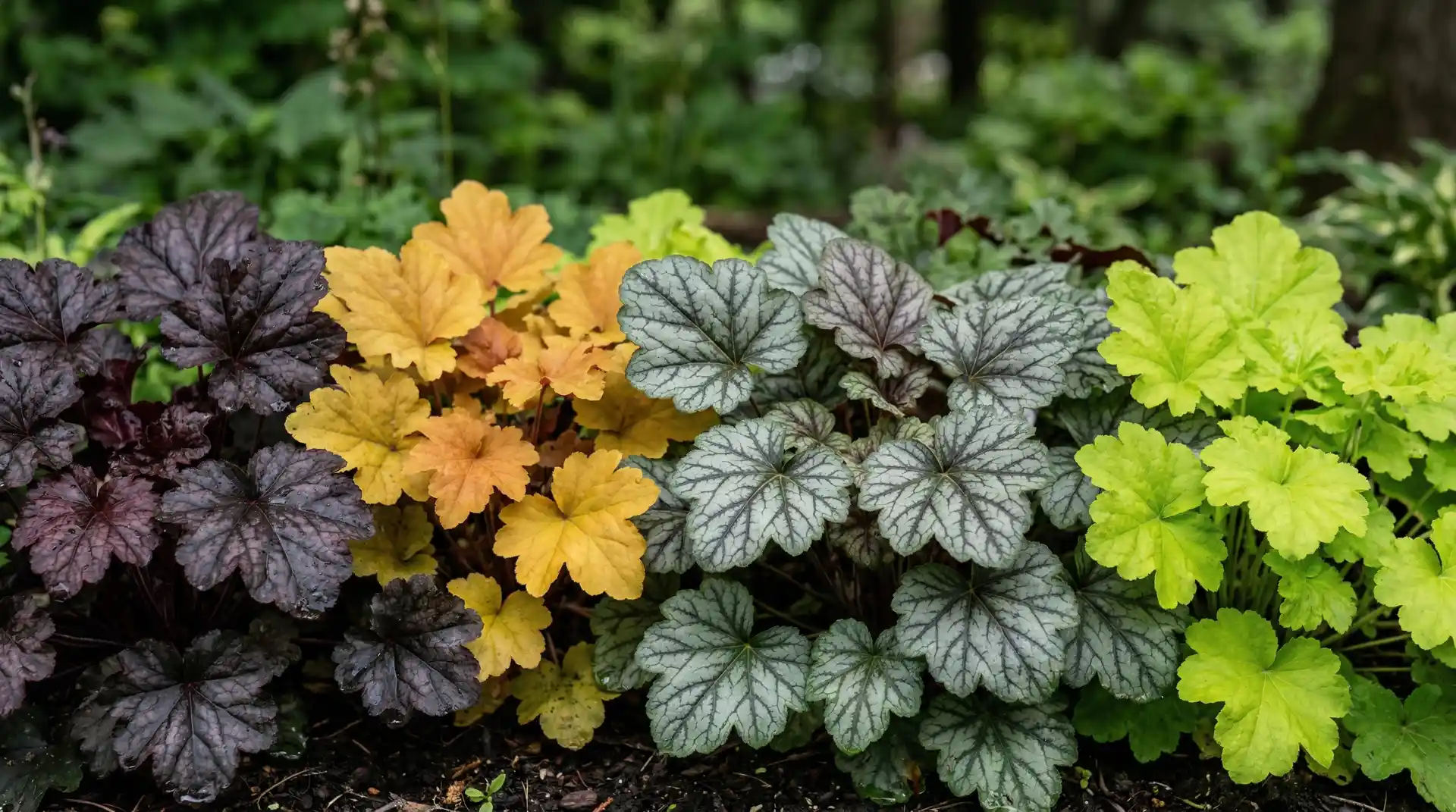
Modern Heuchera hybrids offer extraordinary foliage colour ranging from near-black burgundy to bright caramel-gold, silver-pewter, and lime-green — providing year-round interest in shade gardens where most flowering plants are brief. Heuchera performs best in part shade; too much shade dulls leaf colour and reduces vigour. Flowers on tall wiry stems attract hummingbirds. Outstanding varieties include ‘Obsidian’ (deepest purple-black), ‘Caramel’ (gold-apricot), ‘Georgia Peach’ (coral-pink, silver overlay), and ‘Palace Purple’ (reliable deep wine). Height: 12–18 inches. Bloom: Summer (small bell flowers on wiry stems).
6. Impatiens (Impatiens walleriana) — Annual, All Zones
Impatiens remain the most reliable annual for deep shade, saturating dark corners with colour from May through frost. Traditional I. walleriana is susceptible to impatiens downy mildew, which has devastated plantings in many areas since 2011. The solution: use New Guinea Impatiens (I. hawkeri), which carries resistance to the disease and is equally shade-tolerant. Deadhead-free, low-maintenance, and available in every colour from white through coral, scarlet, and lavender. Companion planting impatiens with shade-tolerant edibles like mint or sorrel works well in kitchen gardens with limited sun. Height: 8–18 inches. Bloom: May–frost.
7. Hydrangea macrophylla — Zones 5–9
Mophead and lacecap hydrangeas thrive in east-facing shade, receiving morning sun while being protected from the afternoon heat that bleaches and scorches their flowers. They are not suited to deep shade — bloom production drops significantly below 3 hours of light. Flower colour is pH-dependent: blue in acid soils, pink in alkaline soils, purple in neutral. For a comprehensive guide to all hydrangea species, pruning, and variety selection, see our complete hydrangea growing guide. Height: 3–6 feet. Bloom: July–September.
8. Hellebore (Helleborus spp.) — Zones 4–9
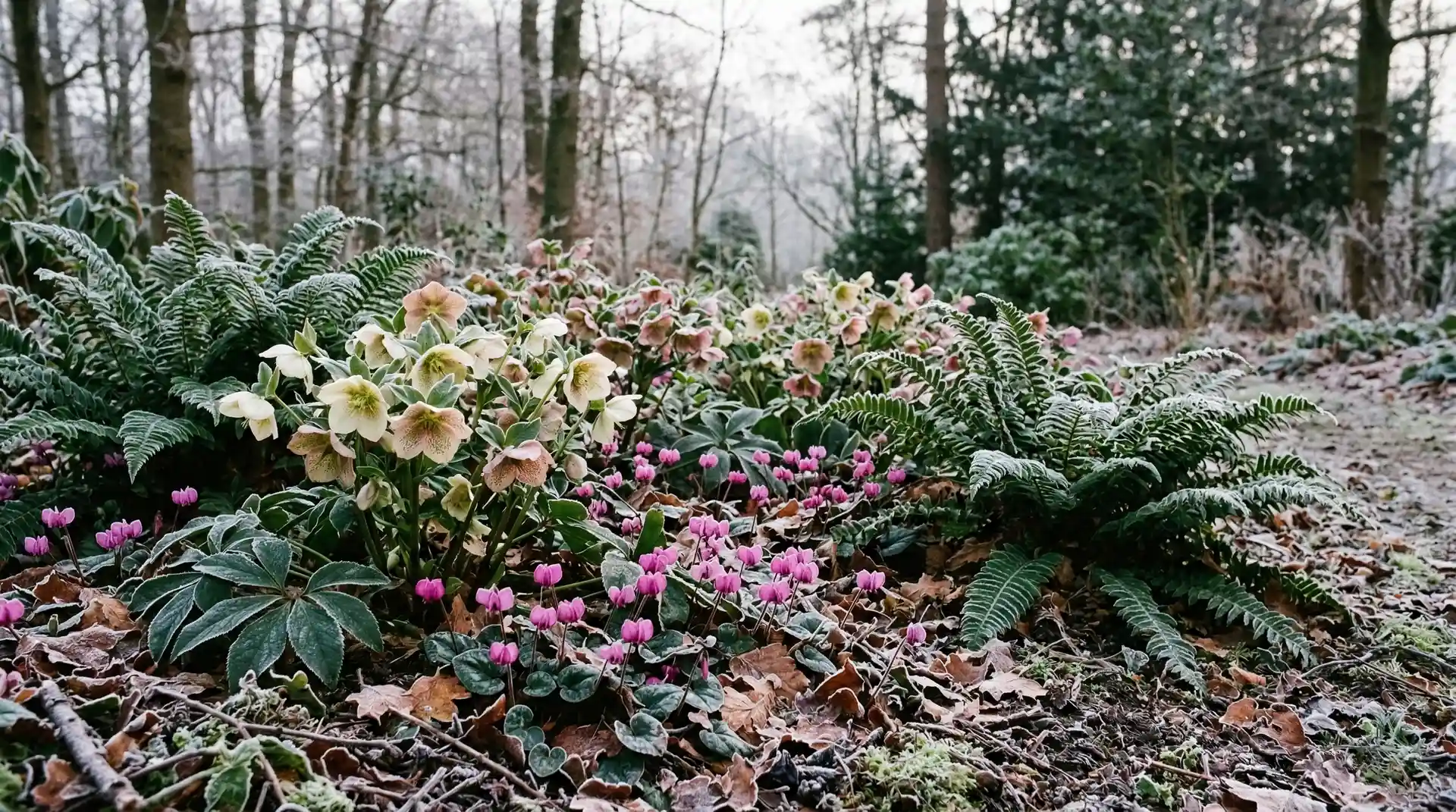
Hellebores bloom from December through April — exactly when the rest of the shade garden is bare — making them arguably the most valuable shade perennial in the seasonal rotation. They tolerate dry shade under trees better than almost any other flowering perennial, are deer-resistant, and self-seed freely once established. Lenten Rose (H. x hybridus) offers the widest colour range: white, cream, pink, mauve, slate, dark red, and near-black, with single, semi-double, and double forms. Plant with crowns at soil level, avoid disturbing once established. Height: 12–18 inches. Bloom: December–April.
9. Pulmonaria / Lungwort (Pulmonaria spp.) — Zones 3–8
Pulmonaria is one of the first shade plants to flower, opening in March and April alongside snowdrops and early bulbs. Its unusual flowers open pink as buds and turn blue as they mature, so both colours are present on the plant simultaneously — a distinctive feature unmatched by other early perennials. The silver-spotted foliage is attractive from early spring right through to hard autumn frosts. Best varieties: ‘Sissinghurst White’ (pure white flowers, heavily silver-spotted leaves), ‘Trevi Fountain’ (cobalt blue), ‘Raspberry Splash’ (pink). Height: 10–15 inches. Bloom: March–May.
10. Ajuga / Bugle (Ajuga reptans) — Zones 3–9
Ajuga is one of the most reliable shade ground covers available, forming dense weed-suppressing mats of rosettes and sending up spikes of blue-purple flowers in April and May. It tolerates dry shade and competes successfully with shallow tree roots — two of the most difficult conditions to fill. Spreads readily by runners, which can be controlled by edging twice a year. Varieties: ‘Catlin’s Giant’ (large bronze leaves, robust), ‘Burgundy Glow’ (tricolour pink-cream-green), ‘Black Scallop’ (deepest purple, near-black). Height: 4–6 inches (12 inches in bloom). Bloom: April–May.
11. Foxglove (Digitalis purpurea) — Biennial, Zones 4–8
Foxglove contributes dramatic vertical structure to the shade border, producing stately 4–6-foot spires of tubular flowers in pink, white, purple, and cream with dark-spotted interiors in June. As a biennial, it produces a leafy rosette in year one and flowers in year two before setting seed and dying. Once self-seeding is established, foxgloves appear reliably every year as if perennial. Part shade is ideal — too much shade significantly reduces flowering. Best in woodland edges and hedgerow situations. Height: 4–6 feet. Bloom: June–July.
12. Japanese Forest Grass (Hakonechloa macra) — Zones 5–9
One of the finest ornamental grasses for shade, Japanese Forest Grass creates an arching, flowing habit that suggests movement even in still air. The gold form ‘Aureola’ — with bright yellow-and-green striped leaves — acts as a natural light source in dim areas, glowing in low light where other plants look flat. Slow to establish in its first two seasons but extremely long-lived and carefree once settled. Deer-resistant. Excellent in containers for shaded patios. Height: 12–18 inches. Bloom: Insignificant (primarily a foliage plant).
13. Solomon’s Seal (Polygonatum spp.) — Zones 3–8
Solomon’s Seal brings architectural elegance to the shade garden with its distinctive arching stems and pairs of pendant white bell flowers in May. The symmetrical, clean foliage remains attractive throughout the growing season, turning soft gold before the stems die back in autumn. Native P. biflorum (Great Solomon’s Seal) is well-suited to eastern and central US woodlands and drier conditions. P. multiflorum and the variegated form ‘Striatum’ are outstanding border plants. Height: 1–4 feet. Bloom: May–June.
14. Lamium / Dead Nettle (Lamium maculatum) — Zones 3–8
Lamium is the go-to plant for dry shade under trees — one of the toughest conditions in the garden. Its silver-marked leaves remain attractive even under dense canopies with minimal rainfall, providing evergreen ground cover where almost nothing else will establish. Pink or white flowers appear in spring. Varieties: ‘White Nancy’ (white flowers, silver leaves, most popular), ‘Pink Pewter’ (pink flowers, silver leaves), ‘Beacon Silver’ (lavender-pink). Spreads moderately — contains itself more politely than Ajuga. Height: 6–8 inches. Bloom: April–June.
15. Cyclamen coum — Zones 5–9
Cyclamen coum blooms in December through March — flowering through frost and light snow — making it one of the most remarkable plants in the garden year. It thrives in dry shade under deciduous trees, naturalising freely in the leaf litter where the soil remains dry in summer (when the corms are dormant). The marbled silver-green leaves emerge in September and remain through May, providing months of ground-level interest. Plant dry corms in summer (point-side down) or growing plants in autumn. Height: 3–4 inches. Bloom: December–March.
16. Camellia (Camellia japonica) — Zones 7–10
Camellias are the premier flowering shrubs for shade gardens in the South and Pacific Coast, producing glossy evergreen foliage year-round and spectacular flowers from January through April. They prefer morning sun with afternoon shade, or bright indirect light — direct afternoon sun bleaches flowers and can scorch leaves. Acid soil is essential; use ericaceous compost or acidify if soil pH exceeds 6.5. Outstanding varieties: ‘Donation’ (semi-double pink, vigorous), ‘Alba Plena’ (formal double white), ‘Adolphe Audusson’ (deep red, semi-double). Height: 6–12 feet. Bloom: January–April.
17. Oakleaf Hydrangea (Hydrangea quercifolia) — Zones 5–9
The most shade-tolerant of all hydrangeas, Oakleaf Hydrangea tolerates dry shade better than other species — a significant advantage under trees. Named for its distinctive deeply lobed oak-shaped leaves, which turn brilliant crimson and burgundy in autumn, it provides three seasons of garden interest: white conical flowerheads in summer, autumn leaf colour, and attractive peeling cinnamon bark in winter (the dried flowerheads persist through winter too). ‘Snow Queen’ and ‘Snowflake’ are outstanding selections. Height: 4–8 feet. Bloom: June–August.
18. Rhododendron / Azalea (Rhododendron spp.) — Zones 4–9
Rhododendrons and azaleas are the classic shade shrubs for acid-soil gardens, producing spectacular floral displays in April through June. They require dappled to part shade — direct afternoon sun in hot climates scorches the leaves and reduces bloom. Consistent moisture and well-drained acidic soil (pH 4.5–6.0) are non-negotiable. Deciduous azaleas tolerate slightly more shade than evergreen types and often produce more intensely fragrant flowers. In Zones 4–6, choose cold-hardy Northern Lights series. In the South, native azaleas such as R. canescens are excellent. Height: 2–15 feet. Bloom: April–June.
19. Tiarella / Foamflower (Tiarella cordifolia) — Zones 3–8
A native North American woodland plant, Tiarella produces frothy spikes of white or pale pink flowers in spring and maintains attractive lobed foliage — often with dark central markings — from spring through autumn. It spreads slowly by runners, naturalising beautifully without becoming invasive. Tolerates both moist and dry shade, making it versatile across different garden conditions. Among the many plants valued in the best perennials for US gardens, Tiarella stands out for its adaptability and native habitat value. Height: 6–12 inches. Bloom: April–June.
20. Primrose (Primula vulgaris) — Zones 3–8
Primroses deliver classic spring colour in the shade garden from March through May, flowering in lemon yellow, white, pink, red, and deep purple. They prefer cool temperatures and consistent moisture — they struggle in hot, humid summers but perform brilliantly in spring, especially in northern states. Plant in autumn for spring flowering; divide clumps every two to three years to maintain vigour. The Acaulis hybrid series offers the broadest colour range at garden centres. Polyanthus types produce larger flower clusters on taller stems and are equally shade-tolerant. Height: 4–8 inches. Bloom: March–May.
Shade Garden Plant Comparison
| Plant | Shade Tolerance | Moisture Needs | USDA Zones | Blooms |
|---|---|---|---|---|
| Hosta | Full–Part | Moist | 3–9 | Yes (late summer) |
| Astilbe | Part | Moist | 4–9 | Yes (June–Aug) |
| Bleeding Heart | Part | Moist | 3–9 | Yes (May–June) |
| Ferns | Full–Part | Varies | 3–11 | No |
| Heuchera | Part | Moderate | 4–9 | Yes (summer) |
| Impatiens | Full–Part | Moist | Annual | Yes (May–frost) |
| Hydrangea macrophylla | Part | Moist | 5–9 | Yes (July–Sept) |
| Hellebore | Full–Part | Dry–Moderate | 4–9 | Yes (Dec–Apr) |
| Pulmonaria | Part | Moist | 3–8 | Yes (March–May) |
| Ajuga | Full–Part | Dry–Moderate | 3–9 | Yes (Apr–May) |
| Foxglove | Part | Moist | 4–8 | Yes (June–July) |
| Japanese Forest Grass | Part | Moist | 5–9 | No |
| Solomon’s Seal | Part–Full | Moderate | 3–8 | Yes (May–June) |
| Lamium | Full–Part | Dry | 3–8 | Yes (spring) |
| Cyclamen coum | Full | Dry | 5–9 | Yes (Dec–Mar) |
| Camellia | Part | Moist | 7–10 | Yes (Jan–Apr) |
| Oakleaf Hydrangea | Full–Part | Moderate | 5–9 | Yes (June–Aug) |
| Rhododendron/Azalea | Part–Dappled | Moist | 4–9 | Yes (April–June) |
| Tiarella | Part–Full | Dry–Moist | 3–8 | Yes (spring) |
| Primrose | Part | Moist | 3–8 | Yes (March–May) |
How to Design a Successful Shade Garden
Layer Heights for Maximum Impact
The most successful shade gardens work in three distinct layers: tall shrubs or understory plants (rhododendrons, camellias, oakleaf hydrangea) at the back and margins; medium-height perennials (astilbe, bleeding heart, hostas, Solomon’s Seal) in the middle ground; and low ground covers (Ajuga, Tiarella, Lamium, Cyclamen) carpeting the front and filling gaps. This layering mirrors the woodland edge that these plants evolved in and ensures year-round interest at every level. Vary the depth of each layer — a ground cover that runs up behind a medium perennial adds naturalness that a clean horizontal band cannot achieve.
Use Pale Foliage to Brighten Dark Areas
Shade gardens live or die by their foliage. Bright gold Japanese Forest Grass, silver-spotted Pulmonaria leaves, white-margined hostas like ‘Patriot’, and silver-leaved Lamium ‘White Nancy’ all act as natural light sources in dim areas — catching what light there is and reflecting it back, making the space feel luminous rather than merely dark. Many experienced shade gardeners limit dark-foliaged plants like ‘Obsidian’ Heuchera to occasional accents rather than allowing them to dominate, precisely because too many dark leaves in shade create a flat, heavy effect.
Build on Foliage, Add Flowers as Punctuation
The most common shade garden design mistake is choosing plants primarily for their flowers, then being disappointed when the border looks dull after bloom time ends. In shade, foliage is the primary design medium. The flowering period of most shade perennials is brief — bleeding heart blooms for six weeks, primroses for eight, astilbe for four to six. It is the leaf texture, colour, and habit of hostas, ferns, and heucheras that carry the garden for the remaining ten months. Build the backbone with foliage plants first; add flowering plants for seasonal punctuation. Also think carefully about difficult dry conditions under shallow-rooted trees — maples, beeches, and surface-rooting oaks are the hardest to underplant, and the dry-shade specialists listed above (Lamium, Cyclamen coum, Hellebore, Ajuga) are the best starting points for those situations.
Frequently Asked Questions
What plants grow in full shade (under 3 hours of sun)?
Full shade — under 3 hours of direct sun per day — limits but does not eliminate your plant options. The most reliable full-shade performers are hostas, ferns (particularly Autumn Fern and Hart’s Tongue Fern), hellebores, Cyclamen coum, Tiarella, Solomon’s Seal, Ajuga, and Lamium. For annual colour in deep shade, New Guinea Impatiens is the most reliable option, providing season-long flowering where other plants will not bloom. All of these can be combined for a layered full-shade planting that offers interest from December through October.
What are the best plants for dry shade under trees?
Dry shade under tree canopies is the most challenging condition, combining low light with moisture competition from tree roots. The proven performers for this situation include: Cyclamen coum (naturalises freely in leaf litter), Lamium maculatum (Silver Dead Nettle, one of the toughest), Helleborus x hybridus (Lenten Rose), Ajuga reptans, Solomon’s Seal, and Oakleaf Hydrangea (more drought-tolerant than other hydrangea species). Improving the soil annually with a 2-inch layer of composted bark mulch helps all of these plants establish more quickly and perform more strongly once settled.
Which shade plants actually produce good flowers?
A well-planned shade border can have something in flower from December through August. Hellebores bloom December–April; Cyclamen coum December–March; Pulmonaria and Primroses from March; Ajuga, Bleeding Heart, and Solomon’s Seal in April–May; Foxglove and Astilbe in June; Hydrangeas in July–September. Impatiens covers May through frost as the annual backbone. The shade garden is not flowerless — it just requires more thoughtful plant selection than a sunny border where almost everything blooms freely in summer.
What is the best ground cover for shade?
Ajuga reptans is the most vigorous and reliable shade ground cover, tolerating dry shade under trees and spreading steadily to form a dense weed-suppressing mat. Lamium maculatum suits drier, more difficult conditions. Tiarella is more refined and slower-spreading, suitable for naturalising under deciduous trees. Cyclamen coum works beautifully in dry shade under mature trees, naturalising over years to create a carpet. For moist shade, Pachysandra terminalis is almost indestructible and forms a clean, low evergreen carpet. Check local invasive species lists before planting Vinca minor (Periwinkle), as it is prohibited in some states.
Sources
- Missouri Botanical Garden. Plant Finder — Shade Garden Plant Profiles. Missouri Botanical Garden.
- Royal Horticultural Society. Shade Gardening Guide — Plants for Shade. RHS.
- Penn State Extension. Shade-Tolerant Ground Covers for Pennsylvania Landscapes. Penn State University.
- Cornell University Cooperative Extension. Gardening in the Shade — Plants for Shaded Gardens. Cornell University.
- American Fern Society. Fern Cultivation Resources and Native Fern Guide. American Fern Society.


