

Buttercup Meaning: The Under-Chin Test, Childhood Lore and What This Humble Wildflower Represents

Buttercup Meaning: Childhood Joy, Cheerfulness and What This Humble Flower Represents
Few flowers arrive pre-loaded with memory the way the buttercup does. You have almost certainly held one under a friend’s chin, waited for the yellow glow, and delivered your verdict: you like butter. That five-second ritual, repeated across generations in gardens and meadows throughout Britain and North America, tells you almost everything you need to know about what the buttercup represents. It is not a flower of grand passion or solemn ceremony. It is the flower of ordinary, uncomplicated joy — and that turns out to be surprisingly powerful symbolism.
This guide explores the full flower symbolism guide context for the buttercup: what it meant in the Victorian language of flowers, what ancient myth surrounds its botanical name, and why a small yellow weed growing in a damp field can carry genuine emotional weight.
What Does a Buttercup Symbolise?
The buttercup’s core symbolic meaning centres on childlike joy, cheerfulness, and the simple pleasures of an uncomplicated life. Unlike roses or lilies, which carry layers of romantic or religious significance built up over centuries of deliberate cultivation, the buttercup earned its symbolism by being everywhere — in meadows, hedgerows, lawns, and school fields — and by being the flower children pick first.

That accessibility is the heart of what buttercups represent. They are one of the most universally remembered flowers in the English-speaking world despite being considered a weed by most gardeners. The Ranunculus acris that carpets British meadows in May and June is not planted or tended. It simply appears, in abundance, wherever conditions allow. That effortless abundance — the meadow suddenly golden without anyone’s intervention — became the flower’s symbolic signature: the richness that ordinary things contain when you stop and notice them.

Get a free pre-planned flower bed (vase-worthy from June to frost)
Printable planting plans for a cut-flower bed and a cottage pollinator bed — plant list, spacing, and calendar included.
The buttercup also represents innocence and the particular happiness of early childhood, a time when a yellow flower under a chin constitutes a genuine social ritual. This association with the uncritical joy of children is both its charm and, historically, a source of mixed reception.
The Chin Test: Childhood Tradition and Unexpected Science
The “do you like butter?” test is one of the most widespread informal flower traditions in the English-speaking world. You hold a buttercup beneath someone’s chin; if a yellow glow appears on their skin, they like butter. The result is always positive. Every chin reflects yellow in sunlight. And for most of the tradition’s long history, no one knew exactly why.

The answer turned out to be genuinely remarkable. Research by Beverley Glover and colleagues at the University of Cambridge, published in the Journal of the Royal Society Interface in 2011, identified a unique optical structure in buttercup petals that explains the effect. Beneath the transparent upper epidermal layer lies a starch-filled cell layer that acts as a specular reflector — essentially a biological mirror. This layered architecture bounces light forward and upward in a focused, directional manner, far more efficiently than most flower petals, which scatter light diffusely. The result is an unusually intense, highly directional yellow reflection that illuminates whatever is held close to the petal.
The same study noted that this optical property likely evolved to attract pollinators by mimicking the appearance of a pollen reward, making the flower more visually compelling from a bee’s perspective. What children discovered by accident, bees had been responding to for millions of years.
You might also find mimosa meaning: sensitivity, modesty helpful here.
This combination — a piece of universal childhood memory underpinned by peer-reviewed optical physics — makes the buttercup unusually interesting. The tradition is not just charming; it is, it turns out, grounded in a real and measurable phenomenon.
Buttercup Symbolism Across Cultures
The buttercup’s symbolic history spans Victorian etiquette manuals, ancient myth, and modern wildflower culture.

Victorian language of flowers: In the nineteenth-century floral dictionaries that codified flower meanings for polite society, the buttercup carried a double-edged message: ingratitude and childishness. This was not entirely a condemnation. The Victorians associated the buttercup’s charm with a kind of naive, unreflective pleasure — the joy of a child who accepts happiness without analysing it, the cheerfulness that lacks depth or gratitude for what produced it. Sending buttercups was a gentle reproach: you are delightful, but perhaps not as thoughtful as you might be.
Greek myth and the Ranunculus origin story: The buttercup’s botanical genus, Ranunculus, derives from the Latin for “little frog” — a reference to the plant’s preference for damp, marshy ground where frogs are found. But an older legend, referenced in traditions attached to Ovid’s Metamorphoses, offers a more romantic etymology. In this tradition, Ranunculus was a young man of Lydia gifted with an extraordinary singing voice. He sang to the nymphs with such beauty and such relentless passion that the nymphs were entirely enchanted — but Ranunculus sang without rest until the effort destroyed him. The nymphs, unable to let his memory fade, transformed him into the small golden flower that now bears his name. The buttercup thus carries, in its mythological root, a story about beauty that burns too bright — passion that consumes itself, preserved forever in something small and common and golden.
Modern meaning: In contemporary usage the buttercup means simple joy, abundance, childhood, and the discovery that ordinary things contain beauty when properly attended to. It is the wildflower counterpart to the dandelion meaning — another cheerful wildflower that was dismissed as a weed while quietly accumulating rich symbolic associations. Both flowers reward a second look.
What Does a Buttercup Mean as a Gift?
The buttercup is not a conventional formal gift flower. You will not find it in florist arrangements for anniversaries or condolences. Its symbolic register is different: it belongs to childhood gifts, to spontaneous gestures, to moments when you want to offer joy without ceremony.

A small posy of buttercups works well as part of a child’s first encounter with giving flowers — simple, bright, and entirely without the price tag that makes formal floristry inaccessible. They are equally apt for someone who needs cheering up: the buttercup’s message is unambiguously cheerful, without the romantic overtones of roses or the elegiac quality of lilies. You are offering someone a handful of meadow sunshine, which is sometimes exactly the right thing.
For anyone who associates buttercups strongly with a particular childhood place or person, they can function as a deeply nostalgic gift — a shortcut to a specific memory in a way that a more formal flower rarely achieves. The symbolism here is personal and immediate rather than cultural and coded.
The Spiritual Meaning of Buttercups
In spiritual and nature-focused traditions, the buttercup is associated with the abundance of the earth: the meadow that turns gold without instruction, the flower that requires no rarity to have value. This is a form of gratitude teaching — the buttercup as evidence that beauty does not have to be scarce or difficult to be real.
Stop building garden beds by guesswork.
Drag and drop plants into your raised bed grid — see companion pairs, spacing, and full layout before you dig.
→ Plan My Garden Layout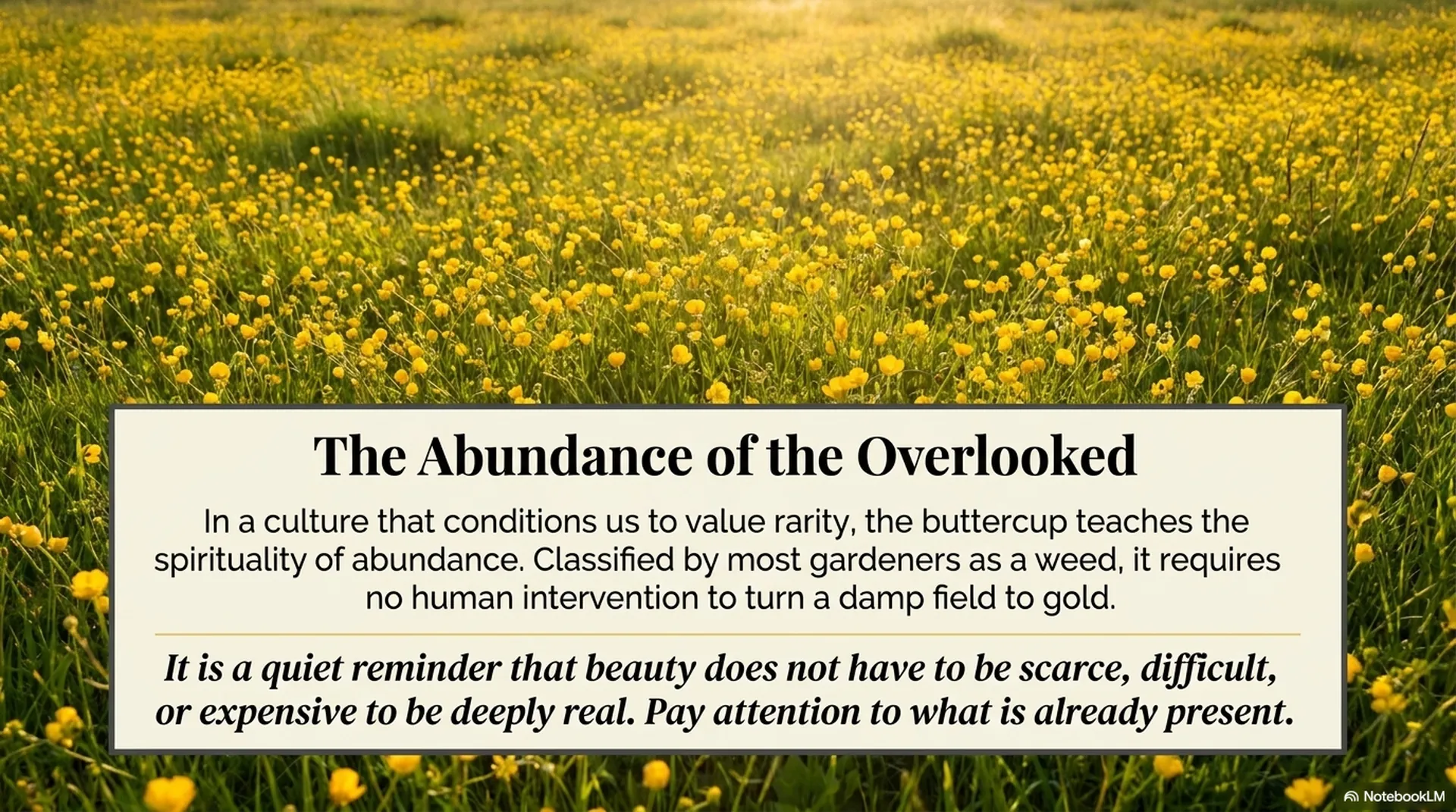
This connects to a broader spiritual theme in wildflower symbolism: the things most freely given are often the most overlooked. The buttercup, classified as a weed, dismissed from lawns and flowerbeds, and yet remembered by virtually every adult who spent time outdoors as a child, is a small argument for paying attention to what is already present rather than always seeking what is rare.
The flower also connects to themes of gratitude for small, daily pleasures — the opposite of the Victorian “ingratitude” reading, and perhaps its correction. Where the Victorians read childish thoughtlessness, a more generous interpretation sees the capacity to be genuinely delighted by something freely available, without needing it to be expensive or exclusive to enjoy it fully.
For those drawn to pansy meaning and childhood flower memories, the buttercup occupies a similar emotional register — both are flowers whose meaning is partly stored in specific personal memories rather than in abstract cultural codes.
FAQ
What does buttercup mean in the language of flowers?
In the Victorian language of flowers, the buttercup traditionally signified ingratitude and childishness — understood as naive, unreflective charm rather than mature feeling. In modern usage it is more positively associated with cheerfulness, simple joy, and childhood happiness.
Why is the buttercup called a buttercup?
The most widely accepted explanation is that the name refers to the butter-yellow colour of the flower combined with its cup-shaped form. A folk belief also held that cows grazing in buttercup-rich meadows produced richer, more golden butter — the flower was thought to be responsible for the colour of the butter, though cows actually avoid eating buttercups in quantity because the plants contain a mild irritant (protoanemonin).
Does buttercup symbolise love?
Not conventionally. The buttercup does not carry strong romantic symbolism in the way that roses, tulips, or even daisies do. Its associations are primarily with childhood, cheerfulness, and uncomplicated happiness. If it appears in a romantic context it tends to suggest playfulness or nostalgic affection rather than passionate love.
Sources
- Glover, B.J., Vignolini, S., et al. (2011). “The mirror-like optical properties of buttercup flowers.” Journal of the Royal Society Interface. DOI: 10.1098/rsif.2011.0759.
- Ovid. Metamorphoses. Translated by A.D. Melville. Oxford University Press, 1986. (Ranunculus mythological tradition.)
- Greenaway, Kate. Language of Flowers. London: Routledge, 1884.
- National Wildlife Federation / Wildflower Society references on Ranunculus acris ecology and distribution.


