

8 Types of Kale to Grow: Flavor, Hardiness, and Uses Compared

8 kale varieties ranked by flavor, cold hardiness, and use — including the species distinction most guides miss. Find your zone’s best pick in the comparison table.
Most gardeners pick a kale variety by what the seed packet looks like, without realizing they’re choosing between two distinct plant species — and that choice determines more about flavor, cold hardiness, and harvest timing than any growing technique will.
The majority of kale belongs to Brassica oleracea: curly, Lacinato, Redbor. These share a characteristic bitterness that softens dramatically after frost and the sturdy leaf texture that holds up well in soups and stir-fries. Red Russian and Siberian kale are Brassica napus — an ancient hybrid with turnip ancestry — producing leaves that are milder, more tender, and significantly more cold-tolerant from the start.
This guide covers eight varieties across both species, explains which USDA zones suit each one best, and includes a comparison table and use-case chooser so you can pick the right kale before seeds go in the ground.
Two Species, One Name: Why It Matters Before You Plant
The word “kale” covers two different plant species, and the difference matters more than most guides acknowledge. The majority of kale sold at garden centers — curly kale, Lacinato, Redbor — belongs to Brassica oleracea, the same species as cabbage, broccoli, and Brussels sprouts. These share a characteristic bitterness, sturdy leaf structure, and broadly similar cold-hardiness profiles.

Skip the guesswork — get a pre-planned 4×8 kitchen garden bed
Free printable planting plan: what goes where, when to plant it, and how to keep it alive. Plus two bonus flower bed plans.
Red Russian and Siberian kale are different. Both belong to Brassica napus, an ancient hybrid between B. oleracea and Brassica rapa (the turnip). That turnip ancestry produces leaves that are flatter, more tender, and noticeably milder — structured more like arugula than like the frilled cabbage-cousins on the same seed rack. According to NC State Extension, Brassica napus kales are “more tender than other varieties with a milder flavor” and more resistant to insects and diseases.
The practical split: choose B. napus for cold zones, raw salads, and mild flavor without frost conditioning. Choose B. oleracea for cooked applications, larger leaf structure, and peak fall-season flavor after a hard frost.
Curly Kale — The Beginner’s Standard
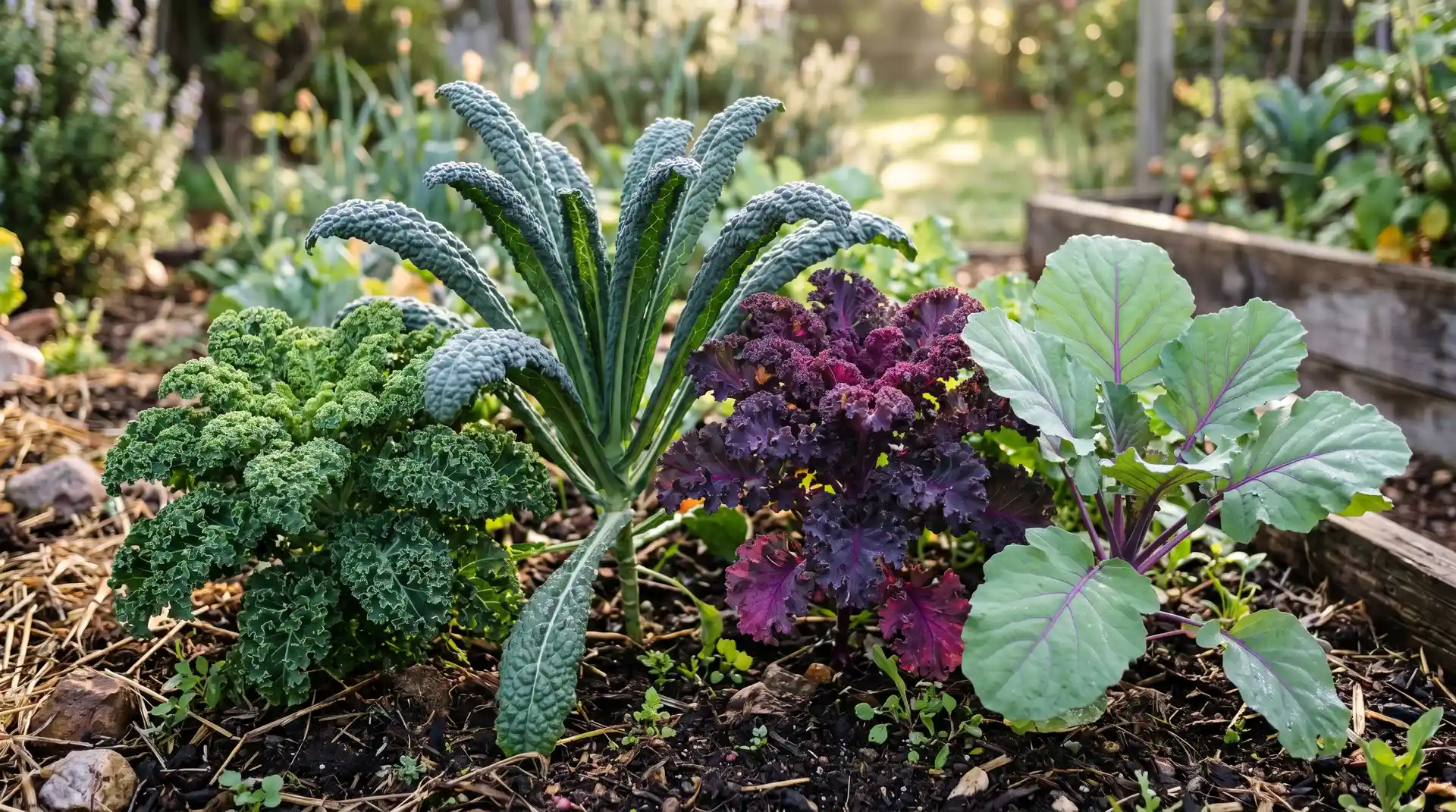
Tightly ruffled blue-green leaves and an earthy, slightly bitter flavor define the kale most people picture first. Curly kale earned that default status for good reasons: it’s productive, adaptable across zones 3–10 as a fall and winter crop, and the lowest-maintenance type for organic gardens. Those deep ruffles that give it its look also make life harder for cabbage caterpillars — larvae find the textured surface harder to grip than the smooth leaves of Lacinato or Red Russian, making curly kale the best choice for gardeners who prefer not to spray.
Flavor improves dramatically after cold. Utah State University Extension notes that heat causes “bitter or off flavors to develop” — the same plant that tastes sharp in September becomes noticeably sweeter after October frosts as the leaves convert starches to protective sugars.
Best cultivars: ‘Winterbor’ is the cold-hardiest standard variety, rated to about −5°F and reliable for zones 4–7 winter harvest. ‘Starbor’ (RHS Award of Garden Merit) grows to just 40cm tall and wide — ideal for containers or tight beds. ‘Dwarf Blue Curled’ matures early and works well for baby greens.
Best for: kale chips, soups, smoothies, stir-fries. The curled leaves hold texture through long cooking better than any other type.
Lacinato (Dinosaur) Kale — The Chef’s Choice
Lacinato’s long, narrow leaves are dark blue-green and puckered with a texture that genuinely resembles dinosaur skin. The flavor is earthier and deeper than curly, with a slight nutty undertone and considerably less bitterness — centuries of culinary breeding in Tuscany have optimized it for the kitchen. ‘Nero di Toscana’ (‘Black Tuscan’ or ‘Cavolo Nero’) holds an RHS Award of Garden Merit and crops reliably through March with consistent harvesting.
Cold hardiness is adequate but not exceptional — to around 10°F, suitable for zones 5–9 as a fall and winter crop. For zones 4–5, Rainbow Lacinato (see below) is the cold-hardy swap. For zones 7–9 where summer growing is the goal, ‘Black Magic’ handles heat stress better than standard Lacinato types.
Best for: Italian cooking — ribollita, pasta e fagioli, braised with garlic and olive oil. The leaves collapse beautifully when sautéed while holding more flavor through long cooking times than curly kale does.
Redbor Kale — Cold, Colorful, and Underused
Redbor earns its place in gardens that take both aesthetics and flavor seriously. The deep purple-red, tightly frilled leaves are striking from late summer through winter — and unlike purely ornamental kale, the flavor is genuinely good: mild, slightly nutty, and noticeably sweet once temperatures drop. The purple coloring deepens as temperatures fall, making November Redbor visually more dramatic than September Redbor.
The RHS gives Redbor an Award of Garden Merit and describes it as “tall, sturdy and fully hardy.” At two feet tall with dense foliage, it’s one of the more productive options by weight per square foot. Cold hardiness reaches around 0°F, making it reliable in zones 4–9. The deep color signals high anthocyanin levels — pigments that accumulate in cold as a form of cellular protection — which makes Redbor visually distinct from any other kale variety as the season progresses.
Best for: salads where color contrast matters, roasting (it caramelizes beautifully), and ornamental food garden beds where you want something that earns its spot visually as well as in the kitchen.
Portuguese (Tronchuda) Kale — The Overlooked Mild Option
Tronchuda barely appears in most variety guides, which is a mistake. Its large, paddle-shaped, smooth leaves with thick white midribs look nothing like curly or Lacinato kale — and cook differently too. The flavor is mild and sweet even before frost, the texture is tender, and the crunchy white stems are fully edible. At 18 inches tall and wide, it’s medium-sized but productive.
If you’ve served kale to skeptics who found it “too bitter,” Tronchuda is the closest thing to a guaranteed convert. It tolerates light frost well (zones 5–9 for fall harvest) but is less cold-hardy than curly or Siberian types, making it a fall-only crop in zone 5.
Stop missing your zone's planting windows.
Select your US zone and month — get a complete checklist of what to plant, prune, feed, and protect right now.
→ View My Garden CalendarBest for: raw salads, juicing, smoothies, and light sautés. The thick midribs hold up in juicers without turning bitter under pressure — something curly and Lacinato types struggle with. This is also the variety to reach for when you want mild leafy greens and don’t want to wait for frost to do the flavor work.
Red Russian Kale — Sweetest for Salads
Red Russian’s flat, slightly serrated green leaves with bright purple veins look more like arugula than kale — which is the first sign that this is a different plant. That Brassica napus ancestry produces a flavor that’s almost sweet, especially after frost, with a gentle mineral edge and none of the aggressive bitterness that makes some people dislike kale. Baby greens are ready in about one month; full maturity comes at roughly 50 days, making it the fastest of the eight varieties here.
Utah State University Extension recommends Red Russian specifically for “excellent production, eating quality and cold hardiness.” Zone guidance matters: Red Russian thrives in zones 3–7 where summers are short enough to prevent rapid bolting. In zones 8–10, plant as a fall and winter crop only — summer heat triggers bolting within weeks. For zone-by-zone timing on cool-season crops, the year-round planting guide covers specific dates across all USDA zones.
Best for: raw salads, wraps, fresh baby-leaf harvest through late fall. At baby stage with 1-inch leaves, Red Russian is arguably the best of all kale types for eating raw — none of the chewing resistance that puts off first-time kale eaters.
Siberian Kale — Cold-Climate Champion
For gardeners in zones 3–5, Siberian kale isn’t just the best kale choice — it may be the best leafy green for winter harvest overall. NC State Extension confirms it “can be grown all winter long” in southern regions, and reports of mature plants surviving down to −20°F are consistent with its northern Asian and northern European origin. It became a homesteader staple in the 19th century precisely because it survived frosts that killed other brassicas.
Leaves are ruffled blue-green and larger than Red Russian, reaching 24–36 inches at full height. Flavor is mild and slightly sweet — the typical B. napus characteristic. Maturity takes about 60 days, so for a winter harvest in zone 4, sow mid-summer to have established plants heading into October. Just as you’d plan a vegetable rotation to follow warm-season crops like tomatoes, Siberian kale fills the opposite end of the season calendar with no growing overlap and no soil competition.
Cultivar choices: ‘Premier’ (compact 12-inch leaves — best for containers or raised beds), ‘Red Ursa’ (Frank Morton’s Red Russian × Siberian cross, award-winning flavor and color), and standard ‘Siberian Kale’ (reliable and productive). NC State Extension notes these Brassica napus varieties are more resistant to insects and diseases than B. oleracea types, making them lower-maintenance in pest-prone gardens.
Best for: zones 3–5 winter harvest, succession planting for fresh greens through March, or any gardener who prioritizes cold hardiness above all other considerations.
Rainbow Lacinato — Cold-Hardy Lacinato Upgrade
Rainbow Lacinato delivers the deep, earthy Lacinato flavor with two meaningful improvements: it’s more cold-hardy than standard Lacinato, extending viable growing into zones 4–5 where standard Lacinato struggles, and it’s slower to bolt in marginal conditions. The blue-green leaves develop red and purple hues as temperatures fall, intensifying through autumn into something visually striking that plain Lacinato cannot match.
The flavor gain over standard Lacinato is modest — the main argument for Rainbow is the extended cold hardiness range and the seasonal color development. For zone 5 gardeners who love Lacinato’s cooking qualities but have lost plants to early November frosts, this is the practical switch.
Best for: zone 4–6 gardens where standard Lacinato is marginal; fall and early winter harvest; decorative food garden beds where appearance through November matters.
Why Frost Sweetens Kale — The Science Behind It
“Frost sweetens kale” appears in nearly every growing guide, but the mechanism is rarely explained. Here’s what actually happens at a cellular level.
When temperatures drop into the above-zero single digits — around 2–5°C — kale plants convert stored starches into simple sugars, primarily sucrose and glucose, as a cold-protection strategy. These sugars lower the freezing point of cell fluid, acting as a natural antifreeze that protects cell membranes from ice crystal damage. Peer-reviewed research on cold acclimatisation in kale found that cold exposure significantly increases soluble sugar content while glucosinolate levels — the compounds responsible for kale’s characteristic bitterness — may simultaneously decrease. The result is a double flavor shift: more sweetness, less bitter edge.
This metabolic response begins at above-zero single-digit temperatures, not just after a hard freeze. The plant doesn’t need ice to trigger the reaction — a string of cold autumn nights is enough to start the starch-to-sugar conversion. Different cultivars respond at different rates, which is why Red Russian (already mild) shows a smaller perceptible shift than curly kale (sharply bitter before cold), which can transform dramatically between a September and a November harvest.
Practical harvest timing: in zones 5–7, late October through November typically delivers the best-tasting kale of the year. One overnight frost is less effective than a sustained stretch of cold nights — the flavor peak comes from accumulated metabolic change, not a single frost event.
Choosing the Right Kale Variety
Here’s how all eight varieties compare across the key growing decisions:
| Variety | Species | Height | Cold to | Flavor | Best For |
|---|---|---|---|---|---|
| Curly Kale (Winterbor) | B. oleracea | 2 ft | −5°F | Earthy, bitter to sweet | Chips, soups, smoothies |
| Lacinato | B. oleracea | 2–3 ft | 10°F | Deep, nutty, less bitter | Soups, sautés, braising |
| Redbor | B. oleracea | 2 ft | 0°F | Mild, nutty, sweet | Salads, roasting |
| Portuguese (Tronchuda) | B. oleracea | 18 in | 20°F | Mild, sweet without frost | Raw salads, juicing |
| Red Russian | B. napus | 3 ft | 5°F | Almost sweet, mild | Raw salads, baby greens |
| Siberian | B. napus | 24–36 in | −20°F | Mild, slightly sweet | Zones 3–5, containers |
| Rainbow Lacinato | B. oleracea | 2–3 ft | 5°F | Deep, earthy, nutty | Zones 4–6, Italian cooking |
| Starbor (compact curly) | B. oleracea | 15 in | −5°F | Earthy, slightly bitter | Containers, small gardens |
Quick chooser by use case:
- First-time grower: Curly Kale (Winterbor) — reliable, pest-resistant, hard to kill
- Raw salads and baby greens: Red Russian — mildest flavor, ready in one month
- Soups and Italian cooking: Lacinato, or Rainbow Lacinato for zones 4–6
- Winter harvest, zones 3–5: Siberian Kale — the cold champion
- Ornamental plus edible: Redbor — deepens purple in cold
- Kale skeptics who hate bitter: Portuguese Tronchuda or Red Russian
- Containers and small-space growing: Starbor or Premier (Siberian) — both under 15 inches
Frequently Asked Questions
What is the easiest kale to grow for beginners?
Curly kale — specifically ‘Winterbor’ — is the most forgiving variety. It tolerates cold down to −5°F, naturally deters cabbage worms with its ruffled texture, and produces heavily from late summer through winter. Start here before experimenting with Lacinato or Siberian types.
Which kale survives winter in zones 3–5?
Siberian kale is the strongest choice, with mature plants reported to survive down to −20°F. Red Russian is a reliable second option and matures faster at 50 days versus 60. Both belong to Brassica napus and handle extreme cold significantly better than standard curly or Lacinato varieties.
Does all kale taste better after frost?
Yes, but the degree varies. Red Russian and Siberian kale (B. napus) are already mild before frost, so the improvement is less dramatic. Curly kale shows the most noticeable shift — from sharply bitter to genuinely sweet — after several cold nights in the single digits Celsius. For best flavor across all types, wait for a sustained cold period rather than a single overnight frost.
Which Kale Should You Grow?
The right variety comes down to three things: your USDA zone, how you’ll use the harvest in the kitchen, and how much bitterness you’re comfortable with before frost arrives. For zones 3–5, Siberian kale is the clear cold-hardiness choice. For raw salads, Red Russian. For soups and Italian cooking, Lacinato or Rainbow Lacinato. For ornamental impact that doubles as a kitchen harvest, Redbor.
If this is your first kale crop, start with Winterbor curly kale and add a second variety the following season once you’ve learned your garden’s cold timing. The frost-sweetening mechanism applies to all of them — the only variable is when that first sustained cold arrives in your zone. For a comparison of kale with another popular winter green, the kale vs. Swiss chard guide breaks down the differences in flavor, nutrition, and growing demands. A complete kale growing guide with full spacing, watering, and season-extension details is the next read once you’ve settled on your variety.
Sources
- NC State Extension — Brassica napus Pabularia Group (Siberian Kale): https://plants.ces.ncsu.edu/plants/brassica-napus-pabularia-group/
- Utah State University Extension — Kale in the Garden
- Royal Horticultural Society — How to Grow Kale
- PubMed — Cold acclimatisation effects on glucosinolates, sugars and fatty acids in kale


