

7 Companion Plants for Kale (Plus 4 to Avoid in the Same Bed)

7 research-backed companion plants for kale that fight aphids, cabbage worms, and flea beetles — and 4 neighbors to avoid.
Plant kale in isolation and you’re practically inviting every brassica pest in the garden to dinner. The imported cabbageworm, cabbage looper, and diamondback moth all locate Brassica oleracea var. acephala — the species name for kale — through volatile chemical signals the leaves emit, and they arrive within days of transplant. Flea beetles appear almost as fast, riddling young seedlings with tiny round holes. Cabbage aphids cluster on new growth and leaf undersides, building colonies fast enough to stress even a mature plant before you notice them.
Companion planting addresses all of these pests through biology, not gardening folklore. The right neighbors either mask kale’s chemical signals from flying insects, attract the parasitoid wasps that hunt caterpillars and aphids before populations build, or function as decoy crops that draw pest pressure away from your kale entirely. Utah State University Extension confirms that when brassica crops are inter-planted with unrelated plants, larval populations tend to be lower and parasitism by beneficial wasps increases. [3]

The seven companions below do at least one of those things with documented evidence behind them. The four plants to avoid either concentrate pest pressure, compete aggressively for root space, or suppress kale through allelopathic root chemistry.
Kale’s Main Pest Threats
Knowing which pests you’re actually dealing with shapes which companions matter most. Kale faces three categories of pressure:
- Caterpillars: The imported cabbageworm (Pieris rapae), cabbage looper (Trichoplusia ni), and diamondback moth (Plutella xylostella) are the primary species. Each has specific parasitoid wasps: Cotesia glomerata and Cotesia rubecula parasitize cabbageworm; Diadegma insularis targets diamondback moth larvae. [3] Companions that sustain these wasps do the most work in your garden.
- Aphids: Cabbage aphid (Brevicoryne brassicae) is the main species on kale. Its primary parasitoid is Diaeretiella rapae, a tiny wasp that lays eggs inside individual aphids. [2] Understanding this explains exactly why sweet alyssum belongs in every brassica bed.
- Flea beetles: Crucifer flea beetles jump rapidly between plants and are especially destructive to seedlings. A treatment threshold of just 1–5 beetles per plant is appropriate on young transplants. [4]
Quick Reference: 7 Good Companions, 4 to Avoid
| Plant | Primary Benefit | Evidence Level |
|---|---|---|
| Garlic / Onions / Chives / Leeks | VOC odor masking of host plant from aphids | Research-backed (T1) |
| Dill | Parasitoid wasp habitat + flea beetle repellent | Research-backed (T1) |
| Sweet Alyssum | Banker plant for D. rapae aphid parasitoid | Research-backed (T1) |
| Thyme / Sage | Diamondback moth reduction in greenhouse trials | Research-backed (T1) |
| Nasturtiums | Trap crop for aphids and caterpillar adults | Research-backed (T2) |
| African Marigolds | Syrphid fly habitat; aphid deterrence (not flea beetles) | Mixed evidence |
| Hairy Vetch (cover crop) | Kale yield doubled; weed suppression before main planting | Research-backed (T1) |
| Sunflowers — AVOID | Sesquiterpene lactones inhibit brassica germination | Research-backed |
| Fennel — AVOID | Allelopathic to most crops within 3–5 feet | Research-backed |
| Other Brassicas — AVOID | Concentrates caterpillar and aphid pressure | Established practice |
| Strawberries — AVOID | Compete for shallow root zone; shared slug and thrips risk | Practitioner consensus |
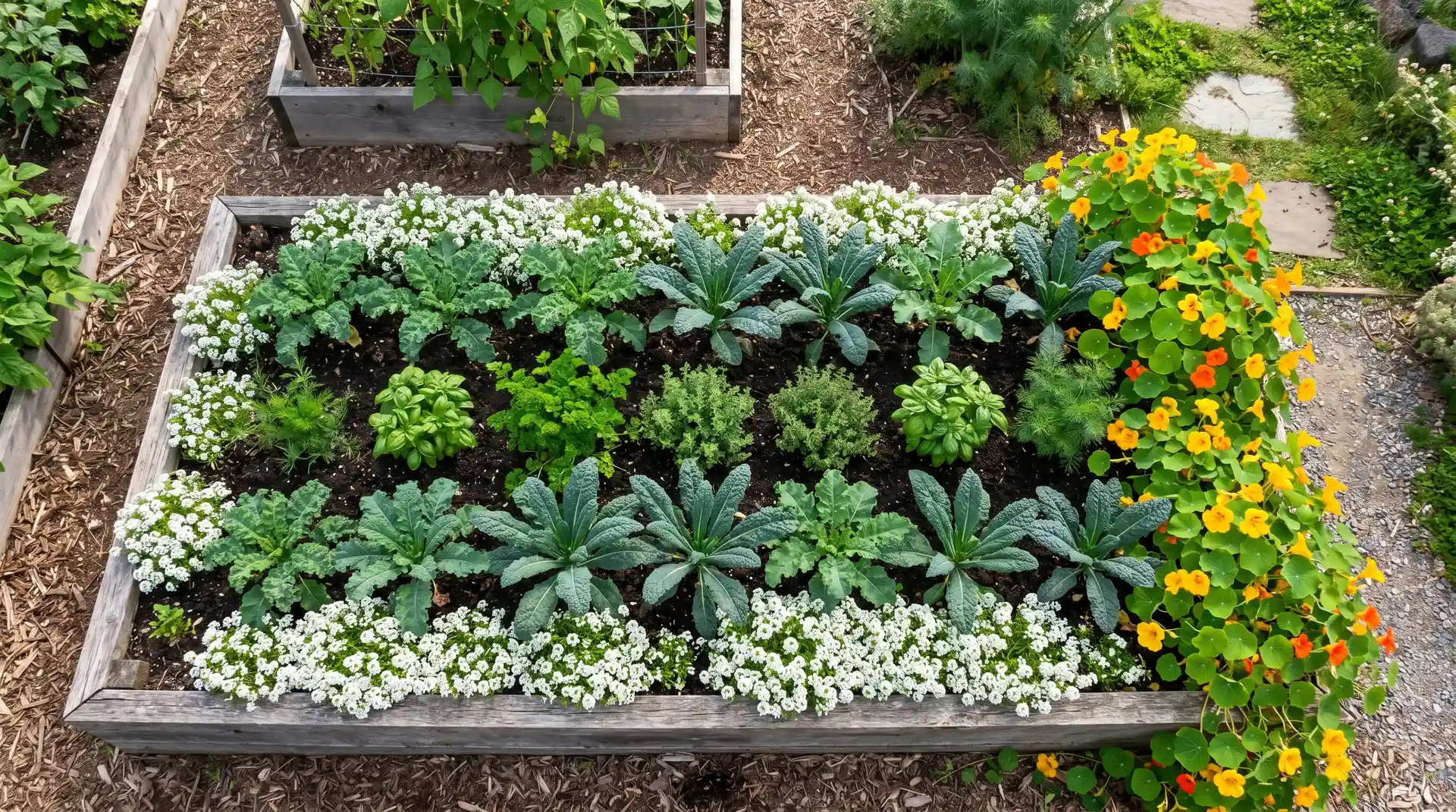
The 7 Best Companion Plants for Kale
1. Alliums: Garlic, Onions, Chives, and Leeks
Alliums are the strongest evidence-backed companion for kale, and the mechanism behind them is specific. Their sulfur volatile organic compounds — 94% of allium VOC emissions are sulfur-based — physically adhere to the leaves of neighboring plants, masking the host plant’s chemical identity from aphids. [5] A cabbage aphid that cannot detect kale’s characteristic leaf volatiles has no guidance signal to land on it. The protective effect works within roughly 12–18 inches; at three feet or more, the VOC concentration dissipates enough to lose its value.
Garlic is the most practical choice for most kale beds. Its tall, narrow form doesn’t shade kale, and it’s harvested by midsummer in most US climates — right before kale enters its heat-stressed period — so it doesn’t compete for resources when kale needs them most. Chives work equally well in smaller beds and re-grow through the season, providing a continuous VOC source. Onion sets planted around the perimeter serve double duty as both pest deterrents and a harvest you can actually use.
One calibration worth including: a 2021 study found that leek VOCs disrupted aphid feeding by 50% but paradoxically increased aphid fecundity in laboratory cage experiments — what the authors called a “hometic effect.” Field results differ from enclosed lab conditions, and the consensus across university extension services remains solidly pro-allium. Include them, but pair them with other companions rather than treating them as a standalone solution.
How to plant: Garlic cloves every 4–6 inches along kale bed edges and between plants. Chives at 6–8 inch spacing within rows. For best effect, plant alliums on all sides of the kale bed rather than one edge only.
2. Dill
Dill earns its place in the kale bed twice over — once as a young plant, again as a flowering one — and most companion planting guides miss this entirely. Young dill at the harvest stage releases terpenoid VOCs from its aromatic foliage that may help mask nearby crops from aphids searching for host plants. Once dill bolts and opens its flat umbel flowers, it becomes a dedicated habitat plant for parasitoid wasps, which require pollen and nectar as adults. The parasitoid wasp Cotesia glomerata, which lays its eggs inside imported cabbageworm larvae, uses dill flowers as a primary nectar source. [3]
Dill also plays a direct role in flea beetle management. Utah State University Extension lists dill as part of a push-pull strategy: aromatic companions repel flea beetles from the main crop while trap crops planted on the perimeter simultaneously attract them. [4] Planting a row of Chinese southern giant mustard or pac choi two to four weeks before your kale, with dill interspersed within the kale bed, creates a functional push-pull system that outperforms either approach alone.
The practical catch: you cannot harvest dill for cooking and maintain the beneficial insect habitat from the same plant simultaneously. Once it bolts, let those plants flower rather than cutting them back. Succession-sow every three weeks — harvest the early rows, and let the final row flower at the bed edge where it can also intercept incoming caterpillar moths.
How to plant: One dill plant every 3–4 feet within the kale bed. A dedicated row of flowering dill at the sunniest edge provides the densest wasp habitat.
3. Sweet Alyssum
Sweet alyssum (Lobularia maritima) functions as a banker plant for Diaeretiella rapae, the parasitoid wasp that lays eggs inside cabbage aphids. Oregon State University research found that parasitism of cabbage aphids was nearly doubled in alyssum-planted plots compared to pure brassica stands — one of the cleaner data points available for any companion plant claim. [6] Clemson University’s Land-Grant Press lists sweet alyssum, buckwheat, cilantro, and dill as the most effective flowering plants for attracting parasitoids to brassica beds specifically. [7]
Honest limitation: the same USDA ARS research that documented alyssum’s parasitoid-boosting effect acknowledged “mixed results” on brassicas compared to its stronger performance on lettuce. Aphids on kale can retreat into the dense lower canopy and leaf axils, making them harder for parasitoids to reach than aphids on open-leafed lettuce. [6] Alyssum significantly increases beneficial wasp populations around your kale — what that translates to in actual aphid numbers depends on how early in the season you establish it and whether aphid populations are already entrenched.


Start sweet alyssum from seed alongside your kale transplants. It germinates quickly and flowers within six weeks, staying in bloom through most of the season with minimal deadheading needed.
How to plant: One alyssum plant per two to three kale plants, positioned 6–8 inches from the kale row. A border of alyssum along one side of the bed provides concentrated habitat without competing for bed space.
4. Thyme and Sage
Thyme is the most underrated companion on this list. A greenhouse study (Dove 1986), cited in the University of Minnesota Extension companion planting guide, found that sage and thyme reduced diamondback moth populations on Brussels sprouts — a close relative of kale sharing the same pest pressure. [1] A 2006 Iowa State University study testing multiple companions alongside broccoli found thyme “might have been its best protector” against cabbage loopers and imported cabbageworm, ranking it above marigolds, onions, and nasturtiums. [1]
The mechanism is VOC-based: thyme releases monoterpenoids, particularly thymol, that interfere with the chemoreception insects use to locate host plants. Sage produces 1,8-cineole and camphor with similar effects. [5] Both compounds disrupt the host-finding behavior of adult cabbageworm and diamondback moths searching for egg-laying sites — which means the protection happens before damage starts, not after.
Both are perennials in USDA Zones 5–9, so planting them once protects your kale for years. Position them along the upwind edge of your kale bed to maximize VOC drift across the planting.
How to plant: Thyme and sage 12–18 inches apart along the windward perimeter. Both tolerate full sun and dry conditions better than kale, so place them where water stress is less of a concern.
5. Nasturtiums
Nasturtiums work as a trap crop for kale — aphid populations and egg-laying cabbageworm moths preferentially land on nasturtiums when they’re available nearby, drawing pest pressure away from the kale you’re protecting. UMN Extension cites nasturtiums as part of the companion combinations that reduced cabbage looper and imported cabbageworm damage in broccoli research trials. [1]
The spacing rule matters more here than most guides acknowledge. Nasturtiums attract aphids deliberately, which means if they’re planted too close to kale and populations peak, aphid colonies can overflow onto adjacent plants during warm weather. Plant nasturtiums at least 18–24 inches from kale plants, or as a perimeter row outside the main bed entirely. Monitor weekly once temperatures climb above 70°F, when aphid reproduction accelerates. The goal is to concentrate pests on a sacrificial plant, not to introduce a secondary infestation at the kale’s doorstep.
Direct-sow nasturtiums two weeks before your kale transplant date to establish the trap crop before the main planting fills in. Trailing varieties spread to fill gaps; bush types are easier to manage in tight raised beds.
How to plant: Perimeter row, minimum 18–24 inches from kale plants. One nasturtium plant per two to three kale plants if inter-planting directly in a large bed.
Stop guessing if your garden pays.
Log what you grow and harvest — see total yield weight, estimated retail value, and season-on-season progress in one place.
→ Track My Harvest6. African Marigolds
African marigolds (Tagetes erecta) attract syrphid fly adults — whose larvae are active predators of soft-bodied insects including aphids — and support a broad range of beneficial insects that use the open flower structure for nectar and pollen. Their roots produce alpha-terthienyl, a compound that suppresses nematodes in the surrounding soil, though this nematode effect requires planting marigolds as a dense cover crop for two or more months in the same location before the susceptible crop — not just interplanting them alongside kale.
One correction worth making to widespread gardening advice: University of Minnesota Extension explicitly states “there is little research to support” marigolds repelling flea beetles from brassicas. [1] If flea beetles are your main problem with kale, marigolds shouldn’t be your primary tool — the push-pull system with dill and B. rapa trap crops is more effective. For general aphid deterrence and beneficial insect habitat, African marigolds contribute meaningfully, and that’s what they’re best used for.
How to plant: One marigold plant every 12–18 inches within the kale bed, or as a row between kale and the bed border.
7. Hairy Vetch (Cover Crop Companion)
Hairy vetch (Vicia villosa) delivers the most dramatic yield benefit of anything on this list — provided you approach it as a pre-season cover crop rather than a simultaneous companion. A 2009 study by Mennan, Ngouajio, Kaya, and Isık, conducted over two growing seasons at the Black Sea Agricultural Research Institute in Turkey, found that kale yield in hairy vetch plots was more than double that of the no-cover-crop control — roughly a 100%+ yield increase. Weed suppression was also strongest in hairy vetch plots compared to sorghum, sudangrass, pea, and amaranth treatments. [8]
The mechanism combines nitrogen fixation and organic matter: hairy vetch fixes atmospheric nitrogen into the root zone throughout the growing season and releases it as organic nitrogen when the biomass decomposes after incorporation. This slow nitrogen release matches kale’s feeding pattern far better than synthetic fertilizer, which delivers a nitrogen spike that research links to conditions favoring aphid outbreaks.
Sow hairy vetch in early fall, let it overwinter and fix nitrogen through spring, then terminate and incorporate it two weeks before your kale transplant date. It’s a season-ahead commitment — not a same-season fix — but among the best investments you can make for a high-productivity kale bed.
4 Plants to Keep Out of the Kale Bed
Sunflowers
Sunflowers produce sesquiterpene lactones and other phenolic allelochemicals released through root exudates and decomposing plant residue. Research has documented that β-caryophyllene — a sesquiterpene present in sunflower tissue — inhibits germination and reduces seedling root elongation in related Brassica species even at low concentrations. Keep sunflowers at least 10 feet from your kale, or grow them in a completely separate bed on the opposite side of the garden.
Fennel
Fennel releases anethole and fenchone from its roots — allelopathic compounds that suppress germination and root development in a wide range of nearby crops. This isn’t kale-specific; fennel is broadly incompatible with most vegetables and herbs. It belongs in an isolated container or at a minimum of 3–5 feet from any vegetable planting. The one use case for fennel near your garden: letting it flower at the far periphery does attract parasitoid wasps, which is documented by Clemson University. [7] Keep that role strictly outside the kale bed.
Other Brassicas
Grouping kale with cabbage, broccoli, cauliflower, or Brussels sprouts concentrates brassica pest pressure in a single area. All of these crops emit the same volatile leaf chemicals that guide imported cabbageworm moths searching for egg-laying sites — planting them together creates a highly attractive target. Club root, black rot, and downy mildew also spread readily between closely planted brassica relatives. Rotate brassicas to different beds each year and avoid planting them adjacent to each other within the same season.
Strawberries
Strawberries and kale compete for the same shallow root zone — both are shallow feeders that occupy the top 6–12 inches of soil. They also share vulnerability to slugs and thrips. In large in-ground beds with plenty of space, some gardeners manage this pairing, but in raised beds and small spaces the competition consistently outweighs any benefit. For strawberry placement strategies that keep them productive without encroaching on your brassica beds, see our strawberry growing guide.
How to Lay Out Your Kale Companion Bed
A 4×8 raised bed of kale can support a full push-pull companion system in three layers:
- Perimeter — push layer: Thyme and sage along the windward side (typically south or west in US gardens). Garlic or chive planted every 6 inches along the remaining three sides.
- Interior — habitat layer: One sweet alyssum plant between every second kale plant. One dill plant at each corner of the bed, left to flower once it bolts.
- Outside the bed — pull layer: A nasturtium row 18–24 inches from the bed edge. A 2-foot trap crop row of pac choi or Chinese mustard, seeded two to four weeks before the kale transplant date to intercept flea beetles first.
For complete growing advice from soil prep to harvest, see our kale growing guide.
For a comprehensive look at which companion pairings are actually backed by research across your whole vegetable garden, see our companion planting guide for vegetables.

Frequently Asked Questions
Can I grow kale and tomatoes together?
Sources differ on this pairing. Some gardeners report reduced diamondback moth pressure when tomatoes are nearby; others keep them in separate beds because kale prefers consistent moisture while tomatoes tolerate drier periods. Neither crop actively harms the other, but they’re not a strong positive pairing. Prioritize companions with documented mechanisms over tomatoes as a pest-control tool for kale.
Does garlic actually grow well next to kale, or just help with pests?
Both. Garlic is harvested by midsummer in most US climates, right as kale enters its warmest growing period. The timing works cleanly — garlic occupies vertical space and finishes before kale’s canopy fills in fully, so there’s no meaningful competition for resources during the period when garlic is actively protecting nearby plants.
Is companion planting still useful if I use row covers?
Row covers are the most effective physical barrier for flea beetles and caterpillar moths and should be your first line of defense on young transplants. Companions become most valuable once you remove covers — typically once plants are established enough to tolerate some pest pressure, or at flowering when pollinators need access. Think of companion planting as the defense layer that takes over when the cover comes off.
Sources
[1] University of Minnesota Extension. “Companion Planting in Home Gardens.” extension.umn.edu
[2] UC IPM / UC ANR. “Cabbage Aphid — Cole Crops.” ipm.ucanr.edu
[3] Utah State University Extension. “Caterpillar Pests of Brassica Vegetables.” extension.usu.edu
[4] Utah State University Extension. “Flea Beetles on Vegetables.” extension.usu.edu
[5] Ben-Issa R, Gomez L, Gautier H. “Companion Plants for Aphid Pest Management.” Insects. 2017;8(4):112. pmc.ncbi.nlm.nih.gov
[6] USDA ARS. “Flower Power: Attracting Natural Enemies of Pests to Your Field and Garden.” ars.usda.gov
[7] Clemson University Land-Grant Press. “Common Natural Enemies of Brassica Insect Pests.” lgpress.clemson.edu
[8] Mennan H, Ngouajio M, Kaya E, Isık D. “Weed Management in Organically Grown Kale Using Alternative Cover Cropping Systems.” Weed Technology. 2009;23(1). cambridge.org


