Sansevieria Types: Snake Plant Varieties Guide

Sansevieria Types: Snake Plant Varieties Guide
Snake plants are among the most recognisable houseplants in the world — but most people only know one or two varieties. In reality, there are over 70 species in the genus (now reclassified under Dracaena), and the cultivated varieties available to home growers range from 6-inch rosettes that fit on a desk to 4-foot architectural specimens that anchor a living room.
This guide profiles the 10 most popular snake plant varieties in depth, plus a handful of lesser-known cultivars worth hunting down. For each one, you’ll get the key details: appearance, mature height, care quirks, best placement, and whether the variegation holds stable. If you’re new to snake plants entirely, start with our complete snake plant care guide first — then come back here to choose your next variety.
A Quick Note on Names
In 2017, molecular phylogenetic studies led Kew Gardens to reclassify the entire Sansevieria genus into Dracaena. Every snake plant species — including the classic Sansevieria trifasciata — is now officially Dracaena trifasciata. You’ll still see “Sansevieria” on nearly every nursery label, and both names refer to exactly the same plants. For a deeper look at the taxonomy, see our Dracaena trifasciata species page.
Throughout this guide, we use the cultivar names that nurseries actually label their plants with — these haven’t changed.
10 Snake Plant Varieties in Detail
1. Laurentii (Dracaena trifasciata ‘Laurentii’)
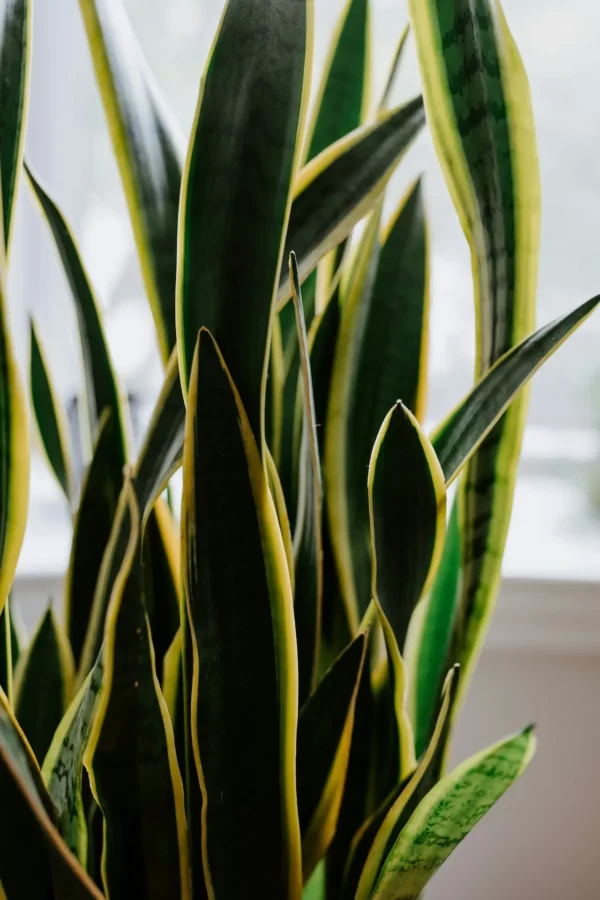
The iconic snake plant. If you picture a snake plant in your mind, this is almost certainly the one you see — tall, sword-shaped leaves in dark green with silvery horizontal banding and bold golden-yellow margins running the full length of each leaf.
- Max height: 3–4 feet (90–120 cm)
- Growth habit: Upright, clumping, with new pups emerging from rhizomes at the base
- Care quirks: Needs brighter indirect light than plain green varieties to maintain the yellow edge. In sustained low light, new leaves emerge with reduced or absent yellow margins — the plant reverts toward plain green.
- Best placement: 2–4 feet from a bright window (east or south-facing). Works as a floor plant or tall shelf accent.
- Variegation stability: Moderate. The golden margin is a chimeral variegation — it’s maintained through division but lost when propagating from leaf cuttings. Leaf cuttings produce plain green offspring.
Laurentii accounts for the majority of snake plants sold worldwide and remains the best all-round variety for most homes.
2. Hahnii / Bird’s Nest (Dracaena trifasciata ‘Hahnii’)
A compact dwarf mutation discovered in 1939 by Sylvan Hahn at a New Orleans nursery. Instead of growing tall upright leaves, Hahnii forms a tight, low rosette — a “bird’s nest” — that rarely exceeds 8 inches. The leaves are shorter, wider, and curve gently inward, creating a funnel shape.
- Max height: 6–8 inches (15–20 cm)
- Growth habit: Low rosette, slowly offsetting to form clusters
- Care quirks: Extremely tolerant of neglect. The compact form means less leaf surface area losing water, so it dries out even more slowly than tall varieties. Water less frequently than standard snake plants — every 3–5 weeks in summer is typical.
- Best placement: Desks, bookshelves, bathroom windowsills, terrariums (open-top only). Its small footprint makes it ideal for spaces where a tall plant won’t fit.
- Variegation stability: The standard Hahnii is plain green with faint banding. ‘Golden Hahnii’ has yellow margins like a miniature Laurentii; ‘Silver Hahnii’ has pale silvery-green leaves. Both variegated forms need bright indirect light to hold their colour.
The bird’s nest snake plant is one of the best desk plants available — virtually impossible to kill and perfectly scaled for small spaces.
3. Moonshine (Dracaena trifasciata ‘Moonshine’)
Moonshine is immediately recognisable for its ethereal, almost ghostly appearance. The broad, upright leaves are a uniform silvery sage-green — so pale they appear nearly white in certain light — with extremely faint horizontal banding visible only up close.
- Max height: 2 feet (60 cm)
- Growth habit: Upright, moderately compact, with broader leaves than Laurentii
- Care quirks: The pale colouring is light-dependent. In low light, new leaves darken to standard green over time, losing the signature silvery tone. Bright indirect light is essential to maintain the moonshine effect.
- Best placement: A bright room where the pale leaves can contrast against darker furniture or walls. Stunning in white or light-grey ceramic pots. Avoid direct afternoon sun — the pale leaves scorch more easily than darker varieties.
- Variegation stability: Good in bright conditions. The silvery colour is structural (related to wax and chlorophyll distribution) rather than chimeral, so it’s more stable than margin-based variegation — but it still fades in low light.
Moonshine is a favourite among interior designers for its minimalist, architectural appeal. It also features on our list of best low-light houseplants, though brighter conditions bring out its best colour.
4. Black Gold (Dracaena trifasciata ‘Black Gold’)
Think of Black Gold as Laurentii’s darker, moodier sibling. The leaf centres are an extremely deep green — nearly black in low light — bordered by rich golden-yellow margins. The contrast is sharper and more dramatic than Laurentii.
- Max height: 2.5–3 feet (75–90 cm)
- Growth habit: Upright, dense clumping
- Care quirks: Slightly more cold-sensitive than average — keep above 55°F (13°C). The deep leaf colour means it handles moderate light better than pale varieties, but bright indirect light maximises the gold margin contrast.
- Best placement: Floor plant near a bright window. The dark leaves pair well with light-coloured pots and pale walls.
- Variegation stability: Very stable. The gold margin holds well even in moderate light, and the deep green centre rarely changes.
5. Cylindrica (Dracaena angolensis, formerly Sansevieria cylindrica)
Cylindrica breaks every rule about what a snake plant “looks like.” Instead of flat, sword-shaped leaves, it produces perfectly round, pencil-thick spears that grow straight up from the base. Each spear is dark green with lighter horizontal bands and tapers to a sharp point.
- Max height: 3–5 feet (90–150 cm), though 2–3 feet is more typical indoors
- Growth habit: Upright individual spears in a fan-like arrangement from the base. Sometimes sold with tips braided or woven — this is purely cosmetic and doesn’t affect health.
- Care quirks: Identical to trifasciata varieties. The cylindrical leaves store water extremely efficiently, making this one of the most drought-tolerant sansevieria types. Water even less frequently than flat-leaved varieties — every 3–6 weeks in summer.
- Best placement: A sculptural floor plant for modern or minimalist interiors. The vertical lines work well in narrow spaces — hallways, beside doorways, or in corners.
- Variegation stability: Standard Cylindrica is not variegated. A rare cultivar ‘Patula Boncel’ (starfish sansevieria) has a fan-shaped growth pattern with shorter, fatter cylindrical leaves.
The cylindrical snake plant is the most architecturally distinctive variety and a conversation piece in any room.
6. Bantel’s Sensation (Dracaena trifasciata ‘Bantel’s Sensation’)
Bantel’s Sensation is the collector’s snake plant. Narrow, upright leaves feature irregular vertical stripes of white, cream, and varying shades of green — no two leaves are exactly alike. The effect is elegant, airy, and unmistakably different from any other variety.
- Max height: 2.5–3 feet (75–90 cm)
- Growth habit: Upright, narrower leaves than Laurentii, slightly slower growth
- Care quirks: Slower growing than most varieties due to reduced chlorophyll in the white-striped sections. Needs consistent bright indirect light — in low light, the white stripes narrow and new leaves may emerge mostly green. More susceptible to overwatering than robust green varieties.
- Best placement: A well-lit room where the variegation can be appreciated up close. Ideal as a tabletop or console plant rather than a distant floor specimen.
- Variegation stability: Moderate to unstable. The white striping is chimeral and can revert in poor light. Propagate by division only to preserve the pattern — leaf cuttings produce plain green plants.
7. Whitney (Dracaena trifasciata ‘Whitney’)
Whitney is essentially a compact, refined version of Laurentii — similar dark green leaves with silver banding and creamy-white to silver margins, but growing in a shorter, denser clump. It’s more proportional for tabletops and smaller rooms.
- Max height: 1–1.5 feet (30–45 cm)
- Growth habit: Compact, upright rosette — taller than Hahnii but much shorter than Laurentii
- Care quirks: Standard snake plant care. The silver-white margins need moderate to bright indirect light to stay vivid. Very forgiving of inconsistent watering.
- Best placement: Side tables, bathroom counters, office desks. The mid-size form fills the gap between tiny Hahnii and tall Laurentii.
- Variegation stability: Good. The silvery-white edge is reasonably stable in decent light conditions.
8. Futura Robusta (Dracaena trifasciata ‘Futura Robusta’)
Futura Robusta is a chunky, no-nonsense variety with short, broad, heavily textured leaves. The leaves are silvery-green with prominent dark green horizontal bands — thicker and more tightly packed than most varieties. There’s no coloured margin; the appeal is in the bold patterning.
- Max height: 1.5–2 feet (45–60 cm)
- Growth habit: Compact, upright, densely packed rosette
- Care quirks: One of the most robust and forgiving varieties — lives up to its name. Handles low light, dry air, and inconsistent watering without visible stress. The thick leaves store substantial water reserves.
- Best placement: Anywhere you need a mid-sized, low-maintenance plant. Particularly good for offices, bedrooms, and spaces without great natural light.
- Variegation stability: Not variegated in the traditional sense — the silver-green base colour with dark banding is consistent and light-stable.
9. Twist (Dracaena trifasciata ‘Twist’)
Twist is exactly what the name suggests — a snake plant whose leaves spiral and twist as they grow, creating a dynamic, kinetic look that standard upright varieties lack. The leaves have gold-yellow margins similar to Laurentii, with the addition of that distinctive corkscrew curl.
- Max height: 1–1.5 feet (30–45 cm)
- Growth habit: Compact with spiralling, twisted leaves that curve outward from the centre
- Care quirks: Standard care. The twisted growth form is genetic and permanent — it’s not caused by light-seeking or stress. The yellow margins need bright indirect light, same as Laurentii.
- Best placement: Eye-level shelves or tabletops where the twisting form can be fully appreciated. The unusual shape makes it a natural focal point.
- Variegation stability: Good. The golden-yellow margin is stable in adequate light. The twisting growth habit is genetically fixed and always present.
10. Whale Fin (Dracaena masoniana, formerly Sansevieria masoniana)
Whale Fin is the most dramatic snake plant variety you can grow. Instead of multiple narrow leaves, it produces one to three enormous, paddle-shaped leaves — each one can reach 4 feet tall and 10 inches wide. The leaves are mottled dark green and light green with a leathery, almost prehistoric texture.
- Max height: 3–4 feet (90–120 cm) per leaf
- Growth habit: Single large leaves emerging from an underground rhizome. Mature plants may produce 2–4 leaves. Very slow-growing — a single leaf can take 1–2 years to reach full size.
- Care quirks: Water extremely sparingly. The massive leaf holds significant moisture reserves, and the large root system is more prone to rot than multi-leaved varieties if overwatered. Use a very well-draining mix with extra perlite or pumice. Allow soil to dry completely between waterings.
- Best placement: A statement floor plant in a bright room. The sheer scale of the leaves demands space — this is not a shelf plant. Place where it won’t be knocked over, as the top-heavy single leaf makes it unstable in lightweight pots.
- Variegation stability: The standard form has a consistent dark/light green mottled pattern that is very stable. A rare variegated form exists with cream and yellow sections — this is extremely unstable and expensive.
The whale fin snake plant is a collector’s trophy and an instant conversation starter. Expect to pay significantly more than standard varieties — large specimens regularly sell for $50–$100+.

Lesser-Known Varieties Worth Seeking Out
Beyond the ten core varieties above, several lesser-known cultivars are worth hunting for if you’re building a collection:
- ‘Fernwood’ (Dracaena ‘Fernwood’): Thin, round-ish leaves similar to Cylindrica but thinner and more numerous, growing in a dense, spiky clump. Reaches 2–3 feet. Very architectural.
- ‘Sayuri’ (Dracaena trifasciata ‘Sayuri’): Pale silvery-green leaves with white margins — like a subtler, more elegant Moonshine. Increasingly available in specialist nurseries.
- ‘Starfish’ / ‘Boncel’ (Dracaena angolensis ‘Boncel’): A compact, fan-shaped form of Cylindrica with short, fat cylindrical leaves radiating outward. Grows to about 6 inches. Unusual and eye-catching.
- ‘Kirkii’ / ‘Coppertone’ (Dracaena pethera): Wavy-edged leaves with a coppery-brown tinge to new growth. More delicate-looking than most snake plants. Grows to 3–4 feet.
- ‘Samurai Dwarf’ (Dracaena ehrenbergii ‘Samurai’): A compact rosette of short, thick, V-shaped leaves with rough-textured surfaces. Grows just 4–6 inches. Genuinely rare and slow-growing.
Snake Plant Variety Comparison Table
| Variety | Max Height | Leaf Shape | Light Need | Growth Speed | Variegation | Best For |
|---|---|---|---|---|---|---|
| Laurentii | 3–4 ft | Sword, upright | Bright indirect | Moderate | Gold margin | All-rounder |
| Hahnii | 6–8 in | Short rosette | Any | Slow | Plain or gold/silver | Desks, shelves |
| Moonshine | 2 ft | Broad, upright | Bright indirect | Moderate | Silvery-green | Modern interiors |
| Black Gold | 2.5–3 ft | Sword, upright | Moderate–bright | Moderate | Gold margin (dark leaf) | Dramatic accent |
| Cylindrica | 3–5 ft | Round spears | Any | Slow–moderate | None (banded) | Sculptural focal point |
| Bantel’s Sensation | 2.5–3 ft | Narrow, upright | Bright indirect | Slow | White vertical stripes | Collectors |
| Whitney | 1–1.5 ft | Sword, compact | Moderate–bright | Moderate | Silver-white margin | Mid-size spaces |
| Futura Robusta | 1.5–2 ft | Broad, chunky | Any | Moderate | None (silver-green) | Low-light rooms |
| Twist | 1–1.5 ft | Spiralling | Bright indirect | Moderate | Gold margin | Visual interest |
| Whale Fin | 3–4 ft | Single paddle | Bright indirect | Very slow | Mottled green | Statement plant |
How to Identify Your Snake Plant Variety
If you’ve inherited or impulse-bought a snake plant without a label, you can usually narrow it down using four characteristics:
Step 1: Leaf Shape
This is the fastest way to eliminate most varieties. Is the leaf flat and sword-shaped (most trifasciata cultivars), round and pencil-like (Cylindrica), or a single massive paddle (Whale Fin)? If it forms a low rosette rather than growing upright, it’s almost certainly a Hahnii type.
Step 2: Leaf Margins
Check the leaf edges. A bright golden-yellow margin means Laurentii, Black Gold, or Twist. A creamy-white or silver margin suggests Whitney. No coloured margin at all points to Futura Robusta, plain Hahnii, or Moonshine. Irregular white vertical stripes mean Bantel’s Sensation.
Step 3: Overall Colour
Very pale, silvery-green leaves are Moonshine. Extremely dark green (nearly black) centre leaves with gold edges are Black Gold. Standard medium green with grey banding and gold edges is classic Laurentii.
Step 4: Mature Size
Measure the tallest leaf. Under 10 inches and rosette-forming: Hahnii. 12–18 inches and compact: Whitney, Twist, or Futura Robusta. 2+ feet and upright: Laurentii, Moonshine, Black Gold, or Bantel’s Sensation. 3+ feet with a single enormous leaf: Whale Fin.
When in doubt, take a clear photo of the whole plant plus a close-up of a single leaf (showing the margin and surface texture) and post it to a plant identification community — snake plant identification is one of the most common requests, and experienced growers can usually name the cultivar in minutes.
Which Snake Plant Variety Is Best for Beginners?
If you’re choosing your first snake plant — or buying one as a gift for someone who claims to kill every plant they touch — here are the three most forgiving varieties, ranked:
1. Futura Robusta — The Toughest Overall
Futura Robusta is arguably the hardest snake plant to kill. The thick, broad leaves store plenty of water, the lack of variegation means it doesn’t demand bright light to look its best, and the compact size makes overwatering less of a risk (smaller pot = soil dries faster). It handles offices with fluorescent lighting, bathrooms without windows, and bedrooms far from the nearest window — all without visible stress. If you want one plant that will survive virtually anything, this is it.
2. Hahnii (Bird’s Nest) — Best for Small Spaces
The compact rosette form makes Hahnii almost impossible to overwater — there’s simply less soil volume to stay wet. It’s perfect for desks, windowsills, and shelves. The small size also means it’s cheap to replace if something goes wrong (though it rarely does). A strong choice if you want a starter plant that doesn’t take up floor space.
3. Laurentii — The Classic Choice
Laurentii is the default for a reason. It’s widely available, inexpensive, grows to an impressive size over time, and the golden margins add visual interest that plain green varieties lack. The only caveat is that it needs moderate light to maintain the yellow edge — if your space is genuinely dim, Futura Robusta or plain Hahnii are safer choices.
All three of these varieties also appear on our list of best beginner-friendly houseplants — snake plants consistently rank among the top recommendations for new plant parents.
General Care Tips Across All Varieties
While each variety has its quirks, all snake plants share the same core care requirements:
- Watering: The number one killer is overwatering. Let the soil dry completely between waterings. In winter, most varieties can go 6–8 weeks without water.
- Soil: Fast-draining mix — 50/50 potting compost and perlite, or a pre-made cactus/succulent mix.
- Light: All varieties tolerate low light, but variegated forms (Laurentii, Bantel’s Sensation, Moonshine, Twist) need brighter conditions to hold their colour.
- Temperature: Keep above 50°F (10°C). Avoid cold draughts and proximity to single-glazed windows in winter.
- Feeding: Twice a year maximum — once in spring, once in early summer. Half-strength balanced liquid fertiliser. See our take on coffee grounds and snake plants for why organic alternatives aren’t always straightforward.
- Propagation: Division preserves variegation; leaf cuttings do not. For water-based methods, see our guide to growing snake plants in water.
- Outdoor growing: Most varieties thrive outdoors in USDA zones 9–11. For seasonal outdoor placement in cooler climates, read our guide on snake plants outdoors.
- Toxicity: All snake plant varieties are toxic to cats and dogs (saponin content). Keep out of reach of pets that chew.
Comparing snake plants to other low-maintenance options? See our snake plant vs ZZ plant comparison.
Once you have picked your favourite variety, our guide to buying snake plants explains exactly what to look for at the nursery or online.
Frequently Asked Questions
How many snake plant varieties are there?
There are over 70 recognised species in what was formerly the Sansevieria genus, plus dozens of named cultivars. Around 15–20 varieties are commonly available in nurseries and garden centres, with Laurentii, Hahnii, and Cylindrica being the most widely sold.
What is the rarest snake plant variety?
Variegated Whale Fin (Dracaena masoniana variegata), Samurai Dwarf, and some variegated Cylindrica forms are among the hardest to find. Prices for rare variegated specimens can reach several hundred dollars for a single plant.
Do all snake plant varieties purify air?
All snake plants use CAM (Crassulacean Acid Metabolism) photosynthesis, which means they absorb CO2 and release oxygen at night. However, the real-world air purification effect in a ventilated home is minimal — you’d need hundreds of plants per room to measurably reduce indoor pollutants.
Can different snake plant varieties be planted together?
Yes — grouping varieties in a single large pot creates an attractive display, and all varieties share identical soil, water, and light needs. Just ensure the pot is large enough and has drainage. Mixing a tall variety (Laurentii) with a compact one (Hahnii) creates a layered, visually interesting arrangement.
Which snake plant variety grows fastest?
Laurentii and Black Gold are among the faster growers in good conditions, producing 4–8 new leaves per year. Whale Fin and Bantel’s Sensation are the slowest, sometimes adding just one or two leaves annually.
Are all snake plant varieties toxic to pets?
Yes. Every snake plant variety contains saponins, which cause gastrointestinal irritation in cats and dogs if ingested. There are no non-toxic snake plant varieties.
References
- Royal Botanic Gardens, Kew. Dracaena trifasciata (Prain) Mabb. — Plants of the World Online
- Royal Botanic Gardens, Kew. Snake plant — Dracaena trifasciata. Kew.org
- ASPCA Animal Poison Control. Toxic and Non-Toxic Plants: Snake Plant. ASPCA.org
- Takawira-Nyenya, R. & Stedje, B. (2011). Ethnobotanical studies in Dracaena and Sansevieria in Zimbabwe. Transactions of the Royal Society of South Africa, 66(2), 65-73
- Mabberley, D.J. (2017). Mabberley’s Plant-Book: A Portable Dictionary of Plants. 4th ed. Cambridge University Press