

6 Reasons Your Aloe Is Turning Yellow (and the Fix for Each)

Aloe turns yellow for 6 distinct reasons — and the fix depends on which one. Use the 30-second diagnosis table to identify the cause by leaf position and texture, then follow the targeted fix for overwatering, sunscorch, low light, cold damage, pests, or nutrient depletion.
An aloe can turn yellow for at least six different reasons — and the fix for each one is completely different. Watering more solves underwatering; watering less is essential for root rot. Moving the plant closer to the window helps low-light yellowing; moving it away from the window is the right response to sunscorch. Getting the diagnosis right is the whole game.
Over years of troubleshooting aloe plants, the pattern that comes up most often is a grower who spots yellow leaves and immediately reaches for the watering can — which makes the actual problem worse. Check where the yellowing starts and how the leaf feels, and the table below narrows it down in 30 seconds. For a full picture of how to keep your aloe healthy after you have fixed the problem, see our complete aloe vera care guide.
Start Here: Diagnose Your Aloe in 30 Seconds
Two signals together point you to the right cause almost every time: where on the plant the yellowing starts, and what the affected leaf feels like.

| Where yellowing starts | How the leaf feels | Most likely cause |
|---|---|---|
| Base/outermost leaves, spreading inward and upward | Soft, mushy, or translucent — collapses under light pressure | Overwatering and root rot |
| Leaf tips and upper surface only — the sun-facing side | Firm but bleached pale yellow, white, or papery on top | Sunscorch (too much direct sun) |
| All leaves uniformly pale green or yellow | Firm, but plant stretches or leans toward the window | Insufficient light |
| All leaves suddenly, after a cold snap or relocation | Glassy and translucent, then mushy within 24 hours | Cold temperature damage |
| Patchy yellow spots or stippling, not uniform | Firm, but sticky residue or tiny bumps visible on surface | Pest infestation |
| Oldest (outermost) leaves only — new growth looks normal | Thin, papery, slightly shriveled at the tips | Underwatering or nutrient depletion |
If two symptoms overlap — soft mushy leaves combined with a recent cold snap, for instance — read both relevant sections. Causes can stack.

Three pre-planned garden beds, free
Stop staring at empty beds: printable plans with exact layouts, plant lists and planting calendars — yours free from the Garden Library.
Reason 1: Overwatering and Waterlogged Soil
Overwatering is the single most common reason aloe turns yellow indoors. What most growers do not realize is that the yellowing is not caused by too much water in the leaves — it is caused by what happens to the roots underground.

When soil stays saturated, the air pockets between soil particles fill with water. Roots need oxygen to generate ATP, the cellular energy molecule that drives nutrient and water uptake. In waterlogged, anaerobic conditions, roots cannot function and begin to die. Once the root system breaks down, the leaves above lose their supply of water and nutrients, turn yellow, then soften and become translucent as cell walls rupture. The fungi responsible for root rot — primarily Phytophthora, Pythium, and Fusarium species — are always present in potting mix in low numbers. They remain harmless until oxygen-depleted conditions tip the balance in their favour.
The key diagnostic marker is leaf texture: overwatered leaves feel soft and mushy, not papery. Press gently near the base of a yellowed leaf — waterlogged tissue collapses under slight pressure, while drought-stressed tissue stays firm.
How to diagnose it: Lift the pot. A pot that still feels heavy days after the last watering has waterlogged soil. Probe 2 inches into the mix — if damp after 10 or more days, drainage is the problem. Check the roots: healthy roots are white or pale tan; rotted roots are brown, black, or stringy.
How to fix it:
- Remove the plant from its pot and trim all rotted roots with sterilized scissors, cutting back to healthy white tissue.
- Let cut roots callous over by leaving the plant unpotted on a dry surface for 24–48 hours.
- Repot in a well-draining mix. Penn State Extension recommends 1 part potting soil combined with 1 part sand and 1 part perlite or lava rock. A mix of 1 part potting soil to 2 parts perlite or pumice also works well for aloe.
- Use a pot with drainage holes. Clay or terracotta pots dry faster than plastic and reduce overwatering risk.
- Resume watering only when the top 2 inches of soil are completely dry — in winter this often means waiting 3–6 weeks between waterings.
Reason 2: Too Much Direct Sun (Sunscorch)

Aloe is often described as a full-sun plant, which is only partly accurate. In its native range across the Arabian Peninsula and parts of Africa, it grows in bright but often partially shaded rocky terrain. Indoors, the risk comes specifically from intense afternoon sun through south-facing or west-facing windows.

The damage is photo-oxidative: when light intensity exceeds the leaf’s processing capacity, free radicals accumulate and degrade chlorophyll and membrane lipids. The first visible sign is a pale yellow or bleached patch on the upper leaf surface — the side facing the light source. The discolouration does not affect the whole leaf evenly, which separates sunscorch from light deficiency. Within days, bleached patches can turn white or brown, and they will not recover.
Sunscorch is most likely when a plant adapted to indoor conditions is moved outdoors in spring without a transition period, or when a window treatment is removed and afternoon sun reaches the plant for the first time.
How to diagnose it: Bleaching is on the sun-facing side only, not the whole leaf. Affected leaves are firm and dry, not soft or mushy. Leaves shielded from direct light lower in the rosette look normal.
How to fix it:
- Move the plant 18–24 inches back from the window, or add a sheer curtain to diffuse afternoon sun.
- When moving the plant outdoors in spring, harden it off over 7–10 days: start in full shade, then introduce morning sun, then gradually allow afternoon exposure.
- Trim bleached leaf tips if they bother you aesthetically — new growth will emerge healthy green, but the existing damaged tissue will not reverse.
Reason 3: Not Enough Light
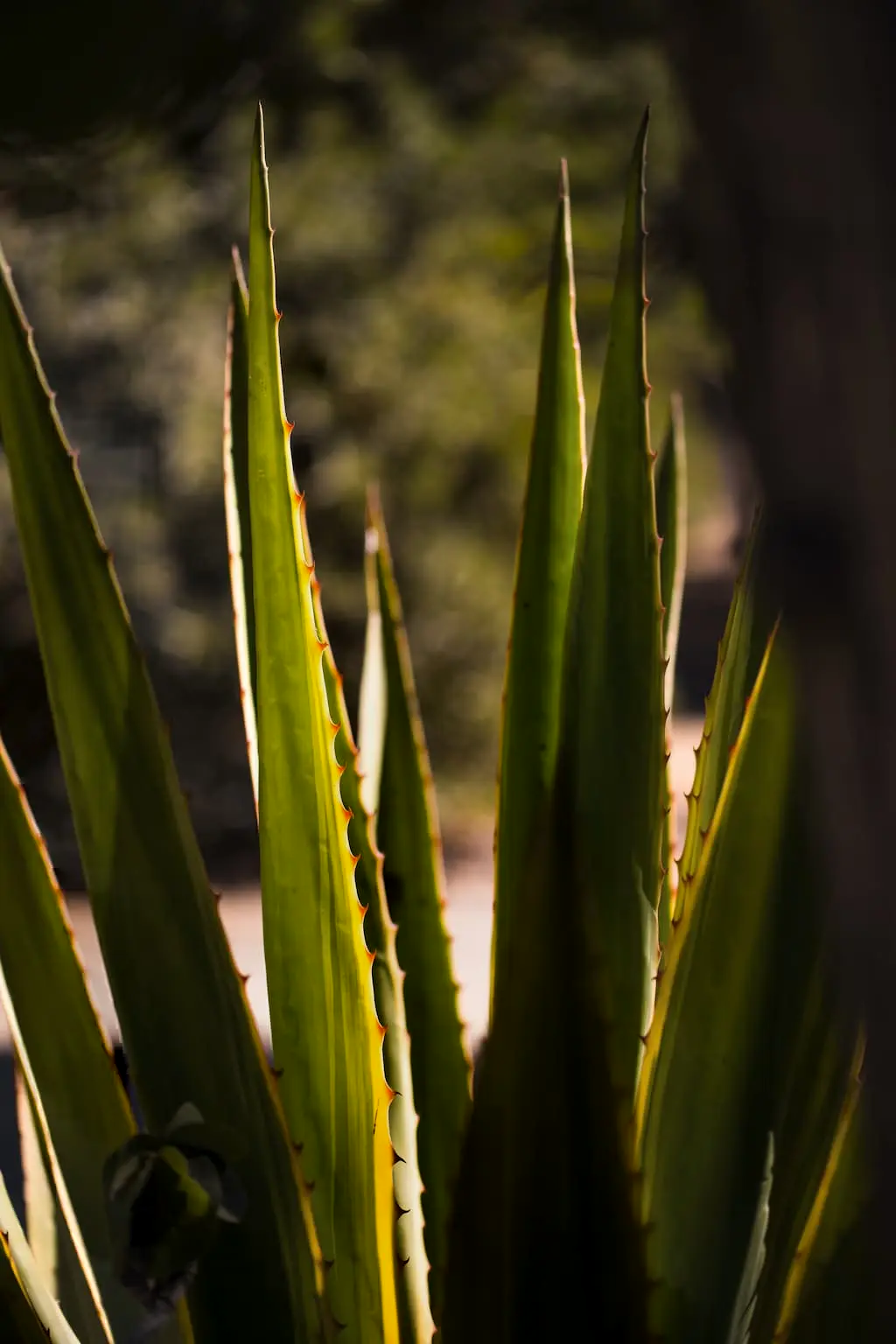
In low-light conditions, aloe gradually exhausts its stored energy. Chlorophyll production slows, and the leaves shift from blue-green or grey-green to a washed-out yellow-green. The plant often produces elongated, floppy new leaves as it stretches toward the nearest light source — a process called etiolation. Unlike sunscorch, which damages one surface of the leaf, low-light yellowing affects the whole plant uniformly.
NC State Extension notes that aloe performs best with full sun to partial shade — at least 6 hours of bright light per day for a healthy compact form and good colour.
How to diagnose it: The entire plant is uniformly pale, not patchy. New leaves are thinner and more widely spaced than older ones. The plant is visibly leaning or reaching toward the window.
How to fix it:
Stop buying the wrong pot size.
Enter plant type and growth goal — get exact pot diameter, depth, and volume before you spend a cent.
→ Find the Right Pot- Move to the brightest spot available — a south- or east-facing windowsill is ideal.
- Transition gradually: move the plant 2–3 feet closer to the window every 3 days rather than repositioning all at once. A plant adapted to low light can sunscorch if suddenly placed in full sun.
- If natural light is limited, a full-spectrum grow light set to 14–16 hours per day, placed 12 inches above the plant, is a reliable substitute.
- Rotate the pot 90 degrees every two weeks so all sides of the rosette receive equal exposure.
Reason 4: Cold Temperature Damage
Aloe vera is subtropical, hardy outdoors only in USDA hardiness zones 8–11. Indoors, it handles most room temperatures, but the cold-damage threshold is higher than many houseplant guides suggest. South Dakota State University Extension recommends keeping aloe between 55°F and 85°F (13°C–29°C). Below 40°F (4°C), tissue damage can occur rapidly.
The mechanism is direct cellular injury. Aloe gel is approximately 99% water. When leaf temperature drops below freezing, ice crystals form inside the cells and expand as they solidify, puncturing cell membranes from within. The result is a leaf that first appears glassy or translucent, then collapses to a yellow, waterlogged mass within hours to a day. This damage is irreversible — frozen cells are dead.
Common indoor triggers: placement next to a drafty exterior window in winter, a cold air-conditioner vent directed at the plant in summer, or leaving the plant on an unheated porch on a cold autumn night.
How to diagnose it: Yellowing appeared quickly — over hours rather than weeks. The plant was recently moved or the room temperature dropped. Affected tissue feels glassy and collapses when touched, rather than feeling mushy and waterlogged as with root rot.
How to fix it:
- Move the plant immediately to a room that stays above 55°F (13°C) year-round.
- Remove damaged leaves at the base with sterilized scissors — they will not recover and can invite fungal infection as they decompose.
- Hold off watering for 1–2 weeks after cold damage. Stressed roots cannot process water efficiently, which increases root rot risk on top of the cold injury.
- Check remaining leaves over the following week — cold damage sometimes extends further into the rosette than is initially visible.
Reason 5: Sap-Sucking Pests
Pests are an underdiagnosed cause of aloe yellowing because early symptoms — patchy discolouration and limp leaves — look similar to watering problems. The difference shows up when you examine the leaf surface directly.

The main offenders and their identifying markers:
Mealybugs: White, cottony clusters in the leaf axils (where leaves meet the stem) and around the base of the rosette. They secrete sticky honeydew that promotes black sooty mould. Affected leaves yellow progressively as the insects drain plant sap.
Scale insects: Small brown or off-white bumps fixed to leaf surfaces or stems, often mistaken for part of the plant’s natural texture. They scrape off with a fingernail. Scale extract sap continuously, causing gradual yellowing and leaf curl.
Spider mites: Nearly invisible to the naked eye, reddish-brown, found on the undersides of leaves in hot, dry conditions. They leave pale stippling — hundreds of tiny yellow dots — across the leaf surface, often with fine webbing between leaves. Unlike most aloe pests, spider mites thrive in dry air.
Aloe gall mites: Less common but more distinctive. Rather than simple yellowing, they cause frilly, distorted new growth and lumpy galls on flower stalks and leaf bases. Removal of all affected tissue is the primary treatment.
How to fix it:
- Isolate the plant immediately to prevent spread to nearby succulents and cacti.
- For mealybugs and scale: wipe affected areas with a cotton swab dipped in 70% isopropyl alcohol. Repeat every 5–7 days for at least three weeks.
- For spider mites: spray the whole plant — including leaf undersides — with insecticidal soap or diluted neem oil. Increasing room humidity deters re-infestation, as mites prefer dry air.
- Do not fertilize until the plant has fully recovered — feeding a pest-stressed plant pushes rapid growth it cannot sustain.
Reason 6: Underwatering or Nutrient Depletion
Underwatering is less common in aloe than overwatering, but it does happen — particularly in warm, sunny spots in summer or when a plant is left unattended for several weeks. The yellowing pattern is distinct: the oldest, outermost leaves turn yellow first, then thin out and become papery rather than mushy. Leaf tips may pucker slightly inward.
The same outside-in pattern appears in plants that have exhausted nutrients in old potting mix. Aloe evolved in poor, rocky soils and is not a heavy feeder, but after 2–3 years in the same compost without repotting, nitrogen and micronutrients become depleted. University of Maryland Extension notes that under-fertilization over several months causes gradual yellowing of older leaves and recommends a light application of a high-nitrogen formula rather than routine feeding — just 1–2 doses is usually sufficient.
How to tell underwatering from overwatering: Press a finger 2 inches into the soil. Bone-dry, dusty soil means underwatering. Damp or wet soil means overwatering. Then check the leaf texture: thin and papery indicates drought stress or nutrient depletion; soft and waterlogged indicates overwatering.
How to fix underwatering:
- Water thoroughly until water runs freely from the drainage holes.
- Allow the plant to recover for 48–72 hours — yellowed leaves will not reverse, but new growth should resume normal colour.
- Going forward: water every 2–3 weeks in summer once the top 2 inches of soil are dry, and every 4–6 weeks in winter.
How to fix nutrient depletion:
- Repot into fresh cactus and succulent mix or a 1:2 soil-to-perlite blend — this is the most effective solution and prevents future depletion.
- If repotting is not practical right away, apply a balanced fertilizer (20-20-20) at quarter strength once in spring and once in early summer. Never fertilize in winter when growth slows.
- Avoid over-fertilizing: salt build-up from excess fertilizer causes the same yellowing and leaf-tip scorch as deficiency, and can damage roots.
Will Yellow Aloe Leaves Turn Green Again?
No. Once a leaf turns yellow, the chlorophyll and cellular structures that gave it its colour are gone. The leaf will not reverse even after you fix the underlying cause. What you can expect is that new growth — once the problem is resolved — will emerge healthy and green.

Remove yellowed leaves by cutting cleanly at the base with sterilized scissors. There is no benefit in leaving them attached; the plant redirects the energy spent maintaining dead tissue toward new growth instead.
There is one partial exception: very mild, uniform pale yellowing in a plant moved to a much brighter location can sometimes deepen in colour on younger leaves that have not fully lost their chlorophyll. But any leaf that has turned clearly yellow will stay yellow.
Frequently Asked Questions
Why are my aloe’s lower leaves turning yellow while the top looks fine?
Lower-leaf yellowing on its own is usually natural aging. Aloe regularly sheds its oldest leaves as the rosette grows. If only 1–2 base leaves are affected and new growth looks healthy, no intervention is needed — simply remove the yellowed leaves at the base.
My aloe turned yellow after I repotted it. Why?
Transplant stress is common after repotting. Roots are disturbed during the process and the plant temporarily struggles to maintain leaf colour while re-establishing. This typically resolves within 2–4 weeks. Keep the plant in bright indirect light and hold off watering for 7 days after repotting. For the full process, see our guide to repotting aloe vera.
Can aloe rust cause yellowing?
Yes. Aloe rust is a fungal disease caused by Phakopsora species. It first appears as tiny pale yellow circles on the upper leaf surface that gradually darken to brown as spore masses form. Unlike the diffuse yellowing from watering or light problems, rust spots are circular with defined edges, and may show orange pustules on the leaf underside in cool, humid conditions. The disease is self-limiting — new growth is unaffected — but dusting affected leaves with sulfur powder every 1–2 weeks slows the spread.
Why is my aloe yellow and soft at the stem base?
Soft, yellow tissue at the base of the stem is a sign of basal stem rot caused by Fusarium species, which thrives in cold, wet conditions. The rot progresses upward. If caught early, cut the plant above the rotted zone with sterilized scissors, allow the cut surface to dry for 48 hours, and re-root in dry cactus mix. If the rot has reached more than half the stem’s height, recovery is unlikely.
Sources
- University of Maryland Extension — Q&A: What Causes Aloe Leaves to Turn Yellow?
- South Dakota State University Extension — Aloe Vera: Houseplant How-To
- Penn State Extension — Aloe, a Hardy Houseplant
- University of Florida IFAS — Aloe Vera
- NC State Extension — Aloe Vera Plant Profile
- PlantVillage (Penn State) — Aloe Vera Diseases and Pests
- Henry Shaw Cactus and Succulent Society — Aloe Pests and Diseases


