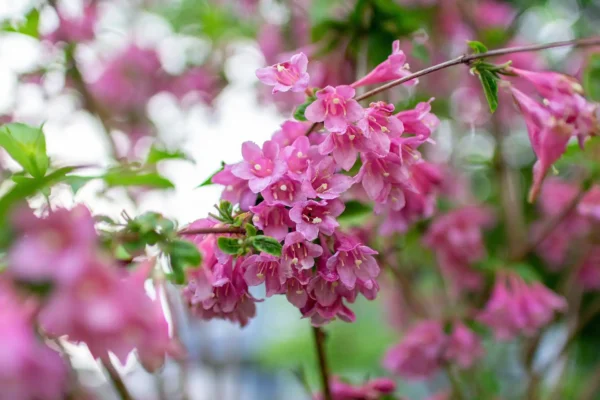
Weigela Varieties: Best Types for Every Garden

Discover the best weigela varieties for every garden size and style — from dark-leaved Wine and Roses to reblooming Sonic Bloom, with a full comparison table, USDA hardiness zones, and a simple pruning guide.
Walk into any garden center in May and you’ll see weigela in bloom — a cascade of trumpet-shaped flowers covering every stem, bees and hummingbirds working methodically through each tube. For decades, the choice was simple: one species, Weigela florida, in green and pink. Then breeders spent twenty years crossing, selecting, and introducing, and the result is the most diverse shrub genus in American garden centers today.
You can now choose from deep burgundy-leaved showstoppers that hold their colour all season, dwarf 18-inch varieties sized for containers, pure-white selections for elegant borders, and reblooming forms that flower from May through September without deadheading. This guide covers 16 varieties across five categories, with USDA hardiness zones, a full comparison table, and a pruning guide built around the single rule that unlocks weigela’s full potential. For full growing details, see our complete weigela growing guide.


Why Choose Weigela?
Before diving into varieties, it’s worth understanding why weigela has become a staple of American shrub borders. Unlike many flowering shrubs, it has no serious pest or disease problems, is ignored by deer in most regions, and asks only for a sunny position and a single annual prune immediately after flowering. The trumpet-shaped flowers are one of the most effective hummingbird attractants of any deciduous shrub — the bloom window in May–June aligns perfectly with the return of ruby-throated hummingbirds to the eastern US.
- Hardy in USDA Zones 4–8 (select varieties to Zone 9)
- Fast-growing: adds 1–2 feet per year once established
- Blooms on old wood — prune immediately after flowering and next year’s buds are safe
- Size range: 18 inches to 8 feet, covering every garden scale
- Remarkable foliage diversity: burgundy, variegated, chartreuse, green, and fiery autumn colour
- Excellent companion planting flexibility — pairs with roses, lavender, perennials, and ornamental grasses
Weigela is also one of a small group of deciduous shrubs where both the flower colour and the foliage colour are ornamental. For gardeners who want maximum impact per square foot of border, that combination is hard to beat. Browse more outstanding options in our guide to the best flowering shrubs for every garden.
Seasonal Garden Calendar
Know exactly what to plant, prune and sow — every month of the year.
Dark and Purple-Leaved Weigela Varieties
The dark-foliaged weigelas transformed the genus from a single-purpose spring shrub into a year-round border plant. The burgundy and near-black leaves emerge in spring and hold their colour through first frost — unusual in deciduous shrubs, which often fade to green by midsummer.
1. ‘Wine and Roses’ (‘Alexandra’)
Height/Spread: 4–5 ft × 4–5 ft | Zones: 4–8 | Flowers: Hot pink, May–June | Foliage: Deep burgundy all season | Rebloom: No
The bestselling weigela in North America, and for good reason. Wine and Roses combines leaves the colour of dark cherries with hot-pink trumpet flowers — the contrast is one of the most dramatic in any shrub border. Selected by the Dutch breeder Breedplan and marketed under the Proven Winners brand, ‘Alexandra’ has been a garden staple since the early 2000s. The burgundy colour holds from leaf-out through first frost without fading, which is the key advantage over some dark-leaved shrubs that turn greenish in summer heat. Plant it against a white fence or beside silver-leaved plants such as Russian sage to maximise the contrast. In USDA Zones 7–8, afternoon shade prevents leaf scorch and keeps the burgundy deeper into summer.
2. ‘Midnight Wine’
Height/Spread: 12–18 in × 12–18 in | Zones: 4–8 | Flowers: Hot pink, May–June | Foliage: Very dark burgundy, near black | Rebloom: No
A dwarf sport of Wine and Roses, Midnight Wine keeps all the same striking colouring at one-quarter the size. It is the lowest-growing weigela widely available in the US, making it useful as a groundcover, edging plant along a path, or container specimen. The foliage is among the darkest of any shrub in its size class — almost black-purple in strong light. It spreads slowly to form a dense, weed-suppressing mound. In containers, its low-mounded form makes it an effective “thriller” when combined with trailing annuals.
3. ‘Spilled Wine’
Height/Spread: 2–3 ft × 3–4 ft | Zones: 4–8 | Flowers: Deep pink to rose, May–June | Foliage: Dark burgundy | Rebloom: No
Spilled Wine has a distinctly arching, near-weeping habit that sets it apart from the upright dark-leaved forms. Branches arch outward and downward, making it excellent for softening the edges of raised beds, retaining walls, and containers. The spreading form also works well on banks where it suppresses weeds through dense coverage. The arching silhouette is architecturally attractive even out of bloom.
4. ‘Fine Wine’
Height/Spread: 2.5–3 ft × 3 ft | Zones: 4–8 | Flowers: Deep rose-pink, May–June | Foliage: Burgundy | Rebloom: No
A compact, tighter version of the Wine and Roses aesthetic, Fine Wine is the right choice for small borders where the parent would eventually become too large. It maintains a neat rounded habit without hard pruning and flowers reliably year after year. The flowers are a slightly deeper rose than Wine and Roses, with less pink and more red.
5. ‘Dark Horse’
Height/Spread: 3–4 ft × 4–5 ft | Zones: 4–8 | Flowers: Pink-red, May–June | Foliage: Very dark, near-black | Rebloom: No
Dark Horse carries the deepest foliage colour of the upright dark-leaved varieties — more saturated than Wine and Roses, with a near-black appearance in high-contrast light. The flowers are a slightly warmer pink-red than Wine and Roses. It is more vigorous than Midnight Wine but still more compact than Wine and Roses, placing it in a useful middle ground for medium-sized borders.

Variegated Weigela Varieties
Variegated weigelas earn their place in the border through four-season interest — the patterned foliage remains ornamental from spring through autumn even when flowers are finished.
6. ‘My Monet’
Height/Spread: 18 in × 18 in | Zones: 4–6 (to Zone 7 with reliable snow cover) | Flowers: Pink-purple, May–June | Foliage: Cream, pink, and green tricolour | Rebloom: No
My Monet is the container weigela. Its tricolour leaves — cream margins, pink blush, and green centre — provide ornamental interest even when not in flower. At 18 inches, it stays genuinely compact without any pruning and is the best choice for small-space gardens, patio containers, and front-of-border positions. Note that it is slightly less cold-hardy than most weigelas: it performs best in Zones 4–6 with reliable snow cover in colder winters, and in Zone 7 it benefits from afternoon shade to prevent leaf bleaching. The pink and cream colouring develops best in morning sun.
7. ‘Nana Variegata’
Height/Spread: 4–5 ft × 4–5 ft | Zones: 5–8 | Flowers: Deep pink, May–June | Foliage: Green with cream-white margins | Rebloom: No
Nana Variegata is the classic variegated weigela, cultivated since the late 19th century. It reaches full shrub size — considerably larger than My Monet — but its cream-margined leaves are elegant and pair beautifully with deep pink flowers. It is more vigorous and cold-hardy than My Monet, making it a better choice in Zones 5–6 where reliability through cold winters matters most.
8. ‘Monet’
Height/Spread: 2–2.5 ft × 2 ft | Zones: 4–7 | Flowers: Pink, May–June | Foliage: Pink and cream with green base | Rebloom: No
The original Monet variety that preceded My Monet — slightly larger, with similar cream-pink-green colouring. Where My Monet has a very tight, mounded habit, Monet grows slightly more loosely. Both are excellent in containers, but Monet suits larger planters and low-maintenance border edges better.
Green-Leaved Weigela: Flower Focus
The traditional green-leaved weigelas remain the best choices when you want the boldest flower colour without foliage competition. Several have been breeding selections for over 80 years and are among the most reliable flowering shrubs available for Zones 4–8.
9. W. florida ‘Bristol Ruby’
Height/Spread: 5–7 ft × 5–6 ft | Zones: 5–9 | Flowers: Deep ruby-red, May–June | Foliage: Medium green | Rebloom: No
Bristol Ruby is the classic red-flowered weigela, in cultivation since 1941 and developed at Bristol Nurseries in Bristol, Connecticut. The flowers are a true ruby-red rather than the pink-red of most varieties — one of the very few deciduous shrubs with genuinely red flowers. It is vigorous and will reach 6 feet within five years, so allow it space. The crimson flowers are an exceptional hummingbird attractant, and the high contrast against bright green foliage makes this shrub visible from a distance even in a large garden.
See also our guide to varieties types every garden size.
10. ‘Red Prince’
Height/Spread: 5–6 ft × 5 ft | Zones: 4–8 | Flowers: True red, May–June with partial rebloom | Foliage: Medium green | Rebloom: Partial (light repeat in August)
Red Prince was introduced by Iowa State University and remains one of the best flowering shrubs for cold northern climates. The flowers are a clean, true red with no pink undertone — unusual in weigela. It has a modest rebloom tendency in August without deadheading, making it one of the better green-leaved varieties for extended season colour. Reliably hardy to Zone 4, it has proven itself in Midwestern gardens where winters are severe and spring arrives late.
Plant too early and frost kills it, too late and heat stunts it — heuchera varieties: coral bells has the window.
11. ‘Candida’
Height/Spread: 5–6 ft × 5 ft | Zones: 5–8 | Flowers: Pure white, May–June | Foliage: Bright green | Rebloom: No
The definitive white weigela. Candida’s flowers emerge pale pink in bud and open to pure white — an elegant sequence that extends the visual interest of the bloom period. It is particularly effective in woodland border situations where white flowers reflect low light, and makes an excellent backdrop for dark-coloured flowering perennials. Despite being one of the most distinctive weigelas, Candida is underused in American gardens; if you want something other than pink or red, it is the first white variety to try.
12. ‘Rumba’
Height/Spread: 3–4 ft × 3 ft | Zones: 4–7 | Flowers: Red with yellow interior margin, May–June | Foliage: Green with yellow-gold leaf edge | Rebloom: Partial
Rumba is distinctive for its bicolour flowers — red petals with a yellow interior margin — and for its yellow-edged foliage that puts it in an intermediate category between the purely green-leaved and the golden-foliaged types. It is compact enough for smaller gardens yet vigorous enough to make a real impact. Note: in full shade, the foliage edge turns entirely green; at least half a day of direct sun is needed to develop the gold edging.

Golden and Chartreuse-Leaved Weigela Varieties
The gold- and chartreuse-leaved weigelas are among the most striking shrubs in any garden — the contrast between luminous yellow-green foliage and deep red or pink flowers is immediate and dramatic from across the garden.
13. ‘Ghost’
Height/Spread: 5 ft × 5 ft | Zones: 5–8 | Flowers: Deep pink-red, May–June | Foliage: Chartreuse to lime yellow | Rebloom: No
Ghost produces some of the most striking colour contrasts in shrub gardening: deep pink-red flowers erupting from lime-yellow foliage. Unlike some yellow-leaved shrubs that scorch in heat, Ghost holds its chartreuse colour through summer without significant bleaching in most climates. It is vigorous, makes a bold specimen plant, and serves as an effective focal point in a mixed border. Position it against dark green or purple foliage plants to maximise the contrast.
14. ‘Briant Rubidor’ (‘Olympiade’)
Height/Spread: 4–5 ft × 4 ft | Zones: 5–8 | Flowers: Deep red, May–June | Foliage: Gold-yellow | Rebloom: No
Briant Rubidor delivers a similar bold effect to Ghost — saturated contrast between gold foliage and dark flowers — but the foliage leans more true gold than chartreuse-green. The red flowers are among the most saturated of any weigela. Position it in full sun for maximum foliage colour intensity; shade softens the gold toward near-green and reduces contrast. Also sold under the name ‘Olympiade’ in some regions.
15. ‘Wings of Fire’
Height/Spread: 4–5 ft × 4 ft | Zones: 4–8 | Flowers: Pink, May–June | Foliage: Green in summer; fiery orange-red in autumn | Rebloom: No
Wings of Fire earns its name in autumn rather than spring. While its summer flowering is typical of the genus, the foliage transitions from green to vivid orange and red as temperatures drop in October, providing a second season of ornamental value that most other weigelas cannot match. If you want year-round interest from a single shrub, Wings of Fire is the strongest choice for that second act of colour.
Reblooming Weigela: Sonic Bloom Series
16. Sonic Bloom® Series (‘Sonic Bloom Pink’, ‘Sonic Bloom Red’, ‘Sonic Bloom Pearl’)
Height/Spread: 4–5 ft × 4 ft | Zones: 4–8 | Flowers: Pink / red / white (by cultivar), May–September | Foliage: Green | Rebloom: Yes — continuous
The Sonic Bloom series, introduced by Proven Winners, represents the most significant advance in weigela breeding in decades. Traditional weigelas bloom once, in May–June, on old wood. Sonic Bloom varieties have been selected to continue producing new flowering stems throughout summer and into early autumn — without deadheading — because they flower on both old and new wood simultaneously.
We cover soil, watering, and seasonal timing in detail in varieties types every garden size.
In practice, a light trim after the main May–June flush stimulates a rapid new flush of growth that flowers within 6–8 weeks, maintaining colour from May through September in most US climates. Three colour options cover the main weigela palette: Sonic Bloom Pink (the most vigorous), Sonic Bloom Red (richest flower colour), and Sonic Bloom Pearl (white, most distinctive). For small gardens where maximising season value is essential, the Sonic Bloom series is the strongest choice in the genus according to Proven Winners’ trial data.
Weigela Variety Comparison Table
| Variety | Height | Zones | Flower Colour | Foliage | Rebloom |
|---|---|---|---|---|---|
| Wine and Roses | 4–5 ft | 4–8 | Hot pink | Deep burgundy | No |
| Midnight Wine | 12–18 in | 4–8 | Hot pink | Near-black burgundy | No |
| Spilled Wine | 2–3 ft | 4–8 | Deep pink | Dark burgundy | No |
| Fine Wine | 2.5–3 ft | 4–8 | Rose-pink | Burgundy | No |
| Dark Horse | 3–4 ft | 4–8 | Pink-red | Near-black | No |
| My Monet | 18 in | 4–6 | Pink-purple | Cream/pink/green | No |
| Nana Variegata | 4–5 ft | 5–8 | Deep pink | Green/cream margin | No |
| Monet | 2–2.5 ft | 4–7 | Pink | Pink/cream/green | No |
| Bristol Ruby | 5–7 ft | 5–9 | Ruby-red | Medium green | No |
| Red Prince | 5–6 ft | 4–8 | True red | Medium green | Partial |
| Candida | 5–6 ft | 5–8 | Pure white | Bright green | No |
| Rumba | 3–4 ft | 4–7 | Red/yellow bicolour | Green/gold edge | Partial |
| Ghost | 5 ft | 5–8 | Deep pink-red | Chartreuse/lime | No |
| Briant Rubidor | 4–5 ft | 5–8 | Deep red | Gold-yellow | No |
| Wings of Fire | 4–5 ft | 4–8 | Pink | Green; orange-red in fall | No |
| Sonic Bloom (series) | 4–5 ft | 4–8 | Pink / Red / White | Green | Yes — continuous |
Pruning Weigela: The One Rule That Matters
Weigela blooms on old wood — stems that grew the previous year. This single fact dictates everything about pruning timing. The rule is: prune immediately after the first flower flush ends, usually in late June or early July. If you prune in autumn, late winter, or early spring (as you would with new-wood bloomers), you cut off every stem that will carry next year’s flowers. The plant survives, but you lose an entire season’s bloom.
The correct pruning method is rejuvenation thinning rather than shearing:
- Wait until the first flower flush is fully spent (late June / early July in most of Zones 5–7)
- Remove one-third of the oldest, thickest stems at ground level — this opens the canopy, improves air circulation, and stimulates vigorous new growth that will flower the following spring
- Shorten remaining stems by up to one-third to shape and reduce bulk
- Do not touch the plant again until after next year’s flowering
Avoid hard shearing with hedge trimmers, which creates a dense, unnatural shape, removes interior growth, and reduces flowering over time. According to the NC State Extension, the thinning approach keeps weigela open, well-structured, and flowering at its natural best for decades.
Reblooming varieties (Sonic Bloom series): a light trim immediately after the main June flush — removing faded flower stems by about one-third — stimulates a rapid new flush of growth and flowers within 6–8 weeks, maintaining colour through September.
Propagating Weigela from Cuttings
Weigela propagates easily from softwood cuttings taken in June and July, with a success rate around 90% under basic conditions:
- Take 4–6-inch cuttings from non-flowering new growth, cut just below a leaf node
- Remove lower leaves, leaving 2–3 leaf pairs at the tip
- Dip the cut end in rooting hormone powder (optional, but increases speed)
- Insert into moist perlite or a 50:50 perlite/peat mix in small pots
- Cover with a plastic bag or humidity dome; maintain 65–70°F
- Roots form within 3–5 weeks; gentle resistance when tugged confirms rooting
- Pot up into standard potting mix and grow on in a sheltered spot for the remainder of the season
Hardwood cuttings can also be taken in late autumn and overwintered in a cold frame, though softwood gives faster and more reliable results. Note that named cultivars (Wine and Roses, Sonic Bloom, etc.) are patented varieties — propagating them for sale is prohibited, though home garden use is generally acceptable.
Best Companion Plants for Weigela
Weigela’s May–June flowering window pairs best with companions that extend the season before and after the main flush. See our full companion planting guide for broader principles that apply equally to ornamental borders.
- Roses: The classic pairing. Wine and Roses weigela alongside David Austin shrub roses gives continuous pink-red interest from May through frost, with the shrubs supporting each other’s ornamental value through the season.
- Lavender: Blue-purple lavender (Zones 5–8) alongside dark-leaved weigelas extends border interest into July and August after the weigela’s bloom period ends. The contrasting flower colours are particularly effective beside burgundy or near-black foliage.
- Perennial Geranium ‘Rozanne’: As a low groundcover beneath upright weigelas, ‘Rozanne’ flowers concurrently in May–June then continues into autumn, providing a long-season complement at the base of the shrub.
- Alliums: Spring-blooming ornamental alliums flower just before weigela’s main flush, providing an elegant lead-in with their spherical purple flower heads. Plant them at the base of dark-leaved weigelas for a late-spring sequence.
- Cottage garden perennials: Weigela’s relaxed, arching habit suits the informal style described in our guide to cottage garden flowers — it works particularly well alongside foxgloves, geraniums, and catmint.

Frequently Asked Questions
Does weigela bloom on new wood or old wood?
Old wood — stems that grew the previous season. Always prune immediately after flowering (late June / early July), never in autumn or late winter. The exception is the Sonic Bloom series, which flowers on both old and new wood, giving continuous bloom from May through September.
When does weigela bloom in the US?
In most of the US (Zones 5–7), the main flush is May through mid-June. In Zone 4, expect late May to early June. In Zone 8–9, early to mid-May. Reblooming varieties (Sonic Bloom series) continue flowering through September in all zones.
How do I keep My Monet small?
My Monet naturally stays 18 inches without pruning — it is a genuine genetic dwarf, not a compact form of a larger plant. Avoid heavy feeding, which promotes excess soft growth. A light trim immediately after flowering maintains shape and keeps it tidy.
Is weigela deer resistant?
Moderately. Weigela does not appear on most deer’s preferred browse list and rates as “rarely damaged” on the Rutgers University deer-resistant plant scale. However, deer under pressure in high-density areas will browse almost any shrub. Dark-leaved varieties appear slightly less palatable in informal garden observations, though no formal research confirms this.
Can I grow weigela in a container?
Yes — especially the compact varieties. My Monet, Midnight Wine, and Spilled Wine all perform well in containers of 12–15 inches diameter or larger. Use a well-draining potting mix, water when the top inch of compost dries out, and in Zone 4–5 bring containers to a sheltered, unheated space (garage or shed) for the winter to protect the roots from hard freeze cycles.
Which weigela is best for hummingbirds?
All weigelas attract hummingbirds, but the red-flowered varieties — Bristol Ruby, Red Prince, and Sonic Bloom Red — are the most effective attractants. Ruby-throated hummingbirds preferentially visit red tubular flowers, and the bloom window (May–June) aligns closely with their spring migration northward through the eastern US.