Spider Mites Attacking Your Weigela? Identify and Eliminate

You have been nurturing your Weigela all season — watering carefully, pruning at the right time, feeding it a balanced fertiliser — and yet here it is: leaves covered in pale stippling, a strange dusty bronzeness creeping across the foliage, and those unmistakable gossamer threads strung between stems. Something is very wrong. If this describes your plant, there is an excellent chance spider mites have moved in, and the hot, dry conditions you created for maximum bloom have made your Weigela irresistible to them.
Spider mites are among the most frustrating pests in horticulture because they are nearly invisible, they reproduce at an extraordinary rate, and by the time most gardeners notice the damage, the colony is already well established. After twenty-five years working with ornamental shrubs, I have seen more Weigela damaged by Tetranychus urticae — the two-spotted spider mite — than by any other single pest. The good news is that they are entirely beatable once you understand how they live, what drives outbreaks, and how to match your treatment to the severity of the infestation.

This guide covers everything: how to confirm you really are dealing with spider mites, the biology that makes them so difficult to control, every treatment method ranked from gentlest to most aggressive, resistance management so your treatments keep working, a practical treatment schedule, and a long-term prevention strategy. Let us get your Weigela back.
How to Identify Spider Mites on Weigela
Before treating anything, you need a definitive diagnosis. Spider mite damage shares surface similarities with nutrient deficiencies, drought stress, and certain fungal diseases, so it is worth spending five minutes being certain.
Seasonal Garden Calendar
Know exactly what to plant, prune and sow — every month of the year.
The Symptoms to Look For
- Stippling. Examine the upper surface of leaves in direct light. You are looking for a very fine scattering of pale yellow or white dots, each one the size of a pinprick. This is stippling — the individual feeding scars left when mites pierce plant cells and drain the chlorophyll. Unlike fungal leaf spots, stippling has no defined border, no halo, and no fuzzy texture. It looks as though someone has taken fine-grit sandpaper and lightly abraded the leaf surface.
- Bronzing and yellowing. As the colony expands and stippling densifies, individual dots merge. The leaf loses its deep green and shifts towards a sickly yellow or a coppery bronze. Photosynthesis is being progressively compromised. In severe cases leaves dry out, curl, and drop prematurely.
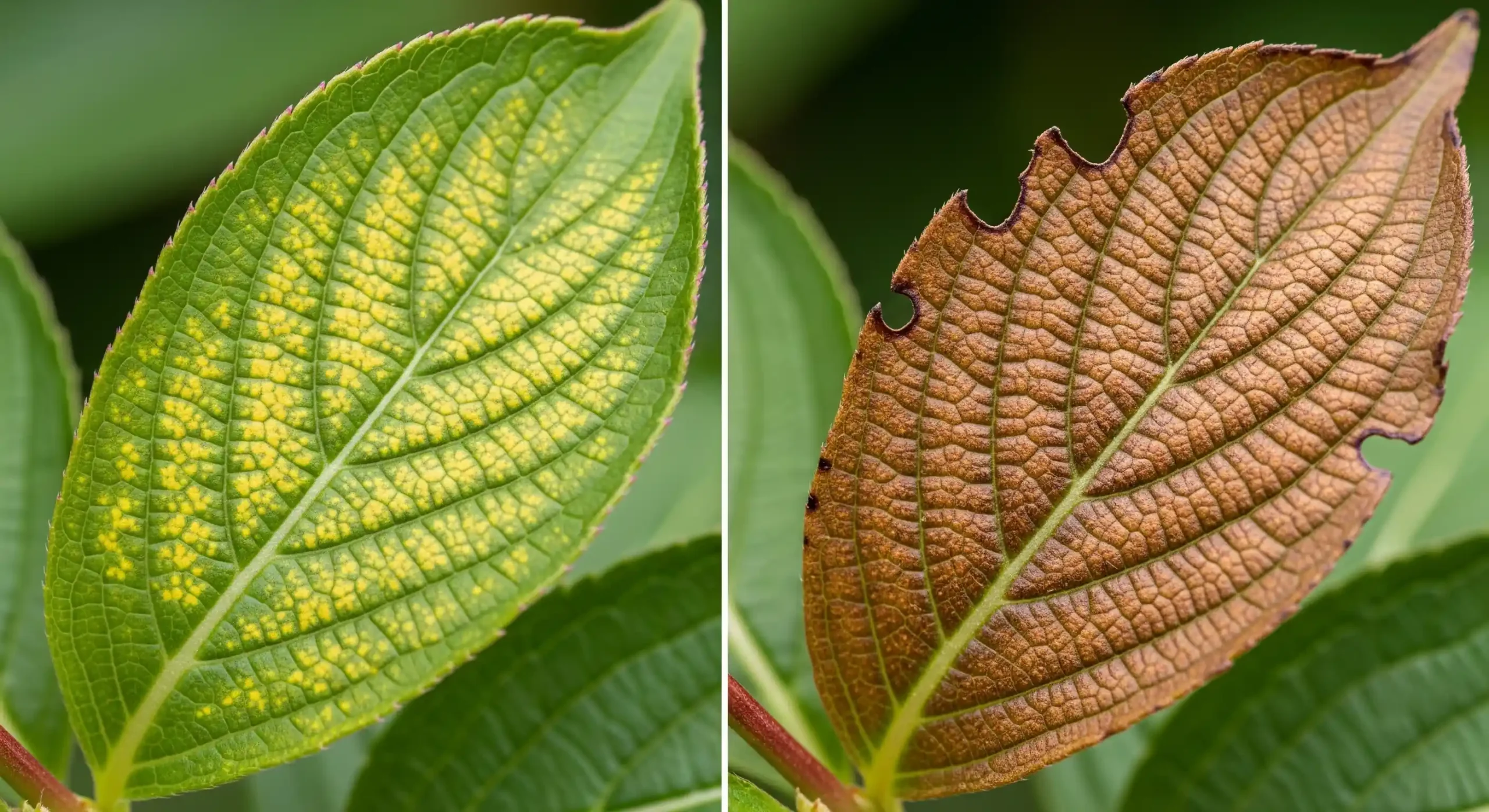
- Fine webbing. This is the definitive identifier. Once a colony is established, spider mites spin delicate protective webbing, usually concentrated on the undersides of leaves and in the angles where leaves meet stems. It is nothing like the bold geometry of a garden spider’s web — it is wispy, almost dusty-looking, and coats the surface like a fine net.
- General plant decline. A heavily infested Weigela will simply look exhausted — drooping, dull-coloured, with stunted new growth. The plant is haemorrhaging energy reserves it cannot replace fast enough.
The White Paper Test
If you are not yet certain, this test will settle it definitively. Hold a sheet of white paper under a suspect branch and give the branch three or four sharp taps. Look immediately at the paper. Do you see specks the size of ground pepper? Watch them for thirty seconds. If they move, you have your answer. To confirm the species, drag a finger lightly across the specks — spider mites leave a reddish-brown or greenish smear. Dust does not smear; spider mites do.
The Magnifier Test
A 10x jeweller’s loupe — available for a few pounds online — transforms early detection entirely. Under magnification you can see the mites themselves: tiny, oval-bodied arachnids, usually pale yellow-green with two darker spots on their abdomen (hence the common name, two-spotted spider mite). You can also see their translucent eggs clustered along leaf veins on the underside of leaves. Catching them at the egg stage, before the colony explodes, gives you an enormous treatment advantage.
The Biology Behind the Outbreak: Why Spider Mites Are So Hard to Control
Understanding their life cycle is not an academic exercise — it is the key to why a single treatment almost never works and why timing matters so much.
Life Cycle: Egg to Adult in 7 to 10 Days
Under optimal conditions — temperatures above 27°C (80°F) and low humidity — T. urticae completes its entire life cycle in as little as seven days. The stages are: egg, larva, protonymph, deutonymph, and adult. A single female can lay 100 to 200 eggs in her lifetime. Do the arithmetic: starting from a small founding population, you can have tens of thousands of mites within three to four weeks. This exponential growth is why infestations seem to appear from nowhere.
Critically, common miticides and contact sprays kill active life stages but often do not affect eggs. This is why treatments must be repeated every five to seven days — to catch newly hatched nymphs before they reach reproductive maturity and before the next generation of eggs hatches into a fresh cohort of feeding mites.
What Triggers an Outbreak
Two environmental factors drive the worst outbreaks:
- Heat and drought. Spider mites thrive when temperatures are high and humidity is low. Plants under drought stress are doubly vulnerable — their natural defences are suppressed and they become more nutritious targets. A Weigela planted in full sun against a south-facing wall, which is an entirely reasonable choice for maximum flowering, is also the highest-risk position for mite attack in a dry summer.
- Disruption of natural enemies. In a balanced garden ecosystem, populations of ladybirds, lacewings, minute pirate bugs, and predatory mites keep spider mites in check. Broad-spectrum insecticide use — particularly pyrethroids and carbamates — eliminates these natural predators while leaving mite populations intact or even stimulated. This triggers what entomologists call a mite flare-up: a population explosion in the absence of natural control.
All Treatment Methods, Ranked by Severity
The right treatment depends on the size of the infestation. Always start with the least aggressive option that matches the scale of the problem. Escalate only if the lower-level treatment fails after two full treatment cycles — roughly ten to fourteen days.
| Method | Best For | Kills Eggs? | Safe for Beneficials? |
|---|---|---|---|
| Water pressure wash | Early / light infestation | Partially (dislodges) | Yes |
| Insecticidal soap | Light to moderate | No | Mostly yes |
| Neem oil (cold-pressed) | Light to moderate | Partially | Yes when dry |
| Horticultural oil | Moderate | Yes (smothers) | Use with care |
| Predatory mites | Moderate, sustained | Indirectly | Yes — they are the beneficials |
| Chemical miticides | Severe infestation only | Depends on product | No |
Level 1: Water Pressure Wash
For a light, early-stage infestation, a forceful jet of water applied to both leaf surfaces — paying particular attention to undersides — is surprisingly effective. It physically dislodges mites, eggs, and webbing, and raises local humidity sharply, which mites hate. Repeat every two to three days for a week. On its own this is rarely sufficient to eradicate a colony, but it dramatically reduces numbers and is an excellent adjunct to other treatments. Always do this early in the day so foliage dries before evening.


Level 2: Insecticidal Soap
Purpose-formulated insecticidal soaps — made from potassium salts of fatty acids — work on contact by dissolving the waxy cuticle of the mite, causing rapid dehydration and death. Do not substitute washing-up liquid; the salt and additive content can burn foliage. Coverage is everything: you must hit the mites directly, which means thorough application to leaf undersides where populations are densest. Because soap leaves no residual action, repeat applications every five to seven days are essential to catch each new cohort of hatching nymphs. Avoid spraying in temperatures above 32°C or in full sun to prevent phytotoxicity.
Level 3: Neem Oil
Cold-pressed neem oil — specifically the type containing azadirachtin — is the most versatile organic option available. Unlike soaps and horticultural oils, which are pure contact killers, azadirachtin acts on multiple biological pathways simultaneously. It is an antifeedant (mites stop feeding), a repellent, and a growth disruptor that prevents nymphs from moulting to the next life stage. Crucially, it is translaminar — it penetrates leaf tissue, so mites feeding on treated leaves will be affected even if spray coverage was imperfect.
Mix at the manufacturer’s recommended rate (typically 2 to 4 ml per litre with an emulsifier), spray thoroughly at dusk to protect beneficial insects, and repeat every seven days for three cycles. Unlike synthetic options, neem oil degrades relatively quickly in sunlight, so timing applications correctly matters.

Level 4: Horticultural Oil
Highly refined petroleum-based or plant-based horticultural oils work by blocking the spiracles (breathing tubes) of mites and smothering eggs — making them one of the few treatments with meaningful ovicidal activity. They are more effective than soap for established infestations with significant egg populations. The trade-off is phytotoxicity risk: do not apply in temperatures above 30°C, in bright sun, or on water-stressed plants. Always read the label for recommended intervals between applications and do not combine with sulphur-based products.
Level 5: Predatory Mites (Biological Control)
For a sustainable, long-term solution — particularly if you have had recurring annual infestations — releasing predatory mites is one of the most effective strategies available. Two species are commercially available and can be ordered online for delivery:
- Phytoseiulus persimilis — the specialist. This predatory mite feeds exclusively on spider mites and reproduces twice as fast as its prey under warm conditions. Releasing it onto an active infestation can collapse a colony rapidly. It works best in temperatures between 18 and 30°C with moderate humidity above 60 per cent.
- Neoseiulus californicus — the generalist. Less voracious than P. persimilis but more resilient: it can survive on alternative food sources such as pollen when spider mite numbers are low, making it an excellent preventative release early in the season before numbers build.
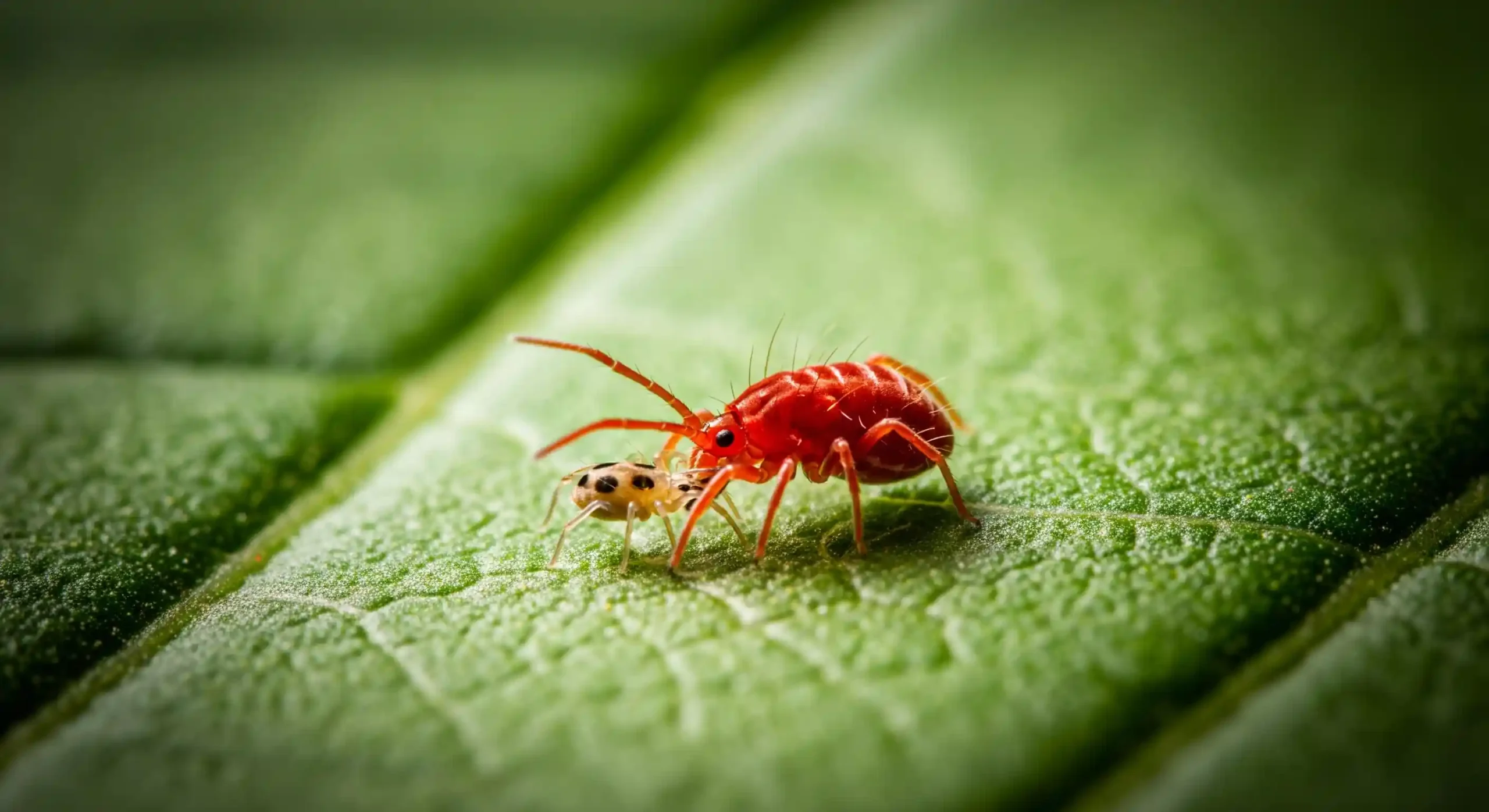
Critical note: do not use chemical treatments within two weeks before or after releasing predatory mites. Pesticides will kill your beneficials before they can establish. If you have recently used a chemical miticide, wait for the residual period to clear before ordering and releasing predatory mites.
Level 6: Chemical Miticides (Last Resort)
When an infestation is so severe that the plant’s survival is at risk and organic methods have failed after two full cycles, a targeted miticide may be necessary. There are important rules that must be followed:
- Use a labelled miticide, not a generic insecticide. Spider mites are arachnids, not insects. Many standard insecticides have no effect whatsoever on them. Look for products labelled specifically for mite control — those containing abamectin, bifenazate, spiromesifen, or cyflumetofen.
- Never use pyrethroids or carbamates against a mite problem. These will kill beneficial insects without effectively controlling mites, and frequently trigger mite flare-ups by eliminating natural predators. If anything, they make the situation worse.
- Rotate chemical classes to prevent resistance. Spider mites develop resistance rapidly — it is one of the most thoroughly documented cases of pesticide resistance in any pest species. Each miticide product carries a resistance group number on its label. Never apply the same group twice in succession. A sensible rotation for a severe infestation: Group 6 (abamectin) on day 1, Group 21 (tebufenpyrad) on day 10, Group 25 (cyflumetofen) on day 20 if still needed. Then transition to organic maintenance once the population collapses.
Resistance Rotation: Why You Must Vary Your Treatments
Resistance management is not optional — it is the difference between treatments that keep working and a population that laughs at everything you spray on it. Spider mites have a generation time of just seven to ten days, meaning natural selection can produce a resistant strain within a single growing season if you use the same product repeatedly.
The principle applies even to organic treatments. Populations can develop tolerance to abamectin with repeated exposure. The practical rule is simple: never use the same product, or the same class of product, more than twice consecutively. After two applications of any treatment, switch to a different mode of action before returning to the original.
Within a single treatment programme, a sensible rotation for a moderate infestation might look like this: water wash on days 1, 3, and 5; insecticidal soap on day 7; neem oil on day 14; then reassess with a loupe. This rotation covers three distinct modes of action — physical removal, contact cuticle disruption, and systemic growth disruption — and gives you the best possible chance of clearing the infestation before resistant individuals can establish.
Treatment Schedule: A Practical Calendar
| Day | Action | Notes |
|---|---|---|
| Day 1 | Diagnosis and water wash | White paper test and loupe inspection to confirm. Hard jet to all leaf surfaces, focus on undersides. |
| Day 3 | Water wash | Repeat. Maintains population knockdown and humidity disruption. |
| Day 5 | Insecticidal soap application | Apply at dusk. Full coverage including leaf undersides and stem joints. |
| Day 10 | Neem oil application | Switch mode of action. Apply at dusk. Penetrates leaf tissue for translaminar effect. |
| Day 17 | Assess and soap repeat if needed | Use loupe on 10 leaves. If mites visible, apply soap. If clear, monitor only. |
| Day 24 | Final neem application if needed | Third cycle closes out most infestations. |
| Ongoing | Weekly visual inspection | Use loupe on undersides of 3 to 5 leaves per plant through the growing season. |
For severe infestations, shift to the chemical miticide rotation from day 10, using Group 6 followed by Group 21 with a seven-day interval between applications. Then transition to organic maintenance once the population collapses and use predatory mites as a long-term suppression strategy.
Preventing Re-infestation: Making Your Weigela a Poor Target
The best spider mite management programme is one that prevents the infestation from establishing in the first place. Stressed plants invite mites; healthy, well-maintained plants in a biodiverse garden resist them. Here is what to focus on throughout the year.
Watering Discipline
Water deeply and infrequently at the base. Allow the top few centimetres of soil to dry between waterings, but never allow the plant to reach the wilting stage. A Weigela under drought stress is several times more susceptible to mite attack than a well-hydrated one. During heatwaves, consider a light overhead misting of foliage in the early morning — this temporarily raises localised humidity and makes the environment less hospitable for mites without leaving foliage wet overnight.
Fertilising Correctly
Avoid excessive nitrogen. High-nitrogen fertilisers produce rapid, lush, soft growth that is highly attractive to sap-sucking pests including spider mites. Use a balanced, slow-release fertiliser formulated for flowering shrubs. This produces sturdy, robust growth that is both less attractive to pests and better able to tolerate and recover from mild infestations.
Encourage Natural Predators
A single Weigela growing in a sterile, monoculture border is far more vulnerable than one surrounded by diverse companion planting. Grow plants known to attract beneficial insects: dill, fennel, coriander, yarrow, cosmos, and phacelia all support populations of ladybirds, lacewings, hoverflies, and predatory mites — all of which feed on spider mites. Avoid broad-spectrum insecticide use on any plants near your Weigela. The collateral damage to beneficial populations is not worth the short-term gain against any target pest.
Quarantine New Plants
New plants purchased from garden centres are among the most common vectors for introducing spider mites to your garden. Keep any new acquisition separate from established plants for a minimum of two to four weeks, inspecting thoroughly with a loupe before introducing it to the border.
Autumn Clean-Up
Mated female spider mites overwinter in diapause — a dormant hibernation state — sheltering in bark fissures, beneath leaf litter, and in the surface layer of soil around the base of the plant. A thorough autumn clean-up — removing fallen leaves, cutting back dead stems, and applying a fresh layer of mulch — destroys a significant proportion of the overwintering population and gives you a head start in spring when populations begin to rebuild.
Regular Monitoring with a Loupe
Make weekly loupe inspections of leaf undersides part of your gardening routine from late April through September — the active season for spider mites in temperate climates. Early detection when populations are at the egg or early nymph stage means you can intervene with nothing more aggressive than water washes and a single soap application, preserving your beneficial insect populations and avoiding the need for chemical intervention entirely. It takes less than two minutes per plant and the investment is absolutely worth it.

Frequently Asked Questions
Why do spider mites keep coming back to the same plant year after year?
Two reasons. First, overwintering: mated females enter diapause in autumn and hide in bark crevices and leaf litter near the plant’s base, emerging in spring to begin laying eggs. A thorough autumn clean-up significantly reduces this overwintering population. Second, microclimate: if your Weigela is in a hot, sheltered position with low air movement, it will always be a high-risk site. Consider whether additional planting around it could moderate temperature and raise ambient humidity during the hottest months.
Can spider mites kill a Weigela?
A minor infestation on a healthy, established Weigela is unlikely to be fatal. However, a severe, untreated infestation on a young plant or one already under drought or heat stress absolutely can be fatal. The combination of massively reduced photosynthetic capacity, physical tissue destruction, and water loss through feeding sites leaves the plant unable to sustain itself. Early intervention is everything — the difference between a five-minute water wash job and a full chemical rescue programme is often just a week or two of delay.
Can I see spider mites with the naked eye?
Barely, and only in good light. Individual adults are about 0.4 to 0.5 mm long — just visible as a moving speck if you know what to look for and have sharp eyesight. In practice, you will almost always notice the damage — stippling, bronzing, webbing — long before you can see the mites themselves. A 10x loupe makes identification immediate and definitive and costs very little.
Are some Weigela cultivars more resistant to spider mites?
There is no published evidence of mite-specific cultivar resistance in Weigela. However, resistance is almost always linked to overall plant vigour. A robust cultivar well-suited to your soil and climate, maintained in good health, is substantially less attractive to spider mites than a stressed plant of any variety. Choose for fitness to your conditions, not just flower colour.
Is neem oil safe for bees and other beneficial insects?
Cold-pressed neem oil is considered low-risk to bees when applied correctly. Spray at dusk when bees are not foraging, allow the spray to dry fully before bees become active in the morning, and avoid spraying directly onto open flowers. The active compound, azadirachtin, degrades relatively quickly in sunlight and soil, unlike many synthetic insecticides with prolonged residual activity.
How do I know when the infestation is fully resolved?
Use your loupe. Inspect the undersides of ten to fifteen leaves across the plant on two consecutive weekly checks. If you find no live mites and no new eggs after two clean inspections, the infestation is resolved. Continue monthly monitoring through summer as a precaution — a single surviving mated female can restart the cycle within a fortnight in warm conditions.
Sources
- Gerson, U., Smiley, R.L., and Ochoa, R. Mites (Acari) for Pest Control. Blackwell Science, 2003. Comprehensive reference on mite biology, life cycles, and integrated management. Wiley
- Cranshaw, W.S. and Baumler, B. Two-Spotted Spider Mite: Tetranychus urticae. Colorado State University Extension, Fact Sheet 5.504, 2012. Management guidance including resistance rotation principles. CSU Extension
- Royal Horticultural Society. Glasshouse red spider mite / two-spotted mite (Tetranychus urticae). RHS Advisory, 2024. UK-focused management including biological control options. RHS.org.uk