

Fall Broccoli: Plant This Exact Date Range and Harvest Before the First Hard Freeze

Get your fall broccoli planting date by zone and harvest heads that taste sweeter than spring — our zone-specific calendar makes timing simple.
Spring broccoli sounds appealing until July, when the heads bolt before they reach a dollar-coin size and taste like hot cabbage. The problem isn’t you — it’s the calendar. Broccoli evolved in cool Mediterranean winters, and heat interrupts head formation at the cellular level. Fall planting puts the plant in sync with its biology.
The fall window is narrower than spring and the timing is less forgiving, so most gardeners skip it. That’s a mistake. A properly timed fall crop produces tighter heads, better flavor, and a harvest that stretches through November in most of zones 5–8. This guide gives you exact planting dates by zone, the varieties that handle fall best, and how to push your harvest through light frosts without losing heads to a hard freeze.
Why Fall Produces Better Broccoli Than Spring
When night temperatures settle between 45°F and 55°F, broccoli shifts its chemistry. The plant converts stored starches into soluble sugars — a cold-acclimation response that lowers the freezing point of its cell sap and protects tissues from ice damage. That sugar accumulation is what makes fall-harvested broccoli taste sweeter and less sulfurous than spring broccoli cut during warming weather.
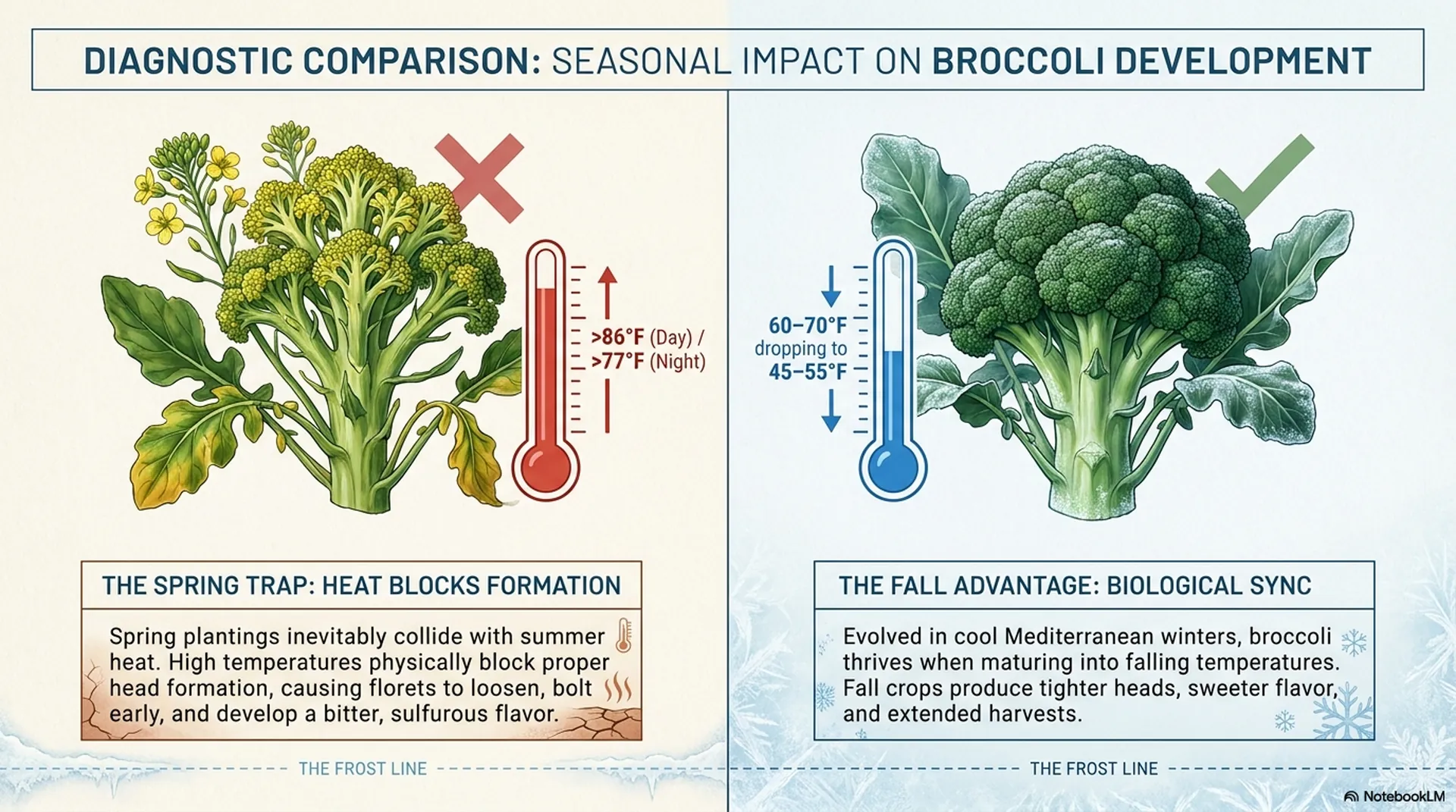
Research published in PMC documented this mechanism in Brassica crops: cold acclimation ‘decreases some glucosinolates while increasing soluble sugars — the compounds responsible for perceived sweetness.’ A separate analysis in Frontiers in Nutrition found that at cool growing temperatures (45–55°F daily range), key beneficial aliphatic glucosinolates in broccoli increased 8-fold compared to warm-grown plants — the same compounds associated with broccoli’s cancer-protective properties.

Skip the guesswork — get a pre-planned 4×8 kitchen garden bed
Free printable planting plan: what goes where, when to plant it, and how to keep it alive. Plus two bonus flower bed plans.
Spring broccoli faces the opposite problem. Iowa State University Extension notes that daytime temperatures above 86°F or nighttime temperatures above 77°F physically block proper head formation — the florets loosen and the head becomes an open, bitter cluster rather than a tight dome. In zones 5–7, spring-planted broccoli often hits this wall in June before heads fully develop. Fall broccoli matures as temperatures fall through the ideal 60–70°F window.
The Date Math: Planting Windows by Zone
Illinois Extension provides the most precise formula for fall timing: count backward from your first expected frost date, then add 10 days to your variety’s days-to-maturity number. That buffer accounts for days when the plant grows slowly as temperatures drop in late fall.

Formula: Last transplant date = first frost date — (days to maturity + 10 days)
Example: Zone 6, first frost October 20, growing Packman at 50 DTM. 50 + 10 = 60 days. Count back 60 days from October 20: transplants must go in the ground by August 21.
| Zone | First Frost Range | Transplant Window | Direct Seed Window |
|---|---|---|---|
| 3–4 | Sep 15 – Oct 1 | Jul 1–20 | Jun 15 – Jul 1 |
| 5 | Oct 1–15 | Aug 1–20 | Jul 15 – Aug 1 |
| 6 | Oct 15 – Nov 1 | Aug 15 – Sep 1 | Aug 1–15 |
| 7 | Nov 1–15 | Sep 1–15 | Aug 15 – Sep 1 |
| 8 | Nov 15 – Dec 1 | Sep 15 – Oct 1 | Sep 1–15 |
| 9 | Dec 1 – Dec 31 | Oct 1–15 | Sep 15 – Oct 1 |
Zones 3–5 face the tightest margins. Missing the transplant window by two weeks in zone 4 often means heads form during the first cold snap while plants are still small — triggering buttoning (covered below). In zones 8–9, the challenge runs the other way: transplanting while daytime highs are still above 85°F stresses young plants and can also trigger premature heading. In these zones, wait for daytime highs to drop below 85°F before setting out transplants.
For plants that work well alongside fall brassicas, see our Companion Planting Guide for Vegetables. For a full 12-month sowing calendar by zone, see our Year-Round Planting Guide.

Best Varieties for Fall Broccoli
Not all broccoli handles fall equally. For fall planting, prioritize two traits: shorter days-to-maturity (more buffer against early frost) and proven cold tolerance. Heat tolerance matters less — you need a variety that heads up well as temperatures drop, not one built to handle summer heat.

| Variety | Days to Maturity | Type | Cold Tolerance | Best For |
|---|---|---|---|---|
| Packman | 50 days | Hybrid | Good | Zones 3–5, shortest growing windows |
| Green Comet | 55 days | Hybrid | Moderate | Early fall harvest, any zone |
| Belstar | 60–65 days | Hybrid | Excellent | Zones 5–8, reliable quality |
| Arcadia | 63–68 days | Hybrid | Exceptional | Zones 5–8, extended harvest into frosts |
| Waltham 29 | 63–74 days | Heirloom (OP) | Very good | Side-shoot harvest, zones 4–7 |
| Green Magic | ~60 days | Hybrid | Heat + cold tolerant | Zones 7–9, fluctuating fall temps |
For zones 3–5 with a short window: Packman at 50 days gives you the most buffer. In zone 4 with a September 20 first frost, Packman needs to go in the ground by August 1 — tight but doable. Green Comet at 55 days is the next step up if Packman isn’t available.
For zones 6–8 where you have more runway: Arcadia is the standout. It holds its head in good condition through multiple light frosts and keeps producing side shoots well into November. Grown through three consecutive nights at 27°F, a well-established Arcadia plant won’t lose a harvestable head — it’s the default choice for extending the fall season.
Waltham 29 is the side-shoot specialist. The central head runs smaller (4–8 inches) but the plant pushes abundant lateral shoots for 4–6 weeks after central head harvest. If you want broccoli on the table from September through November, grow two plants of Waltham 29 alongside one Packman.
Transplants vs. Direct Seeding for Fall
Both work, with different failure modes.
Transplants give you a 4–5 week head start and let you harden plants under controlled conditions before late-summer heat. Iowa State Extension recommends starting transplants indoors 4–5 weeks before your outdoor planting date — so for a zone 6 August 21 transplant target, start seeds indoors around July 17. Transplants are the safer choice for zones 3–5 where the window is shortest and a week of bad weather can cost you the crop.
Direct seeding works well in zones 6–9 where the summer taper provides more time. Sow seeds ¼–½ inch deep, 2–3 per spot, and thin to one plant at 3 inches tall. Directly seeded broccoli doesn’t experience transplant shock during hot weather and often establishes a stronger root system. The tradeoff is a 1–2 week longer time to first harvestable head. University of Minnesota Extension recommends selecting varieties with 60–85 days to maturity for fall planting, ensuring heads form during the cooler autumn weeks rather than racing against late summer heat.
Soil Prep and Fertilizing
Broccoli is a heavy feeder, and fall crops need fertile soil from day one. Target soil pH 6.0–7.0. Below 6.0, phosphorus becomes less available and head development suffers; above 7.0, clubroot disease pressure increases.
Stop missing your zone's planting windows.
Select your US zone and month — get a complete checklist of what to plant, prune, feed, and protect right now.
→ View My Garden CalendarBefore planting, work in a 10-10-10 granular fertilizer at 1–2 pounds per 100 square feet. This primes the soil for the nitrogen-intensive vegetative growth phase where the plant builds the leaf canopy it needs to fuel head development.
Side-dress twice during the season:
- 4 weeks after transplanting: ½ cup of ammonium sulfate (21-0-0) per 10-foot row. This nitrogen push drives the leaf mass needed for a full-sized head.
- When the head is quarter-sized: ¼ cup of 21-0-0 per 10-foot row. This final boost supports rapid cell division during head development.
One caution from MSU Extension: excessive nitrogen causes hollow stems. Don’t over-apply thinking more nitrogen equals bigger heads. The two side-dresses above are calibrated to the plant’s actual needs — stick to those rates.
Water consistently at 1–1½ inches per week. Soil moisture fluctuations during head development cause hollow centers and tip burn. Mulch with 2 inches of straw or shredded leaves after transplanting to hold soil moisture and moderate late-summer soil temperature.
The Buttoning Trap: Why Planting Too Late Destroys Your Fall Harvest
Buttoning is the most common fall broccoli failure and the one most gardeners don’t understand until after it happens: tiny heads — the size of a quarter — form on plants that never develop a full-sized central head, and nothing you do afterward changes the outcome.

The mechanism: broccoli moves through three developmental stages — juvenile (vegetative growth, building leaf mass), reproductive (head formation), and maturation. The plant normally stays juvenile until it reaches sufficient size, at which point cool temperatures signal it to initiate heads. When young, small plants experience cool nights before accumulating enough leaf mass, they skip to the reproductive stage with insufficient energy reserves to produce a full head. The result is permanently undersized heads.
The fall-specific risk is direct: plant too late with a long-DTM variety, and your plants are still in the 4-leaf stage when September nights drop below 50°F. The plants button and the harvest is lost. Iowa State Extension notes that broccoli forms proper heads when daytime temperatures run 50–86°F with nighttime temperatures in the 50–59°F range — below these nighttime thresholds on young plants, buttoning risk climbs sharply.
Prevention comes down to three things:
- Plant on time. Use the Date Math table above. Missing the window by more than two weeks carries real buttoning risk.
- Match variety DTM to your zone. In zone 4, a 75-day variety planted in late July is a recipe for buttoning — use Packman at 50 days instead.
- Protect young transplants from early cold snaps. If temperatures drop below 50°F in the first three weeks after transplanting, use floating row cover at night. Young transplants with fewer than 8 true leaves are most vulnerable.
Pest Management: The Fall Caterpillar Surge
By the time you’re planting fall broccoli in July or August, summer’s caterpillar population has had four months to build. Expect heavier pest pressure on fall crops than on spring plantings — this isn’t anecdote, it’s population biology.
Three species attack fall broccoli across most of the US:
- Imported cabbage worm (velvety green, 1–1½ inches): larvae of the white cabbage butterfly. Most visible — check the undersides of leaves for pale yellow eggs laid singly.
- Cabbage looper (smooth, light green, loops its body when walking): often found inside the developing head, which is the most frustrating place to discover one at harvest.
- Diamondback moth (small pale green larvae): has developed resistance to many synthetic pesticides, making it the hardest of the three to control chemically.
The most effective defense is floating row cover applied at transplanting. It physically excludes all three species and simultaneously provides a few degrees of frost protection on cool nights — a double benefit in fall. Leave the cover on until early October, then remove it.
Without row cover, check plants every 3–4 days and remove eggs and larvae by hand. Bacillus thuringiensis (Bt) spray is effective on all three species and safe for beneficial insects — apply in the evening when larvae are most active. Illinois Extension confirms that caterpillar populations crash sharply after the first frost, so your pest pressure window has a firm end date.
Harvest Timing and the Hard Freeze Threshold
Cut the central head when it reaches 6–7 inches across (some varieties reach 12 inches) with buds tightly closed and uniformly green. Once individual buds begin to swell or show any yellow tinge, cut immediately — at warm temperatures the head will be in flower within 24–48 hours.

Broccoli’s cold tolerance is a genuine advantage in fall. SDSU Extension classifies it as tolerant of moderate freezes: light frost (28–32°F) causes no damage, and a moderate freeze down to 26°F is survivable. MSU Extension confirms mature broccoli tolerates temperatures down to 25°F, and cold exposure improves flavor through the sugar-accumulation mechanism described above. You can leave heads on the plant through multiple nights of light frost — and should, for the flavor benefit.
The threshold that matters is the severe freeze: temperatures below 24°F. At that point, ice crystals form inside the florets and cell damage is irreversible. When your forecast shows an incoming hard freeze, harvest everything that day. Heads don’t recover from severe freeze damage even if the plant survives.
Harvest in the morning. Heads are at peak firmness and lowest internal temperature, which slows deterioration after cutting. Broccoli stored at 32–40°F keeps 10–14 days; at room temperature, it yellows within 3–4 days.
Side Shoots: Extending Your Harvest After the Main Head
Cutting the central head starts a second harvest phase. The plant redirects energy into side shoots — small florets that emerge from the leaf axils along the main stem. On varieties like Waltham 29, De Cicco, and Belstar, side-shoot production continues for 4–6 weeks after the central head harvest.
Harvest side shoots when they’re 2–4 inches across and buds are still tight. Cut with 4–6 inches of stem — the stem is edible and the length makes handling easier. Don’t wait for side shoots to fully expand; they go from perfect to flowering faster than the central head.
If a moderate freeze (26–28°F) is in the forecast, cover plants with floating row cover the night before. This keeps side shoots harvestable for another 2–3 weeks past what the open-air forecast would otherwise allow. In zones 6–7, a covered plant can produce side shoots into late November.
Before a confirmed hard freeze below 24°F, harvest all remaining side shoots — even undersized ones. Small broccoli florets roasted with olive oil are far better than florets frozen solid on the plant.
Frequently Asked Questions
How late can I plant broccoli in fall?
The latest safe transplant date is: first frost date minus (days to maturity + 10). In zone 6 with a first frost of October 20 and Packman at 50 DTM, the last transplant date is August 21. After that, the heads won’t develop before the cold arrives.
Can fall broccoli survive frost?
Yes. Broccoli tolerates light frost (28–32°F) and moderate freeze down to 26°F without damage to the heads. A severe freeze below 24°F will damage head tissue — harvest before a confirmed hard freeze, not after.
Why is my fall broccoli forming tiny heads?
Buttoning — premature heading triggered when young plants with limited leaf mass experience cool nights before they’re developmentally ready. Plants need at least 8 true leaves before cool nights (below 50°F) become a heading trigger. It usually means you planted too late for your zone or chose a variety with too many days to maturity for your available window.
Sources
- Growing Broccoli in the Home Garden — Iowa State University Extension
- Growing Broccoli in a Home Garden — University of Maryland Extension
- Growing Broccoli in Home Gardens — University of Minnesota Extension
- How to Grow Broccoli — Michigan State University Extension
- Broccoli — Illinois Extension, UIUC
- How to Grow Broccoli in Your Garden — Utah State University Extension
- Chilling and Freezing Temperature Stress Differently Influence Glucosinolates in Brassica — PMC
- Pre- and Post-harvest Factors Affecting Glucosinolate Content in Broccoli — Frontiers in Nutrition
- Fall Frost Tolerance of Common Vegetables — SDSU Extension
- Broccoli Zone Planting Guide — Bonnie Plants
- When to Plant Broccoli: Timing by Zone and Season — HarvestToTable
- Broccoli Buttoning: What Causes Multiple Tiny Heads? — Gardener’s Path


