

The 8 Best Lettuce Companion Plants (and Why Radishes Belong in Every Row)

Find out which companion plant suppresses lettuce aphids up to 50 feet away — and why radishes belong in every row you plant.
Every spring starts the same way — crisp, beautiful lettuce coming in strong. Then June arrives, temperatures climb past 85°F, and you get one warm week before the lettuce bolts and the aphids move in. Companion planting won’t make your lettuce impervious to summer, but the right plant combinations can genuinely extend your harvest by two to four weeks and cut aphid pressure significantly without spraying anything.
The research matters here. A UC Davis study tested 22 different flowering plants in actual lettuce fields and found that sweet alyssum suppressed aphid populations up to 50 feet from where it grew — the most effective of all 22 plants tested. That’s a funded field study, not folklore. Most companion planting advice skips data like that and hands you a list. This article explains the mechanisms, because knowing why each pairing works lets you adapt it to your specific setup.

You’ll also find out which common recommendation is backed by peer-reviewed research showing it inhibits lettuce root growth by up to 85% — and why you should avoid it despite the shade it offers. For full guidance on growing lettuce from seed through harvest, see the lettuce growing guide.
Why Companion Planting Makes Such a Difference for Lettuce
Lettuce has two persistent problems: aphids and bolting. Companion planting addresses both — but the mechanism matters more than the plant list.
When leaf lettuce hits temperatures above 30°C (86°F), abscisic acid accumulates in the plant’s cells and accelerates the bolting response, triggering flower formation and turning leaves bitter within days. Shade from a taller companion — a cucumber on a trellis, a row of pole beans — keeps soil surface temperatures several degrees lower, staying below that threshold even on warm summer days. A 2022 study in Frontiers in Plant Science confirmed that the ABA hormonal pathway is the primary driver of high-temperature bolting in leaf lettuce, and that maintaining temperatures below 30°C is the critical intervention point.
Aphid control works through plant chemistry. Companion plants with strong scents release volatile organic compounds (VOCs) that physically coat the leaves of nearby plants. Since aphids locate host plants almost entirely by smell, a lettuce plant growing next to chives smells like chives to approaching aphids — and most move on. Research published in Insects (2017) shows this masking effect is strongest within 12 to 18 inches and becomes negligible beyond 3 feet, which is why placement matters as much as plant selection.
Illinois Extension notes that while much companion planting advice is anecdotal, an Iowa State study found that any herb companion tested alongside vegetables, including lettuce, showed measurable pest management improvement compared to the control — though you may need more companion plants than you’d expect for lasting results. Companions reduce pressure; they don’t eliminate it. That’s the honest baseline.
1. Chives: The Best All-Around Aphid Deterrent
Plant chives at 12-inch intervals along the border of your lettuce bed and trim them to 2 inches above soil every three to four weeks. Fresh-cut chive leaves ramp up sulfur VOC production — the compounds that make them effective against aphids.
Why it works: allium plants emit volatiles that are 94% sulfur compounds. These physically adhere to the surface of neighboring leaves, masking their chemical identity from approaching aphids — particularly the green peach aphid (Myzus persicae), the species that causes the most damage to lettuce crops. An aphid that can’t identify lettuce by smell simply doesn’t land.
One honest caveat worth including: a 2021 study in Scientific Reports testing leek alongside sweet pepper found the expected reduction in sustained aphid feeding, but also a hormetic effect — aphids in clip-cage exposure to leek volatiles showed 20% higher fecundity and 91% survival versus 65% in controls. Field conditions differ significantly from clip-cage lab tests, and the feeding disruption effect holds in field settings. But VOC masking is a deterrent, not a kill mechanism — chives reduce aphid pressure, they don’t eliminate it.
Garlic works by the same mechanism and can be planted at the bed ends. Both are edible, which makes the border productive beyond pest deterrence.
2. Sweet Alyssum: The Banker Plant That Punches Above Its Weight
This small, honey-scented annual deserves a permanent row along any lettuce bed. When UC Davis researchers tested 22 different plants for attracting beneficial insects to lettuce fields in California, sweet alyssum was the most effective of all — suppressing aphid populations up to 50 feet away from where it grew.
The mechanism: sweet alyssum’s nectar feeds adult parasitoid wasps, green lacewings, and syrphid flies. These beneficial insects need carbohydrates from flowers to survive while they hunt — without that energy source, they can’t search long enough to find aphids. Plant sweet alyssum and they stay. Research at Aarhus University published in Environmental Entomology (2014) confirmed that parasitoid wasp species including Aphelinus abdominalis can achieve 51% mortality against lettuce aphids within 24 hours, though the inner-leaf architecture of lettuce heads limits wasp access to the most protected aphid colonies.
Plant sweet alyssum in a continuous 6-inch-wide strip along the bed border. The flowers bloom for months and reseed reliably. Deadhead occasionally to keep it producing fresh nectar and prevent exhaustion. A single border strip does the work — you don’t need heavy plantings.
Stop guessing if your garden pays.
Log what you grow and harvest — see total yield weight, estimated retail value, and season-on-season progress in one place.
→ Track My Harvest


3. Nasturtiums: Effective Trap Crop — With One Non-Negotiable Rule
Nasturtiums work well as a companion for lettuce, but only if you manage them actively. Left alone, they become an aphid breeding ground that makes your problem worse, not better.
The appeal is real: nasturtiums attract green peach, melon, and potato aphids away from lettuce — aphids prefer the soft, succulent nasturtium foliage over tougher crops. Plant a border row 4 to 5 feet away from your lettuce, close enough that pests migrate there preferentially, far enough that aphid colonies don’t immediately overflow back onto the lettuce.
Inspect nasturtiums twice a week. When you find aphid colonies forming, spray them with insecticidal soap or cut and dispose of infested stems. If you skip this, you’re farming aphids at the edge of your lettuce bed. Yellow-flowering varieties attract the heaviest aphid pressure for maximum trap crop effect. The secondary benefit — nasturtium flowers attract hoverflies whose larvae eat aphids — adds a biological control layer on top of the trap crop function.
4. Radishes: The Best Space-and-Soil Partner for Lettuce
Radishes and lettuce have been grown together longer than almost any other crop pairing — and for concrete reasons. In my own raised beds, I plant a radish seed between every two lettuce transplants as a matter of habit: they’re harvested before the lettuce needs room, and the soil where the radish taproot was is noticeably easier to work.
Radishes germinate in 3 to 5 days, marking your lettuce rows before the slower seedlings emerge. They’re harvested in 25 to 30 days, making space available exactly as lettuce needs room to spread. This interplanting cycle means zero wasted soil in a raised bed or intensive planting.
Below ground, radish taproots break through any compaction as they grow, creating aeration channels that benefit lettuce’s shallow fibrous root system. Because lettuce roots sit in the top 6 to 12 inches of soil while radishes go deeper, they don’t compete for the same soil volume. The pest deterrence angle also applies: in beds with both crops, cabbage maggot flies (Delia radicum) are drawn primarily to the radish’s stronger chemical signature, giving nearby lettuce relative protection from root-level pest activity.
Plant one radish seed for every two lettuce plants in alternating positions. Pull radishes at 25 days before they bolt and become woody — bolted radish roots turn pithy and lose flavor rapidly.
5. Carrots: Root-Level Compatibility
Carrots are the low-drama companion: no elaborate mechanism, just genuine root-level compatibility with lettuce.
Carrot taproots extend 6 to 10 inches or more, improving soil structure as they grow through it and leaving aeration channels after harvest that lettuce roots benefit from. Both crops share a cool-season window — lettuce prefers 60 to 70°F, carrots 60 to 65°F for steady growth — and they go into the ground at the same time under the same watering regime.
Space them 6 inches apart in alternating positions. Young carrot tops provide very light early-season filtered shade for lettuce seedlings, slightly buffering warm spells before larger shade companions are established. Harvest timing aligns well: most carrot varieties mature in 70 to 80 days, clearing the bed for a second lettuce planting before summer heat sets in.
6. Tomatoes, Cucumbers, and Pole Beans: Shade to Stop the Bolting Clock
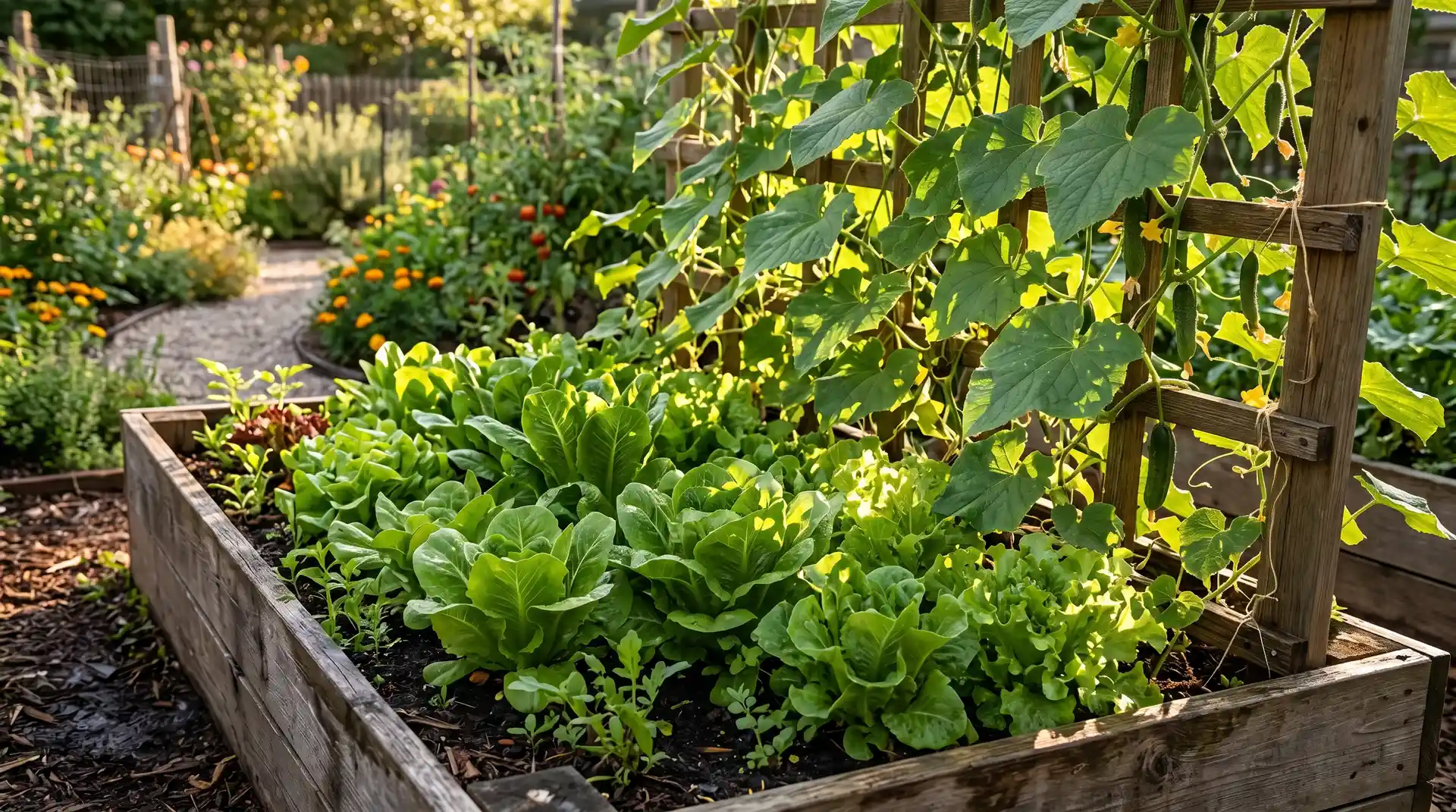
These are the shade companions — the ones that buy your lettuce two to four additional weeks of harvest time in early summer by directly addressing the bolting trigger.
The threshold is precise: temperatures consistently above 86°F (30°C) at the plant’s growing tip activate the ABA hormonal pathway that pushes lettuce into flower production. A mature cucumber on a trellis running east to west, or a row of pole beans on the north side of your lettuce patch, keeps afternoon temperatures below that threshold in the immediate microclimate.
Plant lettuce on the north or northeast side of your trellised crops — morning sun reaches the lettuce while afternoon heat from the south and west is blocked by the trellis and foliage. With tomatoes, lettuce planted within 18 to 24 inches benefits from afternoon canopy shade by mid-June in most US zones. One timing consideration: avoid planting lettuce directly under dense tomato foliage. Mature tomato plants in peak season block too much light, causing lettuce to grow etiolated and spindly. The goal is 30 to 50% shade filtering, not full shade — a row of pole beans on the bed’s west edge achieves this naturally without the risk of over-shading.
7. Strawberries: A Space-Efficient Pairing for Both Crops
If you’re already growing strawberries, filling the gaps between plants with lettuce is one of the best uses of that bed space. The relationship works in both directions.
Strawberry plants spread 12 to 18 inches and develop a dense canopy by summer — exactly when lettuce wants to bolt. The strawberry foliage provides the natural shade that slows bolting, while lettuce acts as a living mulch between plants, suppressing weeds and reducing soil moisture evaporation around the strawberry roots.
Both crops prefer similar conditions: consistent moisture, well-drained fertile soil, and a slightly acidic pH around 6.0 to 6.5. Plant a head lettuce or loose-leaf variety between every two strawberry plants and harvest the lettuce before the strawberry canopy fully closes in early summer. For full strawberry care including spacing and variety selection, see the strawberry growing guide.
8. Dill: Parasitoid Wasp Support on the Bed’s Back Edge
Young dill and mature dill serve completely different companion functions — and both are useful for lettuce beds.
Young dill at the harvest stage releases terpenoid VOCs through its aromatic foliage that may mask nearby crops from aphids, similar to the chive mechanism. Mature dill at the flowering stage produces flat umbel flowers that are among the best nectar sources for parasitoid wasps — the same beneficial insects sweet alyssum attracts. Running both at once via succession sowing gives you overlapping pest protection functions throughout the season.
Plant two to three dill plants at 14-day intervals along the back edge of the bed. Harvest young foliage from early plantings; let the final planting run to flower at bed edges to fuel the wasp population. Since dill’s taproot goes deep, it doesn’t compete with lettuce’s shallow roots. Keep dill at the perimeter rather than interplanted through lettuce rows — dense mature dill can inhibit neighboring plants through allelopathic compounds at close range.
Plants to Avoid Near Lettuce
Brassicas (Cabbage, Broccoli, Kale, Cauliflower)
The most common mistake is planting lettuce alongside brassicas because they share a cool-season growing window. The problem: they attract the same aphid species while competing aggressively for nitrogen and moisture in the same soil layer. A cabbage aphid colony on nearby broccoli is a reservoir waiting to migrate. Keep a full bed’s width between lettuce and any brassica crop.
Fennel
Fennel releases allelopathic compounds — anethole and fenchone — from its roots that inhibit germination and root development of nearby plants, including lettuce. Keep fennel in an isolated container or at least 5 feet from any lettuce bed. It’s a poor neighbor for most vegetables, not just lettuce.
Sunflowers
This one surprises most gardeners: sunflowers are widely recommended as shade providers for lettuce, and the shade does help. But peer-reviewed research published in MDPI Applied Sciences (2022) found that sunflower root and leaf water extracts inhibited lettuce root length by up to 85% compared to controls — with flowering-stage plant material showing the highest phytotoxicity from compounds including heliannuols and chlorogenic acid. The shade benefit doesn’t outweigh the allelopathic risk when those compounds concentrate in soil near the roots. Use trellised cucumbers or pole beans for shade instead. They deliver the same microclimate benefit without the root inhibition.
Companion Planting Layout at a Glance
| Companion | Distance | Function | Key Rule |
|---|---|---|---|
| Chives | 6–12 in (row edge) | VOC aphid masking | Trim every 3–4 weeks |
| Sweet alyssum | 6–8 in (bed border) | Banker plant for wasps | Keep in bloom; deadhead |
| Nasturtiums | 4–5 ft (perimeter) | Aphid trap crop | Inspect twice weekly |
| Radishes | Interplanted | Soil aeration + spacing tool | Harvest at 25 days |
| Carrots | 6 in, alternating | Root compatibility + light shade | Same watering regime |
| Tomatoes/cucumbers/beans | North/east side | Afternoon shade, prevents bolting | 30–50% shade only |
| Strawberries | 12–18 in gaps | Living mulch + shade | Harvest before canopy closes |
| Dill | Bed perimeter | Parasitoid wasp nectar | Keep at edge; succession sow |

FAQ
Can I plant lettuce under tomatoes?
Yes — plant it on the north or northeast side where it receives morning sun and afternoon filtered shade from the tomato canopy. Avoid planting directly beneath dense foliage once tomatoes are in full growth. You want 30 to 50% shade filtering, not full cover, or lettuce becomes spindly.
Do marigolds help lettuce?
Marigolds attract beneficial insects and are commonly recommended as companions. They’re most effective against root nematodes when planted as a cover crop before the growing season — not as an in-season companion. For in-season aphid control specifically around lettuce, sweet alyssum, chives, and nasturtiums are better-documented choices.
Does lettuce make a good companion for other crops?
Yes. Lettuce acts as living mulch between strawberries, suppresses weeds between rows of taller vegetables, and matures fast enough to clear ground before heat-loving crops need the space. It’s as useful as a companion plant as it is a host. See the vegetable companion planting guide for complete cross-crop pairings.
Putting It Together
The most effective lettuce companion beds combine functions: a chive or garlic border for VOC aphid masking, sweet alyssum for parasitoid wasp support, shade providers on the north or east side to beat the 86°F bolting trigger, and radishes interplanted for soil aeration and spacing efficiency. Start with those four — you’ll address the two main lettuce problems (aphids and bolting) with plants that cost under a dollar per seed packet and produce results you can see within a single growing season.
Sources
- Ben-Issa R, Gomez L, Gautier H. Companion Plants for Aphid Pest Management. Insects. 2017;8(4):112. PMC5746795.
- Ameline A et al. Antagonist effects of the leek Allium porrum as a companion plant on aphid host plant colonization. Scientific Reports. 2021. PMC7889937.
- Bailey P. Aphid Relief from Sweet Alyssum. UC Davis. 1992.
- Wang Y et al. LsMYB15 Regulates Bolting in Leaf Lettuce Under High-Temperature Stress. Frontiers in Plant Science. 2022.
- Parasitoid Wasps May Be an Effective Tool against Lettuce Aphids. Entomology Today. 2014.
- Farris N. How to Use Nasturtiums for Pest Control. Gardener’s Path.
- Companion Planting: Anecdotal or Tried and Tested? Illinois Extension, UIUC.
- Sanchez-Moreiras AM et al. Allelopathic Potential of Sunflower Genotypes at Different Growth Stages on Lettuce. Applied Sciences. 2022;12(24):12568. MDPI. (No hyperlink — 403 to automated requests.)


