

Potentilla Care: The Best Way to Get Flowers All the Time in Any Soil

Every gardener wants a plant that will give them a lot of bright color all summer long without needing a lot of care. We look for that one plant that can survive a challenging place in the garden—baking sun, bad soil, and sometimes being ignored—and still look good. If this sounds like something you’ve heard before, it’s time to meet your garden’s new best friend.
Potentilla: The Low-Maintenance Garden’s Unsung Hero
Bush Cinquefoil, sometimes known as Potentilla, is the hard-working, unsung hero of landscapes all throughout the country. For years, this dependable deciduous shrub has been the top choice for landscapers and smart gardeners who want beauty without the work. It keeps its promises and gives you a lot of pretty flowers that look like buttercups from late spring until the first frost.

For a complete potentilla growing guide covering varieties, pruning, and care, see our complete Potentilla plant profile.
But that’s only part of the story. The amazing strength of potentilla is what makes it so special. It can survive in very cold weather (even in Zone 2), it can handle drought once it gets going, and deer practically never eat it. Potentilla is best recognized for its bright yellow flowers, but it also comes in crisp whites, gentle pinks, and blazing oranges.
Seasonal Garden Calendar
Know exactly what to plant, prune and sow — every month of the year.
Its beginnings hold the key to its strength. Potentilla is genetically built to survive in the harsh, cold, and often dry areas of the Northern Hemisphere. It changed over time to deal with bad, rocky soils and very hot or very cold weather. Its deep taproot system is a biological wonder that lets it reach moisture far below the surface that other shrubs with shallower roots can’t. This is why it doesn’t care about drought and grows well where other plants don’t.
Potentilla is my secret weapon for clients who say “I kill everything” when I’m designing landscapes. It’s the plant I choose for the hot strips of land near the driveway or for new homeowners who want color without having to work on it all the time. It’s a plant that makes you feel better about yourself.
For more on this, see potentilla five fingers.
How to Pick the Right Potentilla for Your Garden (Not Just Yellow)
The contemporary Potentilla can do more than one thing. Plant breeders have made a great diversity of sizes and colors, so you may find the right one for your garden design. Let’s not simply choose a plant; let’s also choose a purpose.
Varieties Overview
- “Gold Drop”: Bright Yellow, 2 ft tall by 3 ft wide. Best for ground cover, slopes, and the front of the border.
- “Goldfinger”: Dark Golden Yellow, 3 feet tall and 4 feet wide. Best for foundation planting and mass planting.
- “Abbotswood”: Just White, 3 feet high and 3 feet wide. Best for planting in contrast with mixed borders.
- “Pink Beauty”: Clear Pink, two and a half feet tall and three feet wide. Best for specimen planting in cooler climates.
- “Mango Tango”: Bicolor Orange and Red, 2 feet tall and 2 feet wide. Best for containers and accent planting.
- “Jackman’s Variety”: Bright Yellow, 4 feet high and 4 feet wide. Best for informal hedges and screening.
For a groundcover that grows low and spreads
If you want to cover a sunny slope or make the front edge of a garden bed easier to care for, go for a low-growing, spreading type like “Gold Drop.” The fern-like leaves with fine textures make a velvety mound, while the bright yellow flowers add color all season.
For more on this topic, see our guide: Mock Orange Care: The Best Way to Get the Most Fragrant Flowers.
I like to use “Gold Drop” near the front of a border or on a gradual slope where it can spill over nicely. Its leaves are quite fine, which makes it look wonderful next to plants with bigger leaves, like daylilies or sedum.
For a classic shrub of medium size
This is the best place for most garden uses, such growing plants around the foundation or lining a walkway.
- “Goldfinger”: This is the best Potentilla for heavy work. It is recognized for its very big, deep golden-yellow flowers and its thick, dependable habit. This is the yellow that you can’t miss.
- “Abbotswood”: This is the standard for white-flowering types. Its clear, crisp white flowers make the summer garden feel cooler and look great with purple or blue perennials.
- “Pink Beauty”: This is a reliable and well-liked choice for pink flowers. It’s good to know that the pink color is brightest in cooler places or when the plant gets some light shade in the afternoon. In very hot weather all day long, the pink can turn into a faint off-white.
For a pop of color that isn’t like any other
If you want to add some fire to your garden, look for the newer orange and red types.
- “Mango Tango”: This is a beautiful two-color variation that needs to be seen. The flowers have a deep orange-red core that fades to yellow at the borders. This small plant is great for pots or as a unique accent.
- The “Happy Face”® Series: This is a recent series of Potentilla that is recognized for being very hardy, resistant to disease, and having extra-large flowers in several hues, such as yellow, white, and pink.
For a hedge or screen that is taller
Choose a taller, more upright type like “Jackman’s Variety” if you want a low, informal hedge to mark off a space. It may grow up to 4 feet tall and has a lot of little branches that make it a good screen from spring to fall. It is covered in vivid yellow blooms.
Planting Potentilla: Getting Ready for Years of Success
One of Potentilla’s best traits is that it’s easy to plant. If you do a few things well, your shrub will be happy for a long time.
- When: The best periods to plant are in the spring or fall. This lets the plant grow its roots in cooler, wetter conditions before the stress of summer heat or winter cold.
- Where: This is the most crucial rule: there must be full sun. Potentilla needs at least 6 to 8 hours of direct sunlight every day to bloom a lot.
- How: Make a hole that is twice as wide as the nursery pot but the same depth. Carefully take the plant out of its pot and put it in the hole, making sure that the top of the root ball is level with the soil around it. Put the native soil you took out back into the hole and carefully pack it around the roots. After planting, water the area deeply and thoroughly to settle the soil.
Now, let’s talk about what “poor soil that drains well” really means. Potentilla grows well in soil that lets water flow through easily, like sandy, gravelly, or rocky soil. It is fine with soil that doesn’t have a lot of nutrients. It really doesn’t like heavy, thick clay soil that stays damp and soggy for a long time. This can cause the roots to decay. You can still do well even if your soil is heavy clay. Before you fill the hole back in, just mix a lot of compost or soil conditioner into the soil you took out. This will make the soil structure and drainage better for good.
The most common mistake I see is people planting Potentilla in a shady place since they have a hole there. You’ll have a healthy green bush, but you’ll be wondering where all the blossoms are. The most important thing for a plant to bloom is full sun for at least 6 to 8 hours a day.
How to Prune Potentilla: More Flowers and a Better Shape
For beginning gardeners, pruning might be scary, but with Potentilla, it’s easy and very rewarding. The most important thing to remember is that Potentilla blooms on new wood. This means that the new stems that sprout in the spring will have flower buds on them for the next season. So, the best time to prune is in late winter or early spring, before the new growth starts. This will help the flowers blossom more.
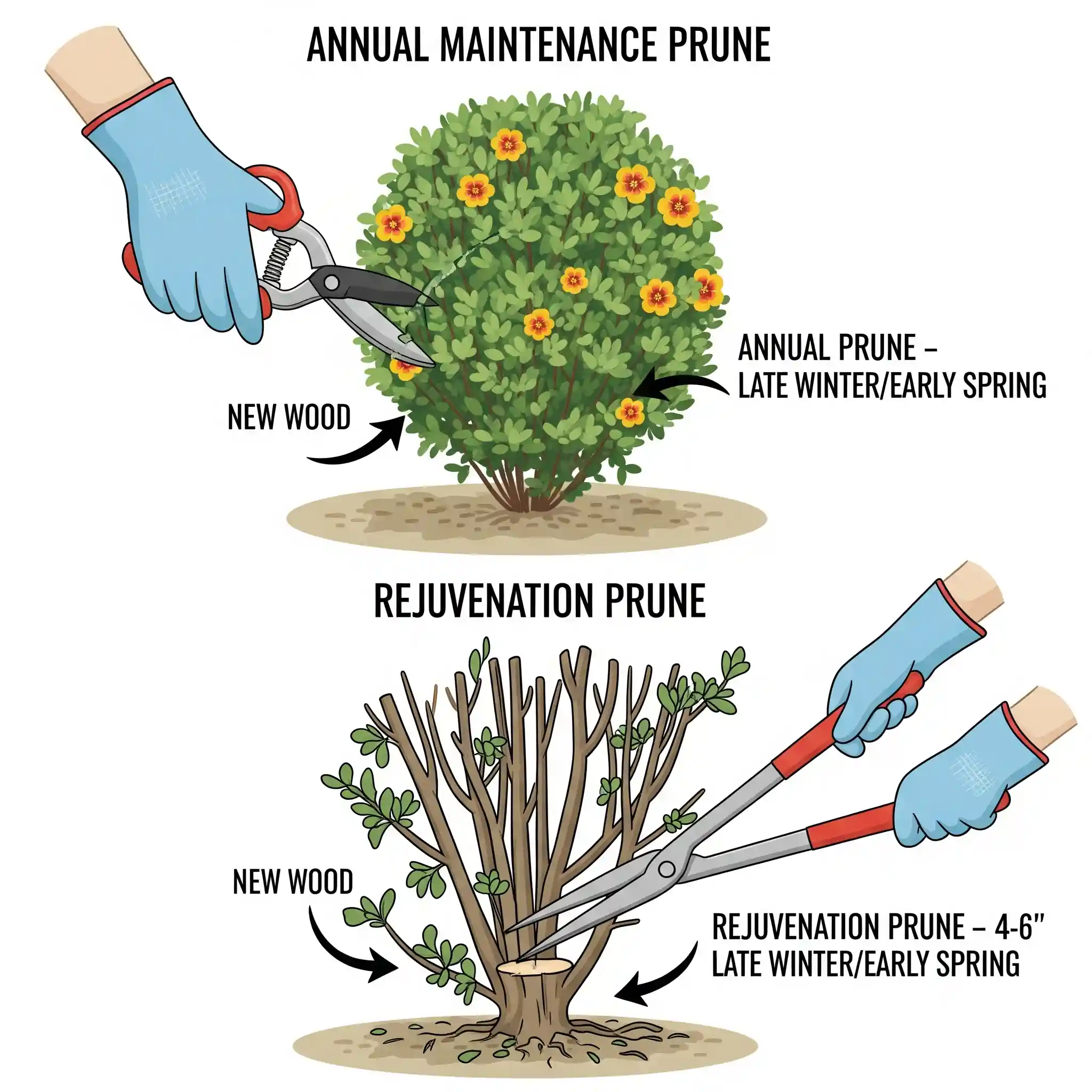
Don’t listen to ambiguous recommendations like “give it a light trim.” These are two different ways to reach two different goals.
Method 1: The yearly maintenance prune (for shape and flowers)
This is the easy, once-a-year haircut that keeps your shrub looking neat and healthy. It’s ideal to perform it in late winter or early spring, when the plant is still asleep.
Instructions: Use a clean, sharp pair of pruners to trim back the whole shrub by about a third. Don’t be shy. This makes the plant grow a lot of new stems from the base and sides. More new stems means more flowers. While you’re there, take a moment to cut off any dead, damaged, or awkwardly crossing branches. This will help the plant’s health and airflow.
Method 2: The Rejuvenation Prune (for shrubs that are old and woody)
Is your old Potentilla a tangled, woody monster with flowers that are largely at the ends of the branches? It’s time to prune for a fresh start. This is a more extreme but very effective way to reset a shrub that has gotten too big.
In late winter or early spring, use a strong set of loppers or a pruning saw to chop the whole shrub down to about 4–6 inches from the ground. It will appear bad, and you could wonder if you made the right choice, but don’t worry. This harsh cut makes the plant send up a burst of new, strong stems from its existing root system. You could lose some blooms in the first season following the prune, but by the second season, your shrub will be back to being a lovely, compact, and heavy-blooming shape.
Watering and Fertilizing: A Lesson in “Tough Love”
This is where a lot of well-meaning gardeners go astray. Potentilla does best when it gets what can only be called “tough love.” It’s more dangerous to care too much for this plant than to not care for it at all.
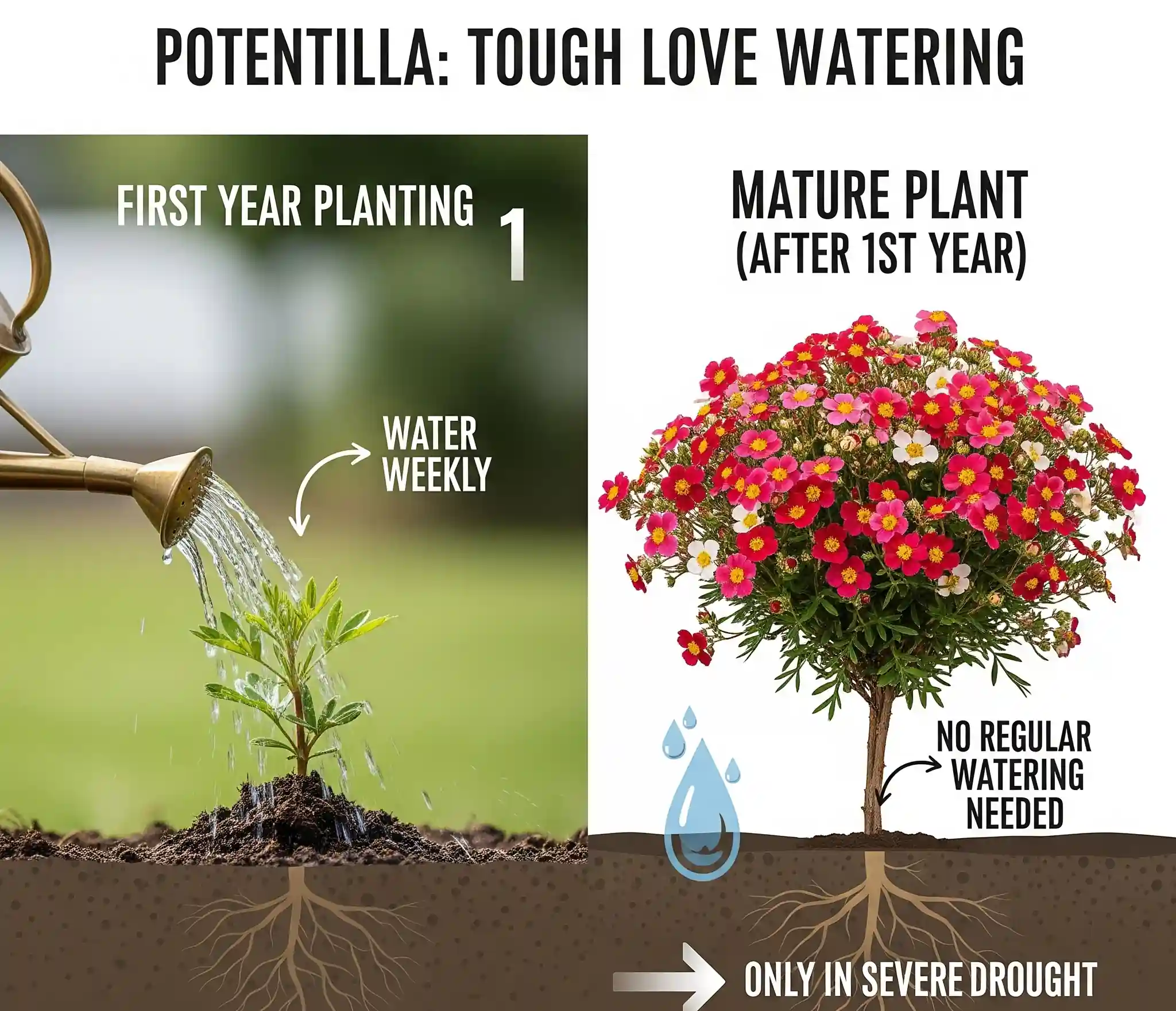
- Watering: For the first year after planting, water your Potentilla once a week, unless it rains, to help it grow its deep root system. After that first year, stop totally. A mature Potentilla can handle a lot of dry weather and will probably only need extra water during long, severe droughts. On an extremely hot afternoon, the leaves could look a touch droopy, but they’ll perk back up in the evening.
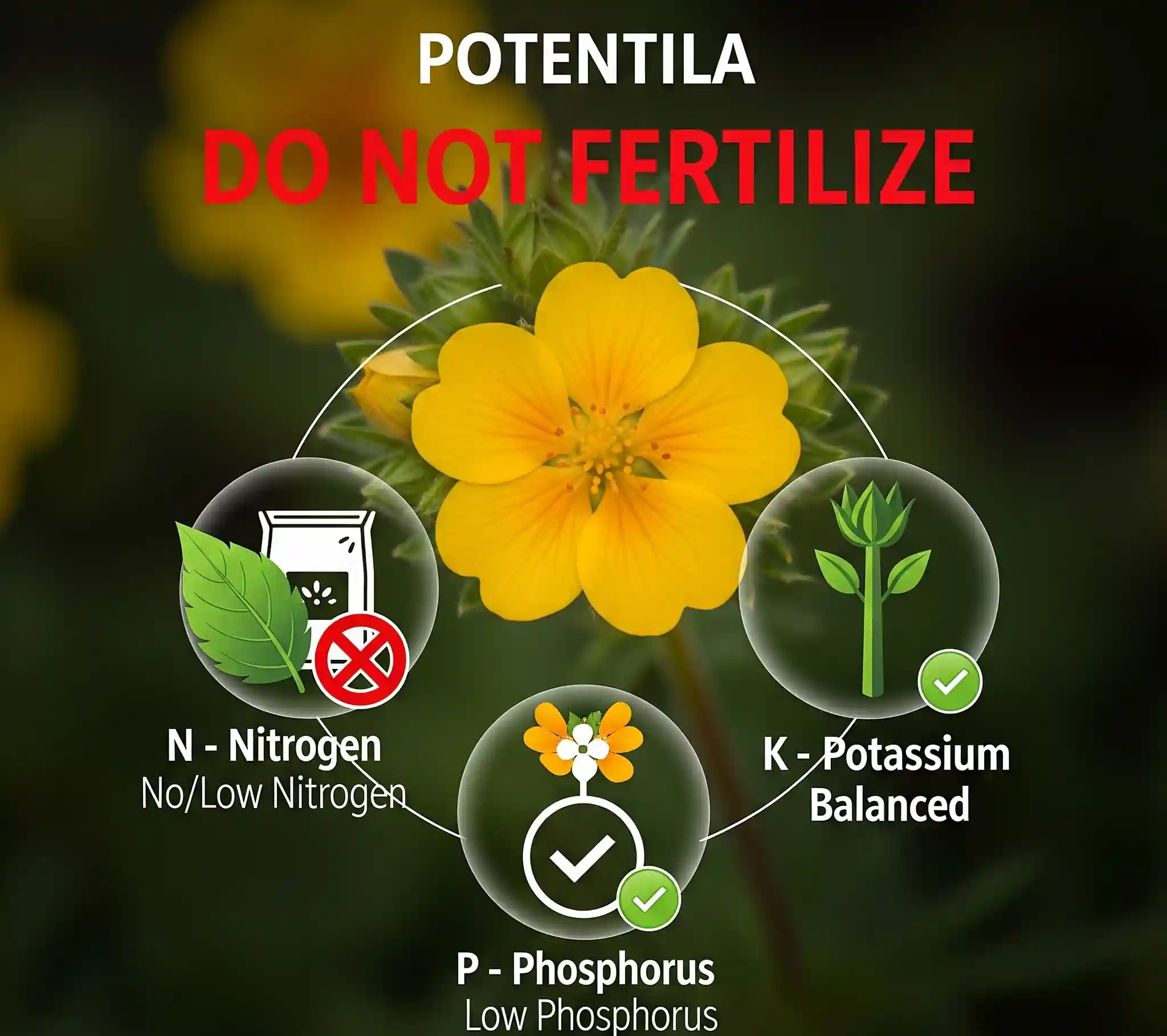
- Fertilizing: This is easy: don’t do it. Potentilla grows well in soils that don’t have a lot of nutrients. Adding fertilizer, especially one with a lot of nitrogen, will make the plant grow weak, leggy, and green instead of blooms.
Really, put the fertilizer away. I have Potentillas growing well in what is basically rocky sand next to a driveway. They bloom from May to October. They simply get a light covering of compost or shredded leaf mulch every other year to help keep the soil moist.
Potentilla’s Perfect Partners: Plants That Go Well With It in Tough Spots
It’s good to know what other plants like Potentilla that adore the sun and can handle dry weather. Putting them all together makes a gorgeous, well-organized garden bed that doesn’t need much care.
- Perennials: Consider perennials like Sedum “Autumn Joy,” which has big, meaty leaves and flowers that bloom late in the season; Russian Sage (Perovskia atriplicifolia), which has silver leaves and spires of purple-blue flowers; and Lavender, which likes the same sunny, well-drained conditions.
- Grasses: Potentilla leaf has a delicate texture that looks great next to attractive grasses. Little Bluestem (Schizachyrium scoparium) and Prairie Dropseed (Sporobolus heterolepis) are both drought-tolerant plants with lovely shapes.
- Other Shrubs: If you want a border that lasts all year, mix Potentilla with a Barberry for its dark burgundy leaves or a Spirea for its flowers that are different shapes.
How to Fix Common Problems with Potentilla
Potentilla is very resistant to pests and diseases, however you might have a small problem once in a while. Here’s a short guide.
- Problem: Few or No Flowers.
- Reason: This is almost often because there isn’t enough sunlight.
- Solution: Put the plant somewhere that gets at least six hours of direct sunlight every day.
- Problem: Leaves that are turning yellow.
- Reason: This is frequently a sign of bad drainage or too much water. The dirt is too heavy and stays damp, which is killing the roots.
- Solution: Stop watering right away. If the problem doesn’t go away, you might have to move it to a place with greater drainage or change the soil.
- Problem: Leaf Spot or Powdery Mildew.
- Cause: These fungal problems might happen in places that are very hot and humid and don’t have good air flow.
- Solution: Make sure the plant has enough room around it so that air may travel freely. Cutting back the middle of the shrub to make it thinner can also help air flow.
- Problem: Spider Mites.
- Cause: These little bugs can show up when it’s really hot, dry, and dusty. There will be thin, silky webs on the leaves.
- Solution: A powerful blast of water from the garden hose is sometimes enough to get rid of the mites and clean the plant.

In conclusion, your garden’s best friend is
Potentilla is a plant that is easy to care for and doesn’t require much attention. It is a true garden hero since it can keep its color all summer long, even when the weather is dry and the soil is bad. It is also very down-to-earth. It’s not just a shrub; it’s a way to solve problems, increase your confidence, and show how beautiful toughness can be.
Commonly Asked Questions (FAQ)
Is Potentilla an invasive plant?
No, the shrub form (Potentilla fruticosa or Dasiphora fruticosa) is a well-behaved shrub that grows in clumps and is not thought to be invasive. Some species of Cinquefoil are low-growing herbaceous perennials that can spread, but this tutorial is just about the non-spreading shrub.
Can I put Potentilla in a pot?
Yes, of course! It’s a great option for growing plants in containers. Pick a small or dwarf type, like “Gold Drop,” and a big pot (at least 18 inches wide) with good drainage holes. Plants in pots will need to be watered more often than plants in the ground because they dry up much faster.
Should I deadhead Potentilla?
No, you don’t have to. Potentilla is “self-cleaning,” so you don’t have to deadhead it to get new blossoms all season long. This is a big part of why it’s easy to take care of.
Why do the leaves on my pink Potentilla look like they’ve been washed out?
The pigments that give Potentilla flowers their pink, orange, and red colors can be damaged by heat and bright sunlight. These colors can fade to pale pink or off-white in places with very hot summers or all-day, searing sun. In places with cooler summers or a little shade during the warmest part of the afternoon, they often show their richest, brightest color. The classic yellow and white kinds, on the other hand, don’t change color at all in the sun.
The Practical Gardener wrote this.
The Practical Gardener has been developing attractive, durable, and low-maintenance landscapes for more than 20 years as a landscape consultant and writer. They love teaching people how to do things in the real world, and their main job is to assist homeowners make landscapes that do well with little work.


