

The Complete Guide to 40+ Types of Calathea (with Pictures and Care Tips)

TL;DR (Too Long; Didn’t Read)
This guide helps you choose the right Calathea by organizing over 40 types by care difficulty.
For a complete overview of Calathea varieties, care requirements, and common problems, see our complete Calathea plant profile.

- Key to Success: The secret to happy Calatheas is consistency. Replicate their native rainforest floor environment: high humidity, filtered/distilled water, bright indirect light, and a stable temperature.
- Start Smart: If you’re a beginner, don’t start with a “diva” like the ‘White Fusion’. Choose a forgiving variety like the Rattlesnake Plant (Calathea lancifolia) or Peacock Plant (Calathea makoyana) to learn their language and build your confidence.
- Water is Crucial: Crispy brown edges are almost always caused by low humidity or the minerals in tap water. Always use filtered, distilled, or rainwater.
- Daily Dance: The daily “praying” movement of the leaves (nyctinasty) is a sign of a healthy, happy plant.
Hello, plant lover!
You’re probably here because you’re fascinated by the magnificent, complex beauty of Calathea plants. It’s no surprise that these plants are popular among houseplant lovers because their leaves seem like a painting. Each leaf is a work of art in nature, with patterns that range from harsh, geometric stripes to soft, feathery ones. These plants are not only beautiful; they also move, which gives your home a lively feel.
Remember this before we get started: the most important thing to remember about Calathea is to be consistent. They are creatures of habit and do best when things stay the same, such when they get water and how the weather is. They don’t like things to change all of a sudden. If you can be consistent, you’ve won half the battle.
🗓️View the Calendar →Seasonal Garden Calendar
Know exactly what to plant, prune and sow — every month of the year.
Calatheas are often dubbed “Prayer Plants.” They are part of a group of plants that do a cool dance every day called nyctinasty. Their leaves fold up like hands in prayer as the sun goes down, and then they slowly lower again when the sun comes up. It’s not magic; it’s a great way for evolution to work. A pulvinus is a unique, bulging joint at the base of each leaf stem. When the day/night light cycle changes, specialized cells in this joint actively pump water in or out, adjusting the turgor pressure or internal water pressure. This clever hydraulic system moves the leaf up and down. Scientists think that this movement helps the plant keep moisture at night and may even keep animals away at night by changing its shape. It gently reminds you of the lively life in your home all the time.

We often call them Calathea, but for those who are interested in plants, it’s important to know that several species in this genus have been legally moved to the genus Goeppertia in the last few years. This scientific knowledge doesn’t change how beautiful they are or how to take care of them, but it’s an amusing tidbit for plant lovers. Even though you’ll still find them advertised as Calathea, we’ll give you the correct scientific names to be accurate. Now, let’s look for the best one for you.
How to Use This Guide to Find the Right Calathea for You
It can be hard not to pick a Calathea just because it looks nice — but that can often make you angry and give you “crispy leaf syndrome.” To help you succeed, we’ve divided our list into groups based on how hard they are to care for. If you’re honest about your experience, the time you can spend, and the conditions you can provide, you’ll find a leafy friend for a long time. This method makes it clear right away that the article is more than simply a lovely list; it’s also a useful tool that will help you avoid common mistakes.

Here’s a quick comparison of a well-known plant from each group to help you decide:
| Different types | Normal Size | Light Tolerance | Needs for Humidity | A Common Problem |
|---|---|---|---|---|
| Beginner: Rattlesnake Plant | 1–2 feet tall | Medium to Low | Moderate | If you water them too much, they can get root rot. |
| Intermediate: Pinstripe Plant | 1 to 2 feet tall and wide | Medium | High | Stripes might fade and are vulnerable to drafts. |
| Expert: ‘White Fusion’ | 1 to 1.5 feet tall | Medium | Very High (No Negotiation) | Very likely to get spider mites and have crispy edges. |
In my experience, the worst thing people do is buy a beautiful but hard-to-care-for Calathea like a “White Fusion” as their first plant. It’s like trying to run a marathon without ever having run before. This guide will help you pick a plant that fits your present ability level so you don’t have to deal with that heartbreak and can be successful.
The Best Calathea Types for Newbies
These types represent the first step into the world of Calatheas. They are tougher and more forgiving of mistakes than their cousins, which makes them great for learning how to take care of Calathea. They usually take their time letting you know what they need, which gives you time to change your course before things become really bad.
Peacock Plant (Calathea makoyana)

- Scientific Name: Goeppertia makoyana There are several reasons why the Peacock Plant is the best Calathea for beginners. The dark green design on its pale green, oval leaves looks like feathers and starts at the midrib. The pattern is beautifully reflected in colors of pink and purple on the undersides. From every aspect, it’s a feast for the eyes. Because its leaves are a little thicker than those of many other types, it can handle little changes in watering or humidity better than a more delicate type, which would quickly dry out. It grows in a lovely, thick cluster that is about 1 to 2 feet tall. The makoyana is a terrific “canary in the coal mine.” Its leaves may droop or curl a little bit before they start to crisp, letting you know it’s thirsty. This gives you a day or so of grace. It’s an excellent plant to learn how to talk to Calathea.
Rattlesnake Plant (Calathea lancifolia)
- Scientific Name: Goeppertia insignis The Rattlesnake Plant has long, wavy-edged leaves that add a lot of texture and a new shape to a cluster of plants. The brilliant green leaves with dark green ovals that alternate along the midrib. The rich purple undersides make a beautiful contrast. Because it grows more erect, it works well in smaller areas or on shelves. The leaves of this plant are thicker and somewhat leathery, which helps it store water better than many other Calatheas. This means that if you forget to water it for a day, it won’t wilt as much.
It’s okay to let the top inch of a Rattlesnake’s soil dry up. I think that overwatering is more likely to cause root rot than a short period of thirst, which is a mistake that rookies often make when they strive too hard.
Calathea musaica ‘Network’

- Scientific Name: Goeppertia kegeljanii This type is one of a kind, and I love it since it’s so subtle. The leaves look like a plain light green at first, but if you look closely, you’ll discover a very complicated, mosaic-like pattern of small lines that cross one other, which is why it’s called “Network.” It’s a natural pixelation wonder. It is noted for being able to handle reduced humidity better than most plants. It grows steadily and makes a gorgeous, rounded shrub.
Fuzzy Feather Plant (Calathea rufibarba)
- Scientific Name: Goeppertia rufibarba The Fuzzy Feather plant is distinctive because of how it feels. The long, thin, wavy leaves are all green on top, but the stems and undersides of the leaves are coated with silky, crimson hairs that make it feel like velvet. It’s one of the toughest plants in its family and doesn’t like dirty water as much as some others, so it’s a great pick for a beginner.
Intermediate Calathea Varieties for Growing Enthusiasts
Are you ready for a little more of a challenge? These types need more care, especially when it comes to watering and humidity. They don’t forgive neglect as easily, but if you take care of them, they will give you some of the most beautiful leaves in the plant kingdom. This is the level where you start to learn how to construct a stable microclimate.
Pinstripe Plant (Calathea ornata)
- Scientific Name: Goeppertia ornata The Pinstripe Calathea is a famous plant. The fine, straight pink or white pinstripes on its big, dark green leaves make them look almost fake in how beautiful they are. One problem that many growers have is that these pink stripes fade over time. This is usually because the leaf is getting older or because it gets too much direct sun, which bleaches the color. A steady location with bright, indirect light is very important for keeping color. It is also quite susceptible to chilly drafts.
People often say that the young leaves on an ornata don’t have stripes. This is typical! They start off as a pale, uniform green, and the stripes get darker over the course of a few weeks as the leaf solidifies. Don’t freak out!
Calathea roseopicta ‘Dottie’
- Scientific Name: Goeppertia roseopicta ‘Dottie’ “Dottie” is great for people who like gothic drama. The leaves are a stunning deep blackish-purple color with a bright pink border and a pink brushstroke in the middle. It’s a real stunner. Because their leaves are black, types like “Dottie” can handle light levels that are a little lower. But this can be a double-edged sword because less light means the soil stays wet longer, which makes plants more likely to have root rot if you don’t check the soil moisture before watering.
I put my “Dottie” in a glass nursery pot. This is the only way I can be confident that the soil is drying out uniformly and that the roots are healthy, which stops the root rot that this type is especially prone to.
Calathea ‘Triostar’
- Scientific Name: Stromanthe thalia ‘Triostar’ Even though it’s a Stromanthe, it’s generally often sold and tended for as a Calathea because they have comparable needs and are related. The long, pointed leaves are a beautiful mix of cream, green, and hot pink. There are no two leaves that are the same, which makes a gorgeous, chaotic splash of color. The undersides are all the same, gorgeous pink. To keep its colors bright, it needs very bright, indirect light. If the light is lower, the pink and cream will turn green.
Zebra Plant (Calathea zebrina)
- Scientific Name: Goeppertia zebrina The Zebra Plant has soft, lime-green leaves with dark, almost black stripes that seem like a zebra’s pattern. It feels great and can develop into a big, bushy plant that makes a big impact. It really hates dry air and is generally one of the first plants in a collection to have crispy edges. This makes it a fantastic (but harsh) sign that you need to raise the humidity in your home.
Calatheas for Experts: For the Serious Collector
These are the divas of the family. They are known for being picky and need exact circumstances to grow well. They will punish even the smallest mistake. You should only try them when you have mastered the others and can keep the humidity level high and steady. The prize is having a real botanical masterpiece that shows how good you are at growing plants.
Calathea ‘White Fusion’
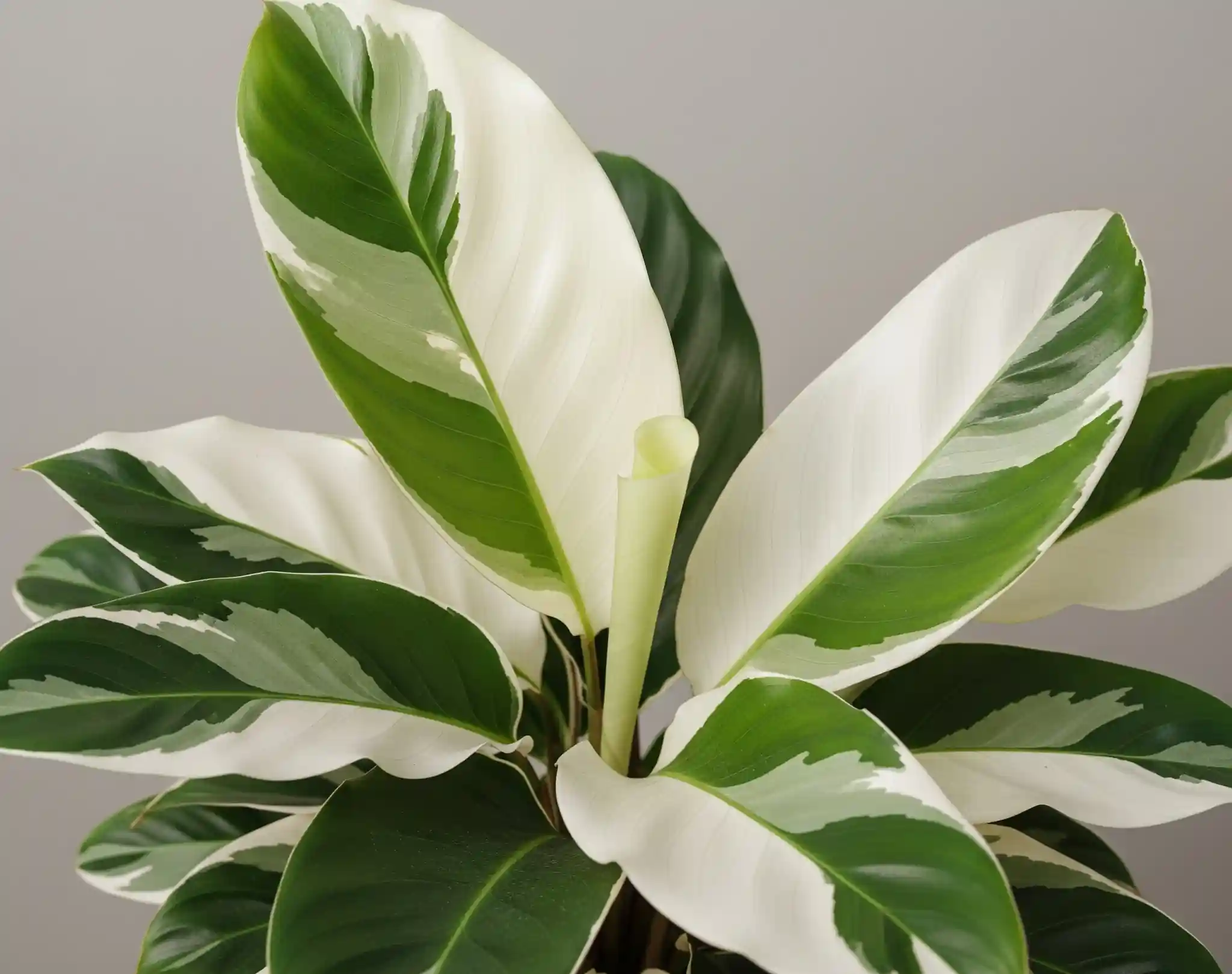
- Scientific Name: Goeppertia ‘White Fusion’ A plant of such beauty that many collectors would do anything to get it. The leaves are a beautiful watercolor artwork with white, green, and lilac-pink spots. It is, without a question, one of the most gorgeous houseplants you can have, but it is also one of the hardest to care for. You can’t change what it needs. The humidity needs to stay over 60% all the time. The white parts of the leaves are very thin and have very little chlorophyll, so they turn brown and crisp up quite easily as the weather changes. It is very sensitive to the minerals in tap water, so you should only offer it distilled, reverse osmosis, or rainwater. Spider mites love it too, and they do well in the warm, dry circumstances that this plant hates.
There is a humidifier next to my “White Fusion” that runs all the time. I clean the top and bottom of its leaves with a moist cloth once a week to keep spider mites away. You have to treat it like a diva. You can’t make a mistake.

Calathea ‘Warscewiczii’
- Scientific Name: Goeppertia warscewiczii This plant is often called the Jungle Velvet Calathea because of how soft and deep its leaves are. The leaves are dark green with a lighter green fishtail pattern in the middle. The undersides are a deep wine-red color. It also creates special white or pink blooms that look like cones. These are called inflorescences. The leaves are soft and pretty, but they are also fragile and don’t like to stay wet because it might cause fungal patches. This implies you need to add humidity to the air, not by misting, and make sure that air flows well.
Calathea ‘Misto’
- Scientific Name: Goeppertia ‘Misto’ The “Misto” is a less common but highly beautiful type. It features silvery-green leaves with dark green edges and a dark green splash down the middle that seems like a painting. To keep this delicate variegation without burning the sensitive leaves, it needs very particular light. People often mix it up with other types that seem like it, but once you’ve seen it in person, you can’t miss its unique pattern. It is very quick to show that it doesn’t like changes in the surroundings.
When the conditions are just right, I’ve discovered that the “Misto” grows fairly quickly. However, if the humidity drops even for a day, it will be the first plant in the room to have brown, crispy edges. It’s a lovely but hard-to-use tool for checking the conditions in your plant area.
The Ultimate Guide to Calathea Care: More Than the Basics
To care for any Calathea, you need to make their native environment, the floor of a tropical rainforest, look like it. This indicates that the light is filtered, the moisture is steady, the humidity is high, and the temperature stays the same. Think warm, wet, and dappled.
The “Bright, Indirect” Myth: What It Means
You see “bright, indirect light” all the time, but what does that mean? The light is bright enough to read a book by, but the sun’s rays never touch the plant’s leaves directly.
- A few feet away from a window that faces east, inside a window that faces north, or a few feet back from a window that faces south or west, often behind a sheer curtain.
- Too Much Light: The leaves will get burned by direct sunlight, creating brown spots and making their bright patterns fade quickly.
- Not Enough Light: The plant will grow more slowly, it might lose its variegation as it makes more chlorophyll to make up for it, and the soil will stay wet for too long, which means the roots are more likely to rot.
Water and Humidity: The Key to No Crispy Edges
This is where most new Calathea owners have trouble, but once you know why, it’s easy.
- Water Quality is Important: Most tap water has fluoride, chlorine, and dissolved mineral salts in it, which can be very bad for Calatheas. The chemicals build up at the tips of the leaves because their roots can’t break them down. This kills cells, which is what causes the crispy brown edges. Use distilled water, rainwater, or water from a reverse osmosis filter all the time. If you let tap water lay out for 24 hours, it will only get rid of chlorine, not fluoride or minerals.
- When to Water: Water the plants well when the top inch of soil feels dry. Check with your finger. They don’t want to dry out completely, but they also don’t like sitting in wet soil since it suffocates the roots.
- Humidity is Key: These are rainforest plants that need a lot of humidity in the air (50–60% or more is best). A simple space is frequently too dry, with 20 to 30 percent humidity. You can do the following to raise the humidity:
- Use a humidifier (the best and most dependable way to keep the humidity level steady).
- Put Plants Together: Plants let out moisture through transpiration, which makes a little humid microclimate surrounding them.
- Use a Pebble Tray: Put the pot on a tray with pebbles and water, making sure the pot is on the stones and not in the water to keep the roots from rotting. Evaporation will make the air more humid in the area.
- Keep them in the bathroom or kitchen. These spaces are naturally more humid if they get enough light.
Feeding, Potting, and Soil
Calatheas need a soil combination that lets air get to the roots while still holding moisture. A regular potting mix is too thick and will cause rot.
- To make the appropriate mix, use 1 part high-quality potting soil, 1 part perlite or pumice (for drainage), 1 part orchid bark (for aeration and structure), and a small handful of horticultural charcoal (to maintain the soil “sweet”). This makes a medium that is thick and airy, which roots love.
- Feeding: They don’t eat much. Every four to six weeks during the growing season in the spring and summer, use a balanced liquid fertilizer that has been cut in half. Don’t fertilize in the fall and winter when plants stop growing. Another common reason for crispy leaves is using too much fertilizer, which causes salts to build up in the soil.
Troubleshooting: Figuring Out What Your Calathea Is Trying to Tell You
Your Calathea will let you know what it needs. You just need to learn how to speak it.
| Signal | Most Likely Cause(s) |
|---|---|
| Crispy, brown edges on the leaves | Low humidity; taking water from the tap. The two main sins. |
| Leaves on the bottom that are turning yellow | Most of the time, it’s too much water; sometimes it’s too little water; and sometimes it’s just normal aging. |
| Leaves that curl | Thirst; the plant is informing you that it wants water right away. It’s a call for help! |
| Colors and patterns that have faded | Too much sun directly. |
| Stems that are limp or droopy | Severe underwatering or advanced root rot (look at the soil!). |
| Pests (fine webs and sticky patches) | Spider mites or mealybugs are frequently a sign of poor humidity and a plant that is stressed. |
Calatheas are known to attract spider mites. One technique to quickly check for them is to hold the leaf up to a light. Before you notice the mites themselves, you’ll observe tiny webs or stippling damage (little dots where they have fed).
Myths About Calathea That Aren’t True
Myth 1: Misting is all you need for humidity.
Misting merely raises the humidity for a short time and can cause fungal problems if leaves stay moist in a place where air doesn’t move. It doesn’t work as a humidifier.
Myth 2: Yellow leaves are always a sign of too much water.
A plant that has been bone dry will also lose its lower leaves, which will become yellow, to save resources for new growth. Before you assume what the problem is, always check the soil.
Myth 3: They don’t need a lot of light.
They don’t love dim light; they can handle it. They won’t do well in a dark spot. They need bright light, but not direct light, to grow and show off their best colors.

In Conclusion: Your Journey with Calatheas Begins
Picking a Calathea is the first step on a journey that will be worth it. These colorful, lively plants add a unique beauty and a lively sense of life to any room. Remember that the way to their heart is to be consistent and be willing to recreate their natural rainforest home. Give them filtered light, clean water, steady temperatures, and, most importantly, the humid air they need.
Don’t let their reputation scare you. Begin with a forgiving type of plant, such as the Rattlesnake or Peacock Plant. Learn how to care for them, gain confidence, and soon you’ll be ready to add even the most beautiful diva to your collection. Have fun growing!
Frequently Asked Questions (FAQ)
Why aren’t the leaves on my Calathea moving?
Most of the time, this means that someone is under a lot of stress. The most typical reasons are not watering the plant enough (the plant is either too dry or the roots have decayed from being too moist), not changing the light enough between day and night, or the plant is just in a place that is too dark for it to care.
Is it possible to grow Calatheas in a residence with little light?
Some types of Calathea, such the Rattlesnake Plant, can handle less light better than others, but none of them are real “low-light” plants like the ZZ Plant or Snake Plant. They will live, but they won’t do well. To look their best, they need bright, indirect light.
Is it usual for leaves that are old to die?
Yes. As the plant puts its energy into making new growth, the oldest and lowest leaves will naturally turn yellow and die. This is how things happen in nature. Cut them off at the base of the stem when they are completely yellow or brown.
How can I grow more Calathea?
The best way to do this is to divide the plant when you repot it, which is best done in the spring. When you take the plant out of its pot, brush off the extra dirt carefully, and you’ll observe natural clumping at the roots. You can carefully pull these clumps apart so that each new piece has its own healthy root system and a few leaves. Put them in pots by themselves and keep them warm and damp as they heal.
Are Marantas and Calatheas the same?
They are both of the Marantaceae family, which is why their care is so similar. But they are in distinct genera. The way they grow is the easiest way to tell them apart. Marantas usually grow in a more trailing or spreading fashion, which makes them perfect for hanging baskets. Calatheas, on the other hand, usually grow in a more upright and bushy way.


